Concept Cars Home
 

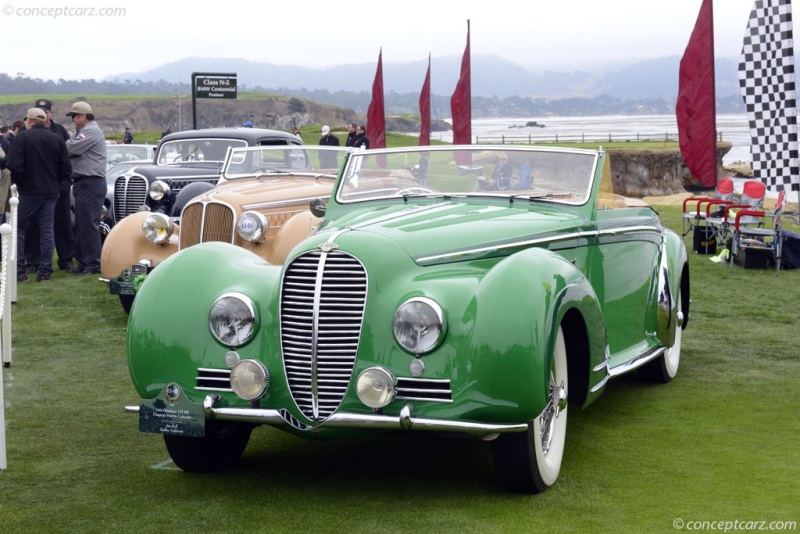
1948 Delahaye 135 MS news, pictures, and information

Cabriolet
Coachwork: Faget-Varnet
Chassis Num: 801077
 
Delahayes were quick, responsive, and very attractive automobiles. In 1894, Emile Delahaye began building rear-engined, belt-driven cars. By 1935, he introduced the Type 135 at the Paris Salon. The car featured an independent front suspension, light steering, and a smooth Cotal electromagnetic gearbox. By 1938, the new top-of-the-line model was introduced at the Paris salon, the MS (Modifiee Speciale). The engine was an updated version of the 3.5-liter six-cylinder unit. The powerplant had a larger cylinder head and bigger valves which improved breathing and horsepower. The result was 130 horsepower and a top speed of 110 mph.

The 1930s saw Delahaye emerge from being a manufacturer of reliable, medium capacity motor cars into the realm of the Grand Routier class, so beloved by French high society. In 1935 the Coupe des Alpes 135 model was introduced, having been named after the marque's success in that rally, and it remained in production for some fifteen years. This 135MS carries bodywork by Faget-Varnet, a small postwar French coachbuilder. Technically this vehicle is extremely advanced because Faget-Varnet pioneered monocoque construction. While not as widely recognized as many other French coachbuilders, Faget-Varnet won numerous Concours d'Elegance awards in the postwar period and this very rare survivor was itself a multiple award winner in period.
The Delahaye Type 135 had impressive accomplishments both on the track and in the sales room. They won the 1938 LeMans race, securing both the fist and second position and beating the competition which, in some cases, had more speed and horsepower. The Type 135 was a refined vehicle with perhaps its biggest advantage being its chassis and suspension. It had an independent front suspension with a live rear axle with semi-elliptic leaf springs. In comparison to other vehicles of its era, it sat very low to the ground. This afforded it impressive handling characteristics and unparalleled performance. Under the bonnet was a six-cylinder engine that displaced 3.2-liters and had between 95 through just-over 110 horsepower depending on the configuration. The bore was later increased bringing displacement to 3.6-liters and horsepower to over 150 bhp.

There were cable-operated drum brakes on all four corners, worm-and-nut steering setup, and a four-speed manual gearbox with synchromesh on third and fourth gear. The transmission would prove to be its Achilles heal and was later replaced with a Cotal unit.

There were nearly 12,000 examples of the Type 135 M and 135 MS produced between 1946 and 1952.

By Daniel Vaughan | Oct 2008
Emile Delahaye was born in Tours, France in 1843. He studied engineering in Angers, France. In 1869 he began work with his engineering degree in applied arts and crafts.

Emile Delahaye began business in Tours, France in the middle of the 19th century for the purpose of constructing engines for the ceramic industry. The company branched out and began constructing mechanical appliances such as pumps and engines. In 1888, Delahaye designed an internal combustion engine for the shipping industry. It was not until 1896 that Automobile production began for Delahaye. His first automobiles produced were powered by belt-driven single and twin cylinder engines.

Emile used motor racing to promote his vehicles. In 1896, Emile Delahaye entered the Paris-Marseilles race. Not only did he enter a vehicle his company had created, but he entered as the driver. The results were astounding, which truly speaks highly of the caliber and quality of the automobile. The demand for the vehicles began pouring-in and a second factory was opened.

Due to failing health, Delahaye was forced into retirement in 1901. This was a year after the second factory was opened in Paris. Since Delahaye had no heirs, management control was passed onto a young engineer named Charles Weiffenbach. Weiffenbach oversaw operations until 1954.

In 1905, due to failing health, Emile Delahaye passed away.

Automotive racing was paramount during this period in history. This is why many of the vehicles built during this era were built to be raced and to be used as the daily driver. The sales of the vehicles were stimulated by the way the vehicle performed on the race track. Weiffenbach, however had a different philosophy. His main focus and priority was to build dependable vehicles. Many of the early vehicles were equipped with four cylinder engines capable of producing between 9-12 horsepower. Near the beginning of the first World War, a 6 cylinder, 2565cc, engine was used.

In addition to automobiles, the Delahaye company produced trucks, lorries, parcel carriers for the post office, motor ploughs, fire engines, and other commercial and military vehicles. Many of the vehicles were used during the First World War

From 1927 to 1933, productions of the medium-class cars were low, but the vehicles that were produced carried with them a reputation of being reliable and robust.

In the early thirties, Weiffenbach, also known as 'Monsieur Charles' by his piers, was in his early 60's. The decision was made to boldly move into the sports car arena. This was in response to the market trends and a way to re-establish a competitive edge in the automotive technology spectrum. For an automotive company that had never created a car that could achieve a top speed faster than 110 km/h, this would be a major undertaking.

Jean Francois, a 29 year-old engineer, was commissioned to construct a series of sporty cars using as many of the spare parts as possible. Talbot's new independent suspension was used along with a new chassis with box-section side members. The engine was borrowed from one of their trucks. The engine featured a 65mm crankshaft with internal lubrication. In 1933, the vehicles were introduced at the Paris Car Salon. They were the 4 cylinder 12CV and the 6 cylinder 18CV. At the show, Lucy O'Reilly Schell approached Weiffenbach with a request to have a vehicle built that could be entered in rally events.

Lucy O'Reilly, a wealthy American with an Irish origin, had a passion for racing. So fueled by Delahayes desire to produce sports cars and Reilly's financial backing and quest to win motor sport events, the company re-entered the racing scene.

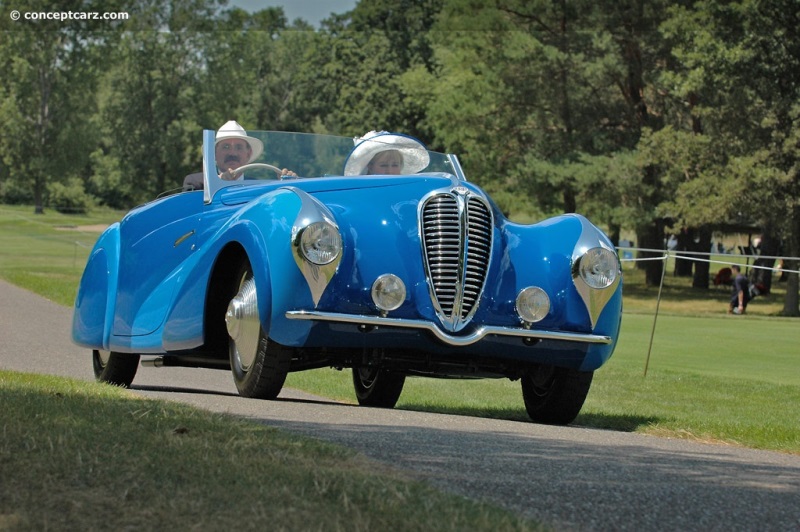
The Type 135 was created with variants such as the 135 Competition Speciale (135 CS), designed specifically for racing. The 135 Sport and the 135 Coupe both featured a 3.2 liter engine. The Sport produced 96 horsepower while the Coupe had 110 horsepower. 120 horsepower was produced by the 3.6 liter engine that rested in the Type 135 Competition model. The engine in the 135 CS was a simple pushrod operated engine borrowed from the 1927 Type 103 truck engine. It gave up horsepower for great acceleration and torque.

The Type 135 is considered as one of the most famous and prestigious vehicles produced by Delahaye. In both design and racing competition, it was very successful. Designed in 1934 it was quickly entered into races such as the 24 Heures du Mans, the Monte-Carlo Rally, and the Paris-Saint-Raphael motor race, where it had great successes at being a competitive and reliable automobile.

The Type 135 Competition Speciale Sports Car (CS) had a chassis 25 cm shorter than the 135 touring car. This shortened version had better weight distribution which greatly improved the handling and performance. The engine and 4-speed Wilson epicyclic gearbox was placed lower in the chassis, thus contributing to the benefits of a better balanced vehicle. The 135 CS came equipped with an 80 liter or a 100 liter fuel tank, this option was left up to the buyer's discretion.

The 135 CS was debut in the 1936 Monte Carlo Rally where it finished 2nd in a field of fierce competition. In 1936 it was the winner of the Marsailles Gran Prix. At the French Gran Prix is placed second, third, fourth and fifth.

Well-known coachbuilders, such as Franay, Letourner & Marchard, Chapron, and Guillore, were tasked with outfitting the 135's. This may have been influenced by Delage, an automotive company that Delahaye merged with in 1935. As a result, the 135 won numerous awards for styling and design.

The Type 135's are truly a prestigious masterpiece with a strong racing history and a heritage that was formed on stability, robustness, and stamina.

By Daniel Vaughan | Feb 2007
For more information and related vehicles, click here

FORD LAUNCHES NEW FUEL-EFFICIENT 1.5-LITER ECOBOOST ENGINE; BOOSTS COMPANY'S GLOBAL ECOBOOST CAPACITY
-Ford announces new fuel-efficient 1.5-liter EcoBoost® engine, extends successful EcoBoost lineup to meet global demand for four-cylinder EcoBoost engines -Ford now has capacity to build 1.6 million EcoBoost engines annually, triples number of plants that produce EcoBoost engines in Europe, Asia and North America from 2010 to 2013 -1.5-liter EcoBoost offers trademark EcoBoost turbocharging, direct fuel injection and variable valve timing; delivers power of a larger engine with smaller unit ec...[Read more...]
Auctions America Readies for Highly Anticipated Spring Carlisle Collector Car Weekend
• Auctions America returns to Carlisle, Pennsylvania for its annual Spring Carlisle sale, April 25-26 • Two-day sale lifts the gavel on a diverse roster of approximately 300 quality collector cars • Notable highlights include a rare 1959 Chevrolet Corvette 'Big-Brake' Fuel-Injected Roadster, a 1970 Chevrolet Chevelle SS LS5 Convertible and a 1999 Bentley Azure Convertible • Sale held during Carlisle Events' highly anticipated Spring Carlisle Collector Car Swap Meet & Corral weekend, April 24...[Read more...]
VICARI AUCTION COMPANY OFFERS RARE '62 & '63 Z06 CORVETTES AT 2013 CRUISIN' NOCONA
In a recent rare find, two classic Chevrolet Corvettes (one '62 and one '63) - stored for decades-are being made available by the Vicari Auction Company. Both vehicles will cross the block during 2013 Cruisin' Nocona, a north Texas collector car auction and classic car poker cruise set for April 19th and 20th in historic Nocona, Texas. The Corvettes are virtually all-original, and have been stored in Texas by a classic-vehicle aficionado and collector since the 1980s. 'These...[Read more...]
Auctions America Reunites Original Mustang Owner With His Car
Nearly five decades after Leon Fake bought a new 1965 Ford Mustang GT, the Silver Blue convertible is back in his garage thanks to the Auctions America by RM Spring Carlisle auction in Carlisle, Pennsylvania. Fake was one of several bidders chasing a dream car during the April 26-27 event in which 267 collector vehicles were offered with a 53% sell-through rate for more than $2.5 million* in total sales. 'I put 85,000 miles on this Mustang and sold it,' said Fake. 'I tried to buy it back a fe...[Read more...]
Size Matters: EcoBoost Gives Ford the Industry Lead in Reducing Engine Size Without Giving Up Performance
•Ford offers seven vehicles with the smallest engines in their segments – more than any other competitor •Powered by EcoBoost®CO2 emissions while delivering the performance customers demand technology, Ford's smaller engines help reduce vehicle weight for better fuel economy and lower •Ford's smallest engine yet, the EcoBoost 1.0-liter three-cylinder, debuts in North America about a year from now For decades, size meant everything when it came to engines – bigger was better and there was no...[Read more...]
Type 135
Type 145
Type 148
Type 235

© 1998-2012. All rights reserved. The material may not be published, broadcast, rewritten, or redistributed.