1975 Fleetwood Eldorado |
1976 Cadillac Eldorado news, pictures, and information | ||
| Tweet | ||
| Convertible |
![]() | ![]() | Convertible Chassis Num: 6L67S6Q188007 |
| Sold for $9,360 at 2006 Bonhams. | ||
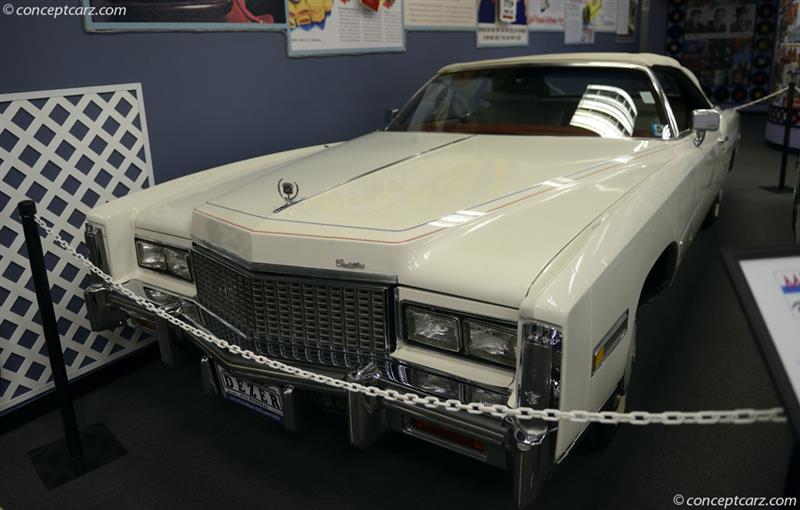
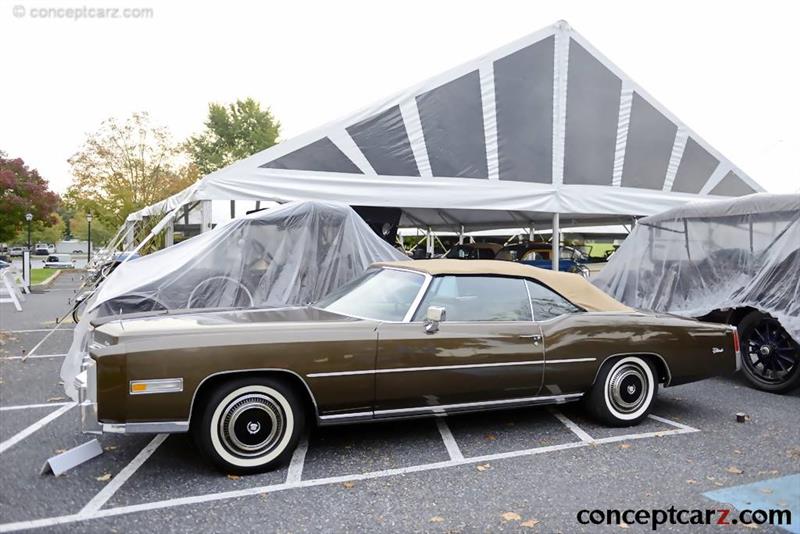
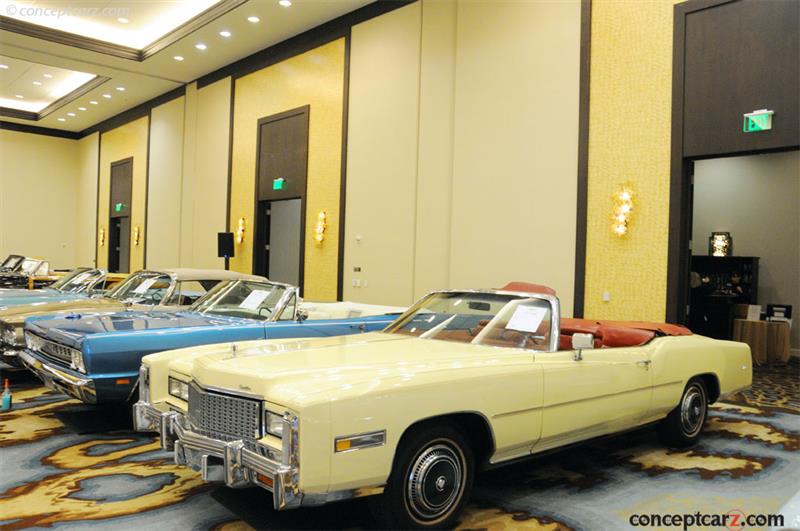
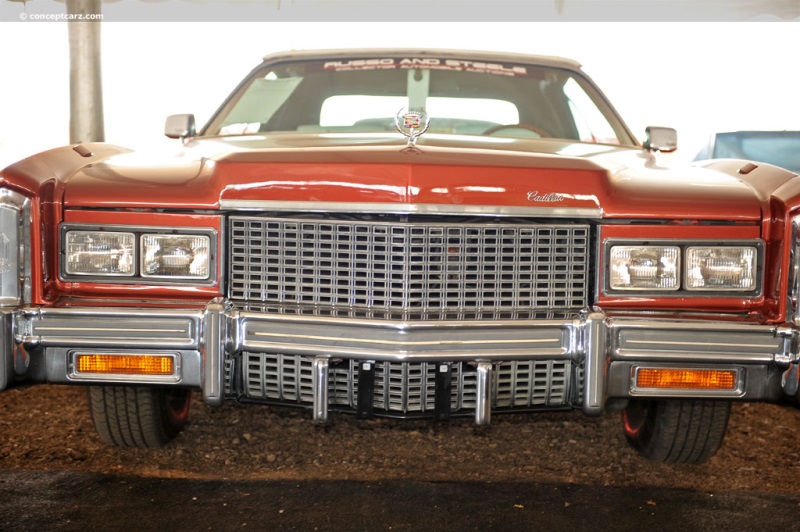
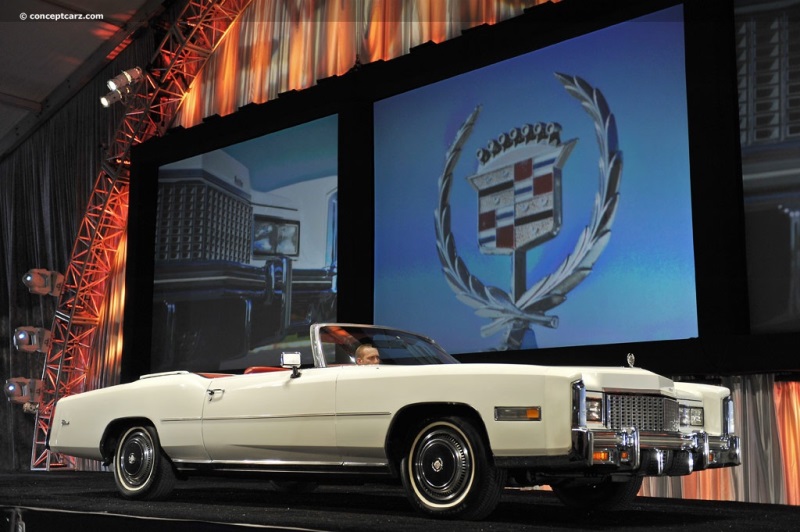
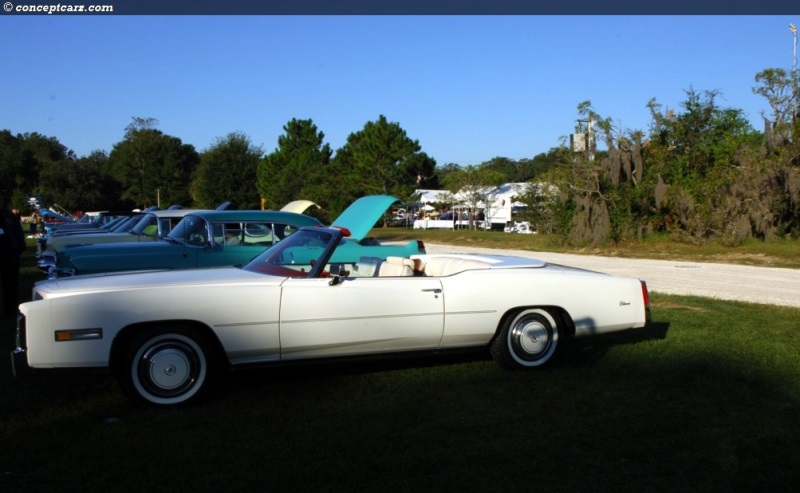
The Fleetwood Eldorado Convertible for 1976 was the only convertible being produced by the big-three in Detroit. The costs of creating these vehicles in such low quantities was creating a financial drain on Cadillac.
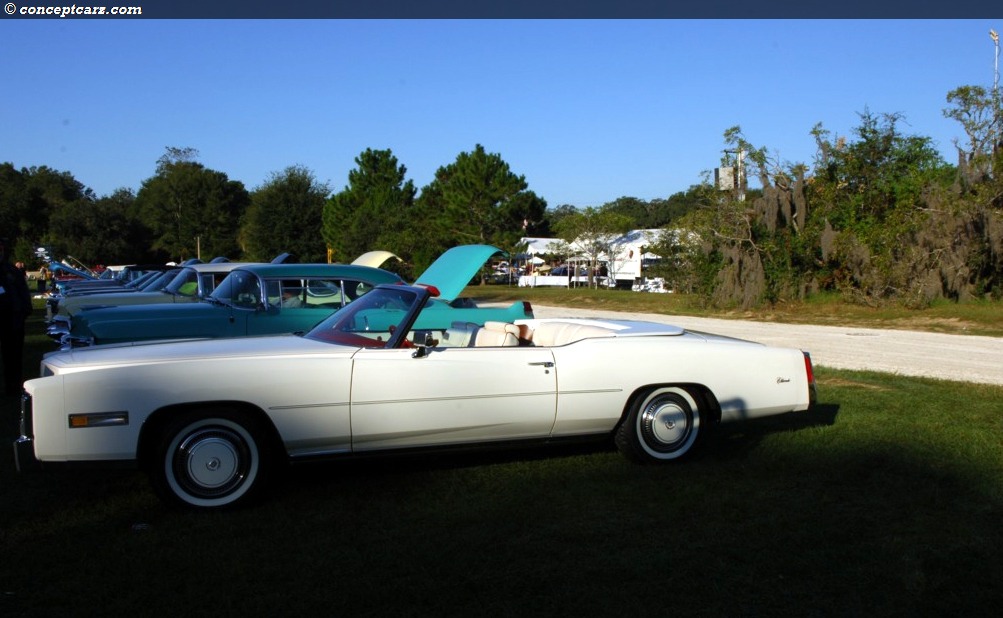
For 1976, Cadillac offered nearly every available option as standard on the Eldorado Convertible. This was the vehicles sixth year in this design and a re-design was on the horizon. The car had seating for four in its massive 224.1 length frame. The car was large, luxurious and very heavy, weighing over 2.5-tons. The engine, too, was large, displacing 500 cubic-inches and powering the front wheels.
Base price for the convertible was $11,049.
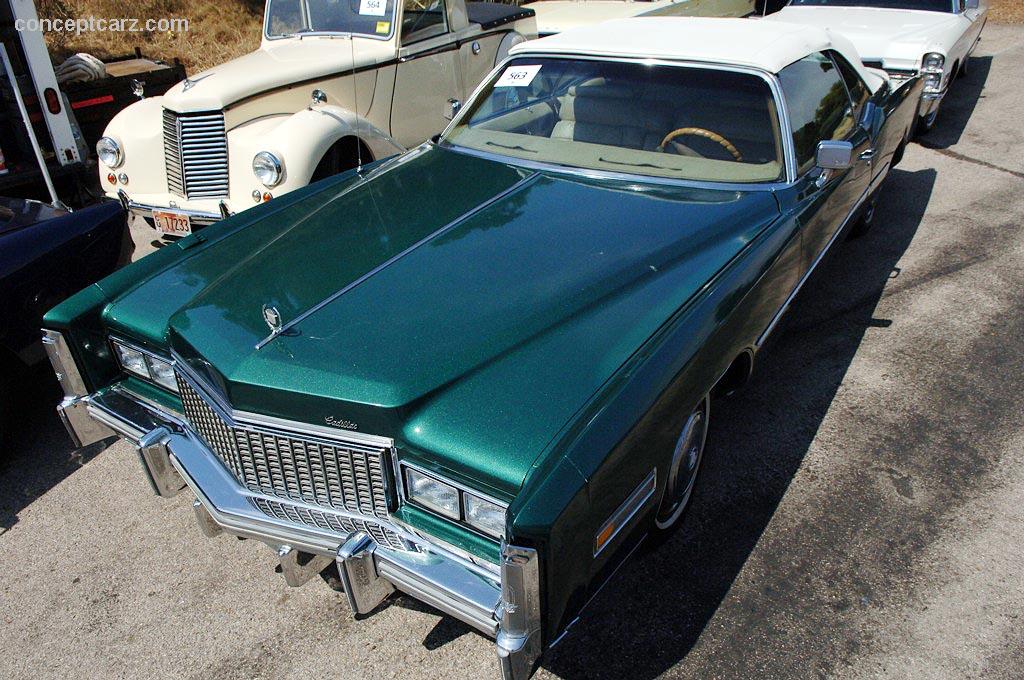
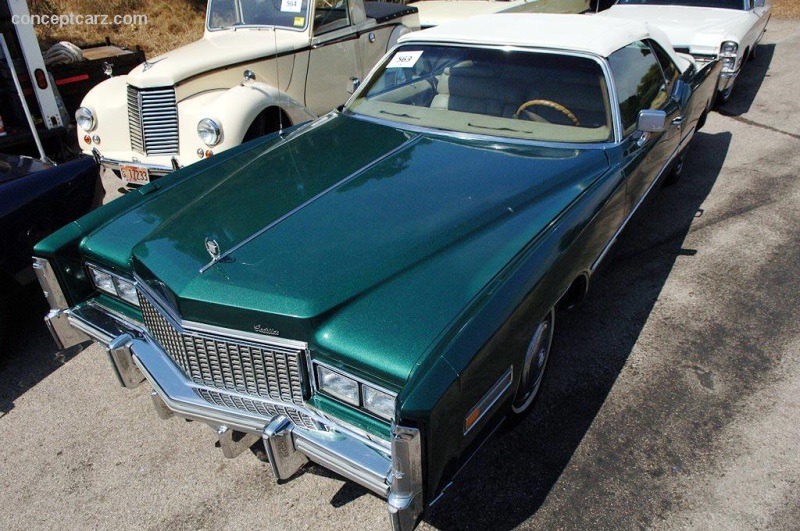
This 1976 Cadillac Fleetwood Eldorado Convertible was offered for sale at the 2006 Bonhams & Butterfields auction held at the Quail Lodge in Carmel, California where it was estimated to sell between $10,000 - $12,000. It was offered without reserve. The car is mostly original, except for the recent Firemist Green paint job. The odometer reads 82,000 miles since new. The interior is tan leather and the convertible top is still in good condition. At auction, the car was sold for $9,360, just under the estimated value but still a fair price for this machine.
By Daniel Vaughan | May 2007
![]() | ![]() | ![]() | Convertible |
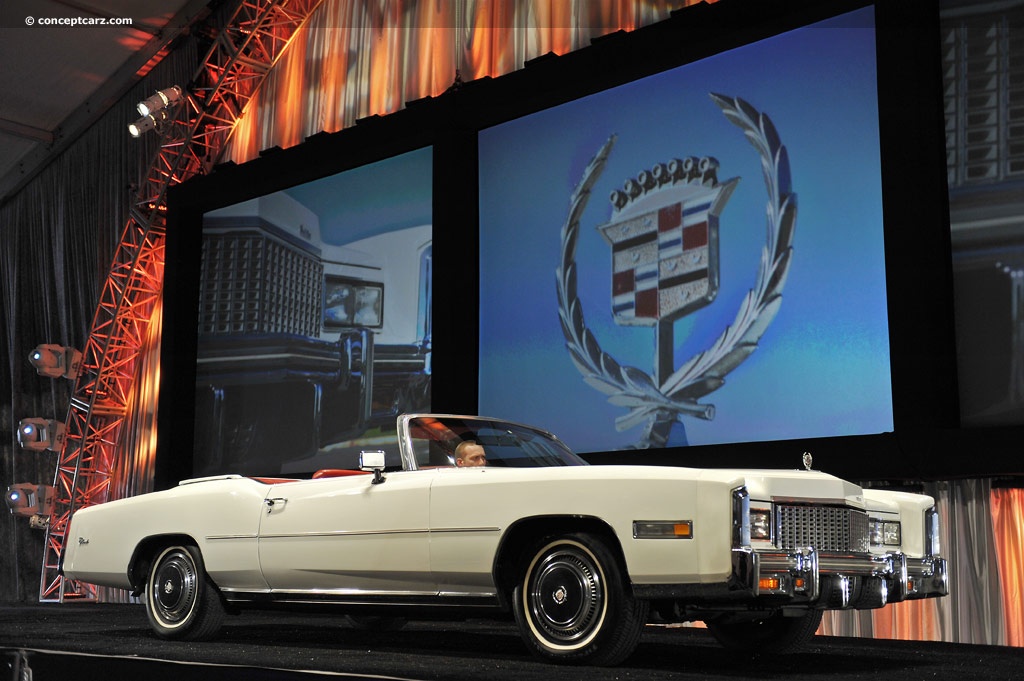
All 200 Bicentennial Eldo models were exactly the same with all options included. Dash plaque starting it is one of the last 200 produced.
Original window sticker price of $12,795 with CA Emission or $50 less without, minus freight. Most stickered in the $13,200 range.
Carrozzeria, Italian meaning coachbuilder, is an individual or company that bodies carriages or automobiles. The name in German is Karosserie. These skills were needed during the early part of the 1900's to fabricate enclosures for rolling chassis. The materials used were mostly wooden or metal. As the evolution of automobile production evolved, manufacturers brought the design and development in-house, making individual coachbuilders a dying breed.
Unibody construction has mostly eliminated the need for coachbuilders. Many coachbuilders were purchased or merged by the automobile manufacturers. Others became highly specialized and worked on a contract basis, mostly for high priced, luxury automobiles.
Fleetwood Metal Body was a coachbuilder during the early 1900s. The name is from Fleetwood, Pennsylvania the birthplace of the company. They specialized in the production of wood and metal bodies. They were large and luxurious and often purchased by the rich and famous. Fleetwood was purchased by Fisher Body in 1925 and integrated into General Motors in 1931.
The luxury segment of General Motors was Cadillac, so it was only natural that Fleetwood would aide in the design and creation of bodies for the Cadillac marque. In 1927 the name appeared on Cadillac's representing their top of the line vehicles. In 1946 Cadillac offered an upscale version of its Series 60, dubbed the Series 60 Special Fleetwood. The name was later used on the Series 70 and Sixty Special models through 1976. The name continued to appear on Cadillac vehicles as late as 1996.
By Daniel Vaughan | Nov 2007
Unibody construction has mostly eliminated the need for coachbuilders. Many coachbuilders were purchased or merged by the automobile manufacturers. Others became highly specialized and worked on a contract basis, mostly for high priced, luxury automobiles.
Fleetwood Metal Body was a coachbuilder during the early 1900s. The name is from Fleetwood, Pennsylvania the birthplace of the company. They specialized in the production of wood and metal bodies. They were large and luxurious and often purchased by the rich and famous. Fleetwood was purchased by Fisher Body in 1925 and integrated into General Motors in 1931.
The luxury segment of General Motors was Cadillac, so it was only natural that Fleetwood would aide in the design and creation of bodies for the Cadillac marque. In 1927 the name appeared on Cadillac's representing their top of the line vehicles. In 1946 Cadillac offered an upscale version of its Series 60, dubbed the Series 60 Special Fleetwood. The name was later used on the Series 70 and Sixty Special models through 1976. The name continued to appear on Cadillac vehicles as late as 1996.
By Daniel Vaughan | Nov 2007
![]() | ![]() | ![]() | Convertible Chassis Num: L67S6Q231155 |
| Sold for $24,200 at 2011 Gooding & Company. | |||
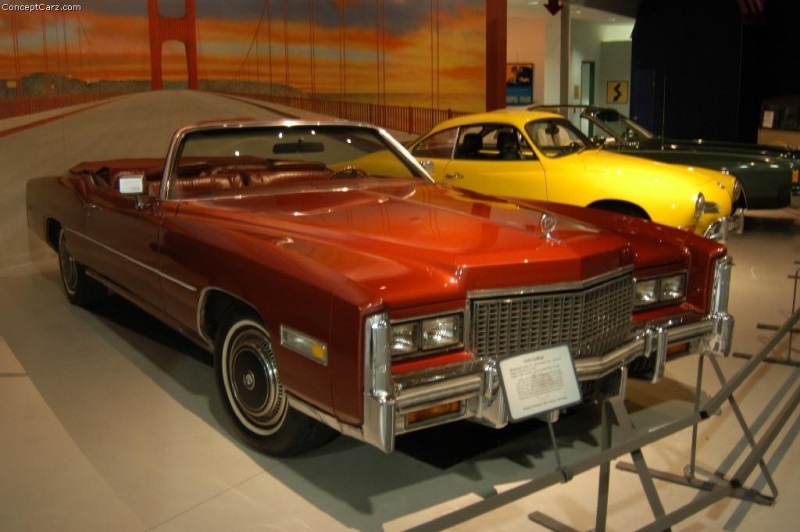
This example was purchased new on March 15th of 1976, from Brogan Cadillac of Ridgewood, New Jersey. The original owner is also the current owner, making this a very rare one-owner car. The car was given - from the factory - six-way dual-comfort power passenger 50/50 seat with recliner, AM/FM radio, carpeted rubber floor mats, cruise control, automatic passenger side mirror, heavy-duty cooling system, auto door locks, tilting and telescoping steering wheel, wire wheel covers and a hard boot for the convertible top. It also features the optional top-of-the-line fuel-injected version of the 500 cid engine, an induction configuration that boosted power by 25 hp over the base unit.
In 2011, the car was offered for sale at the Gooding & Company auction in Scottsdale, Arizona. It was estimated to sell for $35,000 - $45,000 and offered without reserve. As bidding came to a close, the car had been sold for the sum of $24,200 including buyer's premium.
By Daniel Vaughan | Feb 2011
![]() | ![]() | ![]() | Convertible Chassis Num: 6L67S6Q187444 |
1976 was the last year for the Eldorado Convertible.
By Daniel Vaughan | Feb 2012
The Eldorado was a word with many meanings. It was chosen as the name to adore an upscale car that was built by Cadillac to celebrate its Golden Anniversary in 1952. Mary-Ann Zukosky, a secretary in the merchandising department, participated in a in-house competition and suggested the name. Eldorado was derived from the Spanish words 'el dorado' meaning 'golden one'. The name had first been used by the chief of a South American Indian tribe. The story was that his followers and tribe would sprinkle his body with gold dust on ceremonial occasions. He would later cleanse himself by diving into a lake.
Another story states the name represents a legendary but undiscovered city in South America filled with riches. Many European adventurers have long sought for this city including England's Sir Walter Raleigh.
'Palm Spring Life' magazine claimed the name Eldorado was derived from a Californian resort that was frequently visited by General Motors executives. The name of the resort located in Coachella Valley was the Eldorado Country Club.
In respects to the automobile built by General Motors, the Eldorado name was first used in 1953 and given to a limited-edition, low production, convertible and would continue to be used for many years. The original Eldorado was indeed a limited-production vehicle with only 532 examples created. The year prior, GM had shown the 'El Dorado' concept car in celebration of its 50 year anniversary. The Eldorado was the production version of this concept. It was based on the Series 62 and carried no special badging except a golden nameplate 'Eldorado' could be found in the center of the dash.
The convertible tops were available in black or white while the rest of the body could be ordered in one of four colors that included Azure Blue, Artisan Ochre, Alpine White, and Aztec Red. It carried a factory sticker price of $7,750 which was nearly twice as expensive as the vehicle it had been based, the Series 62.
The styling was influenced by the legendary Harley Earl who championed the wraparound windshield design along with other unique and stylish features.
The following year the Eldorado lost much of its unique qualities as it began sharing its body with other standard Cadillac's. This standardization allowed for lower, more cost effective pricing.
For 1955 the Eldorado continued to grow in bold features and radical designs. Tailfins could now be found in the rear giving the impression the car was in motion or pointing forward, even at a stand still. The following year Cadillac introduced the Eldorado Seville, a two-door hardtop coupe version.
One of the most memorable and sought-after designs of the Eldorado appeared in 1957, the Eldorado Brougham. At a price of over $13,000, the Brougham brought ulta-luxury and four doors. Event at this high price, it is estimated that GM lost over $10,000 on each of these hand assembled masterpieces. It cost more than most luxury marque models such as Rolls-Royce. The hardtop roof was stainless steel and it included almost every convenience option offered by General Motors, including dual headlights and air suspension. During its two year production run, only 704 examples were produced.
1957 also saw a new rear-end design on the Eldorado, often referred to as the 'chipmunk cheeks.' Little changed in 1958 and in 1959 Cadillac scaled back on the design. Though it was a couple years older its price remained relatively the same, selling at around $13,075. The assembly was handled by the famous Italian coachbuilder, Pinin Farina. These virtually hand-built machines had large fins, 'rocket-ship' taillights, and a very modern design for its era.
1960 was the last year Cadillac built the Seville version. GM made the Eldorado a trim option on the standard Cadillac convertible which would continue until 1966.
In 1967 the Eldorado was redesigned and now shared an E-Body platform with the Build Riviera and the Oldsmobile Toronado. The styling had been courtesy of GM's styling chief Bill Mitchell. One of the more distinctive features were the hidden lights. It continued to define luxury, prestige, and style. Under the hood lurked a potent 429 cubic-inch V8 which drove the front wheels. Zero-to-sixty took less than 9 seconds. This excellent performance did not translate to all of its mechanical components and its drum brakes were rather inadequate for its size and speed. Disc brakes could be purchased for an additional price.
Strict government regulations, emissions, and safety concerns meant the Eldorado changed slightly in aesthetics and mechanical components for 1968. For 1969 the hidden headlights were no longer part of the Eldorado design. A halo vinyl roof was offered as optional equipment.
A massive 500 cubic-inch V8 engine capable of producing 400 horsepower was offered exclusively on the Eldorado from 1970 through 1975. Thereafter, it was standard on all full size Cadillac's.
GM redesigned their full-size cars in 1971, with the new design lasting until 1975. The Eldorado was again offered as a convertible with fender skirts. The opera window design was all new and would prove to be very popular, indicated by its imitation by almost every domestic manufacturer. The opera window was a fixed rear side window surrounded by a vinyl roof.
Near the close of the 1970's many marques were decreasing the size of their cars. The Eldorado and Toronado continued to remain large and luxurious. In 1979 the Eldorado decreased in size and now sat atop a chassis which it shared with the Buick Riviera and the Toronado. Due to increasing oil prices and stricter government regulations, the engines began to decrease in size as well.
The notchback roofline was perhaps the most distinctive feature on the Eldorado. Its rear window was nearly vertical. An Independent rear suspension could now be found on the Eldorado, offering more rear passenger seating and a larger trunk while retaining a smaller body. The Eldorado Biarritz model was offered with a stainless-steel roof, just like the one that had been used on the first Brougham.
To further comply with evolving government regulations and rising fuel concerns, GM introduced a variable displacement engine in 1981. The idea was to turn off inactive cylinders while not in use. When power was needed, those sleeping cylinders would come alive and provide the power that was need. The idea was genius, but the execution was disastrous. On many occasions, it did not work well or at all which did much to scare the reputation of the Eldorado resulting in poor sales. Within the next few years, the sales rebound and the Eldorado was able to regain its market share.
By 1986, the size of the Eldorado had decreased substantially, now being similar in size to a compact car. The design was mediocre and for the first time in its history it was available with sedan frames around its windows. Many believed that this drastic change was due to fears of skyrocketing fuel prices that would send consumers running to smaller, lighter, and fuel efficient vehicles. Rather, fuel prices remained reasonable and the Eldorado sales plummeted. There were future revisions and aesthetic changes but sales continued to slow for the following years.
In 1992 the Cadillac Eldorado was reborn. Though it did not grow much in size it gained much ground in the styling department. Its design drew from its past and incorporated the frameless window glass that was distinctive to the Eldorado. The Northstar V8 was placed under the hood and provided excellent power and response. The styling and power resulted in increased sales and popularity. Though the four-door Cadillac Seville consistently outsold the two-door Eldorado, it had regained much of its prestige that it had lost.
For the following years, there were minor enhancements to the design and the interior.
In 2003, Cadillac celebrated the 50th model year of this nameplate. An ETC version was offered that produced an astonishing 300 horsepower. A limited number of red and white colored cars, the same as the 1953 convertible, were produced as a tribute to the legacy of the Eldorado.
On April 22, 2002, production of the Eldorado ceased.
By Daniel Vaughan | May 2006
For more information and related vehicles, click hereAnother story states the name represents a legendary but undiscovered city in South America filled with riches. Many European adventurers have long sought for this city including England's Sir Walter Raleigh.
'Palm Spring Life' magazine claimed the name Eldorado was derived from a Californian resort that was frequently visited by General Motors executives. The name of the resort located in Coachella Valley was the Eldorado Country Club.
In respects to the automobile built by General Motors, the Eldorado name was first used in 1953 and given to a limited-edition, low production, convertible and would continue to be used for many years. The original Eldorado was indeed a limited-production vehicle with only 532 examples created. The year prior, GM had shown the 'El Dorado' concept car in celebration of its 50 year anniversary. The Eldorado was the production version of this concept. It was based on the Series 62 and carried no special badging except a golden nameplate 'Eldorado' could be found in the center of the dash.
The convertible tops were available in black or white while the rest of the body could be ordered in one of four colors that included Azure Blue, Artisan Ochre, Alpine White, and Aztec Red. It carried a factory sticker price of $7,750 which was nearly twice as expensive as the vehicle it had been based, the Series 62.
The styling was influenced by the legendary Harley Earl who championed the wraparound windshield design along with other unique and stylish features.
The following year the Eldorado lost much of its unique qualities as it began sharing its body with other standard Cadillac's. This standardization allowed for lower, more cost effective pricing.
For 1955 the Eldorado continued to grow in bold features and radical designs. Tailfins could now be found in the rear giving the impression the car was in motion or pointing forward, even at a stand still. The following year Cadillac introduced the Eldorado Seville, a two-door hardtop coupe version.
One of the most memorable and sought-after designs of the Eldorado appeared in 1957, the Eldorado Brougham. At a price of over $13,000, the Brougham brought ulta-luxury and four doors. Event at this high price, it is estimated that GM lost over $10,000 on each of these hand assembled masterpieces. It cost more than most luxury marque models such as Rolls-Royce. The hardtop roof was stainless steel and it included almost every convenience option offered by General Motors, including dual headlights and air suspension. During its two year production run, only 704 examples were produced.
1957 also saw a new rear-end design on the Eldorado, often referred to as the 'chipmunk cheeks.' Little changed in 1958 and in 1959 Cadillac scaled back on the design. Though it was a couple years older its price remained relatively the same, selling at around $13,075. The assembly was handled by the famous Italian coachbuilder, Pinin Farina. These virtually hand-built machines had large fins, 'rocket-ship' taillights, and a very modern design for its era.
1960 was the last year Cadillac built the Seville version. GM made the Eldorado a trim option on the standard Cadillac convertible which would continue until 1966.
In 1967 the Eldorado was redesigned and now shared an E-Body platform with the Build Riviera and the Oldsmobile Toronado. The styling had been courtesy of GM's styling chief Bill Mitchell. One of the more distinctive features were the hidden lights. It continued to define luxury, prestige, and style. Under the hood lurked a potent 429 cubic-inch V8 which drove the front wheels. Zero-to-sixty took less than 9 seconds. This excellent performance did not translate to all of its mechanical components and its drum brakes were rather inadequate for its size and speed. Disc brakes could be purchased for an additional price.
Strict government regulations, emissions, and safety concerns meant the Eldorado changed slightly in aesthetics and mechanical components for 1968. For 1969 the hidden headlights were no longer part of the Eldorado design. A halo vinyl roof was offered as optional equipment.
A massive 500 cubic-inch V8 engine capable of producing 400 horsepower was offered exclusively on the Eldorado from 1970 through 1975. Thereafter, it was standard on all full size Cadillac's.
GM redesigned their full-size cars in 1971, with the new design lasting until 1975. The Eldorado was again offered as a convertible with fender skirts. The opera window design was all new and would prove to be very popular, indicated by its imitation by almost every domestic manufacturer. The opera window was a fixed rear side window surrounded by a vinyl roof.
Near the close of the 1970's many marques were decreasing the size of their cars. The Eldorado and Toronado continued to remain large and luxurious. In 1979 the Eldorado decreased in size and now sat atop a chassis which it shared with the Buick Riviera and the Toronado. Due to increasing oil prices and stricter government regulations, the engines began to decrease in size as well.
The notchback roofline was perhaps the most distinctive feature on the Eldorado. Its rear window was nearly vertical. An Independent rear suspension could now be found on the Eldorado, offering more rear passenger seating and a larger trunk while retaining a smaller body. The Eldorado Biarritz model was offered with a stainless-steel roof, just like the one that had been used on the first Brougham.
To further comply with evolving government regulations and rising fuel concerns, GM introduced a variable displacement engine in 1981. The idea was to turn off inactive cylinders while not in use. When power was needed, those sleeping cylinders would come alive and provide the power that was need. The idea was genius, but the execution was disastrous. On many occasions, it did not work well or at all which did much to scare the reputation of the Eldorado resulting in poor sales. Within the next few years, the sales rebound and the Eldorado was able to regain its market share.
By 1986, the size of the Eldorado had decreased substantially, now being similar in size to a compact car. The design was mediocre and for the first time in its history it was available with sedan frames around its windows. Many believed that this drastic change was due to fears of skyrocketing fuel prices that would send consumers running to smaller, lighter, and fuel efficient vehicles. Rather, fuel prices remained reasonable and the Eldorado sales plummeted. There were future revisions and aesthetic changes but sales continued to slow for the following years.
In 1992 the Cadillac Eldorado was reborn. Though it did not grow much in size it gained much ground in the styling department. Its design drew from its past and incorporated the frameless window glass that was distinctive to the Eldorado. The Northstar V8 was placed under the hood and provided excellent power and response. The styling and power resulted in increased sales and popularity. Though the four-door Cadillac Seville consistently outsold the two-door Eldorado, it had regained much of its prestige that it had lost.
For the following years, there were minor enhancements to the design and the interior.
In 2003, Cadillac celebrated the 50th model year of this nameplate. An ETC version was offered that produced an astonishing 300 horsepower. A limited number of red and white colored cars, the same as the 1953 convertible, were produced as a tribute to the legacy of the Eldorado.
On April 22, 2002, production of the Eldorado ceased.
By Daniel Vaughan | May 2006
| NISSAN PATHFINDER AND ALTIMA NAMED TO KELLEY BLUE BOOK'S 10 BEST FAMILY CARS LIST | |
![]() | NASHVILLE, Tenn. – The reinvented 2013 Nissan Pathfinder was named to the top spot on the list of 10 Best Family Cars of 2013 from Kelley Blue Book's KBB.com today. The 2013 Nissan Altima also made this year's cut of KBB.com's top family-friendly vehicles. Each year, editors at Kelley Blue Book's KBB.com, the leading provider of new and used car information, develop their list of the 10 Best Family Cars based on characteristics that cater to unique family specifications and situations. ...[Read more...] |
| Tanner Foust Favored For X Games Medal Rookies Victorious After First-Corner Crash Claims Veterans | |
![]() | FOZ DO IGUAÇU, Brazil (April 23, 2013) - Rockstar Energy Drink driver Tanner Foust had a target on his back this weekend in Brazil, where the opening round of the Global Rallycross Championship took place on a challenging X Games course at Foz do Iguaçu. Fans lined up 10-deep before the race to get a glimpse of their favorite rallycross stars and the grandstands were packed for the Sunday race. 'The fans in Brazil are amazing,' said Foust. 'They were totally pumped to watch the rac...[Read more...] |
| TANNER FOUST WINS 2013 RALLYCROSS OPENER AMERICAN DRIVER REPEATS AT LYDDEN HILL CIRCUIT | |
![]() | Rockstar Energy Drink driver Tanner Foust earned the first win of an ambitious international rallycross campaign that will see him contest two major series on three continents this year. The popular American driver arrived at the Lydden Hill circuit in southeast England this weekend ready for a repeat of his dominant 2012 performance there. In addition to a refreshed look for the car and new sponsors including ENEOS Motor Oil and ODYSSEY Battery, the Olsbergs MSE team has again stepped up the...[Read more...] |
| Final Countdown Underway To South Florida's Premier Collector Car Auction | |
![]() | • Auctions America kicks off its 2013 auction season, March 22-24 with its highly anticipated Fort Lauderdale Collector Car Auction • Celebrating its 11th year, the multi-day auction features more than 550 quality collector cars • Latest feature attractions include an outstanding 1963 Shelby Cobra and a 1974 Ferrari Dino 246 GTS • Digital catalog now available for download at auctionsamerica.com AUBURN, Indiana (February 27, 2013) – With the final countdown underway to its highly an...[Read more...] |
| Steve McQueen Chevrolet Styleline Leads Exciting List of Celebrity Rides At Auctions America's Ford Lauderdale Sale | |
![]() | • Auctions America kicks off its 2013 calendar, March 22 – 24, 2013 in Fort Lauderdale, Florida • Regarded as South Florida's premier collector car auction, multi-day sale expected to feature more than 550 quality collector cars • Star attraction: 1951 Chevrolet Styleline DeLuxe Convertible formerly owned by Steve McQueen to be offered at no reserve • Additional highlights include a diverse assortment of 1950s convertibles from 'The Gauthier Collection', 1967 Dodge Coronet WO23 Hemi Super Sto...[Read more...] |
1976
Cadillac
models |
| Cadillac DeVille |
| Cadillac Fleetwood Seventy-Five |
| Cadillac Fleetwood Sixty Castilian |
| Cadillac Fleetwood Sixty Special Brougham |
| Similar Vehicles | |
![]() | 1976 Lincoln Continental Mark IV |
| Similar Automakers | |
| Chevrolet | Chrysler |
| Dodge | Ford |
| GMC | Hummer |
| Jeep | Lincoln |
| Mercury | Pontiac |
| Saturn | |
| Similarly Sized Vehicles from 1976 |
| Buick LeSabre |
| Chrysler New Yorker Brougham |
| Dodge Monaco |
| Ford Bronco |
| Ford Thunderbird |
| Ford Torino |
| Lincoln Continental Mark IV |
| Cadillac: 1971-1980 |
| Similar Automakers |
| Cadillac History |
| Other models by Cadillac |
| Manufacturer Website |
| ||||||||||||||||||||||||||||||||||||||||||||
1975 Fleetwood Eldorado |


1975 Fleetwood Eldorado


1976