1989 962 | 1991 962C ![]() |
1990 Porsche 962C news, pictures, and information | ||
| Tweet | ||
![]() | ![]() | ![]() | Racing Coupe Chassis Num: 962-159 Engine Num: 962.207 |
| Sold for $612,000 at 2008 Bonhams. Sold for $561,250 at 2008 Bonhams. | |||
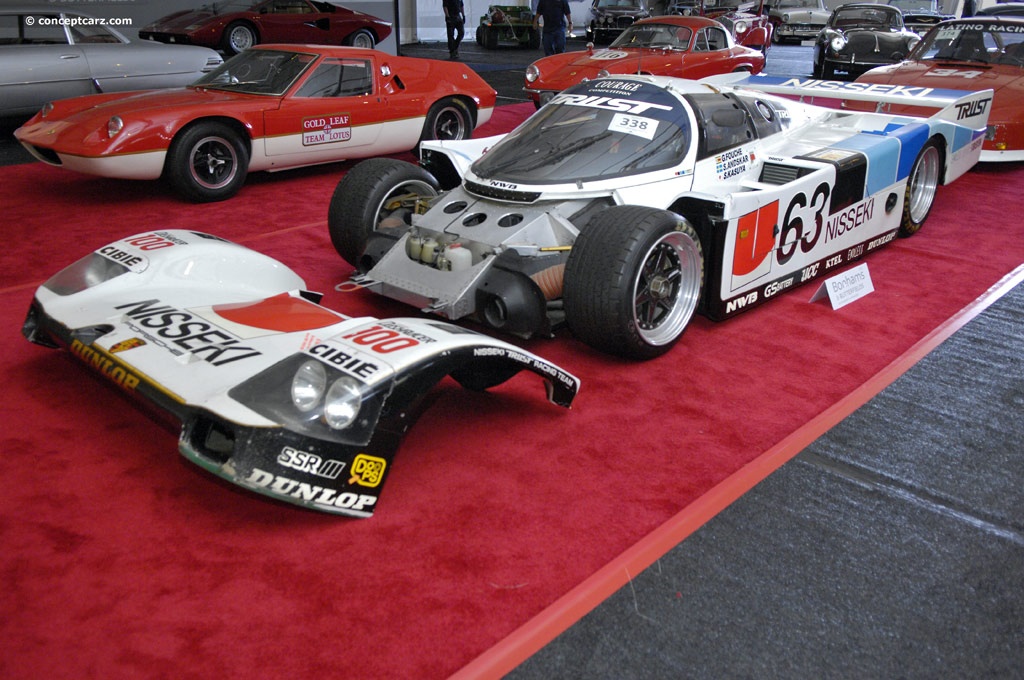
This particular car, chassis number 962-195, is a restored car with a rebuilt 2.8-liter twin-turbo engine. It was campaigned by the celebrated Japanese Team Trust. It was order new from Porsche in 'longtail' specification for Le Mans. Its engine produced over 850 bhp for the 1990 racing season. At LeMans in 1990, the car was driven by George Fouche ex Kremer Racing, Stefan Andskar and Shunji Kasuya. Their main sponsors were the Japanese oil company Nisseki, Cibie and Dunlop and under the team management of Gen Suzuki. The car wore the race number '63' and finished 13th overall.
It returned the following year where it was driven by Fourche/Andsker and wore number 49. It failed to finish the entire race. It finished 1st in the 1991 FIA SWC race at Autopolis, Japan with Fourche/Andsker at the wheel.
Team Trust performed a complete restoration in 1992 on the car which brought it back to its 1990 LeMans 24-Hour race specification. Since then, it has been kept in a museum.
It is believed that there were 91 examples of the Type 962 cars between 1984 and 1991. Of these 16 were used officially by the works team and 75 were sold to customers. A few Type 956 models were rebuilt as Type 962 models. Two were previously written off and four others rebuilt. Three badly damaged 962s were rebuilt with fresh chassis numbers.
In 2008, this 1990-91 Porsche Type 962 Group C Racing Coupe was offered for sale at the 'Quail Lodge, A Sale of Exceptional Motorcars and Automobilia' presented by Bonhams Auction. The lot was sold for $612,000 inclusive of buyer's premium.
By Daniel Vaughan | Dec 2008
Porsche created the 956 during the early 1980s for FIA Group C competition. The design and components of the vehicle would further evolve over the years and become known as the 962. The 956 project was lead by a very determined and experienced project manager named Norbert Singer, who had his sights set on winning the 24 Hours of LeMans race. With Derek Bell and Jacky Ixckx, the factory team drivers, the cars easily dominated the season and won the championship for the team.
The 956 was an evolution of the 935 and 936 cars which had proven to be very competitive racers. Porsche chose to stick with the tried-and-true, reliable flat-six engine which had powered the Porsche 936 to a LeMans victory. It was fitted with an electronic engine management system to help reduce fuel consumption. The FIA had imposed a limit of 100 liters per fuel tank size and allowed only 25 refuelings. The idea was to add an extra level of difficulty for teams and to inspire creativity and innovation. By doing so, they were hopeful that new technology would be born that could trickle down to production vehicles.
Porsche chose to stick with the smaller engine and adapt a turbocharger, another attempt at combating the fuel restriction rules.
The body was very modern, aerodynamic, and elegant. Extensive use of exotic materials, and ground effects were employed that included a venturi positioned between the front wheels, rear wing, and rear venturi. The chassis was comprised of a very rigid monocoque comprised of aluminum and a composite body.
The Porsche 956 made its inaugural debut in 1982 at the Silverstone 6 Hour race, the second round of the World Championship for Makes. The car was piloted by the factory drivers, Jacky Ickx and Derek Bell. They missed the second round at the Nurburgring 1000km but returned for the running of the 25 Hours of LeMans. The cars led the entire race and captured the checkered flag. The three factory Porsche's finished in the top three positions.
After proving the potential of the 956, Porsche began selling them to privateers such as Kremer Racing, John Fitzpatrick, Richard Lloyd, Brumm Motorsports, and more. Porsche continued to make improvements to the vehicles such as reducing the overall weight by incorporating even lighter aluminum chassis. The aerodynamics were improved which made the car quicker and more fuel efficient. Additional safety features were added such as a tire pressure warning system. At the 1983 LeMans, the cars bearing the Porsche badge took nine out of the top ten positions.
The Porsche 962 was based on the 956 and intended for IMSA GTP class competition. To prepare the car for competition, the vehicle required changes to bring it into alignment with ever-changing rules and regulations. For 1984, rules stated that the pedal box had to be mounted behind the front axle. To comply, the wheelbase of the 956 was extended to accommodate additional space. A steel roll cage was also integrated into the car at the time.
The factory began work on a larger engine. In the meantime, Porsche had to find a replacement for the twin K27 turbochargers since twin-turbo's did not comply with GTP class racing regulations at the time. In its place, a single Kühnle, Kopp und Kausch AG K36 turbocharger was fitted.
Porsche named this updated version of the 956, the 962. Five examples were debuted at the 24 Hours of Daytona. One was driven by factory drivers, Mario and Michael Andretti, while the other four were privateer entrants. The factory car led most of the race and appeared that it would go on to claim overall victory, but it was side-lined due to engine and gearbox problems after 127 laps.
For the following season, Porsche created the 962C, which featured a 3.2-liter engine and twin-turbochargers. It was entered in the World Endurance Championship where it was beaten by a 956. For 1987, another new engine was introduced. Though it was in 3-liter form, it was more powerful and durable than the unit it was replacing. The engine carried Porsche to its seventh consecutive victory at the 24 Hours of LeMans.
The Porsche 956 and 962 were very dominate vehicles which lasted for nearly ten years. From 1985 through 1987 they won the IMSA GTP. They were World Sportscar Champions from 1982 through 1986 and are considered the most successful prototype race car in the history of motor sports.
During the early 1990s, Jochen Dauger was able to get the 962 reclassified as a GT1 road-legal car. They were raced at the 1994 24 Hours of LeMans and captured its final overall victory.
By Daniel Vaughan | Mar 2007
For more information and related vehicles, click hereThe 956 was an evolution of the 935 and 936 cars which had proven to be very competitive racers. Porsche chose to stick with the tried-and-true, reliable flat-six engine which had powered the Porsche 936 to a LeMans victory. It was fitted with an electronic engine management system to help reduce fuel consumption. The FIA had imposed a limit of 100 liters per fuel tank size and allowed only 25 refuelings. The idea was to add an extra level of difficulty for teams and to inspire creativity and innovation. By doing so, they were hopeful that new technology would be born that could trickle down to production vehicles.
Porsche chose to stick with the smaller engine and adapt a turbocharger, another attempt at combating the fuel restriction rules.
The body was very modern, aerodynamic, and elegant. Extensive use of exotic materials, and ground effects were employed that included a venturi positioned between the front wheels, rear wing, and rear venturi. The chassis was comprised of a very rigid monocoque comprised of aluminum and a composite body.
The Porsche 956 made its inaugural debut in 1982 at the Silverstone 6 Hour race, the second round of the World Championship for Makes. The car was piloted by the factory drivers, Jacky Ickx and Derek Bell. They missed the second round at the Nurburgring 1000km but returned for the running of the 25 Hours of LeMans. The cars led the entire race and captured the checkered flag. The three factory Porsche's finished in the top three positions.
After proving the potential of the 956, Porsche began selling them to privateers such as Kremer Racing, John Fitzpatrick, Richard Lloyd, Brumm Motorsports, and more. Porsche continued to make improvements to the vehicles such as reducing the overall weight by incorporating even lighter aluminum chassis. The aerodynamics were improved which made the car quicker and more fuel efficient. Additional safety features were added such as a tire pressure warning system. At the 1983 LeMans, the cars bearing the Porsche badge took nine out of the top ten positions.
The Porsche 962 was based on the 956 and intended for IMSA GTP class competition. To prepare the car for competition, the vehicle required changes to bring it into alignment with ever-changing rules and regulations. For 1984, rules stated that the pedal box had to be mounted behind the front axle. To comply, the wheelbase of the 956 was extended to accommodate additional space. A steel roll cage was also integrated into the car at the time.
The factory began work on a larger engine. In the meantime, Porsche had to find a replacement for the twin K27 turbochargers since twin-turbo's did not comply with GTP class racing regulations at the time. In its place, a single Kühnle, Kopp und Kausch AG K36 turbocharger was fitted.
Porsche named this updated version of the 956, the 962. Five examples were debuted at the 24 Hours of Daytona. One was driven by factory drivers, Mario and Michael Andretti, while the other four were privateer entrants. The factory car led most of the race and appeared that it would go on to claim overall victory, but it was side-lined due to engine and gearbox problems after 127 laps.
For the following season, Porsche created the 962C, which featured a 3.2-liter engine and twin-turbochargers. It was entered in the World Endurance Championship where it was beaten by a 956. For 1987, another new engine was introduced. Though it was in 3-liter form, it was more powerful and durable than the unit it was replacing. The engine carried Porsche to its seventh consecutive victory at the 24 Hours of LeMans.
The Porsche 956 and 962 were very dominate vehicles which lasted for nearly ten years. From 1985 through 1987 they won the IMSA GTP. They were World Sportscar Champions from 1982 through 1986 and are considered the most successful prototype race car in the history of motor sports.
During the early 1990s, Jochen Dauger was able to get the 962 reclassified as a GT1 road-legal car. They were raced at the 1994 24 Hours of LeMans and captured its final overall victory.
By Daniel Vaughan | Mar 2007
| WORLD ENDURANCE CHAMPIONSHIP, ROUND 1 IN SILVERSTONE, GREAT BRITAIN; RACE DEBUT OF THE NEW PORSCHE 911 RSR | |
![]() | At the six hour race on the Silverstone Circuit, which signals the start of the 2013 World Endurance Championship (WEC) season on 14th April, the Porsche 911 RSR celebrates its race debut. Running the campaign on the storied 5.981 kilometre circuit in the British Midlands is the Porsche AG Team Manthey works team with Olaf Manthey at the helm. The Porsche drivers Porsche works drivers Joerg Bergmeister (Germany), Patrick Pilet (France) and Timo Bernhard (Germany) take up the GTE-P...[Read more...] |
| DAN GURNEY JOINS 'THE AMELIA'S' FORD GT40 SEMINAR | |
![]() | Le Mans winner Dan Gurney, the Amelia Island Concours d'Elegance's 2002 Honorary Chairman, returns to 'The Amelia' to join a panel of international racing celebrities and experts honoring the 50th anniversary of Ford's game-changing GT40 prototype. Gurney won just one race for the Carroll Shelby-led Ford GT40 team, but it was the race that mattered most: the 24 Hours of Le Mans. Gurney's victory in the 1967 edition of the fabled Le Mans 24 Hour endurance classic has become the stuff of legen...[Read more...] |
| PORSCHE MOTORSPORT NORTH AMERICA PURCHASES HISTORIC ANDIAL NAME | |
![]() | Santa Ana, Calif. - February 14 - With the last active owner Dieter Inzenhofer retiring later this month, the legendary ANDIAL name will stay in the Porsche family as Porsche Motorsports North America, Inc. (PMNA) announced it has purchased the brand for future use. ANDIAL is an anagram made from the names of the founding members - the late Arnold Wagner AN; Dieter Inzenhofer DI; and former PMNA president and current consultant Alwin Springer AL. From the company's formation in 1975, ...[Read more...] |
| EXCEPTIONAL ROSTER OF PORSCHE RACE CARS JOIN THE STARTING GRID FOR RM'S EAGERLY AWAITED MONTEREY SALE | |
![]() | RM Auctions, the world's largest collector car auction house for investment-quality automobiles, has announced more star consignments for its highly anticipated Monterey sale, August 17–18, in California, this time a remarkable group of Porsches. Comprising twelve examples in total and spanning 48 years of production, the offering is headlined by an exceptional group of racing greats from the sixties, seventies, and eighties. Continuing RM's commitment to present the world's finest automobiles, ...[Read more...] |
| 1996 24 Hours of Le Mans: Finally a Victory, Still 2nd | |
![]() | Thierry Boutsen's first encounter with the 24 Hours of Le Mans would come only after a few years of his being involved in racing. In 1981, Boutsen would partner with Serge Saulnier and Michel Pignard to drive the WM P81. It would prove to be an introductory experience as the race would last just 15 laps before it would all come to an end. This would be just the first of three early retirements in the 1980s. The 1990s, however, would be an entirely different story altogether. Boutsen's breakth...[Read more...] |
| View more Group C vehicles |
1990
Porsche
models |
| Porsche 911 Carrera 2 |
| Porsche 911 Carrera 4 |
| Porsche 928 S4 |
| Porsche 944 S2 |
| Porsche 964 Carrera 4 |
| Porsche 964 RS Competition |
| Porsche Cartronic 911 Revanche |
| Similar Automakers | |
| Aston Martin | Bentley |
| Bugatti | Devon |
| Ferrari | GTA |
| Koenigsegg | Lamborghini |
| Lotus | Maserati |
| Maybach | McLaren |
| Rolls-Royce | Spyker |
| Tesla | |
| Similarly Sized Vehicles from 1990 |
| Bentley Turbo R |
| Bertone Corvette Nivola |
| DeTomaso Pantera GT5-S |
| Ferrari F40 |
| Ferrari Testarossa |
| Jaguar XJ-S |
| Jaguar XJR-15 |
| Lamborghini LM002 |
| Maserati Chubasco |
| Mazda 787 |
| Porsche: 1980-1990 |
| Similar Automakers |
| Porsche History |
| Other models by Porsche |
| Manufacturer Website |
| Related Articles and Event Coverage |
| Rolex Monterey Historic Automobile Races |
| Bonhams & Butterfields Sale of Exceptional Motorcars and Automobilia |
| ||||||||||||||||||||||||||||||||||||||||||||
| 356 550/718 Sports Racing Cars 597 904 | 906 907 908 911 | 912 914 917 924 | 928 934/935 944 956 and 962 | 968 Boxster Carrera GT Cayenne | Cayman GT3 Panamera Type 959 |
1989 962 | 1991 962C ![]() |


1989 962


1990