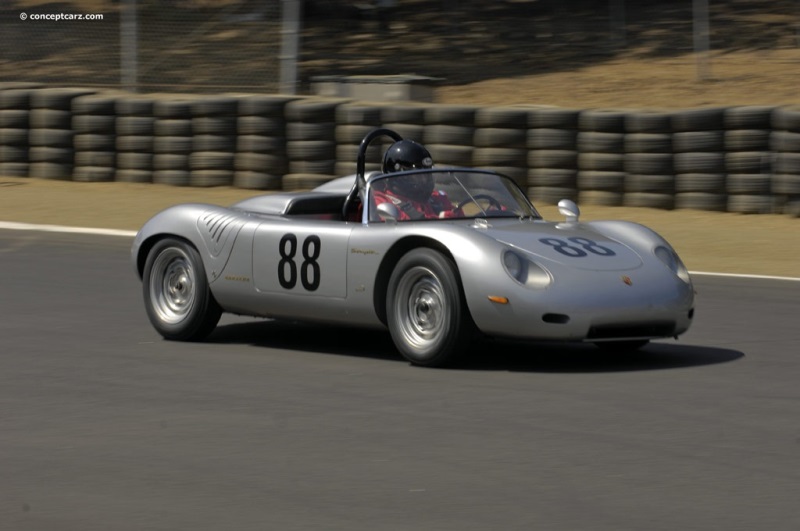
1961 Porsche RS 61 news, pictures, and information | ||
| Tweet | ||
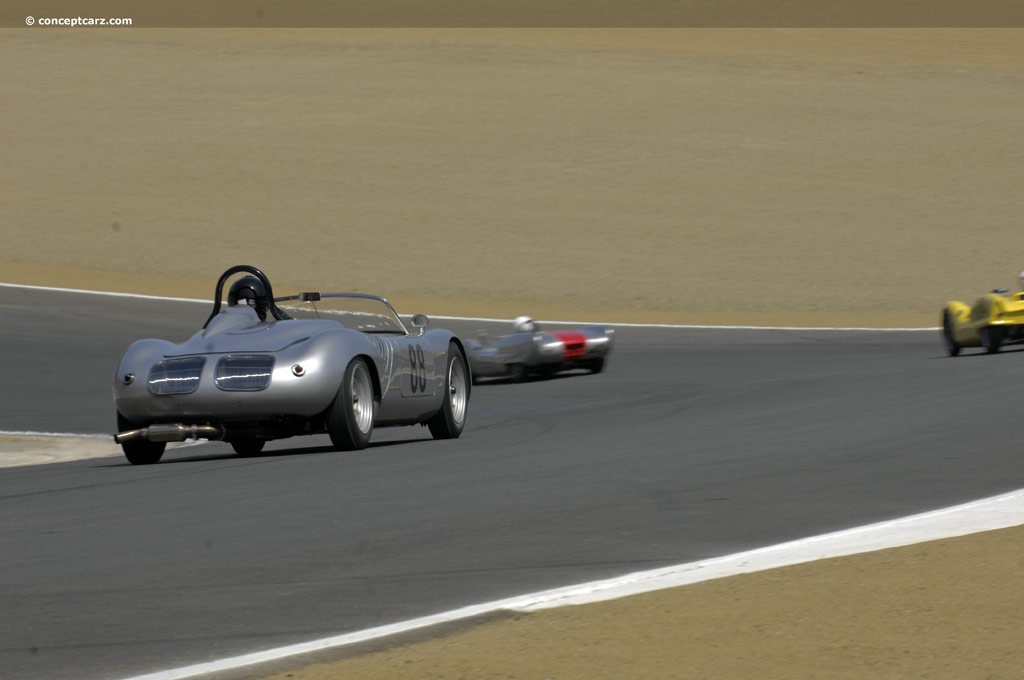
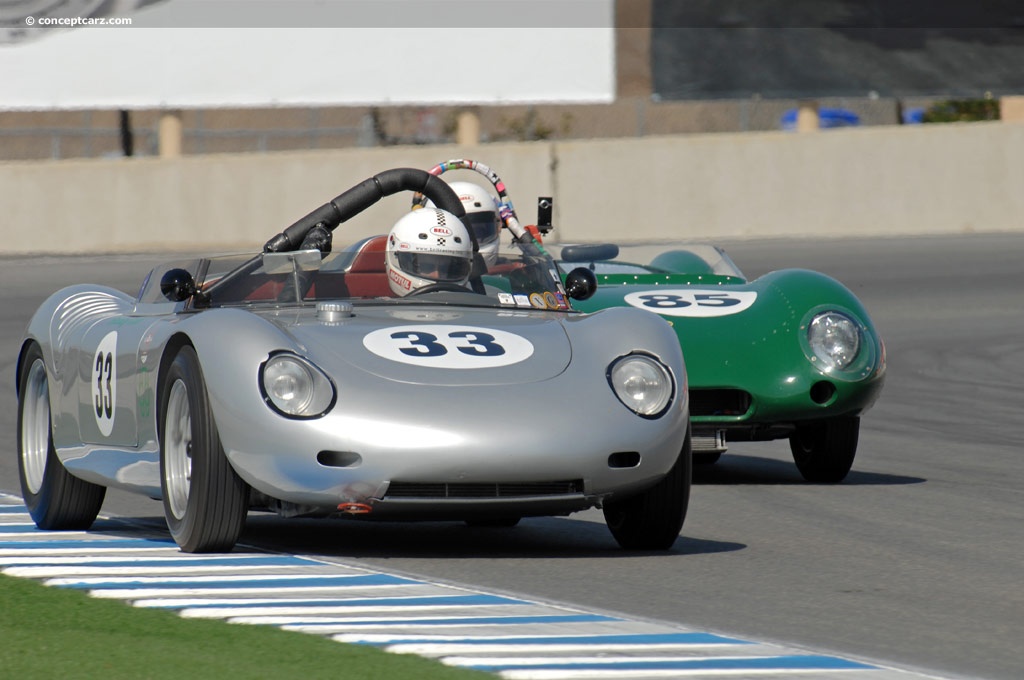
![]() | ![]() | Sports Racing Spyder Chassis Num: 718-068 |
The car is powered by a four-cylinder engine capable of producing 150 horsepower and 130 foot-pounds of torque. It has a Porsche gearbox and an independent suspension in both the front and rear.
By Daniel Vaughan | Feb 2009
Beginning in the early 1950s, Porsche unleashed a series of four cylinder, four cam sports racing cars that were extremely quick and ruled the small bore International Racing circuit for an entire decade. The car had a powerful engine but the cars true advantages were the use of 'free horsepower' - meaning in its lightweight chassis and running gear comprised of streamlined alloy bodies which offered great braking, fuel efficiency, handling, and acceleration.
The Porsche 550s won their class at Monaco in the early 1950s, along with similar wins at the Mille Miglia, the 24 Hours of Le Mans and in the Nurburgring 1000. They would repeat these victories in hillclimbs, international road races, and rallies. At the 1955 24 Hours of LeMans, their 550s finished in an astonishing 4th, 5th and 6th.
At the 1956 Targa Florio race, a Porsche driven by Umberto Maglioli earned Porsche their 'Greatest Victory' by coming in first overall. This was done by beating much more powerful vehicles such as the Ferrari Monza and the Maserati 300S.
Another victory was had at the 1959 Targa Florio and at the 1960 Sebring 12 Hour Endurance Race, the Type 718 Porsche RS 60 Factory entry captured the checkered flag.
There were over 100 examples of the 550 Spyder produced beginning in 1954 and it was easily the company's most successful 'customer' sports racing car to date. Modifications were continuously made, resulting in the 550A, 1500RS, RSK, the RS60 and the RS61 Series.
The early Porsche 550s produced 105 bhp while the final evolution of this successful Porsche Sports Racer, the RS61, produced 174 bhp from the 1600cc engine. By this point in history, the car had been subjected to hours of wind tunnel aero studies along with many races and continuous fine-tuning. When the RS61 was introduced, it was a very polished machine. It had a low coefficient of drag and, along with the RS60, was the ultimate development of the four-cylinder boxer Spyder series.
The RS60 and the RS61 (known as the Type 718) were a new marketing concept for the company. For the first time in the company's history, the customers were able to buy and race identical cars to the ones races by the Factory. Similar to the RSK, the Type 718 had a tubular space frame chassis but with an additional four inches in the wheelbase and a wider cockpit. This was done to comply with the new 43-inch minimum imposed by the FIA. The front suspension was similar to the RSK but now incorporated a hydraulic steering damper. The rear suspension, however, was new - now fitted with a double wishbone system with Koni shocks and coil springs.
There was space for an F.I.A. suitcase under the rear deck. Each car had a top, though it was designed to comply with regulations rather than be effective against the elements. Perhaps on of the largest disadvantages to the RS61 was the new curved safety glass windshield which was higher and wider than in the past. This, along with bigger doors, the convertible top, wider cockpit, and several other changes were done to comply with racing regulations. The extra size of the windshield did little to help with its aerodynamics and the engine had to work harder to keep pace with the more powerful competition. The engine, a Type 547/7 1587cc unit had a 9.8:1 compression ratio and was capable of producing 178 bhp.
Even with these new 'Road Car' regulations, the Porsche Spyders continued to perform extremely well in international endurance competition.
There were only 14 examples of the RS 61 models produced.
By Daniel Vaughan | Feb 2009
The Porsche 550s won their class at Monaco in the early 1950s, along with similar wins at the Mille Miglia, the 24 Hours of Le Mans and in the Nurburgring 1000. They would repeat these victories in hillclimbs, international road races, and rallies. At the 1955 24 Hours of LeMans, their 550s finished in an astonishing 4th, 5th and 6th.
At the 1956 Targa Florio race, a Porsche driven by Umberto Maglioli earned Porsche their 'Greatest Victory' by coming in first overall. This was done by beating much more powerful vehicles such as the Ferrari Monza and the Maserati 300S.
Another victory was had at the 1959 Targa Florio and at the 1960 Sebring 12 Hour Endurance Race, the Type 718 Porsche RS 60 Factory entry captured the checkered flag.
There were over 100 examples of the 550 Spyder produced beginning in 1954 and it was easily the company's most successful 'customer' sports racing car to date. Modifications were continuously made, resulting in the 550A, 1500RS, RSK, the RS60 and the RS61 Series.
The early Porsche 550s produced 105 bhp while the final evolution of this successful Porsche Sports Racer, the RS61, produced 174 bhp from the 1600cc engine. By this point in history, the car had been subjected to hours of wind tunnel aero studies along with many races and continuous fine-tuning. When the RS61 was introduced, it was a very polished machine. It had a low coefficient of drag and, along with the RS60, was the ultimate development of the four-cylinder boxer Spyder series.
The RS60 and the RS61 (known as the Type 718) were a new marketing concept for the company. For the first time in the company's history, the customers were able to buy and race identical cars to the ones races by the Factory. Similar to the RSK, the Type 718 had a tubular space frame chassis but with an additional four inches in the wheelbase and a wider cockpit. This was done to comply with the new 43-inch minimum imposed by the FIA. The front suspension was similar to the RSK but now incorporated a hydraulic steering damper. The rear suspension, however, was new - now fitted with a double wishbone system with Koni shocks and coil springs.
There was space for an F.I.A. suitcase under the rear deck. Each car had a top, though it was designed to comply with regulations rather than be effective against the elements. Perhaps on of the largest disadvantages to the RS61 was the new curved safety glass windshield which was higher and wider than in the past. This, along with bigger doors, the convertible top, wider cockpit, and several other changes were done to comply with racing regulations. The extra size of the windshield did little to help with its aerodynamics and the engine had to work harder to keep pace with the more powerful competition. The engine, a Type 547/7 1587cc unit had a 9.8:1 compression ratio and was capable of producing 178 bhp.
Even with these new 'Road Car' regulations, the Porsche Spyders continued to perform extremely well in international endurance competition.
There were only 14 examples of the RS 61 models produced.
By Daniel Vaughan | Feb 2009
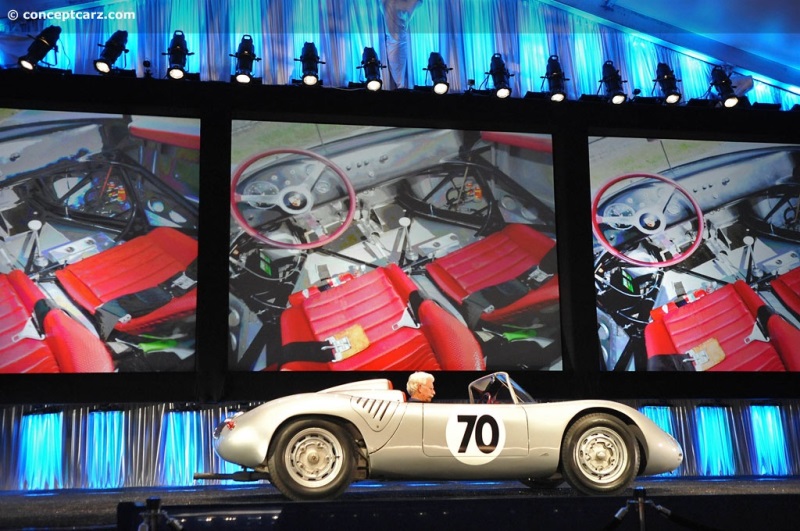
![]() | ![]() | ![]() | Sports Racing Spyder Coachwork: Wendler Chassis Num: 718-070 Engine Num: P90505 |
| Sold for $1,705,000 at 2010 Gooding & Company. | |||
The first recorded race for 718-070 was the Daytona SCCA National that took place in February. Holbert drove the car to a 1st in class in the 2000cc category. The next race for the car was the Governor's Cup that April. It would finish First in Class, repeating its success at Daytona. The result at the President's Cup three-hour race was impressive, with Holbert finishing First in Class and 4th overall.
By May of 1961, Holbert was driving 718-044, the factory-prepared RS61 that Stirling Moss had raced at the Targa Florio in Sicily earlier that year. This led him to sell 718-070 to East Coast driver, 'Gentleman Tom' Payne. Payne continued to race the car in many East Coast events like the Wisconsin Grand Prix, Thompson Nationals, 500 Sprints in Atlanta, and the Cumberland Nationals.
At the close of the 1961 season, the car was sold to Millard Ripley who won 1st overall at Watkins Glen in June of that year.
The car would have a tremendous racing career, earning 13 wins and 20 podium finishes in SCCA National Competition.
After the conclusion of the 1963 season, the car was retired for just a few years. Near the close of the 1960s, the car was given a restoration and prepared for vintage racing.
In 2010, this Porsche RS61 was offered for sale at the Gooding & Company Auction held in Amelia Island, Florida. The car was expected to sell for $1,200,000 - $1,500,000. As bidding came to a close, the car had been sold for the sum of $1,705,000, inclusive of buyer's premium.
By Daniel Vaughan | Apr 2010
Debuting in 1958, the Porsche 718 was a racing vehicle that continued in production until 1962. Riding on the coattails of success from the Porsche 550, the 718 was very similar in concept with its lightweight body, mid-engined, perfectly designed and very simple to maintain. The Porsche 718 was also responsible for bringing Porsche's first win at Sebring, also at the 1960 12 Hours race and a variety of successes in the Targa Florio, and countless national hillclimb, along with endurance and sports car championships throughout the world.
The Type 718 utilized many of the same mechanics that had been successful with the 550, even before the Type 547 engine had with its 1.5 liter displacement with over-head camshafts. This engine is considered to be the signature, first truly developed engine FOR Porsche, for use strictly in their automobiles. The 718 featured a small capacity that allowed it to enter into the ‘small sports car' class, as is defined by the FIA, the European motorsports governing body.
As before, Erwin Komenda was commission to design the Porsche 718. The end result, a streamlined and compact shape that was prime to elicit the fame and reputation the vehicle received throughout its lifetime. The exterior of the 718 was all aluminum placed on top of a tubular space-frame chassis which held the engine. Featuring a brand new five-speed manual gearbox, the drive went to the rear wheels.
It wasn't until 1960 when the Porsche 718 received modifications that included enlarging the engine to 1600 cc, and this was the birth of the 718 RS60. Updates to the Porsche 718 included a larger windshield, a regulation trunk in the tail, a ‘functional' top, and a four-cam engine that now produced 160 hp.
The RS60 wowed fans and was extremely successful and the factory entry driven by Olivier Gendebien and Hans Herrman, who won outright at the 12 Hours of Sebring in 1960. Their team-mated finished second. Meanwhile the RS60 won the 44th running of the Sicilian epic, the Targa Florio under the direction of Jo Bonnier and Hans Herrman.
In 1961, the RS61 was once again updated, and annual updates continued continuously until the end of the vehicles production span.
Though initially the Porsche 718 was intended to be mainly a road-legal sportscar with its two seats and steering wheel placed on the left, Porsche also created a single seat version of the 718; the 718/2 by moving the steering wheel to the center of the cockpit, and eventually into a real open-wheeler Formula 2 car. The first single seater 718 was entered into a Formula 2 championship following a special order by Grand Prix driver Jean Behra. Based on the 718RSK, the 718/2 utilized its engine along with a variety of its mechanical components. Behra still considered the vehicle to be too slow, and created another. Despite all of this, he still went on to win the 1958 Formula 2 race at Reims, in France.
This vehicle kept the 718's engine, but joined it to a brand-new tubular spaceframe chassis. The majority of the work on this vehicle was done by ex-Maserati engineer, Valerio Colotti, in Modena. The vehicle was raced for the first time at the 1959 Monaco Grand Prix, against the much faster Formula 1 cars. Horribly though, this vehicle was involved in a collision with another competitor, and was forced to retire. Hans Herrman, grabbed the wheel at Reims and happened to finish a close second to Stirling Moss in the Cooper. Behra took the wheel of his Porsche at the next race that occurred at Germany's Avus track, but unfortunately the day before the race, he was killed tragically driving a 718 in a Sportscar race, and the vehicle didn't turn another wheel. Eventually, American driver Vic Meinhardt purchased the car and raced it at amateur level in the USA.
In 1961 the Formula One's rules changed and Porsche realized that it could finally enter the earlier single seater into the championship. With mixed results, Porsche entered the car in several Grand Prix races of the 1961 Formula One season. At the 1961 Dutch Grand Prix, four Porsches competed and finished despite complications, making this race the only GP in decades in which all of the starters finished. The results were varied and 718/2 was replaced by the 804 for Porsche's F1 efforts. Fortunately the demand for the race prepared RSK718 was so intense, that Porsche decided to sell a version for road use and was dubbed the RS60 and RS61.
Unfortunately the Porsche 718 was considered by many to be too large, too heavy and down on power when compared side by side with newer designs of the competition that appeared in late 1961. This was a season that was dominated by Ferrari's V6 156 Dino. Until 1964, privateers such as Carel Godin de Beaufort entered the 718 in F1.By Jessica Donaldson
The Type 718 utilized many of the same mechanics that had been successful with the 550, even before the Type 547 engine had with its 1.5 liter displacement with over-head camshafts. This engine is considered to be the signature, first truly developed engine FOR Porsche, for use strictly in their automobiles. The 718 featured a small capacity that allowed it to enter into the ‘small sports car' class, as is defined by the FIA, the European motorsports governing body.
As before, Erwin Komenda was commission to design the Porsche 718. The end result, a streamlined and compact shape that was prime to elicit the fame and reputation the vehicle received throughout its lifetime. The exterior of the 718 was all aluminum placed on top of a tubular space-frame chassis which held the engine. Featuring a brand new five-speed manual gearbox, the drive went to the rear wheels.
It wasn't until 1960 when the Porsche 718 received modifications that included enlarging the engine to 1600 cc, and this was the birth of the 718 RS60. Updates to the Porsche 718 included a larger windshield, a regulation trunk in the tail, a ‘functional' top, and a four-cam engine that now produced 160 hp.
The RS60 wowed fans and was extremely successful and the factory entry driven by Olivier Gendebien and Hans Herrman, who won outright at the 12 Hours of Sebring in 1960. Their team-mated finished second. Meanwhile the RS60 won the 44th running of the Sicilian epic, the Targa Florio under the direction of Jo Bonnier and Hans Herrman.
In 1961, the RS61 was once again updated, and annual updates continued continuously until the end of the vehicles production span.
Though initially the Porsche 718 was intended to be mainly a road-legal sportscar with its two seats and steering wheel placed on the left, Porsche also created a single seat version of the 718; the 718/2 by moving the steering wheel to the center of the cockpit, and eventually into a real open-wheeler Formula 2 car. The first single seater 718 was entered into a Formula 2 championship following a special order by Grand Prix driver Jean Behra. Based on the 718RSK, the 718/2 utilized its engine along with a variety of its mechanical components. Behra still considered the vehicle to be too slow, and created another. Despite all of this, he still went on to win the 1958 Formula 2 race at Reims, in France.
This vehicle kept the 718's engine, but joined it to a brand-new tubular spaceframe chassis. The majority of the work on this vehicle was done by ex-Maserati engineer, Valerio Colotti, in Modena. The vehicle was raced for the first time at the 1959 Monaco Grand Prix, against the much faster Formula 1 cars. Horribly though, this vehicle was involved in a collision with another competitor, and was forced to retire. Hans Herrman, grabbed the wheel at Reims and happened to finish a close second to Stirling Moss in the Cooper. Behra took the wheel of his Porsche at the next race that occurred at Germany's Avus track, but unfortunately the day before the race, he was killed tragically driving a 718 in a Sportscar race, and the vehicle didn't turn another wheel. Eventually, American driver Vic Meinhardt purchased the car and raced it at amateur level in the USA.
In 1961 the Formula One's rules changed and Porsche realized that it could finally enter the earlier single seater into the championship. With mixed results, Porsche entered the car in several Grand Prix races of the 1961 Formula One season. At the 1961 Dutch Grand Prix, four Porsches competed and finished despite complications, making this race the only GP in decades in which all of the starters finished. The results were varied and 718/2 was replaced by the 804 for Porsche's F1 efforts. Fortunately the demand for the race prepared RSK718 was so intense, that Porsche decided to sell a version for road use and was dubbed the RS60 and RS61.
Unfortunately the Porsche 718 was considered by many to be too large, too heavy and down on power when compared side by side with newer designs of the competition that appeared in late 1961. This was a season that was dominated by Ferrari's V6 156 Dino. Until 1964, privateers such as Carel Godin de Beaufort entered the 718 in F1.By Jessica Donaldson
1959/60 Porsche 718 RS 60 Spyder
Automobile sport was part of the picture for the fledgling Porsche sports car firm from the first. The 356 quickly became popular around the world, in the hands of private drivers wîth sporting ambitions. New racesports cars were developed in Zuffenhausen at the beginning of the fifties: the1.5 liter 550 Spyder proved a shark in the goldfish bowl against larger-displacement competitors in major races. This Spyder used the first engine developed by Porsche for Porsche: the Type 547 wîth 1.5 liter displacement and four, shaft-driven, overhead camshafts.Porsche had made the change from a floor pan to tubular space frame for racesport construction, established the five-speed gearbox, continued to increase performance and fitted larger drum brakes. These improvements, along wîth countless other modifications, kept the Spyder at the head of the ' small sports car class ' (up to 1500 cc) throughout the fifties.
But 1960 brought new regulations for racesports cars, leading to the Spyder RS 60 wîth displacement increased to 1600 cc, larger windshield, a 'functional' top and a regulation trunk in the tail, behind a four-cam engine which now produced 160 HP. This RS 60 brought Porsche its finest results up to that time, particularly in long-distance events. While an overall victory in the 44th Targa Florio in 1960 by Bonnier/Herrmann, wîth a lead of more than 6 minutes over a 3 liter Ferrari, was within the range of previous achievements - sports cars from Zuffenhausen had already captured overall Targa Florio victories in l956 and 1959 - a new Porsche chapter opened wîth the first appearance of the RS 60 at the 12 hours of Sebring in the ÚSA. Olivier Gendebien and Hans Herrmann won outright while Holbert/Scheckter/Fowler drove a second factory RS 60 into second, ahead of Nethercutt/Lovely in a 3 liter Ferrari Dino. Swiss driver Heini Walter, at the wheel of an RS 60, secured Porsche's third and fourth European Hillclimb Championships in 1960 and 1961, following those from 1958 by Count Berghe von Trips and 1959 by Edgar Barth.Source - Porsche
| MULTI-YEAR PARTNERSHIP NAMES MAZDA OFFICIAL CAR OF SCCA | |
| Sports Car Club of America and Mazda North American Operations have announced a multi-year partnership that names Mazda the Official Car of SCCA through 2015. Mazda Director of Motorsports John Doonan and SCCA Vice President, Marketing and Communications Eric Prill made the announcement on Tuesday morning during the Mazda Motorsports pre-season media day at the company's headquarters in Irvine. Mazda will be utilized as the official pace car at key SCCA events, including the SCCA National ...[Read more...] | |
| Firestone Returns As Presenting Sponsor of RRDC Evening With Brian Redman in Long Beach | |
![]() | The Firestone brand will return as presenting sponsor of the Road Racing Drivers Club's fifth annual West Coast banquet honoring auto racing's most influential leaders. This year, on Thursday, April 18, prior to the running of the Toyota Grand Prix of Long Beach, the 'RRDC Evening with Brian Redman presented by Firestone' will highlight the career of one of the sport's most popular, talented and successful race-car drivers. This is the Firestone brand's fourth straight year as a supporter of the...[Read more...] |
| Jaguar Heritage Racing scores debut win in Monaco Historic | |
![]() | Jaguar Heritage Racing, the new 'works' supported racing programme of Jaguar Cars, scored its debut win with a C-type in the Grand Prix de Monaco Historique, Serie C for Pre-1953 Sports Prototypes. The prestigious FIA sanctioned race was won by Alex Buncombe, in Jaguar Heritage Racing's 1952 C-type. The Grand Prix de Monaco Historique is widely regarded as the jewel in the crown of historic racing. This is the 8th running of the FIA sanctioned event, which occurs two weeks ahead of the F1 Gra...[Read more...] |
| RM Secures One-Of-A-Kind Ferrari and Talbot-Lago For its Monterey sale | |
![]() | RM Auctions, the world's largest collector car auction house for investment-quality automobiles, is delighted to announce two new headline attractions for its highly anticipated Monterey, California sale, August 17–18: a spectacular 1955 Ferrari 410 Sport Berlinetta and a flawless 1938 Talbot-Lago T23 Teardrop Coupe. On display at the company's sale in Monaco this week (May 11–12), both automobiles represent the pinnacle of exclusivity and style. The extraordinarily rare 410 S, chassis 0594 C...[Read more...] |
| 1958 Moroccan Grand Prix: British All the Way | |
![]() | After years of frustration, and well past his life-expectancy, Mike Hawthorn would be on the verge of his first World Championship. This was more than likely Hawthorn's last and best hope at a World Championship title. Just one last race, and a fellow Brit, would separate Hawthorn from his World Championship. Emotionally, Hawthorn was done. The last few seasons had seen Hawthorn fail to experience anywhere near the level of success he had even in his rookie year of 1952. In 1952, with an unde...[Read more...] |
| View more Sports Racer vehicles |
1961
Porsche
models |
| Porsche 356B |
| Similar Automakers | |
| Aston Martin | Bentley |
| Bugatti | Devon |
| Ferrari | GTA |
| Koenigsegg | Lamborghini |
| Lotus | Maserati |
| Maybach | McLaren |
| Rolls-Royce | Spyker |
| Tesla | |
| Porsche: 1961-1970 |
| Similar Automakers |
| Porsche History |
| Other models by Porsche |
| Manufacturer Website |
| ||||||||||||||||||||||||||||||||||||||||||||
| 356 550/718 Sports Racing Cars 597 904 | 906 907 908 911 | 912 914 917 924 | 928 934/935 944 956 and 962 | 968 Boxster Carrera GT Cayenne | Cayman GT3 Panamera Type 959 |


1961