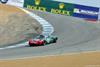
1965 Ginetta G12

1965 Ginetta G12 Navigation
The Ginetta Cars Company was created in 1958 by the four Walklett brothers, Bob, Ivor, Trevers, and Douglas. The Company was located in Woodbridge, Suffolk, England and its first offering was the G2 which was a kit car based on a tubular frame chassis, an aluminum body, and comprised of Ford components. The G2 was followed by the G3 in 1959 and replaced by the G4 in 1961. The G2 and G3 were designed for competition whereas the G4 was intended as a road-going vehicle. The G4 was given a fiber-glass GT body style and a Ford 105E engine. The suspension and other components benefited from modern improvements. Production continued until 1969 with around 500 examples being constructed. The G10 and G11 were produced during the early 1960's and powered by V8 engines courtesy of Ford and MGB. The next Ginetta vehicle was the G12 which brought with it a rather experimental configuration with the driver sitting in front of the motor. It was a fairly uncommon setup though a proven way of achieving excellent balance and weight distribution.The G12 utilized a mid-engine layout and was used as a competition car. At the racing debut of the G12 at Silverstone, it set a lap record. The following race at Snetterton, the G12 won its class. It was not uncommon for these small, lightweight machines to outpace the larger competitors, such as the mighty Shelby Cobras and Ford GT40s.
The G12 had a multi-tubular space frame clothed in a lightweight fiberglass body weighing a mere 1200 pounds. Power was from a Lotus twin-cam 1600cc engine breathing through twin Weber carburetors. The engine was mated to a Hewland 5-speed transaxle sending the power to the rear wheels. In the front, the suspension was comprised of double wishbones with coil-over shocks. The rear had double radius arms, upper transverse links, coil-over shocks, and lower wishbones. Girling disc brakes could be found on all four corners.
By Daniel Vaughan | Feb 2009
In total, there were around 33 (with as many as 50) examples of the G12 produced during the 1960s. Production ranged from 1966 through 1968.
By Daniel Vaughan | Feb 2009
- 1965 Ginetta G12 Menu
- Article
- Image gallery
- Specifications
- Profiles