1967 Mazda Cosmo Sport 110S news, pictures, and information | ||
| Tweet | ||
![]() | ![]() | ![]() | Coupe |
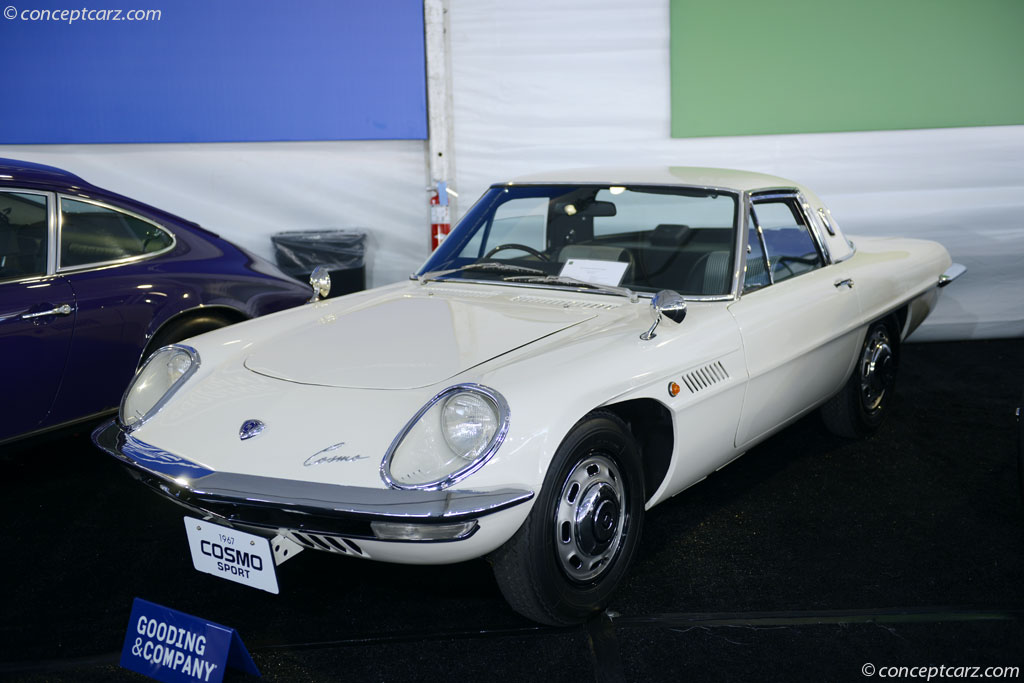
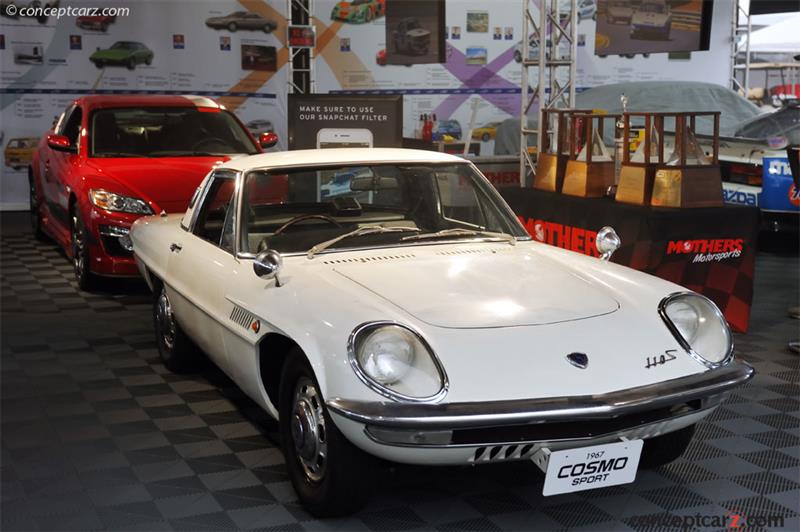
This particular 1967 Cosmo Sport 110S L-110A model is owned by Mazda North American Operations, based in Irvine, California. Records show only two 1967 Cosmos were exported to the United States, this one being registered to Curtiss-Wright Corporation, the North American rights-holder of the Wankel rotary engine, until February 1984 (Mazda was the Asian rights-holder for the use of the engine in motor vehicles). It subsequently changed hands three more times before coming back 'home' to Mazda. The odometer reading is original and correct at a little over 11,000 km.
Introduced on May 30th, 1967, the Cosmo Sports were the world's first two rotor production vehicles. The Cosmo project began in December of 1962 with Mazda's first two rotor engine prototypes in July of 1963, and in October 1963 as the head of Mazda, Tsuneji Matsuda drove the original prototype that was dubbed 'Project L402A' to the Tokyo motor show.
The Sports utilized the prototype engine that was dubbed the L8A or 0353 with 2x398cc and used a combination of peripheral and side intake porting. Eventually the L8A engine evolved into the L10A with 2x491cc and size intake ports. The peripheral ports were finally dropped, and the engine size increased to give way for better operating characteristics. Since then, all production Mazda rotary engines use intake ports.
There were actually four generations of Mazda automobiles that went by the nomenclature of 'Cosmo', though they were not all particularly related to each other. All four generations were GT cars, and the first proved to be a successful introduction for the Mazda Wankel engine. This vehicle also acted as a ‘halo' vehicle for the new Mazda brand. Cosmos eventually competed in the ultra-high luxury performance market in Japan with the final JC Cosmo. This final model was introduced in 1990 through 1995 and was sold as the Eunos Cosmo (Eunos being a luxury sales channel that was very similar to Toyota's Lexus brand).
In April of 1966, prototype engines and vehicles progressed and a pre-production run used 80 Cosmos, 60 of which were sent out as evaluation models to Mazda dealers in Japan. This accumulated over 600,000km in 6 months. In late 1966, the design was finalized and production would begin soon after the May 30th 1967 launch date. The name L10A was shared by both the vehicle and the engine.
Though basically a conventional 1960's sports vehicle, the Mazda Cosmo came with a variety of ‘high tech' items that included front disc brakes, a de-dion rear suspension and an ‘aircraft inspired' dashboard that came with speedometer, oil pressure gauge, tachometer, ammeter and clock, and water temperature. The L10A Cosmo was only sold in Japan.
The first generation of the Mazda Cosmo Sport 110 was introduced in 1967 and had a production run until 1972. A total of 1,519 series vehicles were produced. The original Mazda that carried the Cosmo name was the 110S model, and was the original 2-rotor rotary engine powered vehicle.
At the 1964 Tokyo Motor Show, a prototype was debuted, and 80 pre-production Cosmos were produced for the Mazda test department from 1965 through 1966. Actual production began in May of 1967 and Cosmos were constructed by hand at a rate of about one per day. In the show Return of Ultraman, the Cosmo was featured.
Powered by a 0810 two-rotor engine with 982 cc of displacement, the Series I/L10A Cosmo produced around 110 hp (thus the 110 name). The 110 utilized a Hitachi 4-barrel carb and a strange ignition design with two spark plugs per chamber with dual distributors. Standard on the Mazda Cosmo Sport 110 was a 4-speed manual transmission and 14 in wheels. The front independent suspension on the Cosmo Sport was A-arm/coil spring design with an anti-roll bar. The rear of the vehicle used a live axle with a de Dion tube, trailing arms, and semi-elliptic leaf springs. In the front was power-unassisted 10 in disk brakes with 7.9 inch drum brakes in the rear. The top speed of the Cosmo Sport was 115 mph and 16.4 seconds in the quarter mile. The Cosmo was priced at $4,100, much lower than the Toyota 2000GT.
Introduced in July of 1968 was the Series II/L10B. This series featured a more-powerful 128 hp and 103 ft/lb of torque, 0813 engine, 15 inch wheels, power brakes and 5-speed manual transmission. The wheelbase was enlarged to 5.9 inches and gave the Cosmo a better ride and much more room. This newest version could achieve the quarter mile in just 15.8 seconds and had a top speed of 120 mph.
On the exterior, the new Cosmo featured a larger grille, and two additional vents were added to each side of the mouth under the front bumper. Only 1,519 models were ever built of the Cosmo Series II, and only six were ever imported to the U.S. The price jumped up a bit to $4,390.
Jay Leno owns a 1970 Series II Cosmo, and it was featured on the Speed Channel series 'My Classic Car' in March of 2006. This vehicle is believed to be the only remaining Series II Cosmo in the U.S.
In 1975, the second generation CD Cosmo debuted in 1975 and continued until 1981. This model was dubbed the Cosmo AP in Japan and was sold internationally as the Mazda RX-5. In a few export markets its piston powered counterpart was dubbed the Mazda 121. Mazda America utilized the Cosmo name and offered it from 1976 until 1978.
Unfortunately, Mazda tried too hard to ‘americanize' the CD Cosmo/RX-5 series, and it was a disaster internationally. Fortunately though, the CD/Cosmo/RX-5 was a great success in Japan and over 55,000 units where sold in the first year alone. The Series-II version from 1979 through 1981 was not exported due to poor sales as an export and remained on domestic sale only.
Mazda's ‘large' compact rotary coupe, the Cosmo was based on the Mazda RX-4 floorplan and mechanics but it was heavier because of body design and much more luxurious features. These also included a 5-link rear suspension and rear disc brakes and was available with the 12A and 13B engines.
The Cosmo 1800, a piston engine version utilized a 1769 cc straight-4 SOHC engine that produced 100 hp and produced 100 lb/ft of torque.
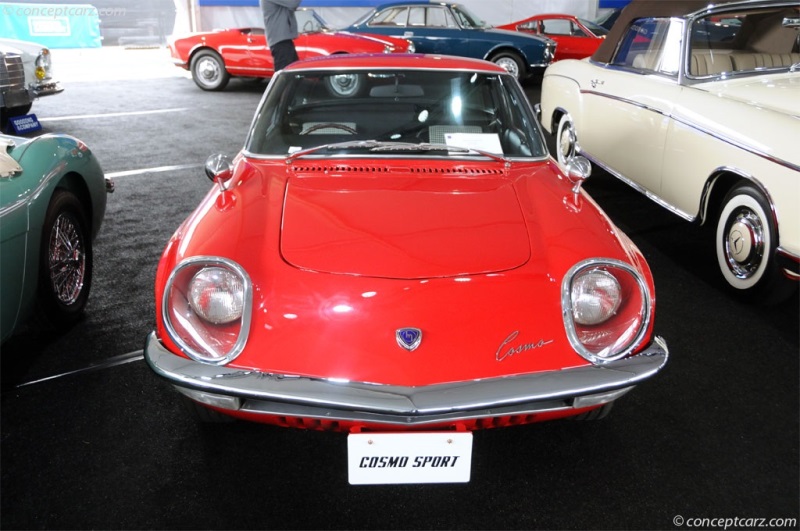
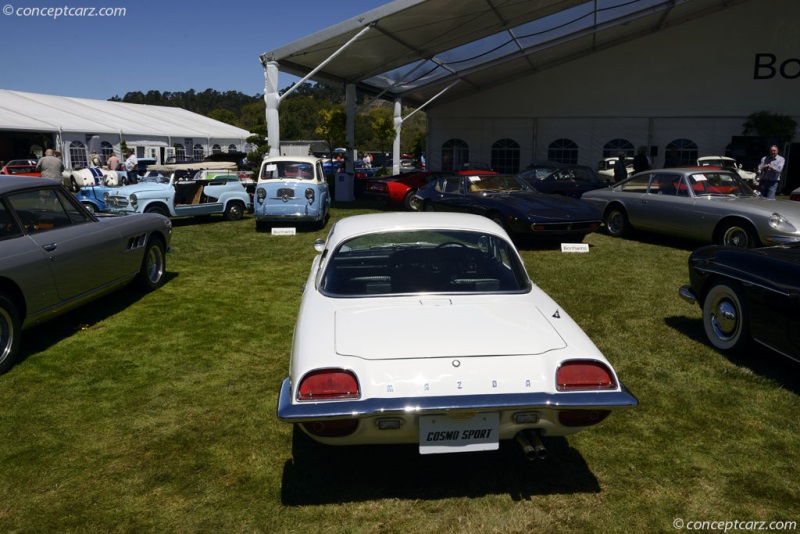
An engineering oddity, the Mazda Cosmo Sport 110S was a unique, piston-less engine in a strange-looking sports vehicle. The Sport 110S was a two-seat Cosmo, 60's era, with a rotary that was the brainchild of Felix Wankel, a self-taught German tinker who never made it to college.
At the time, every auto maker except Mazda gave up attempting to get the rotary to work in the real world. Eventually the rotary became reliable and a staple of Mazda production. Today the company continues to develop the rotary and is even working on alternate-fuel versions. But back then, the rotary was considered to be an automotive novelty. The Mazda Cosmo was also considered to be quite a novelty. The Xosmo was marketed in ads with 'and Mazdas go hhhmmm.' The Cosmo weighs around 2,200 lbs and nearly everything was exceedingly light and easy.
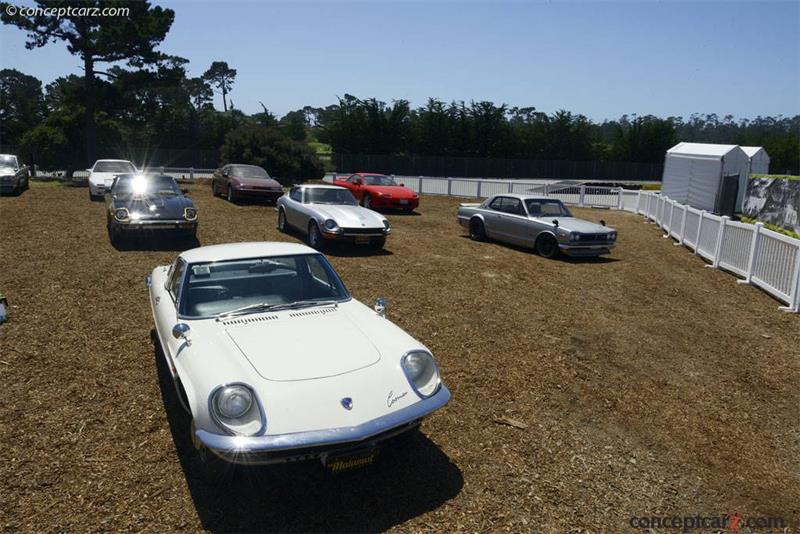
The Cosmo is considered by enthusiasts to be a uniquely styled Japanese interpretation of ‘what a Western sports car' should look like. Near the end of its production period, the Cosmo Sport 110S had a production run of around 1,200 units, and while Mazda kept a Cosmo model in production for several years, it was a ‘less interesting car'.By Jessica Donaldson
For more information and related vehicles, click hereThe Sports utilized the prototype engine that was dubbed the L8A or 0353 with 2x398cc and used a combination of peripheral and side intake porting. Eventually the L8A engine evolved into the L10A with 2x491cc and size intake ports. The peripheral ports were finally dropped, and the engine size increased to give way for better operating characteristics. Since then, all production Mazda rotary engines use intake ports.
There were actually four generations of Mazda automobiles that went by the nomenclature of 'Cosmo', though they were not all particularly related to each other. All four generations were GT cars, and the first proved to be a successful introduction for the Mazda Wankel engine. This vehicle also acted as a ‘halo' vehicle for the new Mazda brand. Cosmos eventually competed in the ultra-high luxury performance market in Japan with the final JC Cosmo. This final model was introduced in 1990 through 1995 and was sold as the Eunos Cosmo (Eunos being a luxury sales channel that was very similar to Toyota's Lexus brand).
In April of 1966, prototype engines and vehicles progressed and a pre-production run used 80 Cosmos, 60 of which were sent out as evaluation models to Mazda dealers in Japan. This accumulated over 600,000km in 6 months. In late 1966, the design was finalized and production would begin soon after the May 30th 1967 launch date. The name L10A was shared by both the vehicle and the engine.
Though basically a conventional 1960's sports vehicle, the Mazda Cosmo came with a variety of ‘high tech' items that included front disc brakes, a de-dion rear suspension and an ‘aircraft inspired' dashboard that came with speedometer, oil pressure gauge, tachometer, ammeter and clock, and water temperature. The L10A Cosmo was only sold in Japan.
The first generation of the Mazda Cosmo Sport 110 was introduced in 1967 and had a production run until 1972. A total of 1,519 series vehicles were produced. The original Mazda that carried the Cosmo name was the 110S model, and was the original 2-rotor rotary engine powered vehicle.
At the 1964 Tokyo Motor Show, a prototype was debuted, and 80 pre-production Cosmos were produced for the Mazda test department from 1965 through 1966. Actual production began in May of 1967 and Cosmos were constructed by hand at a rate of about one per day. In the show Return of Ultraman, the Cosmo was featured.
Powered by a 0810 two-rotor engine with 982 cc of displacement, the Series I/L10A Cosmo produced around 110 hp (thus the 110 name). The 110 utilized a Hitachi 4-barrel carb and a strange ignition design with two spark plugs per chamber with dual distributors. Standard on the Mazda Cosmo Sport 110 was a 4-speed manual transmission and 14 in wheels. The front independent suspension on the Cosmo Sport was A-arm/coil spring design with an anti-roll bar. The rear of the vehicle used a live axle with a de Dion tube, trailing arms, and semi-elliptic leaf springs. In the front was power-unassisted 10 in disk brakes with 7.9 inch drum brakes in the rear. The top speed of the Cosmo Sport was 115 mph and 16.4 seconds in the quarter mile. The Cosmo was priced at $4,100, much lower than the Toyota 2000GT.
Introduced in July of 1968 was the Series II/L10B. This series featured a more-powerful 128 hp and 103 ft/lb of torque, 0813 engine, 15 inch wheels, power brakes and 5-speed manual transmission. The wheelbase was enlarged to 5.9 inches and gave the Cosmo a better ride and much more room. This newest version could achieve the quarter mile in just 15.8 seconds and had a top speed of 120 mph.
On the exterior, the new Cosmo featured a larger grille, and two additional vents were added to each side of the mouth under the front bumper. Only 1,519 models were ever built of the Cosmo Series II, and only six were ever imported to the U.S. The price jumped up a bit to $4,390.
Jay Leno owns a 1970 Series II Cosmo, and it was featured on the Speed Channel series 'My Classic Car' in March of 2006. This vehicle is believed to be the only remaining Series II Cosmo in the U.S.
In 1975, the second generation CD Cosmo debuted in 1975 and continued until 1981. This model was dubbed the Cosmo AP in Japan and was sold internationally as the Mazda RX-5. In a few export markets its piston powered counterpart was dubbed the Mazda 121. Mazda America utilized the Cosmo name and offered it from 1976 until 1978.
Unfortunately, Mazda tried too hard to ‘americanize' the CD Cosmo/RX-5 series, and it was a disaster internationally. Fortunately though, the CD/Cosmo/RX-5 was a great success in Japan and over 55,000 units where sold in the first year alone. The Series-II version from 1979 through 1981 was not exported due to poor sales as an export and remained on domestic sale only.
Mazda's ‘large' compact rotary coupe, the Cosmo was based on the Mazda RX-4 floorplan and mechanics but it was heavier because of body design and much more luxurious features. These also included a 5-link rear suspension and rear disc brakes and was available with the 12A and 13B engines.
The Cosmo 1800, a piston engine version utilized a 1769 cc straight-4 SOHC engine that produced 100 hp and produced 100 lb/ft of torque.
An engineering oddity, the Mazda Cosmo Sport 110S was a unique, piston-less engine in a strange-looking sports vehicle. The Sport 110S was a two-seat Cosmo, 60's era, with a rotary that was the brainchild of Felix Wankel, a self-taught German tinker who never made it to college.
At the time, every auto maker except Mazda gave up attempting to get the rotary to work in the real world. Eventually the rotary became reliable and a staple of Mazda production. Today the company continues to develop the rotary and is even working on alternate-fuel versions. But back then, the rotary was considered to be an automotive novelty. The Mazda Cosmo was also considered to be quite a novelty. The Xosmo was marketed in ads with 'and Mazdas go hhhmmm.' The Cosmo weighs around 2,200 lbs and nearly everything was exceedingly light and easy.
The Cosmo is considered by enthusiasts to be a uniquely styled Japanese interpretation of ‘what a Western sports car' should look like. Near the end of its production period, the Cosmo Sport 110S had a production run of around 1,200 units, and while Mazda kept a Cosmo model in production for several years, it was a ‘less interesting car'.By Jessica Donaldson
| GARMIN TO PROVIDE IN-DASH NAVIGATION FOR FUTURE MERCEDES-BENZ MODELS | |
| Garmin® International Inc., a unit of Garmin Ltd. (NASDAQ: GRMN), the global leader in satellite navigation, today announced that Daimler AG has selected Garmin as global navigation provider for future Mercedes-Benz models. Garmin's award-winning navigation will be fully integrated into Mercedes-Benz infotainment systems over the next four years. 'Being selected by Daimler as their global tier-one navigation solution partner is a testament to Garmin's growing capability and exceptional produc...[Read more...] | |
| Gooding & Company Sells 97% at its Amelia Island Auction, Realizing more than $28 million in Sales and Five World Records | |
| • Two Cars Sell Above the $2 Million Dollar Mark • Eight Cars Sell Above the $1 Million Dollar Mark • World record-breaking 1953 Fiat 8V Supersonic benefits St. Jude Children's Hospital Gooding & Company, the acclaimed auction house celebrated for selling the world's most significant and valuable collector cars, is delighted to announce more than $28 million and 97% in sales for 69 out of 71 lots sold at its annual Amelia Island Auction. This year's superb compilation i...[Read more...] | |
| PORSCHE 911 CARRERA S NAMED ROBB REPORT CAR OF THE YEAR | |
![]() | • Luxury lifestyle authority decorates top Porsche model Atlanta. The seventh-generation Porsche 911 Carrera S has been named the 2013 Robb Report Car of the Year. Captivating the judging panel with its agility, driving dynamics and balance, the 911 bested 12 other competitors for the award and will be featured on the cover of the March issue of the luxury lifestyle magazine. 'Winning Robb Report's 2013 Car of the Year award for the Porsche 911 is a proud achievement for our brand...[Read more...] |
| 1991 24 Hours of Le Mans: Facing the Giants | |
![]() | It had been more than thirty years but the Silver Arrows would compete, and win, the 24 Hours of Le Mans. Jaguar would also earn its first victory in more than thirty years when it took the overall honors in 1988. And then there was Porsche, the most dominant mark in Le Mans history. But each of these three manufacturers shared something in common. Even with the victories by Ford during the 1960s there was something very interesting about the list of victors in the 24 French enduro—none of them ...[Read more...] |
| Chevy Performance Rolls with Hot Rod Magazine Power Tour | |
![]() | Weeklong drive kicks off with unprecedented access to GM's Milford Proving Ground Road trip! It's that time of year again for the annual automotive pilgrimage known as the Hot Rod Magazine Power Tour® and Chevrolet Performance helps get it started on Saturday, June 2, at General Motors' Milford Proving Ground. The Power Tour winds up in Arlington, Texas, on June 9. With more than 3,000 hot rods, muscle cars, classic trucks and late-model performance vehicles and approximately 12,00...[Read more...] |
| Similarly Sized Vehicles from 1967 |
| Alfa Romeo Giulia |
| BMW 1600 |
| Chevrolet Nova Series |
| Ferrari 412 P |
| Lancia Fulvia |
| Marcos 1600 GT |
| Porsche 911 |
| Porsche 911R |
| Porsche 911R Prototype |
| Porsche 911S |
| Mazda: 1961-1970 |
| Similar Automakers |
| Mazda History |
| Other models by Mazda |
| Manufacturer Website |
| Related Articles and Event Coverage |
| Monterey Historic Races at Laguna Seca |
| ||||||||||||||||||||||||||||||||||||||||||||
| 2 3 5 | 6 Chantez Cosmo | CX-5 CX-7 CX-9 | Miata MPV MX-3 | RX-7 RX-8 RX3 | Tribute |