The world was introduced to the Kaiser-Darrin Sports Convertible prototype in 1953 when it was shown at the New York Auto Show, besting Chevrolet's Corvette to become America's first fiberglass production sports car. Its attractive styling and exotic bodywork were betrayed by its anemic F-head six-cylinder engine and, compounded with a high price tag, resulted in low sales. Six prototypes and 435 production examples were built before diminishing corporate finances, a labor strike at the Willow Run plant, the loss of assembly facilities, and a snowstorm brought its euphoric existence to an end. 
Sport Convertible
View info and historyHoward 'Dutch' Darrin
Howard 'Dutch' Darrin was a renowned automotive designer who, along with Thomas Hibbard, established Hibbard & Darrin of Paris during the 1920s. Due to the financial crisis of 1929, it was forced to close. Following a second partnership in Paris, known as Carrosserie Fernandez et Darrin, Howard Darrin returned home in 1937 and settled in Hollywood. With sensuous European curves, low-profile hood, down-swept doors, and the chromed vee'd windshield, his designs became popular with the movie-star elite. By 1940, Darrin-customized Packards appeared in Packard sales literature and were favorites of individuals who wanted something just a bit more unique and distinctive.After World War II, Darin worked with Kaiser-Frazer as a freelance consultant, with his design used on the 1947 Frazer. His relationship with the company was unstable, however, and Darrin became infuriated when his spectacular designs were smoothed over by Kaiser-Frazer stylists. Parting ways with the company, he returned when Frazer asked him to help style the new 1951 Henry J, a small and affordable car. This was a different direction for Kaiser-Frazer, which normally delivered pricey sedans. The designs he penned would remain until the company's demise in 1955. The new styling incorporated unique widows peak to the top of the windshield as well as a Darrin Dip in the rear quarter panel.The Kaiser-Darrin
While working on the Henry J, Darrin also worked on an after-hours project using the short Henry J chassis. It was given unique, sporty styling and Bill Tritt was tasked with crafting the body from fiberglass. The concept was shown to Henry Kaiser, and he was very displeased with the sports car, saying the company wasn't in the sports car business. Darrin believed in the project, having created it in his own time and using his own resources, and told Kaiser that if they would not build it, he would build it himself. According to legend, Mr. Kaiser was joined by his new, younger wife, and her reaction was very different, remarking that it was the most beautiful car she'd ever seen. This convinced Kaiser to change his mind and ordered the production of the Kaiser Darrin. Styling
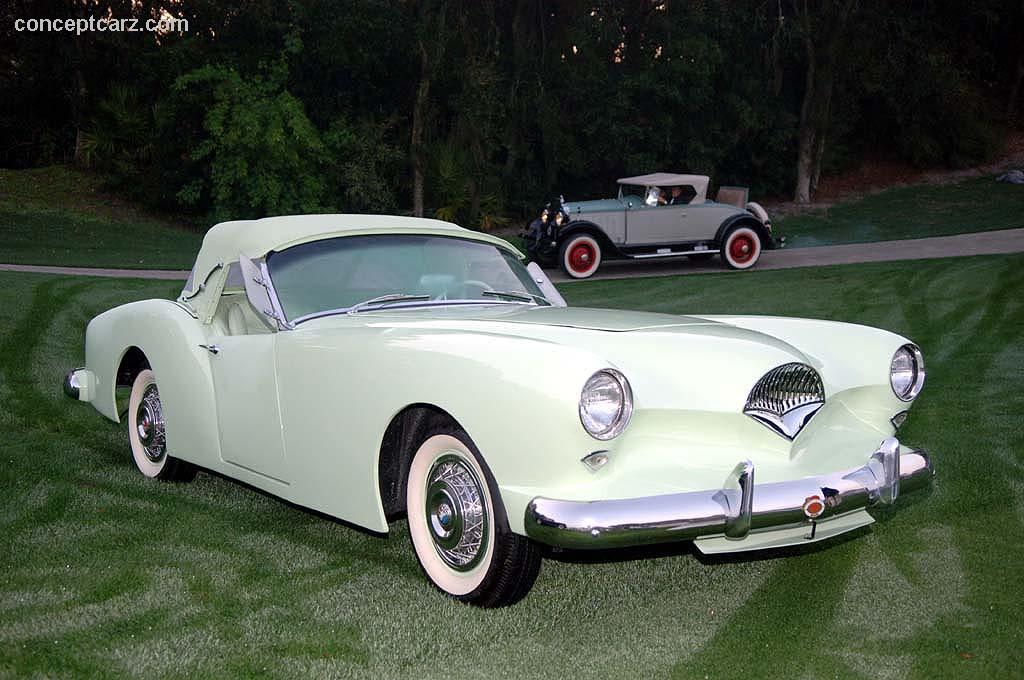
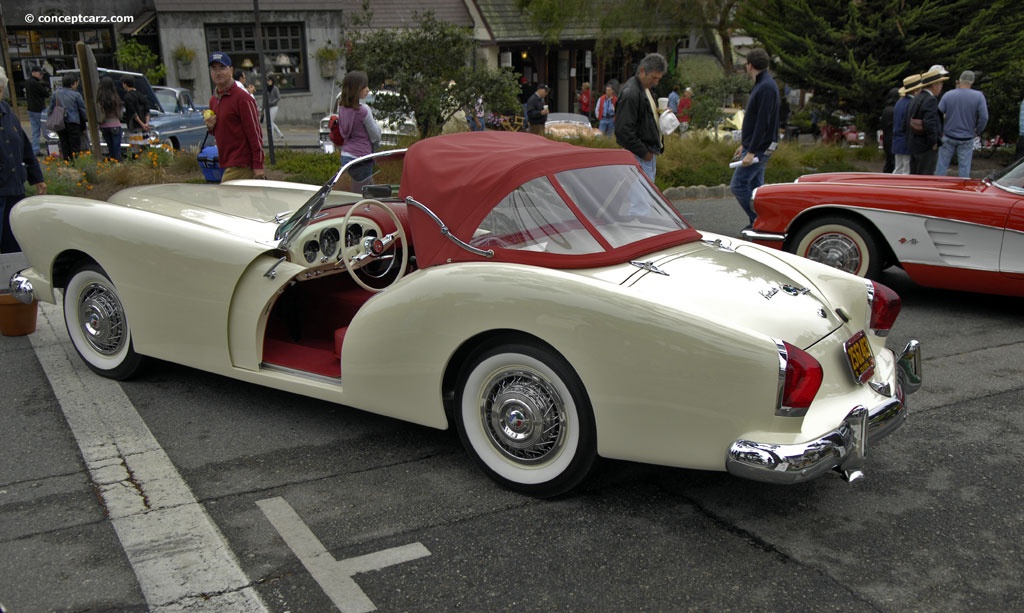
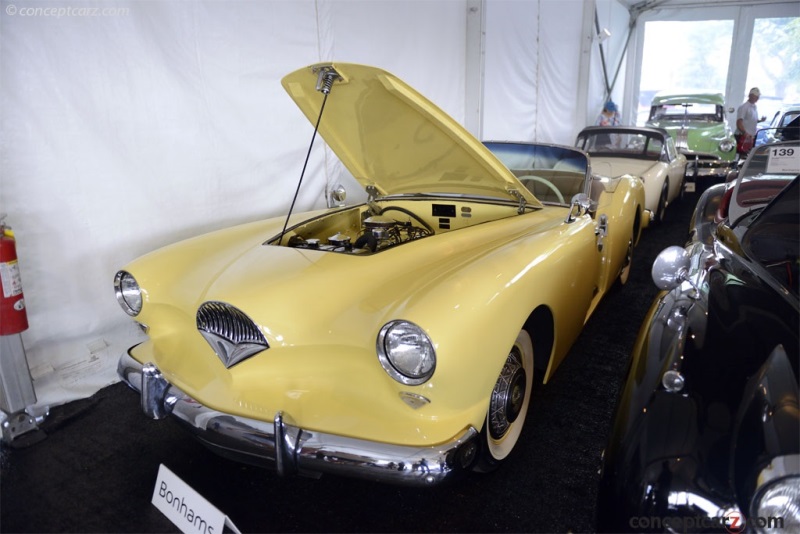
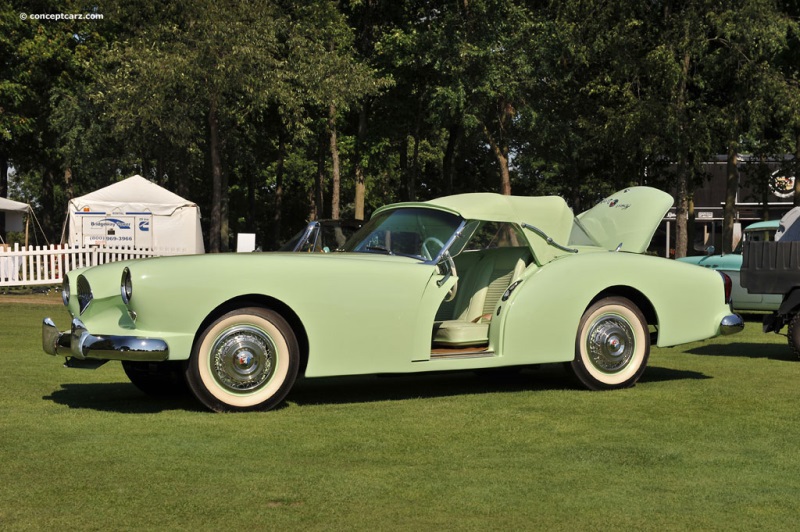
The Kaiser-Darrin is marked by low sweeping lines, a heart-shaped grille, a 'Darrin dip' behind the sweeping front doors, a split windshield, a three-position Landau top, unique pocket doors that glide forward, and almost disappear inside the front fenders, and open two-seater coachwork. Darrin had promoted sliding doors for decades, claiming they were a safe alternative since the doors did not open into traffic. Its eye-catching design and sporty persona were well-aligned with the numerous European and British sports cars that were vying for ownership from American servicemen returning from overseas duty. Independent Kaiser Motors had enlisted industrial designer Howard 'Dutch' Darrin to produce the fiberglass-bodied sports car based on the company Henry J. economy car. It had an overall length of 184.1 inches and a wheelbase of 100 inches. The first prototype was introduced in 1953 at the New York Auto Show.
Sport Convertible
View info and historyThe construction of the fiberglass bodies was outsourced to Glaspar of California. Engine
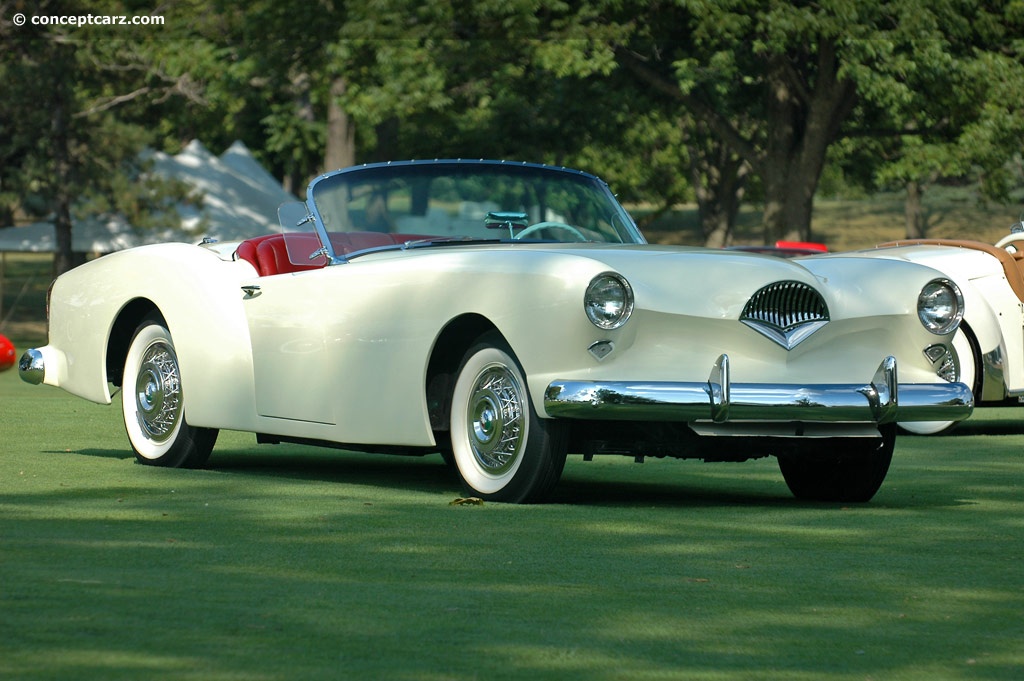
The New York Auto Show prototype car was given a standard Henry J drivetrain. Realizing that more power was needed, Kaiser engineers developed an overhead-valve V8 engine, but abandoned the project due to lack of financial resources required to bring it to production. Seeking alternatives, Darrin approached Oldsmobile in hopes of securing their 303 cubic-inch Rockey V8 engine, but the cost was too high. When Kaiser merged with Willys-Overland to form Willys Motors Incorporated in March 1953, an alternative engine choice presented itself. Although the F-head six-cylinder Willys Hurricane engine produced just six more horsepower than the Kaiser engine, it was more durable and tuneable. The 161 cubic-inch engine produced 90 horsepower and was paired with a three-speed manual transmission with overdrive. The brakes were sourced from the much heavier Kaiser Manhattan.
Sport Convertible
View info and historyZero to sixty mph was accomplished in 15 seconds, and top speed was reached at 95 miles per hour.Standard Equipment
The Kaiser Darrin came standard with a tinted windshield, windwings, electric windshield wipers, whitewall tires, and a tachometer.Production
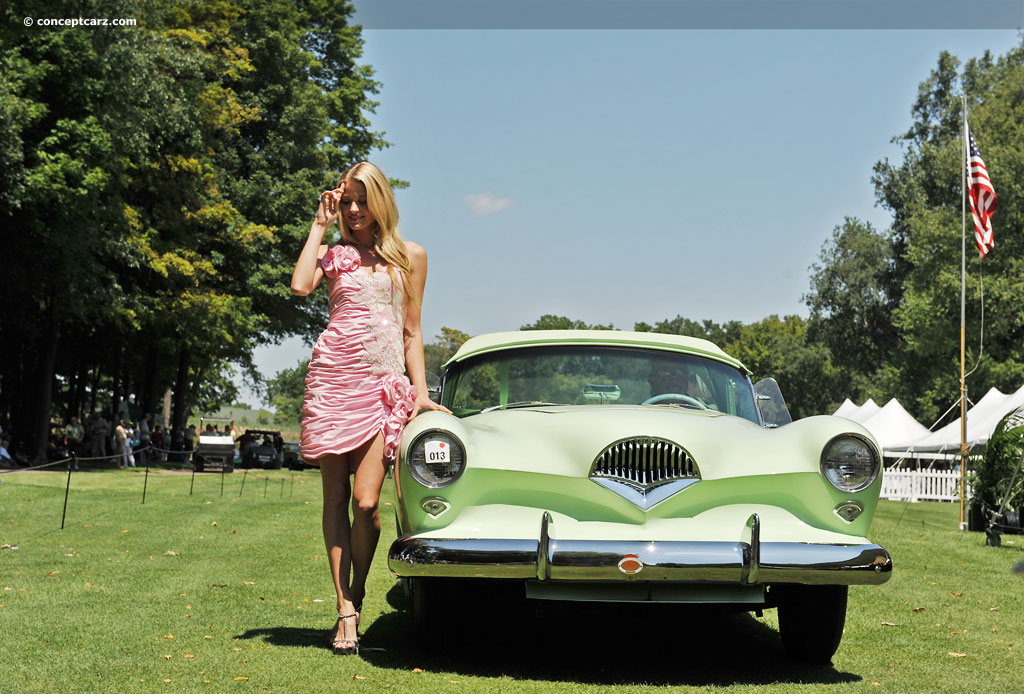
In 1954 (between January and August), the model's only year of production, a mere 435 cars were built in addition to an estimated six pre-production prototypes. These low production numbers were attributed to the nearly $4,000 sticker price, and increasing competition in the sports car market from domestic competitors, GM and Ford, and the numerous (and cheaper) European cars.
Sport Convertible
View info and historyDuring a freak snowstorm, approximately 50 of the cars were destroyed. Darrin purchased these ruined vehicles along with any remaining componentry and materials left in Kaiser facilities and in storage and sold them from his Hollywood, California showroom. It is believed that six examples were given Cadillac Eldorado V8 engines, while many others were tuned with superchargers and multiple carburation. Pilot production on the Darrin commenced in August 1953, and full production began four months later in December. Reception
When the Kaiser-Darrin was introduced, many franchises and dealers had either switched to other automakers or had gone out of business. Consumer confidence in Kaiser's future had evaporated, and few buyers were willing to invest in a Kaiser product. Kaiser's goal of selling 1,000 Darrins a year was unobtainable, and prices were lowered to stimulate sales. With a backlog of unsold cars and the lease on the Jackson, Michigan plant soon to expire, Kaiser stopped production in August 1954.There were many positive and negative aspects of the Kaiser Darrin, with perhaps its biggest Achilles Heel being its $3,670 price tag, making it more expensive than the Cadillac 62 or Lincoln Capri. Its lack of performance was another drawback, but it did have quick steering, excellent brakes, exceptional ride quality (for a sports car), and an exotic fiberglass body and sliding doors. The doors on the early production vehicles tended to jam, however, and the narrow opening made entering or exiting difficult. The jamming issue was resolved by switching to nylon roller bushings, and this fix was retrofitted on earlier cars. The folding top and side curtains leaked, but this was a problem that plagued sports cars of the time, and the heater was inadequate.
by Daniel Vaughan | Nov 2008
Sport Convertible
View info and history
Howard 'Dutch' Darrin was a renowned automotive designer who, along with Thomas Hibbard, established Hibbard & Darrin of Paris during the 1920s. Due to the financial crisis of 1929, it was forced to close. Following a second partnership in Paris, known as Carrosserie Fernandez et Darrin, Howard Darrin returned home in 1937 and settled in Hollywood. With sensuous European curves, low-profile hood, down-swept doors, and the chromed vee'd windshield, his designs became popular with the movie-star elite. By 1940, Darrin-customized Packards appeared in Packard sales literature and were favorites of individuals who wanted something just a bit more unique and distinctive.After World War II, Darin worked with Kaiser-Frazer as a freelance consultant, with his design used on the 1947 Frazer. His relationship with the company was unstable, however, and Darrin became infuriated when his spectacular designs were smoothed over by Kaiser-Frazer stylists. Parting ways with the company, he returned when Frazer asked him to help style the new 1951 Henry J, a small and affordable car. This was a different direction for Kaiser-Frazer, which normally delivered pricey sedans. The designs he penned would remain until the company's demise in 1955. The new styling incorporated unique widows peak to the top of the windshield as well as a Darrin Dip in the rear quarter panel.The Kaiser-Darrin
While working on the Henry J, Darrin also worked on an after-hours project using the short Henry J chassis. It was given unique, sporty styling and Bill Tritt was tasked with crafting the body from fiberglass. The concept was shown to Henry Kaiser, and he was very displeased with the sports car, saying the company wasn't in the sports car business. Darrin believed in the project, having created it in his own time and using his own resources, and told Kaiser that if they would not build it, he would build it himself. According to legend, Mr. Kaiser was joined by his new, younger wife, and her reaction was very different, remarking that it was the most beautiful car she'd ever seen. This convinced Kaiser to change his mind and ordered the production of the Kaiser Darrin. Styling
The Kaiser-Darrin is marked by low sweeping lines, a heart-shaped grille, a 'Darrin dip' behind the sweeping front doors, a split windshield, a three-position Landau top, unique pocket doors that glide forward, and almost disappear inside the front fenders, and open two-seater coachwork. Darrin had promoted sliding doors for decades, claiming they were a safe alternative since the doors did not open into traffic. Its eye-catching design and sporty persona were well-aligned with the numerous European and British sports cars that were vying for ownership from American servicemen returning from overseas duty. Independent Kaiser Motors had enlisted industrial designer Howard 'Dutch' Darrin to produce the fiberglass-bodied sports car based on the company Henry J. economy car. It had an overall length of 184.1 inches and a wheelbase of 100 inches. The first prototype was introduced in 1953 at the New York Auto Show.
Sport Convertible
View info and history
The New York Auto Show prototype car was given a standard Henry J drivetrain. Realizing that more power was needed, Kaiser engineers developed an overhead-valve V8 engine, but abandoned the project due to lack of financial resources required to bring it to production. Seeking alternatives, Darrin approached Oldsmobile in hopes of securing their 303 cubic-inch Rockey V8 engine, but the cost was too high. When Kaiser merged with Willys-Overland to form Willys Motors Incorporated in March 1953, an alternative engine choice presented itself. Although the F-head six-cylinder Willys Hurricane engine produced just six more horsepower than the Kaiser engine, it was more durable and tuneable. The 161 cubic-inch engine produced 90 horsepower and was paired with a three-speed manual transmission with overdrive. The brakes were sourced from the much heavier Kaiser Manhattan.
Sport Convertible
View info and history
The Kaiser Darrin came standard with a tinted windshield, windwings, electric windshield wipers, whitewall tires, and a tachometer.Production
In 1954 (between January and August), the model's only year of production, a mere 435 cars were built in addition to an estimated six pre-production prototypes. These low production numbers were attributed to the nearly $4,000 sticker price, and increasing competition in the sports car market from domestic competitors, GM and Ford, and the numerous (and cheaper) European cars.
Sport Convertible
View info and history
When the Kaiser-Darrin was introduced, many franchises and dealers had either switched to other automakers or had gone out of business. Consumer confidence in Kaiser's future had evaporated, and few buyers were willing to invest in a Kaiser product. Kaiser's goal of selling 1,000 Darrins a year was unobtainable, and prices were lowered to stimulate sales. With a backlog of unsold cars and the lease on the Jackson, Michigan plant soon to expire, Kaiser stopped production in August 1954.There were many positive and negative aspects of the Kaiser Darrin, with perhaps its biggest Achilles Heel being its $3,670 price tag, making it more expensive than the Cadillac 62 or Lincoln Capri. Its lack of performance was another drawback, but it did have quick steering, excellent brakes, exceptional ride quality (for a sports car), and an exotic fiberglass body and sliding doors. The doors on the early production vehicles tended to jam, however, and the narrow opening made entering or exiting difficult. The jamming issue was resolved by switching to nylon roller bushings, and this fix was retrofitted on earlier cars. The folding top and side curtains leaked, but this was a problem that plagued sports cars of the time, and the heater was inadequate.
by Daniel Vaughan | Nov 2008
Related Reading : Kaiser Darrin History
The Kaiser-Frazer Automobile Company introduced the stylish and attractive Darrin roadster in 1954. The company was attempting to revamp its model lineup, and the result was the exciting, image-leading Darrin. The concept of the Kaiser-Darrin roadster was envisioned by famous automotive designer Howard Dutch Darrin. The prototype of the vehicle was built in Santa Monica, CA, at Darrins shop at....
Continue Reading >>
Continue Reading >>
Kaiser
Similar Vehicles
Similarly Sized Vehicles
from 1954


1954 Kaiser Darrin Vehicle Profiles






Recent Vehicle Additions


Performance and Specification Comparison
Price Comparison
$2,400 - $2,450
Darrin Specification Comparison by Year
Year
Production
Wheelbase
Engine
Prices
Related Automotive News

Sliding Doors: 5,800 mile BMW Z1 to be auctioned by Car & Classic
BMW Z1 with just 9,342 kilometres (5,804 miles) for sale by auction on Car %26 Classic
Highly original, and in excellent condition thanks to 30 years of BMW dealership ownership
One of only 8,000 ever made
Auction runs from 01 – 8 October and coul...

The Tammy Allen Collection Consigns Over 80 Vehicles To Barrett-Jackson's Ninth Annual Las Vegas Auction
The collection, which includes over 80 vehicles, will be sold at No Reserve during the 9th Annual Las Vegas Auction at the world-renowned Mandalay Bay Resort and Casino
The vehicles were part of Tammy Allens car museum at Allen Unique Autos,...

Corvette Shines in the Big Apple
All-new Corvette Stingray comes to New York City 60 years to the day after Motorama debut
2013-01-16 Sixty years ago tomorrow, spectators lined New York Citys posh Park Avenue, waiting to get a glimpse of the ground-breaking Chevrolet...

1967 Can-Am Road America: The Beginning of the 'Bruce and Denny Show'
While Formula One will be forever considered the pinnacle of motorsport, from a period between 1966 and 1986 there existed a series that would likely be the closest to anything goes as any motor racing series could truly get. Based upon the FIA Group...

Carroll Shelby, Ford Family for More Than Half a Century
Carroll Shelby was a member of the Ford family for the better part of 60 years, producing stunning performance vehicles from concepts to production models.
He once said his energy and passion for performance products were always strongest when he was...