The stylish 1953 Commander Starliner Coupe was re-christened the Hawk for 1956 and wore the obligatory fins and a forward-thrusting grille. Styled by Loewy staffer Robert Bourke, the Studebaker Corporation underestimated the popularity of the coupe models, resulting in lost sales until production caught up with demand. They would remain in production until the assembly was moved to Canada in 1965.
V8 Hardtop
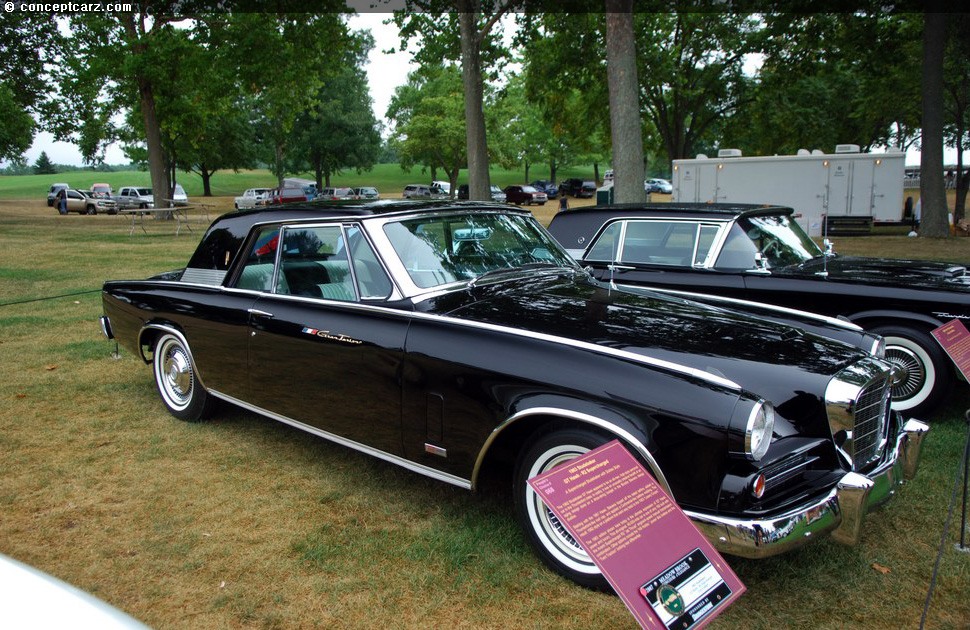
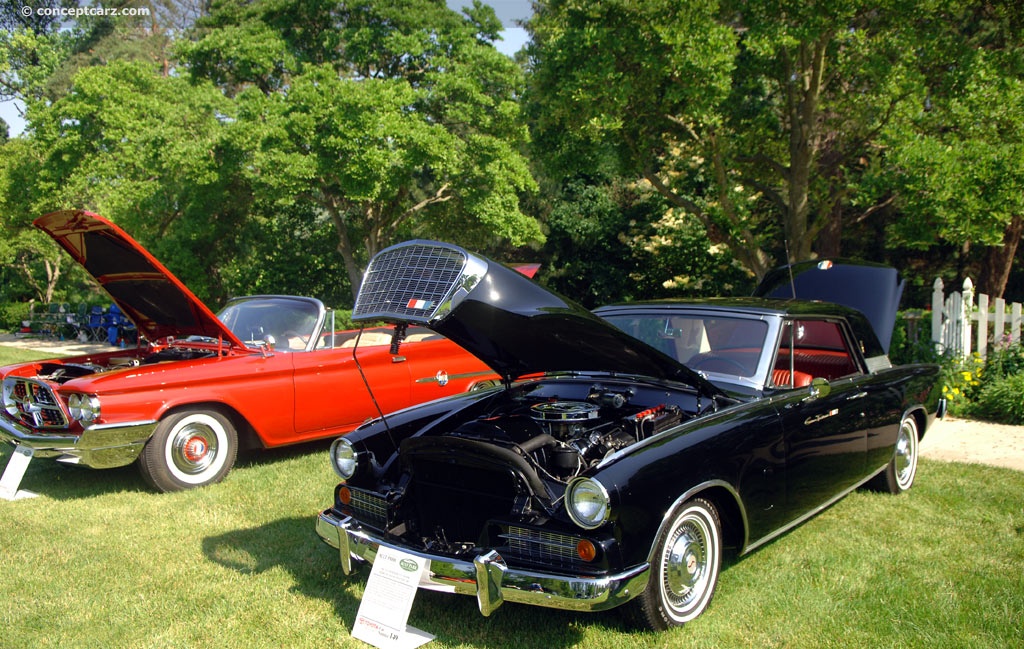
View info and historyThe Studebaker Coupe came in several varieties, including sixes and V-8s, hardtops, and 'post' coupes. Among the early edition was the 1955 President Speedster equipped with an up-rated 289 cubic-inch engine, exclusive colors, and a damascened dashboard with Stewart Warner instruments.All 1956 Studebaker wagon and sedan bodies were restyled with contemporary appearances similar to other American cars. The styling revisions of the coupes, however, focused on the nose and tail. The result was the Studebaker Hawk with a fiberglass fin, a slight bustle trunk lid, and a Mercedes-inspired grille. An array of engines could be installed in the bay, from an L-head six-cylinder up to a 352 cubic-inch Packard V-8. Both the fiberglass fins and the Packard engine were interim solutions, and for 1957 the curvaceous steel fin made its debut. Since the Packard engine had gone out of production, the engines were all Studebaker. By this point in history, the Studebaker V-8 engine had reached its displacement limit, so a McCulloch supercharger was added, resulting in nearly one brake horsepower per cubic inch of displacement.The Gran Turismo was offered in both naturally aspired and supercharged form and a new Super Hawk braking and handling package that included front and rear anti-roll bars, rear radius rods, heavy-duty springs, power steering, and power front disc brakes. The 'Jet Thrust' R-series V-8 engine designed for the Avanti developed 240 horsepower in naturally aspirated R1 configuration or 289 horsepower with the supercharged R2 setup. The limited-production 304.5 cubic-inch R3 V8 powerplant brought horsepower to 335 horsepower.
V8 Hardtop
View info and historyThe Hawk received its most dramatic appearance for 1962 with updates by designer Brooks Stevens, who was working on a shoestring budget as the company's future was surrounded by uncertainty. The Loewy design took on a more formal and modern appearance with reworked roof contours, rounding the rear of the vehicle, and the Mercedes-like grille gaining broad chrome outer moldings. The previous softly arcing roofline was replaced by a more squared-off roof inspired by the Ford Thunderbird. The fin craze of the mid-to-late-1950s and had lost its appeal by the early 1960s, so the car now had a finless rear deck. Although it was an inexpensive facelift, the design appeared completely new, and the new appearance brought about a new name - the Gran Turismo Hawk. The R1 and R2 engines of the Avanti, introduced in 1963, became available as Hawk options. Other features sourced from the Avanti were disc brakes, heavy-duty suspension, and a 160mph speedometer. The new styling received wide acclaim from automotive journalists who praised the Hawk when tested, referring to it as 'a powerful, competent road machine offering European standards of road-holding with American power and quality.'Production of the Gran Turismo Hawk was brief, lasting through the 1964 model year since the Hawk was discontinued after production was moved to Canada. The South Bend plant was closed on December 20, 1963, after 111 years of continuous carriage and automobile production. Production went from a high of nearly 20,000 units in 1957 to 8,388 in 1962 - the year the GT Hawk was introduced. For 1963, Studebaker produced 4,634 examples.
V8 Hardtop
Chassis #: 63V13414
View info and history
Auction entries : 1The base price of the Gran Turismo Hawk was $3,095 before options. Andy Granatelli took a fleet of Studebakers to Bonneville in 1962 and 1963, where they broke over 337 national speed records with R series cars. Paula Murphy drove a prototype 1964 R3 GT Hawk in October 1963 to a top speed of 1954 mph.
by Daniel Vaughan | May 2021
V8 Hardtop
View info and history
V8 Hardtop
View info and history
V8 Hardtop
Chassis #: 63V13414
View info and history
Auction entries : 1
by Daniel Vaughan | May 2021
Related Reading : Studebaker Gran Turismo Hawk History
From 1962 through 1964 Studebaker produced the Gran Turismo Hawk, also known as the GT Hawk. The GT Hawk was an iteration of the Hawk series which had begun with the Golden Hawk in 1956. The styling was performed by Brooks Stevens using the prior Hawk cars as a starting point. The hood was retained while the radiator and grille borrowed inspiration from Mercedes-Benz. The GT Hawks was a marriage of....
Continue Reading >>
Continue Reading >>
Similarly Sized Vehicles
from 1963
Similarly Priced Vehicles


1963 Studebaker Gran Turismo Hawk Vehicle Profiles



Recent Vehicle Additions


Performance and Specification Comparison
Price Comparison
$2,445 - $2,840
$4,440
Gran Turismo Hawk Specification Comparison by Year
Year
Production
Wheelbase
Engine
Prices
9,335
120.50 in.
6 cyl., 169.60 CID., 112.00hp
8 cyl., 259.20 CID., 180.00hp
8 cyl., 289.00 CID., 210.00hp
8 cyl., 259.20 CID., 180.00hp
8 cyl., 289.00 CID., 210.00hp
$3,100 - $3,100
4,634
120.50 in.
8 cyl., 289.01 CID., 175.00hp
8 cyl., 259.23 CID., 180.00hp
8 cyl., 289.00 CID., 210.00hp
8 cyl., 289.00 CID.
8 cyl., 259.23 CID., 180.00hp
8 cyl., 289.00 CID., 210.00hp
8 cyl., 289.00 CID.
$3,095 - $3,095
109.00 in.
6 cyl., 169.60 CID., 112.00hp
8 cyl., 259.20 CID., 180.00hp
8 cyl., 289.00 CID., 210.00hp
8 cyl., 289.00 CID., 240.00hp
8 cyl., 289.00 CID., 290.00hp
8 cyl., 259.20 CID., 180.00hp
8 cyl., 289.00 CID., 210.00hp
8 cyl., 289.00 CID., 240.00hp
8 cyl., 289.00 CID., 290.00hp
$2,960 - $2,960
Related Automotive News

World Debuts, Performance Hypercars From Across The Globe And Immersive Game Changers Grace Michelin Stand At Goodwood
Global reveals of the Noble M500 and Vazirani Automotive Shul on the Michelin Main Stand
French supercar Prato ORAGE will be presented for the first time on British soil alongside compatriot Genty AKYLONE
Elegant, rare art-deco Eadon Green Zeclat...

Driving Impressions: 2018 ELANTRA GT A/T
Adopt a title and youre expected to live up to it. Adding GT or Gran Turismo to your name puts you in rarified company. The descriptor suggests a high-performance luxury two or four seater capable of transporting its occupants in comfort over long...

CHEVROLET TO SHOW CHAPARRAL VISION GRAN TURISMO CONCEPT
Boundary-pushing, Chevy-powered race cars changed motorsports design
DETROIT – When racers Jim Hall and Hap Sharp founded Chaparral Cars in 1962, few could have guessed how they would shake up the conformities of the racing world – and...

Raw Power Has a Stamp of Its Own Muscle Cars Roar at Spring Classic Auction
What do you get when you bring the U.S. Postal Service and Dana Mecums Original Spring Classic Auction together at the State Fairgrounds — a Muscle Car Extravaganza!
Since it began 26 years ago, Mecums Spring Classic auction in Indianapolis...

RICHARD PETTY DEDICATES MUSCLE CARS FOREVER STAMPS
Raw power gets a stamp of its own today as seven-time NASCAR National Champion Richard Petty helps dedicate the America on the Move Muscle Cars Forever stamps.
Petty, his son Kyle and Postmaster General Patrick Donahoe will dedicate the limited-edition...