
Targa Coupe
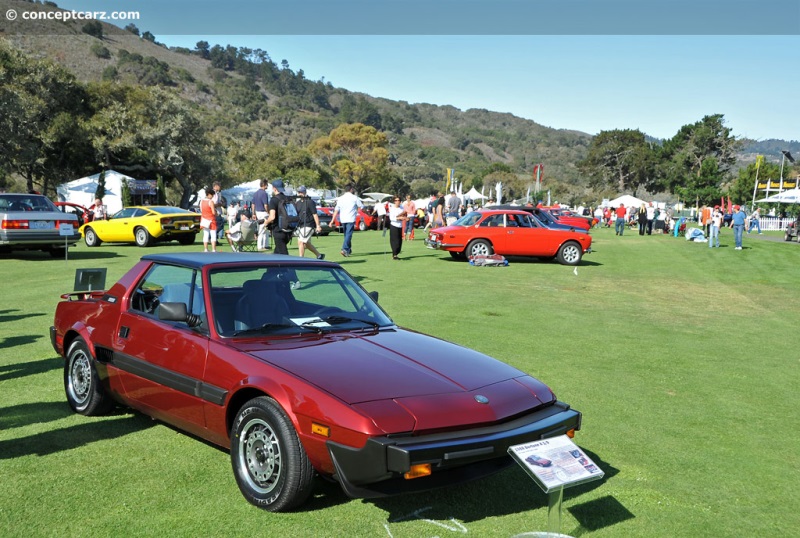
The Fiat X1/9 was produced from 1972 through 1988. This mid-engined sports car was designed by Marcello Gandini of Bertone, an individual who had designed many reputable vehicles, including Lamborghini. The mechanical components of the Fiat 128 were used to establish a rolling chassis. The Fiat 128 was a front-wheel-drive vehicle and the X1/9 was a mid-engined vehicle meaning the entire drivetrain was relocated. Once the chassis, drivetrain, and suspension were in place, Gandini began creating a two-seater design. The result featured many sharp edges, similar in ways to some of the prior Bertone-designed vehicles. The headlights would pop up when in use and disappear when not needed. The roof panel was removable and could be stowed in the front of the car under the hood. The name X1/9 was derived from the company's internal codenaming structure, 'X1/number'. The code name persisted to production. It was shown in concept form at multiple auto shows where the public strongly requested that it be put into production. Almost immediately, Bertone's factory began the production of the Fiat, although in some markets, the later models were badged as Bertone.The beautiful, sporty styling of the X1/9 was unmatched by its performance. Housed in the engine bay was a 1300cc SOHC engine with an aluminum head and 75 horsepower. Coupled with a heavy body shell, the X1/9 had less than desirable performance. The body shell was heavy because it was strong and stable, built to satisfy United States crash test requirements. On a positive note, more powerful engines could be installed in the X1/9, and the shell would not require additional modifications to handle the extra power. As emission and safety requirements in the United States escalated, the power in the Fiat, and other marques, declined. A 1500 cc engine was added, and horsepower power rose to 85. Though it produced ten extra horsepower over the 1300 cc engine, it was also heavier, meaning performance never really increased.
1983 was the last year that Fiat exported cars to the United States. After 1983 the X1/9 was available but through the Bertone nameplate. Malcolm Bricklin handled the Bertone importations. The car was equipped with a Targa top, AM/FM stereo radio with cassette player, power windows, tinted glass, air conditioning, electric rear-window defroster, dual luggage compartments, and a digital clock with a stopwatch.The final version of the Fiat X1/9 was produced in 1988. A special 'Gran Finale' edition, produced in 1988, was a dealer option that included a rear spoiler and Gran Finale badges. With production lasting over ten years, the popularity of the X1/9 is undeniable. It was plagued with growing pains, but they were more inherent in the small car design and having to comply with US regulations. At one point, Fiat even considered using the X1/9 as a rally car but used the Lancia Stratos instead.
By Daniel Vaughan | Jun 2006
The X1/9 was a small, sporty car that often gave its owners problems. The engine bay was tight, making maintenance difficult. Minor problems often went un-serviced, which resulted in greater problems. Rusting was another issue, more prevalent in the earlier models. The transmission was unreliable, and the reverse gear was reported to wear out rather quickly. Despite these and other problems, the X1/9 was a fun car to drive that offered its drivers excellent handling and 'peppy' performance. A popular way to introduce more power was to transplant a 2-liter Lancia engine, resulting in a significant improvement in performance.
By Daniel Vaughan | Jun 2006
Earning its status in automotive history, not many sports cars have endured as long as the X1/9 without many major styling or mechanical changes during its 16-year production run. In 1981 the X1/9 was nominated by Road & Track magazine as one of the ten best sports cars. The X1/9 can transform from coupé to spider with the release of the hard-top roof. Claiming that the X1/9 drove like a Formula One car, Emerson Fittipaldi test-drove the car for Quattroruote magazine. Desiring to fill a gap in their new front-wheel drive family, Fiat decided to create a new sports car, despite the current success of their 850 Spider. Bertone designers in Italy were currently producing mid-engined designs for Lamborghini, so they used their knowledge and assembled a design that involved moving Fiat's entire FWD transverse engine set-up to the rear end of a sports car. In 1969 Fiat debuted a special show car called the Autobianchi Runabout that was inspired by speedboats of the era and styled by Bertone under chief designer Marcello Gandini. The Runabout's power came from the Autobianchi A112's engine. Everyone loved the wedge-shaped power boat-looking Runabout, so Fiat began work on a mid-engined replacement for the rear-engine 850 Spider. Many aesthetic features from the Runabout, like the wedge shape with prominent C pillar roll-over hood and the car-length indented plimsoll-line, the long flat hood with central indentation and the large front overhand all made their way to the X1/9.During the early development of the new car, it was given 'X1/9' as a code name, but strangely enough, the name stuck. At the time Fiat's marketing nomenclature used a numerical system denoting positions in the range. X1 was used as Fiat's prototype coding for commercial vehicles, and the 9 stood for the ninth passenger vehicle using this classification. Late in 1972, as a 1973 model, the X1/9 was introduced to the public. Bertone did an excellent job fitting as much as he could into such a compact car, and the styling was considered exceptionally modern for the time. It featured a strong chassis with most of the strength in the floor, with box section sills beneath the doors and the central tunnel. Due to the impending stricter U.S. crash standard, the chassis was more rigid and heavier than needed. The U.S. standards never actually went through but the design of the car was too far-gone for any revisions.
The two-seater X1/9 featured sharp-edged styling and distinctive pop-up headlights. The X1/9 was a 'corporate kit car' like the Lotus Europa and the VW-Porsche 914 with two-seat sports bodywork over a rearranged group of mechanisms. A wonder of efficiency in its small wedge-like styling, the X1/9 featured impressively adequate cabin space that was tight but well thought out. There was even room for two trunks, one in the front of the car, and the second behind the engine. Early models rear trunk came with very little insulation from the heat of the engine and the muffler so one had to take care with what they stowed in there. The car had a Targa-style light-off roof panel above the cockpit that could be stowed in the front trunk. A top constructed of lightweight clear-smoked polycarbonate was offered by an aftermarket company.Developed for release for European sales in 1972, the intent was to replace the 850 Spider by Bertone. The X1/9 was never intended to take over the 124 Sport Spider's market and for most of the X1/9's production span the two cars ran parallel. Bertone's Turin factory produced the car's monocoque body before it was shipped to the Fiat Lingotto factory for final assembly. Priced slightly high for the time, the X1/9 cost almost as much as a Volvo 144, but the motoring press absolutely loved the mid-engine sports car. In the U.S., there were three different generations of the X1/9: 1974, 1975 through 1978, and 1979 through 1987. The Fiat X1/9 debuted to the American market in 1974 and had very few changes from the European model except for a lit bit bigger horns on the bumpers. The first generation looked very similar to other worldwide models and featured a 4-speed transmission, 1290 cc engine, and small bumpers. From 1975 through 1978, U.S. cars received 'ladder-style' impact absorbing bumpers at the front and rear. The meet U.S. regulations the car was fitted with exhaust gas recirculation valves, air pumps, and an activated charcoal system and was rated at 63HP. The following year the strict U.S. emission regulations brought a variety of engine changes. The car was held back by U.S. emission controls and the extra weight of federally required safety gear that included crash bumpers. Despite the loss of power, the U.S. X1/9 did really well in the American market. The 'Serie Speciale I' was introduced in 1976 and was characterized by a 'ladder pattern' décor alongside a large PU-plastic front spoiler. On the inside was a sporty new striped design fabric and higher back seats. In 1976 Fiat began to market a right-hand variant to the U.K. At the time, only around 30 models had been converted by Radbourne Racing to right hand drive. The last of the 1300 series was the 'Lido' which was introduced in 1978. The Lido model only came in black and featured a black-and-white theme with chromed bumpers and a white interior. In the same year the X 1/9 'Five-Speed' debuted at the 1978 'Autosalon Birmingham'. The introduction of the five-speed was considered by some to be the most significant change in the history of the Fiat car. It brought with it the Fiat Ritmo/Strada known power train that consisted of the 1498 cc engine that produced 86 HP and the 5-speed transmission. On the outside was new large allow bumpers in the full width of the car with a higher engine lid for the new higher engine. The inside also underwent a makeover that included a new dash and seats.
Sales of both the X1/9 and the 124 Spider had fallen so drastically due to quality control issues and the high rust issue for Fiat cars. Fiat removed themselves from the sports-car business and removed their presence from the U.S. in 1982. After turning over marketing and support of the car to International Automobile Importers, Inc., managed by Malcolm Bricklin, it was arranged for Bertone to take over the complete manufacturing and marketing of the Fiat X1/9. Because of this transition, numerous 'special editions' have been produced over the years. Bertone took over from 1982 until 1989 shortly after the introduction of the 1500 model and models were badged as the Bertone X1/9. Bertone models redesigned the footwells to give more legroom and sitting comfort to taller occupants. Other luxury features like power windows, leather seats, and air conditioning were improvements added by Bertone. Prices rose to around $14,000 during the mid-1980s. The Bertone X1/9 'IN' was unveiled to the market in the spring of '82. Featuring two-tone paintwork and the 'IN' décor on the roll-bar, the inside also sports better quality fabric and bright red carpeting. For 1983 new two-tone paint schemes were available with the paint line halfway up the wheel arches. They also produced rust protection and added a modernized electrical system for 1984 models with GBC fused replaced by AGC fuses in a modern fuse and the relay center placed under the dash below the glove box. The Bertone 'VS' model replaced the 'IN' model in the spring of 1983. The only big revision was the new Speedline SL 082 rims. The roll-bar décor now said 'X 1-9' vertically and the new color scheme was metallic Charcoal #900. This model was produced through 1987. In the spring of '84 the 'S' model was introduced with new color schemes where the vertical divider between the two colors was moved up to right below the window line. Another update included mirrors on both sides now. 1984 was also the first year for 'Trons' Cromodora CD-179 wheels. The following year bumper and sail panel molding was updated from natural aluminum to flat black. Introduced in the spring of 1985 was the 'Sunshine' model which featured slight changes in equipment and new materials on the inside, different rims and new color schemes. The new 'S' model was re-introduced in the spring of '86 with sideskirts and Speedline SP 116A rims with 185/60x13 low-profile tires. The engine lid was now sporting the body color rather than the normal black. Two variants were offered, a carb' model and an injection model. In 1986 the CHMSL or Center High Mounted Stop Light was placed in the rear window right below the Targa bar in compliance with federal mandates. A fully padded steering wheel as well as cosmetic changes to climate controls were updates for the 1987 model year. The final official series to be introduced to the continental European market was the Bertone X1/9 1500 'Special Edition'. The series was built n 1985 through 1986 as U.S. models, and for the European markets from 1988 through 1989.During the spring of 1987, the final Fiat X1/9 model to grace the British automotive market was the 'Gran Finale'. Produced for just one year, the Gran Finale had a carb' engine, a rear spoiler and rims that were no longer black. The car was available in two colors: Mica Red or Mica Blue. Standard on the Gran Finale was the Alcantara fabric interior and air conditioning.The first X1/9 racecar, the Filipinetti X1/0 of Scuderia Filipinetti, debuted at the Geneva Motor show in March of 1973. It was created in collaboration with Fiat and Mike Parkes; a racer and technician who would later create the Lancia Stratos. Powered by a 1290 cc engine with Lucas mechanical fuel injection, the Filipinetti pumped out 160hp at 8600 rpm and had a top speed of 130 mph.Also introduced in 1973 was the Abarth X1/9 Prototipo from Fiat subsidiary Abarth. The Prototipo was intended to replace the 124 Spider Abarth as Fiat's chief rally vehicle though the parallel 131 Abarth project was chosen instead as the main rally competition platform. An 1840 cc engine with a custom 16v cylinder head fed by twin 44 mm Weber IDF carbs was the muscle behind the Prototipo. Sporting the customary Abarth lime-green/yellow and orange/pink colors that X1/9 Prototipos featured flared wheel-arches that hid the wide 235/5x13 tires, and a small 'duck tail' spoiler. To feed the carbs cool air from above the roof was an F1-style air intake that was created to feed the carburetor. Since this model was a prototype, there is no way to tell how many exact cars were produced though it is believed that five genuine models were created. As part of the development process, components and whole body-shells were often swapped and replaced. Debuting on the 'Salon Automobile de Bruxelles' in 1975 was the Fiat 'X 1/9 Corsa'. Fiat proposed a very limited edition series for the European market. The Corsa sported a large spoiler on the rear trunk, widened wings, magnesium rims with the Bertone logo and hardtop in the body color. Emblazoned on the door was 'X 1/9 CORSA in all caps, and smaller capitals were written 'FIAT BERTONE'. In spite of the sport race design of the Corsa, the car was equipped as the standard series. Believing that the Turin Company had the answer to the racecar market, Dallara chose to enter the X1/9 in 1975 to enter the World Championship for Makes in the Group 5 Special Production class. Sporting an updated X1/9 engine with a custom 16v cylinder head, the X1/9 was dubbed the Dallara 'Icsunonove'. Dallara was an internationally known engineer that chose the Fiat X1/9 based on its design and economic features. The X1/9 Dallara featured body alterations that included an oversized rear wing and huge flared wheel arches, and fundamental suspension. The interior sported a brand new safety feature: fire-retardant material upholstery that was the same found on Formula 1 driver's suits. A company based in England called the Faran Car Co. Ltd. featured D-I-Y kit and in-house assembled options for their Eliminator kit. The design came with front and rear integrated bumper sections and replacement fiberglass moldings for both the front and rear wings. Similar to a style found on a De Tomaso Pantera, the outside of the kit included side sill skirts and a rear trunk spoiler. The Faran Company also had conversions available that used Lancia or Fiat Twin Cam engine units, though some owners preferred to keep the old SOHC setup. A factory fire shut down production of the Faran kits. Competing with the Faran version was a full kit produced by Eurosport Ltd., an X1/9 parts specialist. Two kit variants were produced commonly by the Company and referred to as full and bolt-on kits. The full kit used wide replacement fiberglass moldings for the front and rear wings and front and rear integrated bumper sections. Testarossa-style side air intake molding was housed ahead of the rear wheels in the stylish side skirts. Bolt-on kit included side sill skirts and replacement front and rear integrated bumper sections that were molded to merge nicely with the standard wings, which allowed the 1500 alloy bumpers to be easily substituted and give a more modern look. Today both of these kits are still available.The Schult conversion kit was manufactured in Germany and featured more angular lines. Sources:
http://en.wikipedia.org/wiki/Fiat_X1/9
http://auto.howstuffworks.com/fiat-sports-cars2.htm
http://www.sportsvogn.no/x19reg/story.html
http://www.x19performance.com/page4.php
http://www.laursen-online.dk/x1-9/gallery-uk/
By Jessica Donaldson
Taking corners as if it was on rails, the X1/9 didn't have any sway bars and didn't really need any. The suspension layout was all independent and came with compact coil-sprung Macpherson struts in the front and Chapman struts at the back, while other small sports cars of the time had solid rear axles or swing axles. The all-new 128 SOHC engine and gearbox were designed from the front-wheel drive Fiat 128. Directly behind the seats was the fuel tank and spare wheel side by side ahead of the engine, which further optimized the weight distribution.
In 1980 Fiat substituted the 1498-cc engine from the Ritmo/Strada sedan and got rid of the original 4-speed transaxle for a 5-speed transmission. U.S. cars kept the previous emission controls. In '81 Bosch L-Jetronic fuel injection took the place of the earlier Weber carburetor. U.S. X1/9 models underwent exterior and interior updates that included a new front grille and airdam and integrated bumpers front and rear. A redesign of the dash and instrument panel relocated the heating and ventilation controls from the center console to the main dash. The radio was moved to the center dash area, the glove box was moved to the top of the dash and fuse panel went from the spot above the driver's left knee to the area above the passenger's footwell where the glove box had been.
http://en.wikipedia.org/wiki/Fiat_X1/9
http://auto.howstuffworks.com/fiat-sports-cars2.htm
http://www.sportsvogn.no/x19reg/story.html
http://www.x19performance.com/page4.php
http://www.laursen-online.dk/x1-9/gallery-uk/
By Jessica Donaldson
Similarly Sized Vehicles
from 1988
Fiat Monthly Sales Volume
March 2023
138


1988 Bertone X1/9 Vehicle Profiles
Recent Vehicle Additions


Performance and Specification Comparison
Price Comparison
X 1/9 Specification Comparison by Year
Year
Production
Wheelbase
Engine
Prices
Related Automotive News

A Revolution In Shapes And Colours With The 33 Stradale, Carabo And Montreal
The design of the Tipo 33 sprang from the competitive spirit that enlivens each Alfa Romeo creation
That same spirit has resulted in so many racing wins and has breathed life into two non-identical twins the 33 Stradale and the Carabo
Designed...

Monterey Car Week. Promises Delivered.
BMW Unveils Production BMW M8 Coupe, M8 Convertible and M850i Gran Coupe.
North American Premieres of the BMW Vision M NEXT and Long Lost BMW Garmisch Recreation.
Pebble Beach, CA – August 15, 2019… On the occasion of the Monterey Car Week...

Lamborghini Miura Celebrated In A Dedicated Class At The 59Th Pebble Beach Concours d'Elegance
SantAgata Bolognese, 12 August 2019 – The Pebble Beach Concours dElegance, established in 1950, is the one of the most renowned classic car shows in the world, and every year the selection of cars for display is very severe, because only the...

Maserati At The 2018 Auto e Moto d’Epoca Show In Padua
Three iconic cars on display on the Maserati stand
Tipo 420M-58 – Eldorado, Merak SS and Khamsin
The Brands current range represented by the Maserati Levante S GranSport MY19
Modena, 25 October 2018 - Maserati is exhibiting at the Auto e...

THE LAMBORGHINI MIURA CELEBRATES ITS 50TH ANNIVERSARY ON THE ROADS OF 'THE ITALIAN JOB'
SantAgata Bolognese, 20 May 2016 - As part of celebrations commemorating the 50th anniversary of the Miura, Automobili Lamborghini has sent two Miuras from its Museum down the route used in the film, The Italian Job, directed by Peter Collinson....