1979 Matra Murena
1979 Matra Murena Navigation
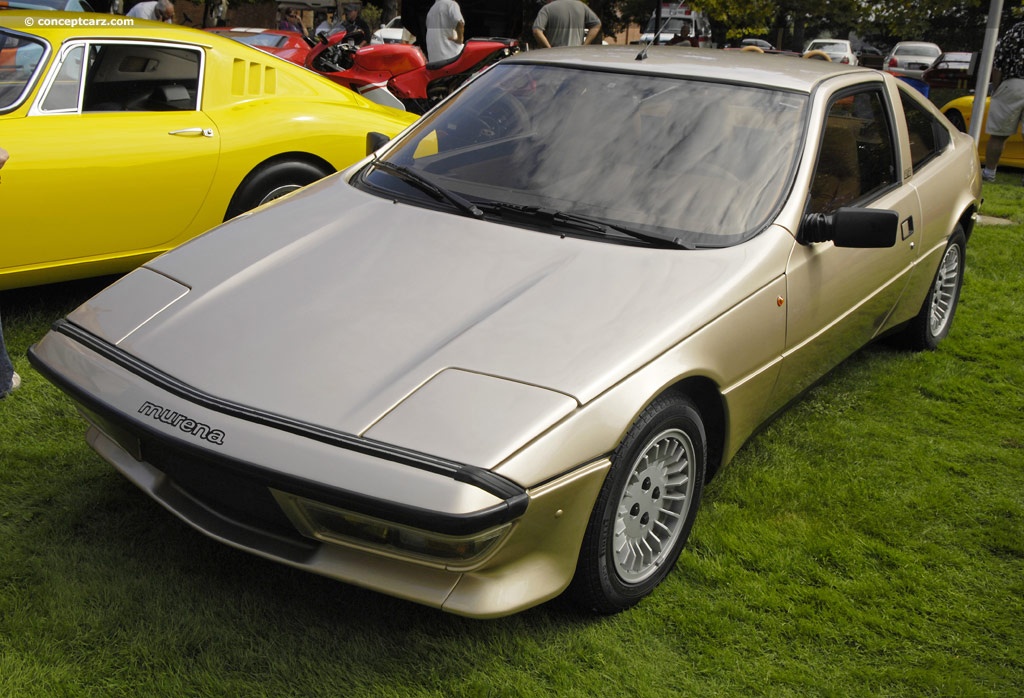
The Matra Murena, also called the Talbot Matra Murena, was produced from 1980 through 1983. It was produced by the French engineering group Matra in cooperation with automaker Simca. Simca became part of PSA in 1979 and was re-branded to Talbot. Thus, the car was marketed as Talbot Matra Murena.The mid-engined sports car was powered by a larger version of the Simca Type 315 engine found in the Bagheera. The overhead valve four-cylinder unit displaced 1.6 liters. A larger and more powerful 2.2-liter unit from the modern Simca Type 180 engine was available with the 'S-kit' upgrade. This was originally a dealer-installed option that was later offered directly from the factory.The styling of the 3-door hatchback Murena was sleek and aerodynamic. The seating was unique, with all three seats placed in one row, with the middle seating able to fold down, becoming an armrest.
By Daniel Vaughan | Oct 2009
The Matra Murena was discontinued in 1983.
By Daniel Vaughan | Oct 2009
PSA chose to create a whole new brand for the entity, basing it all on the Talbot sports car last seen in the 1950, produced by the Rootes Group. Continued until 1986, the Simca range would be sold under the Talbot badge before the Talbot name was put on a back burner once again. During the 1960s, Chrysler was seeking to become the world producer of vehicles. The Matra Murena was developed in cooperation with the automaker Simca. In 1979 Simca as a part of Chrysler Europe and were taken over by PSA. The Simca cars were re-branded to Talbot in 1979, and the car was marketed as Talbot Matra Murena. Considered by some enthusiasts to be one of the most beautiful vehicles ever produced, the Talbot Matra Murena was debuted in 1981. A 3-seat sports vehicle, the Murena featured a mid-engine design that featured a 1594cc ex-Solara engine and an optional 2.2-liter from the Tagora. The Murena featured an even more aerodynamic body and a bigger engine than the previous model. Two versions were produced, a 1.6 and a 2.2. The engine for the 1.6 came from the Talbot Alpine/Solara range while the 2.2 engine was the one used in the Talbot Tagora.Produced until 1983 in the UK, the Murena was offered with an after-market turbocharger. The Matra was produced in France; officially the French Republic, by a company that covered a wide range of products that included bicycles, automobiles, aeronautics, and weapons.
In September 1980, the Murena was launched alongside the all-new Tagora. Journalists clamored for more of a view of this beautiful car, but they wouldn't see more until the spring of the following year. Both the styling and the accommodation factor were largely praised by journalists, but the cost and the performance were in question in the beginning. Many felt that the Matra Murena was 'simply not fast enough,' even though it offered 118bhp in 2.2-liter form. The price of the Murena wasn't extremely popular as comparable coupes; Alfasud Scirocco and Sprint were much cheaper, while similarly priced cars like the Alpine-Renault A310 and the Porsche 924 had much more impressive speeds.Different from its predecessor was the engine selection, as the base version employed a larger version of the Simca Type 315. Commonly known as the Simca 1100 engine, the Type 31 was a straight-4 overhead valve engine that was developed by Simca for use in its Supermini cars and economy vehicles. The Murena was actually the first mass-produced vehicle to undergo a now completely warm galvanized from the factory. The body was then riveted or bonded into place, which produced a very long-lasting car, eliminating the tendency to rust like its predecessor the Matra Simca Bagheera, this was also backed up with a six-year anti-corrosion warranty. Sleek and stylish, the body was made with a steel spaceframe that was fitted with ultra-lightweight fiberglass-polyester panels.The rear suspension was comprised of MacPherson struts, and at the front, the Alpine/Solara's torsion bar setup was utilized. Both the 1529cc version and the 2156cc version came with five-speed gearboxes as standard.The Murena was available with two different engine sizes, a 1.6-liter or the larger 2.2-liter. After facing criticism from stinging journalist comments, Matra developed an uprated Murena 4S model which featured a clever 16-valve head that upped the max power to 180 bhp, based on the standard 2.2-liter model. The Murena 4S had a top speed of 140hp and came with an impressive body kit that included wider wheel arches and spoilers, front and rear, and an aluminum targa-top. Unfortunately, Peugeot management wouldn't approve of the 4S for production. A dealer-install 'S-kit' was also available with a powerful 142 hp. SAIER was a German kit-car that was a very accurate BMW-M1 replica based on the Murena. It was so accurate to detail that BMW sued them and enforced changes to the production.
By Jessica Donaldson
The Matra Murena replaced the Matra Bagheera; a sports car created by the France engineering group. During development, the Murena was referred to as project 'M551' and employed the base Bageera structure. Substantial changes were made to address several of the concerns regarding the previous model. The Murena still featured a steel spaceframe with body panels that were constructed of fiberglass polyester. The Murena was the first production vehicle that used galvanized steel for all chassis parts. Mated with composite panels, the Murena was now essentially immune to rust, except for the rear trailing arm. The Matra Murena also received the Bageera's mid-engined layout along wit the sleek hatchback. The three seats were also carried over from the previous model, a unique feature, all three seats were placed in one row, with the middle seat folding down to become an armrest.
Matra had only one production line that was capable of producing the Murena due to the galvanization process, which resulted in a lower level of production. In December 1983, the final Murena was rolled out of the factory. Following this, the production line was converted to produce the P18, or better known as the Renault Espace. In 1983 the Matra Murena was discontinued at the time when the Matra factory in Romorantin switched to production of the Renault Espace, a large MPV from Renault. The first three generations were manufactured by Matra, though sold under the Renault brand. A total of 10,680 Matra Murena's were produced during its production period, 5,640 Murena 1.6's, 4,560 Murena 2.2s, and 480 Murena 'S type' 142cv's.
- 1979 Matra Murena Menu
- Article
- Image gallery
- Specifications
Matra
Similarly Sized Vehicles
from 1979


Recent Vehicle Additions


Performance and Specification Comparison
Related Automotive News

Alfa Romeo 4C and 4C Spider Add More Personalization Options for 2016, Further Amplifying the Groundbreaking Theme of Advanced Technology, Race-inspired Performance and Seductive Italian Style
New for 2016, Alfa Romeo is offering even more carbon fiber All-new carbon fiber halo offering elevates the 4C Spiders technical look, while hinting at its exclusive carbon-fiber monocoque chassis
All-new Carbon Fiber Trim Package further prolif...

ALL-NEW 2015 ALFA ROMEO 4C SPIDER PRICING ANNOUNCED
All-new 2015 Alfa Romeo 4C Spider Delivers Race-inspired Performance, Advanced Technologies, Seductive Italian Style, and Now an Even More Exhilarating Driving Experience With Open-air Freedom
All-new Alfa Romeo 4C Spiders open-air performance ****...

World-premiere: All-new 2015 Alfa Romeo 4C Spider Delivers Race-inspired Performance, Advanced Technologies, Seductive Italian Style, and now an Even More Exhilarating Driving Experience With Open-air Freedom
Production version of the all-new 2015 Alfa Romeo 4C Spider, revealed at the 2015 North American International Auto Show, will arrive at dealerships this summer All-new 2015 Alfa Romeo 4C Spiders open-air performance cockpit and mid-engine propo...

All-new Alfa Romeo 4C Debuts at the 2014 New York Auto Show, Marks the Iconic Italian Brand's Return to North America
2014 New York Auto Show debut of all-new 2015 Alfa Romeo 4C coupe and limited-edition 4C Launch Edition marks the Italian sports car brands return to the North American market
Mid-engine proportions and inspiration from the brands racing traditio...

MIKE RYAN'S BANKS SUPER-TURBO PIKES PEAK FREIGHTLINER A UNIQUE BIG ONE TO WATCH IN PIKES PEAK OPEN DIVISION
Colorado Springs, June 20--------The Freightliner Cascadia Pikes Peak Special racing machine of Mike Ryan (Santa Clara, CA) is truly like no other entry in the Pikes Peak Open division during the 91st edition of the Pikes Peak International Hill...