With an 11th-place finish at the 1911 Indianapolis 500, Harry Clayton Stutz's first car finished 11th despite numerous stops for fresh tires. It had been built in just five weeks, and its success prompted its creator to establish the Ideal Motor Car Company to manufacture the 'Car That Made Good In A Day.'
Close Coupled Touring
Chassis #: G2851
Engine #: G2851
View info and history
Auction entries : 2Although the horseless carriage was still in its infancy, Ohio-born Harry Stutz had become an expert on this new technology through various jobs within the Indianapolis automobile industry. He came up with a design for a rear transaxle transmission, which was built from 1910 by his Stutz Auto Parts Company. A year later, he had built his first automobile and outpaced many of the established marques at Indy, demonstrating his engineering skills and the extent of his ambition.Using proprietary Wisconsin engines and Stutz's own rear three-speed transaxle, the early Stutz models were closely based on the Indianapolis car. The Wisconsin engine had a twin-camshaft 'T-head' design, with inlet valves on one side of the block and exhausts on the other, a 6.4-liter displacement size, and produced 50 horsepower. Wisconsin engines would power Stutz automobiles up to 1917 when Stutz began to manufacture its own power units. A 60hp six-cylinder model joined Stutz's model line in 1912 and the famous Bearcat body style was available on both chassis. The Bearcat was responsible for much of Stutz's reputation and its legacy, and was one of the first true sports cars. Devoid of all but the bare essentials, the Bearcat sacrificed comfort and weather protection for low weight and enviable speed. The competition success ensured the company enjoyed a disproportionately high-profile reputation. Stutz placed 3rd in 1913 at the Indianapolis 500, and its famous 'White Squadron' of racing cars earned many victories in 1915, including at Elgin, Point Loma, and Sheepshead Bay. That year, they placed 3rd, 4th, and 7th at Indy. Cannon Ball Baker proved the Bearcat's durability in 1915 when he took a stock example on a record-breaking cross-country run, shattering the existing record and making the crossing in 11 days, seven-and-a-half hours. The only damage that occurred during this grueling challenge amounted to one broken shock absorber clip. Astonishing accomplishments such as this led to the nickname 'The Sturdy Stutz.'
Close Coupled Touring
Chassis #: G2851
Engine #: G2851
View info and history
Auction entries : 2The Bearcat remained part of the Stutz portfolio until the end of 1924 when the installation of Frederick E. Moskovics as company president marked a change of emphasis. Going forward, the company contested the luxury end of the market. The Bearcat could be specified with either four- or six-cylinder engines, and was offered in four colors of Yellow, Mercedes Red, Vermilion, or Monitor Grey.
Most of the Stutz automobiles built in the 1910s and early 1920s used either a 120- or 130-inch wheelbase. Stutz's, built from 1917 to 1912, rested on a 130-inch wheelbase, with few exceptions, including the Bearcat, which used the shorter 120-inch platform. The suspension was via semi-elliptic leaf springs and braking was by rear drums with twin expanding shoes. The 389 cubic-inch T-head 16-valve inline four-cylinder was paired with a three-speed manual transaxle and produced approximately 80 horsepower.
The minimalistic Bearcat was priced at $2,750, the same price as the roadster. A close-coupled four-passenger touring and a six-passenger tourer were approximately $100 higher.
by Daniel Vaughan | Dec 2023
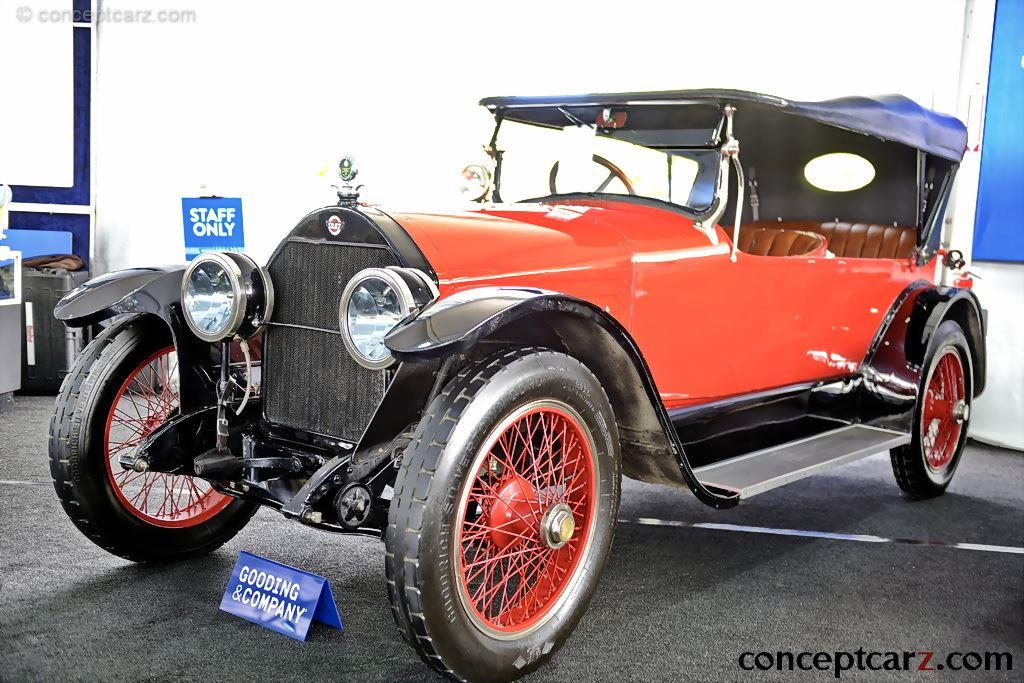
Close Coupled Touring
Chassis #: G2851
Engine #: G2851
View info and history
Auction entries : 2
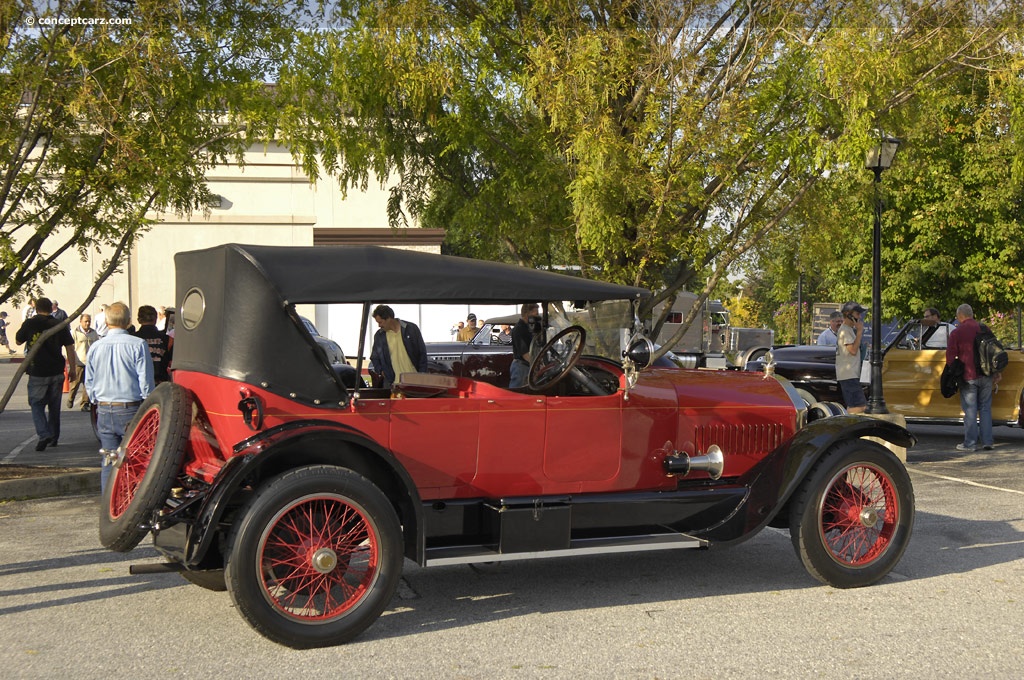
Close Coupled Touring
Chassis #: G2851
Engine #: G2851
View info and history
Auction entries : 2
The 1918 Stutz Series G
Most of the Stutz automobiles built in the 1910s and early 1920s used either a 120- or 130-inch wheelbase. Stutz's, built from 1917 to 1912, rested on a 130-inch wheelbase, with few exceptions, including the Bearcat, which used the shorter 120-inch platform. The suspension was via semi-elliptic leaf springs and braking was by rear drums with twin expanding shoes. The 389 cubic-inch T-head 16-valve inline four-cylinder was paired with a three-speed manual transaxle and produced approximately 80 horsepower.
The minimalistic Bearcat was priced at $2,750, the same price as the roadster. A close-coupled four-passenger touring and a six-passenger tourer were approximately $100 higher.
by Daniel Vaughan | Dec 2023
Related Reading : Stutz Bearcat History
The Stutz Bearcat was produced from 1914 through 1924. The first version was produced from 1914 to 1917 and was powered by a 6388 cc four-cylinder engine. The Bearcat was a creation inspired by an Indy sports car racer built by the Stutz Motor Company in 1911. It was powered by a 361 cubic-inch four-cylinder engine that produced 50 horsepower. The Bearcat continued the tradition of lightweight construction,....
Continue Reading >>
Continue Reading >>
Similar Automakers
Similarly Priced Vehicles


1918 Stutz Series G Vehicle Profiles

Recent Vehicle Additions


Performance and Specification Comparison
Price Comparison
$2,550 - $2,750
Bearcat Specification Comparison by Year
Year
Production
Wheelbase
Engine
Prices
Related Automotive News

120 years of motor sport at Mercedes-Benz take centre stage at the Goodwood Festival of Speed 2014
Addicted to Winning at this years Goodwood Festival of Speed, Mercedes-Benz looks back on some fascinating racing victories of the last 120 years
The unique motor sport heritage of the Mercedes-Benz brand is being celebrated with an exclusive i...

Techno Classica 2014: more than 30 racing cars to celebrate 120 years of Mercedes-Benz motor racing history
Cars that were the heroes of magical moments put their stamp on this high-powered, most comprehensive show presentation
With more than 30 vehicles, Mercedes-Benz Classic presents motor racing history in all its unique breadth and depth
120 years o...

Magic moments: 120 years of Mercedes-Benz motor sport: history at the Retro Classics show from 13 to 16 March 2014
Mercedes-Benz Classic presents highlights in the history of the DTM in hall 7 at the show in Stuttgart
Strong presence by the company and the brand clubs at southern Germanys leading show for automotive classics
Fascinating dialogue between compe...

Mercedes-Benz Classic at the 2013 Pebble Beach Concours d'Élégance
Mercedes-Benz Classic brings Prinz Heinrich Benz and 2440 hp Benz landaulet to California
Representatives of the brands long tradition of sports- and luxury-class cars
Stuttgart – Mercedes-Benz Classic is to mark its attendance at the Pebble...

The Champion in Touring Car Racing : The BMW M3
In August 1985, a rumour surfaced in motor magazine Auto-Deutschland which emanated from a new sports car. An A Group Car from BMW that was a thoroughbred racing car according to the rules but was also to be produced in a version licensed to drive on...