The AC Ace roadster and its closed Aceca coupe sibling were based on a one-off sports racer built in 1952 for Cliff Davis by chassis engineer John Tojeiro. Davis' Tojeiro sports racer proved to be well-engineered and attractive, wearing a body built by Panelcraft in a style reminiscent of early Ferrari 166 MM Barchettas bodied by Touring. The Davis car was given registration 'LOY 500,' and a second car, 'LOY 501' was later built by Tojeiro and given an MG powerplant. As many as two more cars followed, and one of those is believed to be the MG-powered LOW 77 - the other car was Vin Davison's LER 371 which had a Lea-Francis engine.
It was Ernie Bailey of Buckland Bodywork who suggested to Tojeiro that perhaps A.C. may be interested in Tojeiro's creation. At the time, Bailey was supplying bodies for A.C. Tojeiro agreed and showed LOY 500 to the A.C. Works at Thames Ditton. A.C. agreed to display LER 371 at the 1953 Earls Court Motor Show and installed one of their own engines into the engine bay. The vehicle was painted blue and re-licensed as TPL 792 and announced as the A.C. Ace roadster.
The popularity of the A.C. Ace prompted AC Cars to acquire the rights to the design, which was put into production in 1954.
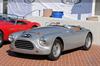
The sleek and elegant Barchetta-style bodies were formed of welded aluminum panels supported by small-diameter steel tubes similar to the techniques employed by Touring for the Superleggera construction. The bodies were fitted atop Tojeiro's twin-tube ladder frame chassis with a 90-inch wheelbase and suspended by a Cooper-influenced all-independent setup with transverse leaf springs and dual wishbones. Under the graceful bonnet was AC's own venerable, 2.0-liter, long-stroke six-cylinder engine which was designed by AC co-founder John Weller with origins that date back to 1919.
In tuned form, the overhead-camshaft engine awarded the Ace with great success in production sports car racing. They won three successive SCCA E-Production championships between 1957 and 1959, followed by two D-Production championships in 1960 and 1961. They raced at the pinnacle of motorsport competition, finishing second in class at Le Mans in 1957 and 1958. In 1959, they placed seventh overall at LeMans.
AC equipped 223 examples with the 2.0-liter AC engine along with 463 with Bristol power and a further 37 examples with Ford power. The 2.0-liter six with triple SU carburetors and twin triple-branch exhaust manifolds offered approximately 102 horsepower and was backed by a four-speed Moss manual gearbox. Four-wheel Girling hydraulic finned aluminum (Al Fin) Wellworthy drum brakes provided the stopping power. 16-inch Dunlop knock-off wire-spoke wheels were wrapped with 5.50-inch tires.
In 1956, overdrive became available and the following year, the Ace could be installed with front disc brakes which later became standardized. In 1961, a 'Ruddspeed' 2.6-liter straight-six engine became optional, adapted by Ken Rudd from the powerplant used in the Ford Zephyr. Depending on the setup, the engine delivered upwards of 170 bhp, giving the Ace a top speed of 130 mph.
The AC Ace was the first post-war British sports car with a fully independent suspension. It was also the car that was later used as the basis for the 289 and 427 Shelby Cobra derivatives. Carroll Shelby, who had won LeMans when the Ace had finished 7th, must have been impressed by the little sports car and recognized an opportunity to shoe-horn a Ford V8 engine into the chassis after Bristol ceased building their 6-cylinder engine in 1961. Production of the AC Cobra began in 1962 and initially came with small block power, later switching to big block configurations.
by Daniel Vaughan | Dec 2021
It was Ernie Bailey of Buckland Bodywork who suggested to Tojeiro that perhaps A.C. may be interested in Tojeiro's creation. At the time, Bailey was supplying bodies for A.C. Tojeiro agreed and showed LOY 500 to the A.C. Works at Thames Ditton. A.C. agreed to display LER 371 at the 1953 Earls Court Motor Show and installed one of their own engines into the engine bay. The vehicle was painted blue and re-licensed as TPL 792 and announced as the A.C. Ace roadster.
The popularity of the A.C. Ace prompted AC Cars to acquire the rights to the design, which was put into production in 1954.
The sleek and elegant Barchetta-style bodies were formed of welded aluminum panels supported by small-diameter steel tubes similar to the techniques employed by Touring for the Superleggera construction. The bodies were fitted atop Tojeiro's twin-tube ladder frame chassis with a 90-inch wheelbase and suspended by a Cooper-influenced all-independent setup with transverse leaf springs and dual wishbones. Under the graceful bonnet was AC's own venerable, 2.0-liter, long-stroke six-cylinder engine which was designed by AC co-founder John Weller with origins that date back to 1919.
In tuned form, the overhead-camshaft engine awarded the Ace with great success in production sports car racing. They won three successive SCCA E-Production championships between 1957 and 1959, followed by two D-Production championships in 1960 and 1961. They raced at the pinnacle of motorsport competition, finishing second in class at Le Mans in 1957 and 1958. In 1959, they placed seventh overall at LeMans.
AC equipped 223 examples with the 2.0-liter AC engine along with 463 with Bristol power and a further 37 examples with Ford power. The 2.0-liter six with triple SU carburetors and twin triple-branch exhaust manifolds offered approximately 102 horsepower and was backed by a four-speed Moss manual gearbox. Four-wheel Girling hydraulic finned aluminum (Al Fin) Wellworthy drum brakes provided the stopping power. 16-inch Dunlop knock-off wire-spoke wheels were wrapped with 5.50-inch tires.
In 1956, overdrive became available and the following year, the Ace could be installed with front disc brakes which later became standardized. In 1961, a 'Ruddspeed' 2.6-liter straight-six engine became optional, adapted by Ken Rudd from the powerplant used in the Ford Zephyr. Depending on the setup, the engine delivered upwards of 170 bhp, giving the Ace a top speed of 130 mph.
The AC Ace was the first post-war British sports car with a fully independent suspension. It was also the car that was later used as the basis for the 289 and 427 Shelby Cobra derivatives. Carroll Shelby, who had won LeMans when the Ace had finished 7th, must have been impressed by the little sports car and recognized an opportunity to shoe-horn a Ford V8 engine into the chassis after Bristol ceased building their 6-cylinder engine in 1961. Production of the AC Cobra began in 1962 and initially came with small block power, later switching to big block configurations.
by Daniel Vaughan | Dec 2021
Related Reading : AC Ace History
The Ace was introduced in 1953 at the London Motor Show and was produced beginning in 1954 and continuing through 1963. The vehicle consisted of lightweight tubular chassis with steel boxes in the front and rear which supported a transverse leaf and lower wishbone independent suspension system. The chassis was designed by John Tojeiro. Power was initially provided by a Welleter-designed engine and....
Continue Reading >>
Continue Reading >>
Related Reading : AC Ace History
The oldest British car manufacturer, AC has continuously produced vehicles since 1901 and the marque carries enormous prestige. The AC Aceca, a closed coupe, was unveiled in 1954 in London and only 328 prototypes were ever produced. Production of the Aceca Coupe commenced in 1955 and Le Mans 1957 was a lucrative one for AC, with an AC Bristol finishing tenth overall. 1958 was an even better year....
Continue Reading >>
Continue Reading >>
Similar Vehicles


1963 AC Ace Vehicle Profiles


Recent Vehicle Additions


Related Automotive News

Rare Ferrari 412P Achieves $30.25 Million At Bonhams|Cars Quail Auction
A historic Monterey Car Week moment – this Maranello Masterpiece becomes the fourth most valuable Ferrari ever sold at auction
A monumental moment today when BonhamsCars at its Quail Auction in California achieved %2430.25 million...

London Concours 2021 celebrates the 'Lost Marques'
The London Concours has announced the latest class celebrating the fascinating world of automotive marques that no longer exist
Sponsored by presenting partner, Breguet, the display features the most beautiful cars built by manufacturers that have...

Rare And Exclusive Cars To Feature In Silverstone Classic Sale
1 of only 200 Renault 5 Turbo 2 Evolutions to be offered
Very rare Maserati Bora 4.7-litre coupe in right-hand drive
1 of 50 Series 3 commemorative Jaguar E-types and the first AC Aceca with a Bristol engine
Silverstone Auctions sale on the 26th...

Automobiles with Exceptional Provenance Highlight Gooding & Company's Pebble Beach Auctions
SANTA MONICA, Calif. (July 10, 2014) – Gooding %26 Company, celebrated for its world-class automotive auctions and record-breaking results, will begin its second decade as the official auction house of the Pebble Beach Concours dElegance® on August...

Barrett-Jackson Flavors Its January Scottsdale Auction With NASCAR Treats
RACING HERITAGE, HIGH PERFORMANCE ARE RECIPES FOR CAR-COLLECTING FEAST
SPEED™ SET FOR 39 HOURS of LIVE COVERAGE STARTING JAN. 15
The great Henry Ford once said, Auto racing began five minutes after the second car was built.
...