1955 Elva MKI
1955 Elva MKI Navigation
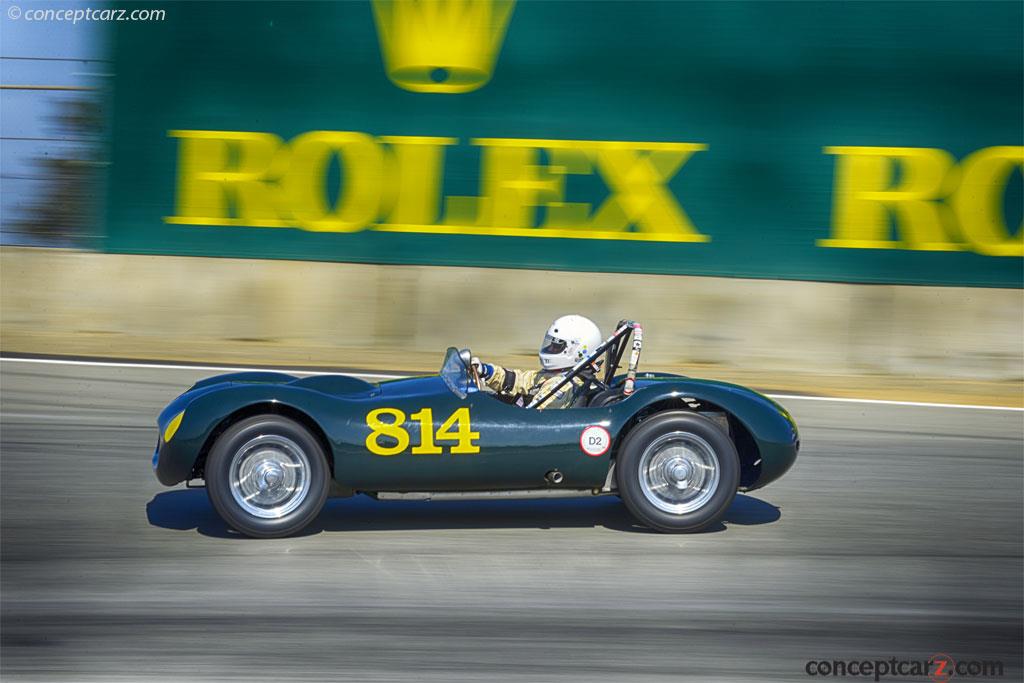
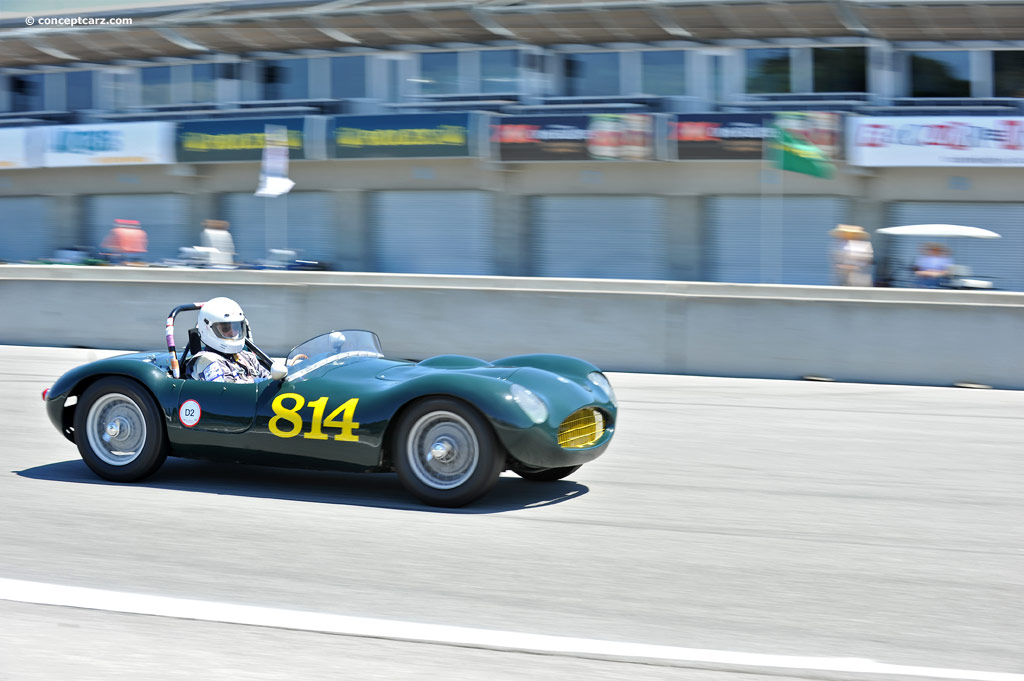
After leaving the Army following World War II, Frank G. Nichols acquired a small garage business at Westham in 1947. It was soon very successful and larger facilities were needed. He moved to a larger garage in London Road, Bexhill. He gained a love and appreciation for motorsports after racing a Lotus IV, which led to the commission of a racing special called the CSM. One of Frank's mechanical engineers was 'Mac' Witts, who had created an 'inlet over exhaust' conversion for the Ford 100E engine. In regular guise, the Ford engine offered 36 horsepower. With the conversion in place, which greatly improved engine breathing, horsepower increased. Frank may have had some racing experience, but his true talents were as a businessman. He recognized an opportunity to promote the 'inlet over exhaust' conversion and had it installed in the custom-made CSM. 
Sports Racer
Chassis #: REB-338-ECC
View info and historyHis business sense told him there was a market and demand for sports racing cars, and soon the 'ELVA' was born. The name 'ELVA', for 'ell va', means 'she goes.' Frank chose to use the name after a friend watching the CSM perform commented: 'Elle va!' in French. The Mark 1 was the first ELVA built for sale to private owners. They were given a simple ladder frame arrangement from round tubing, with the drivetrain sourced from the Ford Prefect. The steering was from a Standard Ten sedan, the front suspension was comprised of wishbones and coil springs, and a live axle in the back was located by a Panhard rod and trailing links. A three-speed gearbox was attached to the Ford engine. The early examples were given aluminum bodywork, but costs and delivery time had Frank consider alternatives. A solution was found with Ashley Laminates (later renamed to Falcon), who created a fiberglass shell of the alloy body. It was quick and inexpensive, and the entire body could be bolted and unbolted to the chassis very easily. The Elva's were not sophisticated or complex, but they were inexpensive. They offered buyers with limited resources the opportunity to buy a race car and compete against the much more expensive Cooper and Lotus cars.
Sports Racer
Chassis #: REB-338-ECC
View info and historyAfter delivering a few cars, receiving feedback, and proving there was a market for these cars, Frank and his team worked to improve the product even further. Soon the MK 1/B emerged, with the most distinguishable difference from the earlier cars being an ELVA custom-fabricated front suspension, employing tubular A-arms and coil-over shocks. Buyers could now select either the Ford or Climax FW racing engine, the three-speed gearbox, or a BMC 4-speed transmission. Impressed by the MK1, Chuck Dietrich of the United States became the U.S. distributor for Elva, expanding the market and potential even further. All of the MK/1B racecars that Dietrich received were powered by Climax engines. Roughly 23 examples of the MK1 were built, including 6 MK1s.
Sports Racer
Chassis #: REB-338-ECC
View info and historyThe Elva MK1 provided the team with the opportunity to learn and grow. The Elva's that followed were much more sophisticated and competitive.
by Daniel Vaughan | Feb 2020

Sports Racer
Chassis #: REB-338-ECC
View info and history
Sports Racer
Chassis #: REB-338-ECC
View info and history

Sports Racer
Chassis #: REB-338-ECC
View info and history
by Daniel Vaughan | Feb 2020
Related Reading : Elva Sports Racer History
In the year 1955, Frank G. Nichols founded the Elva sports car manufacturing company. Based in Hastings, United Kingdom, the name Elva comes from the French phrase ella va which means she goes. Unfortunately, financial problems that were caused by the failure of the U.S. distributor the Elva Company was sold to Trojan in 1961. Production was relocated to Rye, Sussex, and again in 1966 to the main....
Continue Reading >>
Continue Reading >>
- 1955 Elva MKI Menu
- Article
- Image gallery
- Valuation
- Specifications


1955 Elva MKI Vehicle Profiles

Recent Vehicle Additions


Related Automotive News

Remembering the Busse, an amphibious ATV powered by Volkswagen
The 70s were an era defined by bell-bottoms, disco music, revolutionary movements, and a craze for small vehicles that could go anywhere over land – and sometimes water too.
The first all-terrain vehicle was dreamed up by a Canadian inventor in 1959,...

The Mid-Engine Corvette at the Amelia Island Concours d'Elegance
With the recent introduction of the Chevrolet C8 Corvette, the first production mid-engine Corvette sports car, the 2020 Amelia Island Concours dElegance took the opportunity to tell the story of the mid-engine Corvette legacy. The canvas...

Porsche 911 Speedster Concept Fascinates U.S. Audience
North American premiere at Rennsport Reunion VI in California
Atlanta, Georgia. The Porsche 911 Speedster Concept received an enthusiastic welcome at its third public appearance. Following its world premiere on June 8 in Stuttgart-Zuffenhausen,...

Looks, Rarity, Performance: The Ultimate Connoisseur's Ferrari at RM Monterey...
LOOKS, RARITY, PERFORMANCE THE ULTIMATE CONNOISSEURS FERRARI, 275 GTBC SPECIALE HEADLINES RM AUCTIONS FLAGSHIP MONTEREY SALE
RM Auctions offers the first of only three 1964 Ferrari 275 GTBC Speciales, chassis 06701, at its flagship Mon...

NISSAN READY TO 'PARTY LIKE IT'S 1994' – LE MANS WINNING NO. 75 300ZX RACE CAR SET FOR MONTEREY MOTORSPORTS REUNION
Steve Millen commemorates the 20th anniversary of his 1994 24 Hours of Le Mans victory behind the wheel of the No. 75 IMSA GTS Championship Nissan 300ZX race car.
Familiar red-white-and-blue 800-plus horsepower Clayton Cunningham Racing Z® will com...