1961 250 GT California | 1963 250 GT California ![]() |
1962 Ferrari 250 GT California news, pictures, and information | ||
| Tweet | ||
![]() | ![]() | Convertible Chassis Num: 3119 GT Engine Num: 3119 GT |
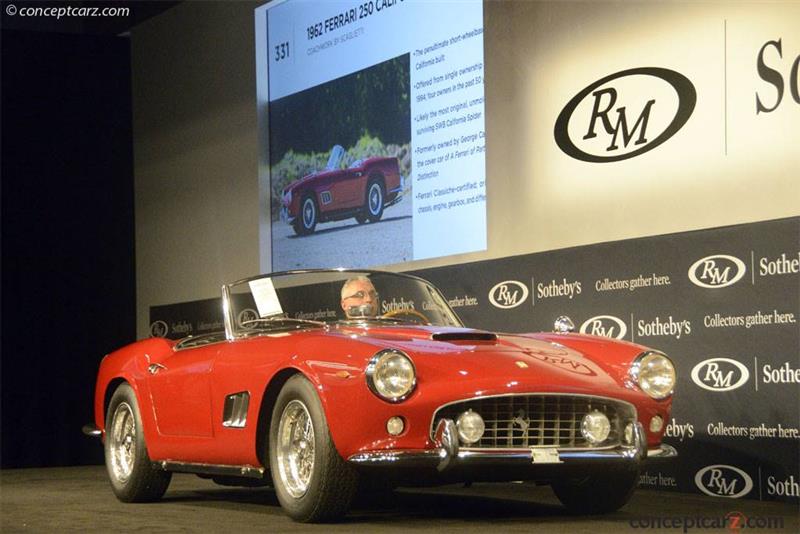
| High bid of €4,000,000 at 2009 RM Auctions. (did not sell) Sold for $8,580,000 at 2012 RM Auctions. | ||
Pinin Farina would design a couple of different series of the 250 GT Berlinetta. One would focus on being a touring car filled with luxurious appointments and comforts. In their own right, these exquisite Ferraris would earn a very special place in Ferrari history and in the hearts of aficionados around the world. The other series, however, would not focus on comfort but on performance. Known as the 'Tour de France', these Berlinettas were much more racing cars based upon the very same models taking part in the 24 Hours of Le Mans and other sportscar races. Nimble and quick, the 'Tour de France' appealed to a certain crowd.
Ferrari wanted to continue to build upon the success gained with the 250 GT. It was clear getting rid of the model entirely was not the way to go. Therefore, in 1959, Ferrari would introduce two new models penned by Pinin Farina and built by Scaglietti. One would be a Cabriolet that would focus on appointments and comfort. The Series II Cabriolets would be perfectly suited to the everyday use of the wealthy and affluent.
Pinin Farina noted the success, and the love Enzo had, of the 'Tour de France'. They wanted to maintained that level of excitement without it just being another run of the very same design. Therefore, drawing upon the styling used in the 'Tour de France', Pinin Farina would design an exciting Spyder body. So while the Cabriolet would be filled with luxurious appointments and comforts intended for a touring car, the Spyder version would still be all about the performance.
In all actuality, the California would be an idea floated by the American Ferrari importer Luigi Chinetti. He recognized that state of things in the United States and believed an open top Ferrari, with the performance of the company's GT cars, would make for one popular concept.
The design just seemed right, especially with the more nimble handling of the shorter-wheelbase. And, as with the 'TdF', the California Spyder, as it would become known, would be as much at home driving around city streets and back roads as it would be on the track.
The California Spyder would certainly provide the performance necessary to make a convertible owner happy. Bristling with 280 bhp from a 3.0-liter V12 engine and three Weber carburetors, the 250 GT Spyder could certainly get moving quite rapidly providing copious amounts of wind flowing over and around the car to add even more of a sensation of speed to a car already capable of some truly spine-tingling speeds. And, with the shorter wheelbase, the California Spyder beautifully complimented the sheer speed with some impressive handling as well.
Just a little more than one hundred of the California Spyders would be built. Just 56 of those built would be placed on the shorter wheelbase chassis. And of those 56, just 37 would feature one of the most desirable of all configurations: complete with covered headlights.
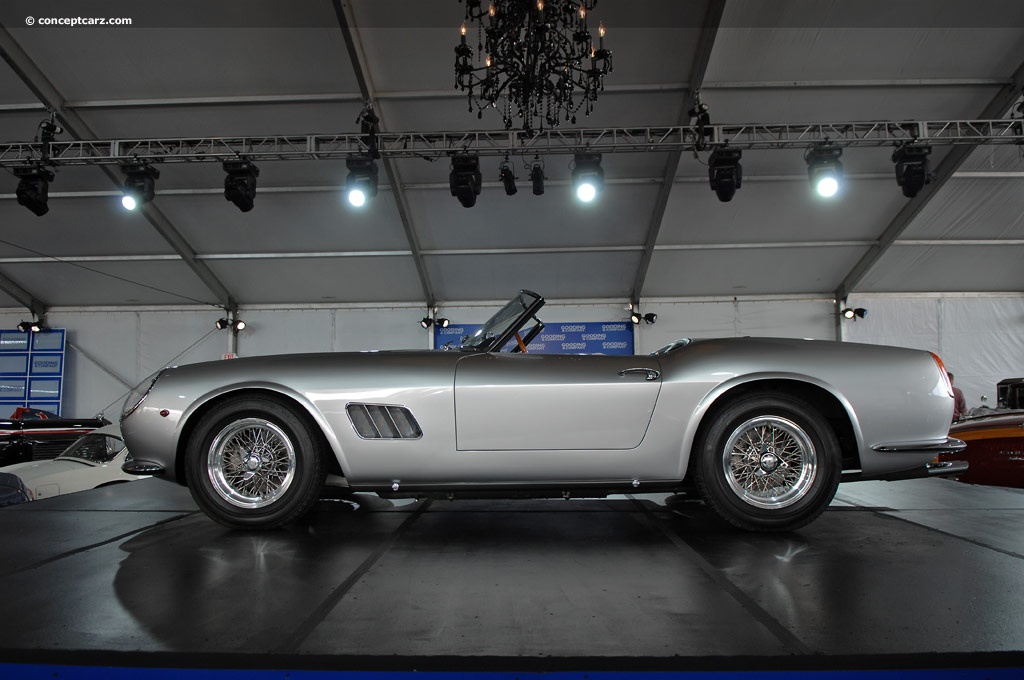
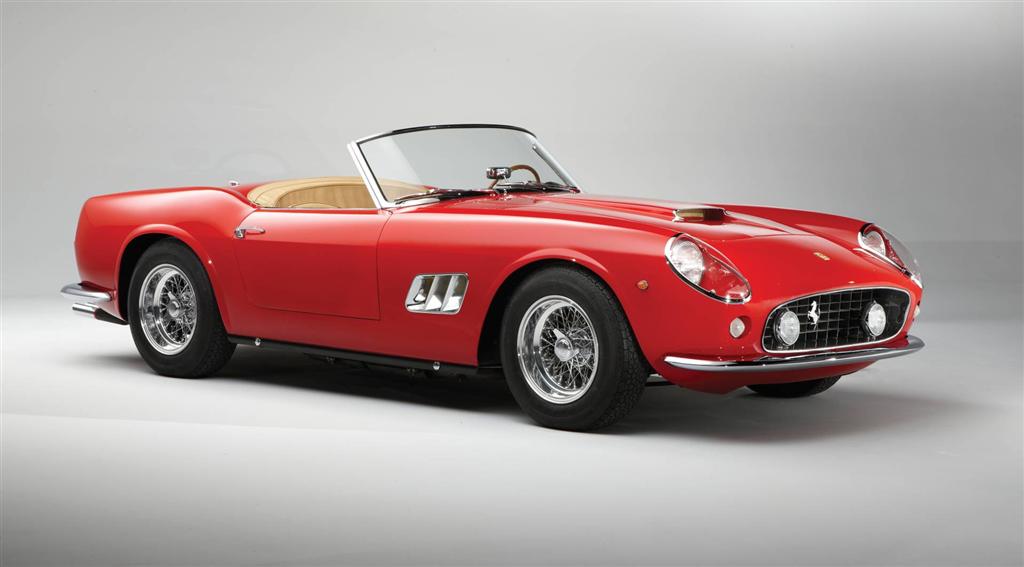
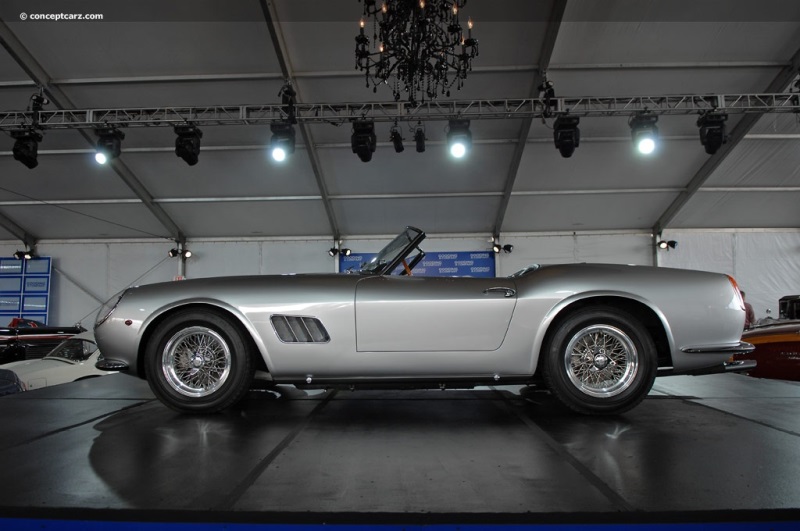
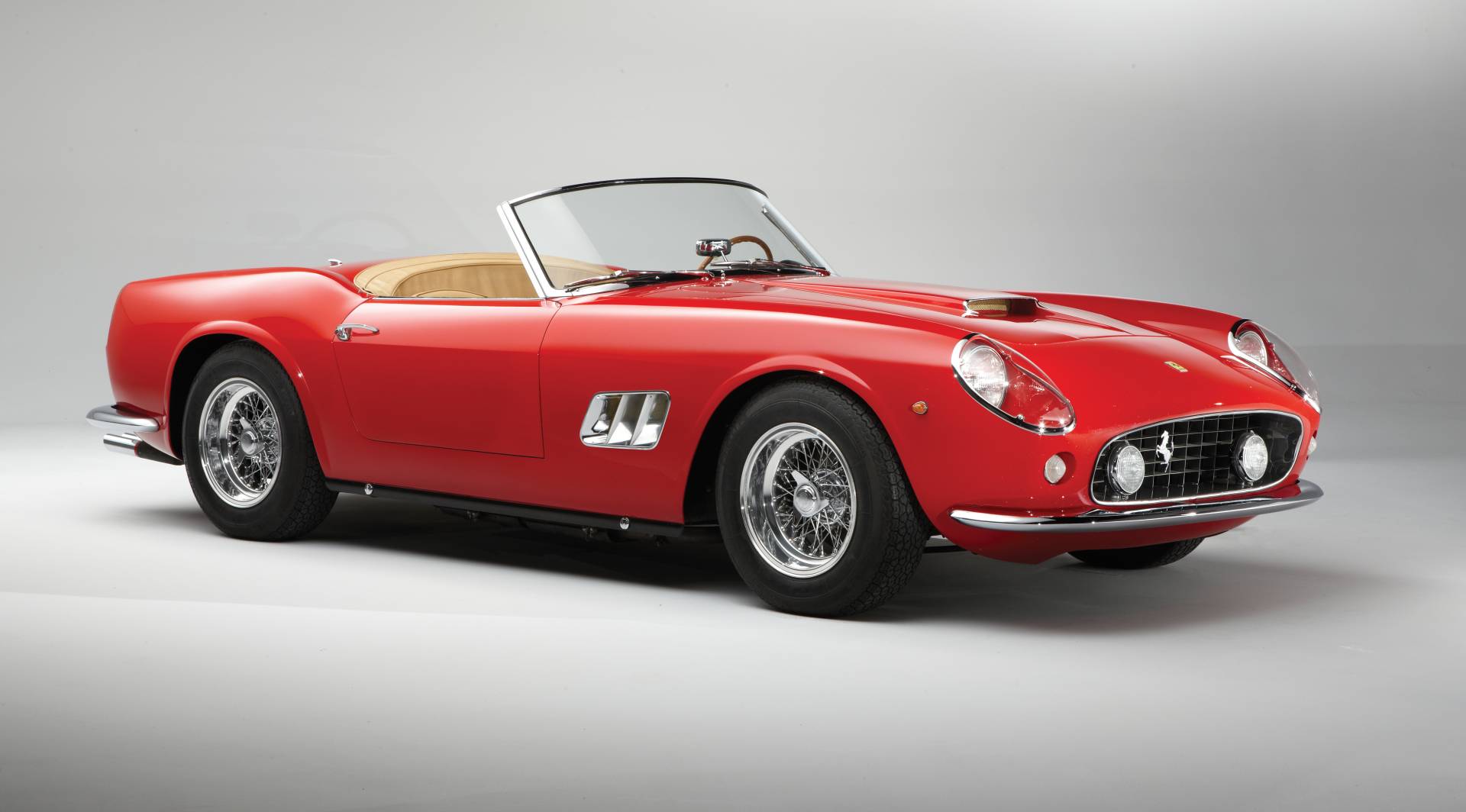
Chassis 3119 GT happens to be one of those highly-desirable 37 250 GT California Spyders sitting on a short wheelbase with the all-important covered headlights. And at the 2012 RM Auctions event in Monterey this sheik and brawny Ferrari would be made available for sale.
By the late 1950s and the early 1960s, the scene in Hollywood was that of jet-setting actors and actresses enjoying their expensive but very elegant toys. And the Pinin Farina-designed Ferrari 250 GT California Spyder had certainly been designed for just such an environment. Chassis 3119 GT would therefore, not surprisingly, make its way to the United States but not before it was sold to Fredy Damman via Jacques Swaters' Garage Francorchamps SA located in Brussels, Belgium.
Philipp Cole would come to own the car in 1970 after it arrived in the United States. Nineteen years later, 3119 GT would be in the hands of Walt McCune and not only would he show in the Newport Beach Concours d'Elegance in 1989, but he would also contract Luigi Menerella's shop to perform a restoration of the SWB California Spyder. When the car returned from restoration it would be shown at the 40th Pebble Beach Concours d'Elegance where it would win its class, thereby adding weight to its incredible provenance, restoration and elegance.
The victories would continue to come. During the mid-1990s Bill Bauce would become the proud owner of the California Spyder and he would present it at the 29th Ferrari Club national meeting held in Palm Beach. There, again, the car would come away with another class victory.
Bauce would own 3119 GT for a number of years before it would be sold to its current owner, also a recognized Ferrari enthusiast. Since coming to its current owner, 3119 GT has become a prominent part of an already exceptional collection and continues to be an exquisite example of the famed SWB California Spyders.
Expected to garner between $7,500,000 and $9,000,000, the 1962 Ferrari 250 GT SWB California Spyder chassis number 3119 GT, with matching engine number, is certainly expected to be one of the highlights of the RM Auction at Monterey. And, being one of just 37 produced with the covered headlights, a multiple award winner, Ferrari Classiche certified, matching numbers and just a completely stunning car to behold, it is not at all difficult to understand why.
Sources:
'Lot No. 240A: 1962 Ferrari 250 GT SWB California Spyder', (http://www.rmauctions.com/FeatureCars.cfm?SaleCode=MO12&CarID=r238). RM Auctions. http://www.rmauctions.com/FeatureCars.cfm?SaleCode=MO12&CarID=r238. Retrieved 9 August 2012.
'1959 Ferrari 250 GT SWB News, Pictures and Information', (http://www.conceptcarz.com/vehicle/z13223/Ferrari-250-GT-SWB.aspx). Conceptcarz.com: From Concept to Production. http://www.conceptcarz.com/vehicle/z13223/Ferrari-250-GT-SWB.aspx. Retrieved 9 August 2012.
'Ferrari 250 GT SWB California Spyder', (http://www.ultimatecarpage.com/car/2176/Ferrari-250-GT-SWB-California-Spyder.html). Ultimatecarpage.com: Powered by Knowledge, Driven by Passion. http://www.ultimatecarpage.com/car/2176/Ferrari-250-GT-SWB-California-Spyder.html. Retrieved 9 August 2012.
'Ferrari 250 GT SWB California Spyder—Classic Cars for Sale', (http://www.sportscardigest.com/ferrari-250-gt-swb-california-spyder-classic-cars-for-sale/). Sports Car Digest: The Sports, Racing and Vintage Car Journal. http://www.sportscardigest.com/ferrari-250-gt-swb-california-spyder-classic-cars-for-sale/. Retrieved 9 August 2012.By Jeremy McMullen
![]() | ![]() | ![]() | Convertible Chassis Num: 3163GT |
| Sold for $5,115,000 at 2009 Gooding & Company. | |||
The car was in Italian ownership until coming to the United States in the late 1960s. It has remained in the States ever since.
After its restoration, the car was put on display at the Pebble beach Concours in 1999. The following year it was at the Cavallino Classic. It would return to West Palm Beach and the Cavallino Classic in 2005.
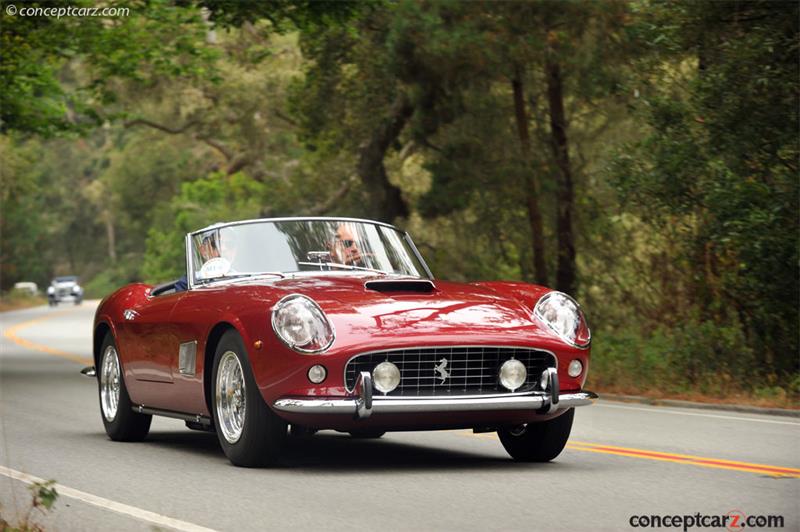
In 2009, the car was offered for sale at Gooding & Company's Pebble Beach Auction. The car was sold for an impressive 5.115 million including buyer's premium.
By Daniel Vaughan | Nov 2012
Production of the 250 Series began in 1954 and continued on through the early part of the 1960's. There were numerous variations of the 250 and would ultimately become Ferrari's most successful line of vehicles to date. The 250 is also recognized as the first Ferrari to ever receive disc brakes. This did not take place until the end of the 1950's. Also, the 250 was the first four-seater.
Ferrari's were custom built cars. They were not mass-produced. Ferrari provided the engine and chassis while Italian coach builders provided the body. This meant the specifications varied. Engines also varied in horsepower rating, torque, and displacement. This was no different for the 250 GT which saw many different variations in body style and body types.
Ferrari built the road-going Ferrari's to fuel his passion for racing. Many of the vehicles he built for the road had a competition model. That is, a modified version of the road-going model. An example of this was the 1959 short-wheel base (SWB) Berlinetta (Berlinetta which means coupe) and given an aluminum body. It was debuted in October 1959 at the Paris Salon. GT cars were road-legal vehicles that could also be taken to the track and compete without the need for modifications. Although this was their purpose, Ferrari realized that many customers would not race their vehicle, but rather wanted the power and performance that sports cars offered. To comply, Ferrari built these cars to be powerful and luxurious. The vehicles could still be run on the track, mostly on requiring the adoption of stickers and complying with any safety requirements.
The 250 road-going vehicles mostly shared two wheelbase sizes, a 2400 mm and 2600 mm. The 2400 wheelbase were referred to as the SWB (Short wheel base) while the other was the LWB (long wheel base).
The base engine was a Colombo 60-degree, single-over-head cam, 'vee' type 12-cylinder, with aluminum alloy block and heads, and cast-iron cylinder liners. The displacement was 180 cubic inch (2953 cc). Horsepower production was around 220-260. The front suspension was independent with double wishbones and coil springs. The rear suspension was a live axle.
The first 250 introduced was the 250S and available in either berlinetta or spider configuration. Introduced in 1952, they were powered by a 3-liter Colombo engine producing about 230 horsepower.
At the 1953 Paris Motor Show, Ferrari introduced the 250 Europa and Export. These were the only models in the series that were powered by a Lampredi v-12 engine also seen in Formula 1. The 250 Export had a 2400 MM wheelbase, similar tot he 250 MM. The 250 Europa had a larger, 2800 mm wheelbase which allowed more interior room. During their short production lifespan, only 18 examples were produced. Pininfarina and Vignale were tasked with creating the coachwork.
In 1954 four specialty built 250 Monza were built for racing. They shared many similarities with the 750 Monza's, but were equipped with the 3-liter Colombo engine.
At the 1957 Geneva auto show, Ferrari displayed their 250 GT Cabriolet. Coachwork was courtesy of Pininfarina; the wheelbase was 2600 mm in size. In 1959 the second in the 250 GT Cabriolet series production began after only 36 examples being produced.
From 1957 through 1959 Ferrari produced the 250 GT Berlinetta 'Tour de France' (TdF). The name had been given for the 10-day automobile race. Originally the engine produced 240 horsepower but was later modified to 260 horsepower. Carrozzeria Scaglietti was responsible for creating the bodies based on Pinin Farina's design.
Scaglietti was responsible for constructing the 1957 250 GT California Spyder. These sat atop a long, 2600 mm chassis and aluminum was used throughout the body in efforts to reduce the overall weight. In total, around 45 examples were created before they were replaced by the SWB version in 1960.
There were 250 examples of the 250 GT Berlinetta SWB produced. Production began in 1959 and used the shortened, sportier wheelbase. Giotto Bizzarrini, Carlo Chiti, and Mauro Forghieri were responsible for the development. Some were built for racing while others were meant for daily transportation. Horsepower ranged from 240 to 280. Steel or aluminum bodies were used. The steel bodies were suited for the road-going vehicles, also known as Lusso. The racing trim vehicles were powerful and had low weight. They were vary competitive and are regarded as the most important GT racers of its time. In 1961 the SWB Berlinetta captured the GT class of the Constructor's Championship.
In 1960 a Scaglietti 250 GT Spyder California SWB was shown at the Geneva Motor Show. Built as a replacement for the LWB and based on the 250 GT SWB, around 55 examples were produced.
The Ferrari 250TR was produced from 1957 through 1958 during which only 19 examples were created. The 'pontoon' fender body was designed by Scaglietti and the power was supplied through a Colombo 12-cylinder engine mounted at a sixty-degree angle and outfitted with six Weber 38 DCN carburetors. Power was sent to the rear wheels via a four-speed manual gearbox. With 300 horsepower, the 800 kg vehicle was able to achieve a 168 mph top speed. From 1958 through 1961, the 250 TR was entered in 19 championship races where they emerged victorious ten times.
The 250 in 250 TR represented the unitary displacement while the TR was an acronym meaning Testa Rossa. Testa Rossa translates to 'red head' which referred to the color of the engine's cylinder head.
The 250 TR series was built to capture the world championship which was experience questionable times. During the 1955 24 Hours of Lemans a fatal accident occurred and the Commissione Sportiva Internazionale (CSI) began investigating ways to make the sport safer for the drivers and the spectators. Their efforts were escalated in 1967 when another fatal accident occurred at the 1957 Mille Miglia. The committee decided upon a displacement limit but they were in disagreement on the size; the proposed figures ranged from 3 to around 3.5 liters.
1958 was the introductory year for the new regulations, which had been announced during the later part of 1957. Ferrari had been building, testing, and racing the 250 GT which had performed well during the 1957 Mille Miglia. The Colombo V12 260 horsepower engine received a larger bore, camshaft, and other improvements resulting in a 3.1 liter displacement and 320 horsepower. Testing continued throughout the 1957 season in both body configuration and mechanical components.
Ferrari had anticipated the new engine size regulations and thus had been sufficiently prepared to capture the world championship. Due to the potential of negative publicity caused by the fatal accidents, other manufacturers, such as Aston Martin, Lotus, Cooper and Jaguar, were hesitant to continue racing. Ferrari believed their closest competitor would be the powerful and technologically advanced Maserati 450 S which featured a quad-cam eight-cylinder engine.
Ferrari quickly began capturing victories during the 1958 season. The 250 TR was a solid vehicle thanks to the preparation and testing. The steel tubular ladder frame was of traditional Ferrari construction; a DeDion rear axle was used on the works racers. Customer cars were outfitted with a live axle. Drum brakes were placed on all four corners of the car. The engine had been modified to comply with regulations and to fit in the engine bay. In reality, the vehicle was an outdated car having only the benefit of proper planning and proven technology. Most cars featured disc brakes which provided superior stopping power. The Colombo engine dated back to the beginning of Ferrari and was antiquated in comparison to the modern power-plants.
Nearing the close of the 1958 season, the competition began to rise. Aston Martin had a lethal combination, a 3 liter DBR1 racer and Stirling Moss as the driver. Even though the Aston Martins did score a victory at Nurburgring 1000 KM, Ferrari was able to capture the World Championship. The legendary Phil Hill and Olivier Gendebien easily capture a third victory for Ferrari at the grueling 24 Hours of Lemans. The 250 TR works cars were referred to as TR58, to distinguish them from the customer TRs.
For the 1959 season, the vehicles received slight modifications which made the vehicle lighter and more powerful. The big news was the use of Dunlop disc brakes. The engine received coil valve springs and the horsepower increased slightly to 306. A Colotti designed five speed gearbox replaced the four-speed unit. Pininfarina was tasked with designing a new body and the construction was handled by Fantuzzi. As a result of the improvements, the name was changed to TR59. At their inaugural race, the TR59 finished first and second. This streak did not last and at the end of the season, it was Aston Martin who emerged as the world champion. The TR59 was plagued with reliability issues mostly due to the gearbox. The vehicles were forced to retire early from races, including Le Mans.
For the 1960 season, the TR was modified slightly to comply with new regulations and to rectify the transmission issues. These vehicles are commonly referred to as the TR59/60. Aston Martin had withdrawn from the championship which left no factory opposition for Ferrari. Porsche and Maserati provided competition, especially at Targa Florio and the Nurburgring 1000 km where they scored victories. At Le Mans, Ferrari finished first and second and captured the word championship, beating Porsche by only four points.
For the 1961 season, Ferrari introduced the mid-engined 246 SP. The TRI61 was given a new spaceframe chassis and was able to capture victories at Sebring 12 Hours and Le Mans. With victories between the 246 SP and the TRI61, Ferrari once again captured the world championship.
The CSI implemented stricter rules for the 1962 season which meant the TR was unable to score points for the factory. It was still allowed to race for the overall victory.
By Daniel Vaughan | Feb 2007
For more information and related vehicles, click hereFerrari's were custom built cars. They were not mass-produced. Ferrari provided the engine and chassis while Italian coach builders provided the body. This meant the specifications varied. Engines also varied in horsepower rating, torque, and displacement. This was no different for the 250 GT which saw many different variations in body style and body types.
Ferrari built the road-going Ferrari's to fuel his passion for racing. Many of the vehicles he built for the road had a competition model. That is, a modified version of the road-going model. An example of this was the 1959 short-wheel base (SWB) Berlinetta (Berlinetta which means coupe) and given an aluminum body. It was debuted in October 1959 at the Paris Salon. GT cars were road-legal vehicles that could also be taken to the track and compete without the need for modifications. Although this was their purpose, Ferrari realized that many customers would not race their vehicle, but rather wanted the power and performance that sports cars offered. To comply, Ferrari built these cars to be powerful and luxurious. The vehicles could still be run on the track, mostly on requiring the adoption of stickers and complying with any safety requirements.
The 250 road-going vehicles mostly shared two wheelbase sizes, a 2400 mm and 2600 mm. The 2400 wheelbase were referred to as the SWB (Short wheel base) while the other was the LWB (long wheel base).
The base engine was a Colombo 60-degree, single-over-head cam, 'vee' type 12-cylinder, with aluminum alloy block and heads, and cast-iron cylinder liners. The displacement was 180 cubic inch (2953 cc). Horsepower production was around 220-260. The front suspension was independent with double wishbones and coil springs. The rear suspension was a live axle.
The first 250 introduced was the 250S and available in either berlinetta or spider configuration. Introduced in 1952, they were powered by a 3-liter Colombo engine producing about 230 horsepower.
At the 1953 Paris Motor Show, Ferrari introduced the 250 Europa and Export. These were the only models in the series that were powered by a Lampredi v-12 engine also seen in Formula 1. The 250 Export had a 2400 MM wheelbase, similar tot he 250 MM. The 250 Europa had a larger, 2800 mm wheelbase which allowed more interior room. During their short production lifespan, only 18 examples were produced. Pininfarina and Vignale were tasked with creating the coachwork.
In 1954 four specialty built 250 Monza were built for racing. They shared many similarities with the 750 Monza's, but were equipped with the 3-liter Colombo engine.
At the 1957 Geneva auto show, Ferrari displayed their 250 GT Cabriolet. Coachwork was courtesy of Pininfarina; the wheelbase was 2600 mm in size. In 1959 the second in the 250 GT Cabriolet series production began after only 36 examples being produced.
From 1957 through 1959 Ferrari produced the 250 GT Berlinetta 'Tour de France' (TdF). The name had been given for the 10-day automobile race. Originally the engine produced 240 horsepower but was later modified to 260 horsepower. Carrozzeria Scaglietti was responsible for creating the bodies based on Pinin Farina's design.
Scaglietti was responsible for constructing the 1957 250 GT California Spyder. These sat atop a long, 2600 mm chassis and aluminum was used throughout the body in efforts to reduce the overall weight. In total, around 45 examples were created before they were replaced by the SWB version in 1960.
There were 250 examples of the 250 GT Berlinetta SWB produced. Production began in 1959 and used the shortened, sportier wheelbase. Giotto Bizzarrini, Carlo Chiti, and Mauro Forghieri were responsible for the development. Some were built for racing while others were meant for daily transportation. Horsepower ranged from 240 to 280. Steel or aluminum bodies were used. The steel bodies were suited for the road-going vehicles, also known as Lusso. The racing trim vehicles were powerful and had low weight. They were vary competitive and are regarded as the most important GT racers of its time. In 1961 the SWB Berlinetta captured the GT class of the Constructor's Championship.
In 1960 a Scaglietti 250 GT Spyder California SWB was shown at the Geneva Motor Show. Built as a replacement for the LWB and based on the 250 GT SWB, around 55 examples were produced.
The Ferrari 250TR was produced from 1957 through 1958 during which only 19 examples were created. The 'pontoon' fender body was designed by Scaglietti and the power was supplied through a Colombo 12-cylinder engine mounted at a sixty-degree angle and outfitted with six Weber 38 DCN carburetors. Power was sent to the rear wheels via a four-speed manual gearbox. With 300 horsepower, the 800 kg vehicle was able to achieve a 168 mph top speed. From 1958 through 1961, the 250 TR was entered in 19 championship races where they emerged victorious ten times.
The 250 in 250 TR represented the unitary displacement while the TR was an acronym meaning Testa Rossa. Testa Rossa translates to 'red head' which referred to the color of the engine's cylinder head.
The 250 TR series was built to capture the world championship which was experience questionable times. During the 1955 24 Hours of Lemans a fatal accident occurred and the Commissione Sportiva Internazionale (CSI) began investigating ways to make the sport safer for the drivers and the spectators. Their efforts were escalated in 1967 when another fatal accident occurred at the 1957 Mille Miglia. The committee decided upon a displacement limit but they were in disagreement on the size; the proposed figures ranged from 3 to around 3.5 liters.
1958 was the introductory year for the new regulations, which had been announced during the later part of 1957. Ferrari had been building, testing, and racing the 250 GT which had performed well during the 1957 Mille Miglia. The Colombo V12 260 horsepower engine received a larger bore, camshaft, and other improvements resulting in a 3.1 liter displacement and 320 horsepower. Testing continued throughout the 1957 season in both body configuration and mechanical components.
Ferrari had anticipated the new engine size regulations and thus had been sufficiently prepared to capture the world championship. Due to the potential of negative publicity caused by the fatal accidents, other manufacturers, such as Aston Martin, Lotus, Cooper and Jaguar, were hesitant to continue racing. Ferrari believed their closest competitor would be the powerful and technologically advanced Maserati 450 S which featured a quad-cam eight-cylinder engine.
Ferrari quickly began capturing victories during the 1958 season. The 250 TR was a solid vehicle thanks to the preparation and testing. The steel tubular ladder frame was of traditional Ferrari construction; a DeDion rear axle was used on the works racers. Customer cars were outfitted with a live axle. Drum brakes were placed on all four corners of the car. The engine had been modified to comply with regulations and to fit in the engine bay. In reality, the vehicle was an outdated car having only the benefit of proper planning and proven technology. Most cars featured disc brakes which provided superior stopping power. The Colombo engine dated back to the beginning of Ferrari and was antiquated in comparison to the modern power-plants.
Nearing the close of the 1958 season, the competition began to rise. Aston Martin had a lethal combination, a 3 liter DBR1 racer and Stirling Moss as the driver. Even though the Aston Martins did score a victory at Nurburgring 1000 KM, Ferrari was able to capture the World Championship. The legendary Phil Hill and Olivier Gendebien easily capture a third victory for Ferrari at the grueling 24 Hours of Lemans. The 250 TR works cars were referred to as TR58, to distinguish them from the customer TRs.
For the 1959 season, the vehicles received slight modifications which made the vehicle lighter and more powerful. The big news was the use of Dunlop disc brakes. The engine received coil valve springs and the horsepower increased slightly to 306. A Colotti designed five speed gearbox replaced the four-speed unit. Pininfarina was tasked with designing a new body and the construction was handled by Fantuzzi. As a result of the improvements, the name was changed to TR59. At their inaugural race, the TR59 finished first and second. This streak did not last and at the end of the season, it was Aston Martin who emerged as the world champion. The TR59 was plagued with reliability issues mostly due to the gearbox. The vehicles were forced to retire early from races, including Le Mans.
For the 1960 season, the TR was modified slightly to comply with new regulations and to rectify the transmission issues. These vehicles are commonly referred to as the TR59/60. Aston Martin had withdrawn from the championship which left no factory opposition for Ferrari. Porsche and Maserati provided competition, especially at Targa Florio and the Nurburgring 1000 km where they scored victories. At Le Mans, Ferrari finished first and second and captured the word championship, beating Porsche by only four points.
For the 1961 season, Ferrari introduced the mid-engined 246 SP. The TRI61 was given a new spaceframe chassis and was able to capture victories at Sebring 12 Hours and Le Mans. With victories between the 246 SP and the TRI61, Ferrari once again captured the world championship.
The CSI implemented stricter rules for the 1962 season which meant the TR was unable to score points for the factory. It was still allowed to race for the overall victory.
By Daniel Vaughan | Feb 2007
| WHAT IS THE MILLE MIGLIA? | |
![]() | Numerous attempts have been made to answer the question 'What exactly is the Mille Miglia?' and the responses have been carefully considered and contemplated. Many of the answers are more than valid, as they involve a Red Arrow race that encompasses a multitude of shades, facets and colors. According to the online encyclopedia known as 'Wikipedia', the Mille Miglia is defined as the following: 'The Mille Miglia was an open-road endurance race which took place in Italy twenty-four times fro...[Read more...] |
| Montezemolo: 'Ferrari Must Remain Exclusive' | |
![]() | Maranello, 8th May - Luca di Montezemolo addressed more than 250 members of the media today at the Maranello factory to explain key areas of the business to the media, as well as announcing impressive results for the first quarter of 2013. 'I base my plans for Ferrari on four key areas,' said Montezemolo. 'Our team spirit, our passion, our extreme technology and our exclusivity' this is how he summed up his feelings to the assembled journalists from over 30 countries. Montezemolo a...[Read more...] |
| 1965 24 Hours of Le Mans: A Cool Head in the Face of a New Threat | |
![]() | Heading into the 1965 24 Hours of Le Mans it had become clear Ford was intent on taking the fight to Ferrari. Ford would spare no expense to take the fight to the company it had intended to buy. Ironically, the North American Racing Team would enter a Ferrari that would include the talented Jochen Rindt to help quell the storm. It would prove to be the wall necessary to provide Ferrari its last victory at Le Mans. Ford had made his declaration of intent to remove Ferrari from its throne as th...[Read more...] |
| Final Countdown Underway To South Florida's Premier Collector Car Auction | |
![]() | • Auctions America kicks off its 2013 auction season, March 22-24 with its highly anticipated Fort Lauderdale Collector Car Auction • Celebrating its 11th year, the multi-day auction features more than 550 quality collector cars • Latest feature attractions include an outstanding 1963 Shelby Cobra and a 1974 Ferrari Dino 246 GTS • Digital catalog now available for download at auctionsamerica.com AUBURN, Indiana (February 27, 2013) – With the final countdown underway to its highly an...[Read more...] |
| Bonhams Monaco sale | |
![]() | Now in its 26th year, Bonhams celebrated sale 'Les Grandes Marques à Monaco' will be held at the Musée des Voitures du Prince, Monte Carlo on the 11th May and will once again be under the patronage of the Grimaldi Family. The sale also coincides with the biannual Monaco Historic Grand Prix, the focal point for historic motor racing enthusiasts during May. Highlights from the Sale include examples from Bugatti, Ferrari, Alfa Romeo, Rolls-Royce, Aston Martin, Maserati and Facel Vega. Partic...[Read more...] |
1962
Ferrari
models |
| Ferrari 196 SP Dino |
| Ferrari 250 GT |
| Ferrari 250 GT SWB |
| Ferrari 250 GTE |
| Ferrari 250 GTO |
| Ferrari 330 GTO |
| Ferrari 330 TRI/LM |
| Ferrari 400 Superamerica |
| Similar Automakers | |
| Aston Martin | Bentley |
| Bugatti | Devon |
| GTA | Koenigsegg |
| Lamborghini | Lotus |
| Maserati | Maybach |
| McLaren | Porsche |
| Rolls-Royce | Spyker |
| Tesla | |
| Similarly Sized Vehicles from 1962 |
| AMC Rambler American |
| Ferrari 250 GT SWB |
| Ferrari 250 GTO |
| Ferrari 330 GTO |
| Lancia Flaminia |
| Maserati 3500 GTi |
| TVR Grantura |
| Volkswagen Type 343 |
| Ferrari: 1961-1970 |
| Similar Automakers |
| Other models by Ferrari |
| Related Articles and Event Coverage |
| RM Auctions - Monterey |
| Cavallino Classic XIX |
| Pebble Beach Auction : Gooding & Company |
1961 250 GT California | 1963 250 GT California ![]() |


1961 250 GT California


1962