1970 Porsche 917

1970 Porsche 917 Navigation
Porsche's quest for an outright victory at LeMans in international competition began with the class winning 550 of the 1950s. With the Type 547 dual-overhead-cam flat-four engine, Porsche showed the mettle of German engineering in the face of large-displacement Italian competitors. The final evolution of the Carrera-based racing spyder, the RS 60 and RS 61, competed during the early 1960s.
Coupé
Chassis #: 917-043
Engine #: 015
View info and historyThe Type 356-based Abarth-Carreras carried the Porsche flag in international GT competition during the early 1960s. At the end of 1962, Porsche ended its expensive Formula 1 program and turned its complete attention to sports car racing. In 1964, Porsche introduced the 904 GTS Coupe, bringing an end to the four-cylinder engine replacing it with the 356 Carrera 2's Type 587 2.0-litre four-cam, four-cylinder unit. Next came the Type 906, also known as the Carrera 6, and continued the mid-ship placement for the engine, but unlike the 904 which had been built on a sheet-steel backbone fame, used a tubular steel space frame chassis. The suspension was fully independent, with coil springs and wishbones, ZF rack-and-pinion steering, and large four-wheel disc brakes inside the 15-inch steel and alloy disc wheels. Power was from an air/oil-cooled 2-liter boxer engine.In 1966, Porsche introduced the 910, also known as the Carrera 10, which was similar to the Type 906 but with 13-inch magnesium wheels, Targa roof, and suspension changes. Although its competitive lifespan was short, it did earn outright and dominate victories at the Targa Florio and Nurburgring 1000 Km.
Spyder
Chassis #: 917.01.021
View info and history
Auction entries : 2The Type 907 had the chassis and running gear of the preceding Type 910 with new low-drag bodywork specifically designed for long-distance events. Again, the vigorous and unrelenting pace of development meant the racing career of the eight-cylinder 907s were short, but accomplishments included a one-tow-three victory in the Daytona 24 Hours race. The 908 raised the bar further, with a new six-speed gearbox and a considerable boost in power, bringing it close to a victory at LeMans. Beginning with the four-cylinder Type 550 and continuing through the eight-cylinder Type 908, Porsche had built a reputation for taking underpowered, light, and nimble cars and transforming them into machines capable of punching above their weight. When the 908 almost won Le Mans in 1969, Porsche sensed this all-important victory was well within grasp. To compete at the highest level, Porsche understood they would need to start out on somewhat equal footing. To this end, Porsche began work on the 917.The Automobile Club de l'Ouest (ACO) released several new important regulations at the end of the 1968 racing season, aimed at reducing average speeds. The only cars that would be eligible to compete for the World Manufacturers' Championship were five-liter sports cars that had to be constructed in a series of 25 identical examples, three-liter prototypes, and highly tuned exotic racing cars built in limited quantities.
Coupé
Chassis #: 917-022
View info and historyThe five-liter Type 917 sports racer was the culmination of years of intense research and employed the most modern concepts in automotive design. It had a very lightweight aluminum space-frame chassis and the suspension system made extensive use of lightweight materials, such as magnesium and titanium. The streamlined body was made from thin fiberglass and covered in NACA ducts and suspension-controlled aerodynamic flaps. Each car was designed to wear both long and short tails to cater to a variety of tracks. The air-cooled flat 12-cylinder engine was designed by Hans Mezger and given dual overhead camshafts, twin-plug ignition, Bosch mechanical fuel injection, dry-sump lubrication, and mechanical driven six-blade fan. In its original 4.5-liter form, the engine delivered 580 horsepower at 8,400 RPM. The world was introduced to the 917 at the Geneva Auto Show in March of 1969. On Monday, April 21st, Porsche staged 25 completed 917s in a row in the courtyard outside Werk I to greet the inspectors sent by the International Sporting Commission (CSI) of the FIA. They had visited three weeks earlier, where 18 assembled examples rested and parts for seven more were on display. Porsche insisted that the complete 25 could easily be built, as they had all the parts, but this would take time away from race car preparations. The inspectors insisted on seeing 25 completed cars, and Porsche obliged three weeks later. For some reason, a year later when the Ferrari was working on getting the 512 S homologated, their 17 completed examples were deemed satisfactory for homologation upon their CSI inspection. Since the mid-1960s, the Porsche Motorsports department had built a new car nearly every year and they were all prototype race cars. Producing 25 examples to satisfy Group 4 requirements would be expensive, but if they were fast and competitive, Porsche could get a return on their investment from privateers. Much of the design and development had been perfected over the years, but the large engine was a new hurdle. The largest Porsche engine at the time was just under three liters, so building a new and effective five-liter car could be problematic. To make matters worse, the Porsche team had less than a year to design and build a new car before the start of the 1969 24 Hours of Le Mans race.
Long Tail Coupé
Chassis #: 917.042
View info and historyIt is rumored that part - as much as 70-percent - of the project was funded by Volkswagen, who (again, as the rumor goes) stipulated that the air-cooled engine be used solely for competition. Volkswagen viewed this as an effective opportunity to promote air-cooled engines, which - at the time - powered the road-going Volkswagen vehicles.The Porsche 917 made its competition debut in April of 1969 at the Nürburgring 1000km where David Piper (a Ferrari driver) managed an eighth-place finish. It was quickly evident that the 917 was an unpolished gem, requiring significant work to correct the poor handling. Some believed the problem was due to the chassis being unable to cope with the enormous 580 horsepower produced by the engine. With little time to adequately test and solve the mysterious Achilles Heel, Porsche hoped the long straights at Le Mans would mask the unpredictable handling issues. Just like at the Nurburging, none of the Porsche factory team drivers wanted to drive the 917, instead, they drove the tried-and-true-and-predictable 908. Porsche entered three 917s with the car driven by Ahrens/Stommelen qualifying on pole position. During the race, one of the 917s crashed on lap 1 at the Maison Blanche, claiming the life of British driver John Woolfe. The 917 wearing number 14 led early but was forced to retire due to an oil leak. The number 12 dropped out of the lead and the race in the 21st hour due to a broken gearbox, after leading by nearly 50 miles. The race was won by Jacky Ickx's Ford GT40, beating Hans Hermann's 908 by less than 400 feet and just two seconds.
Long Tail Coupé
Chassis #: 917-015
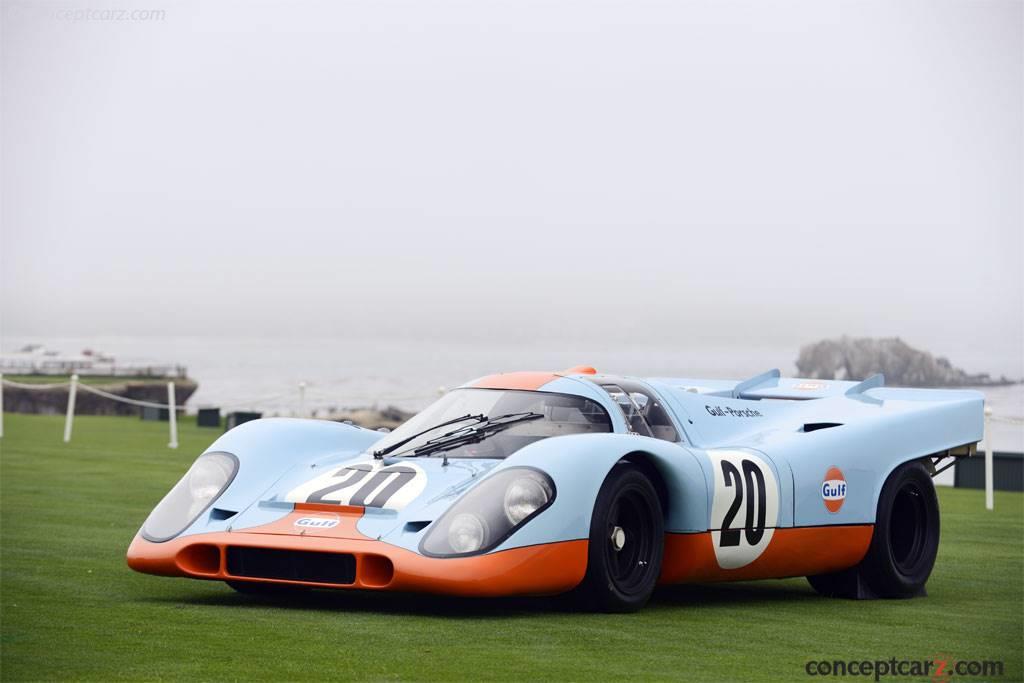
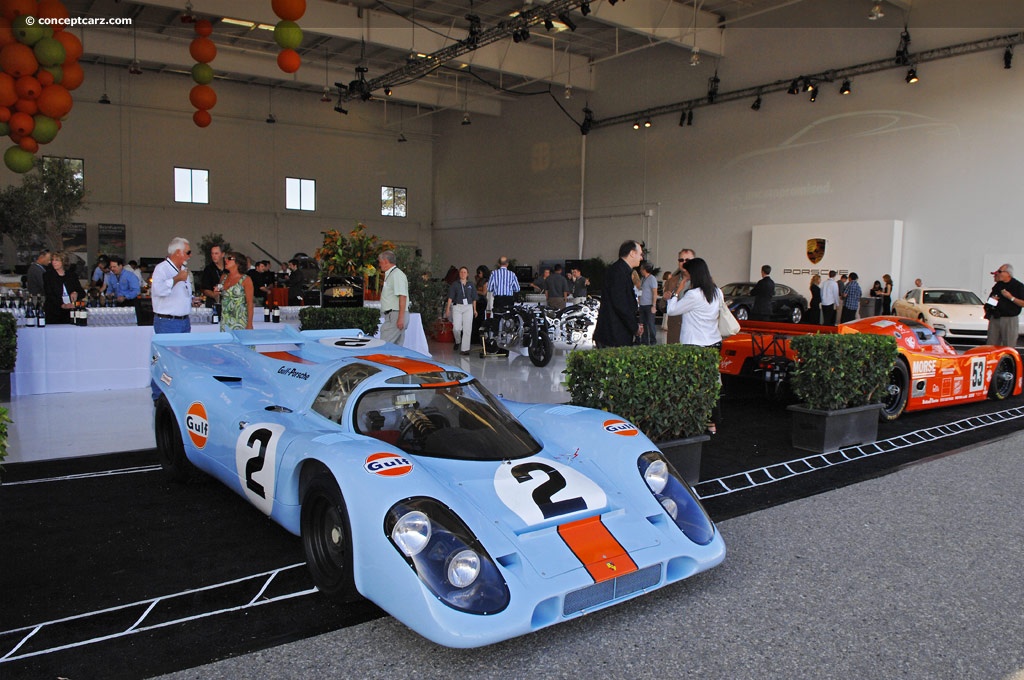
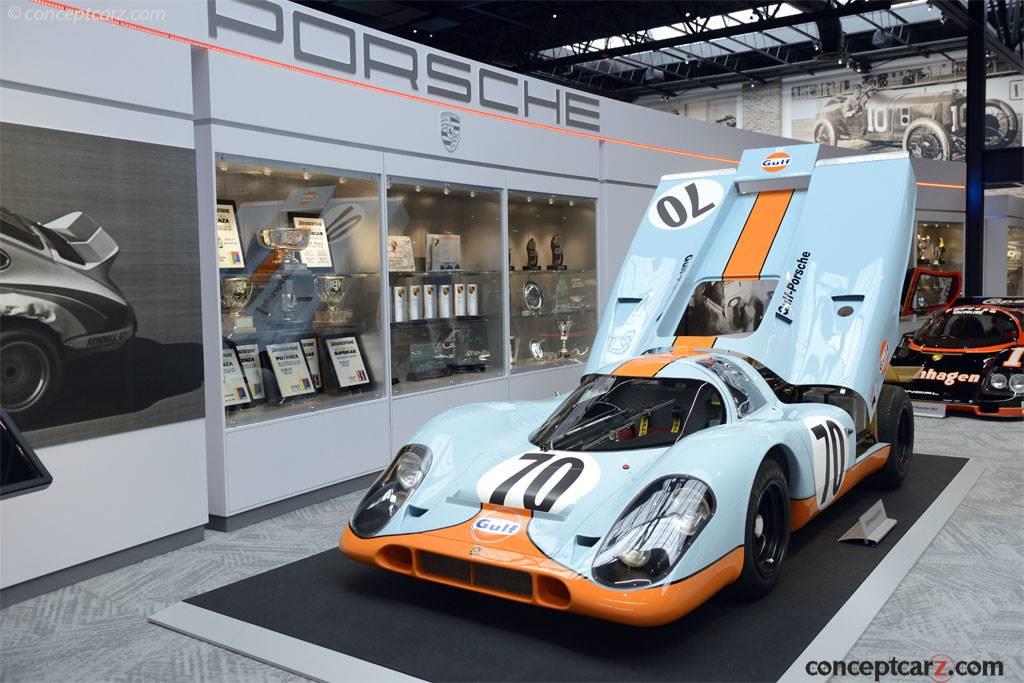
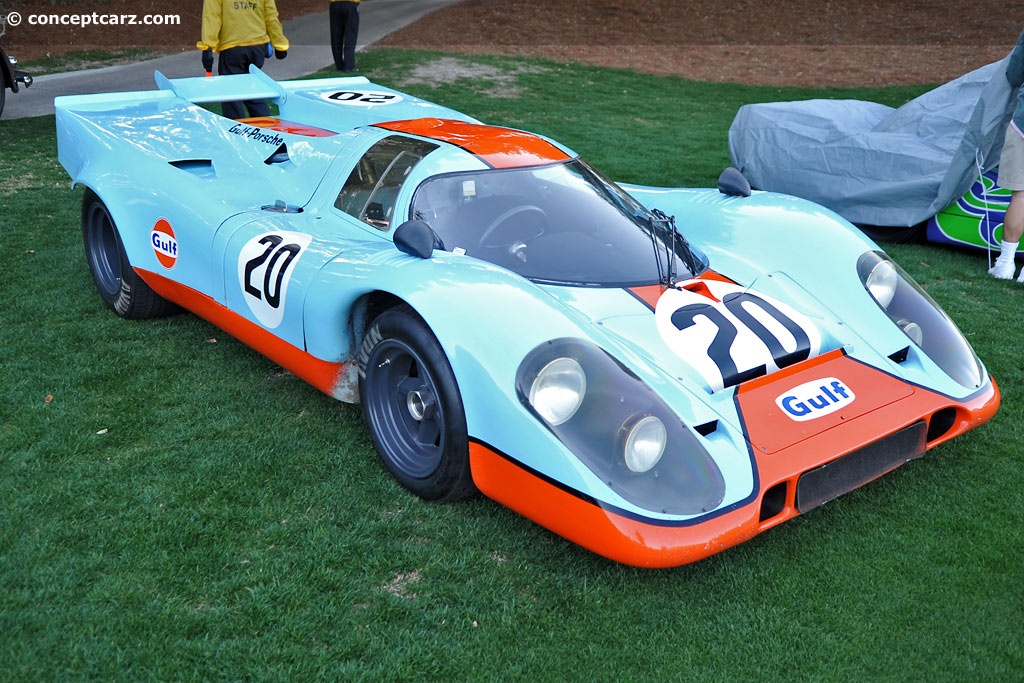
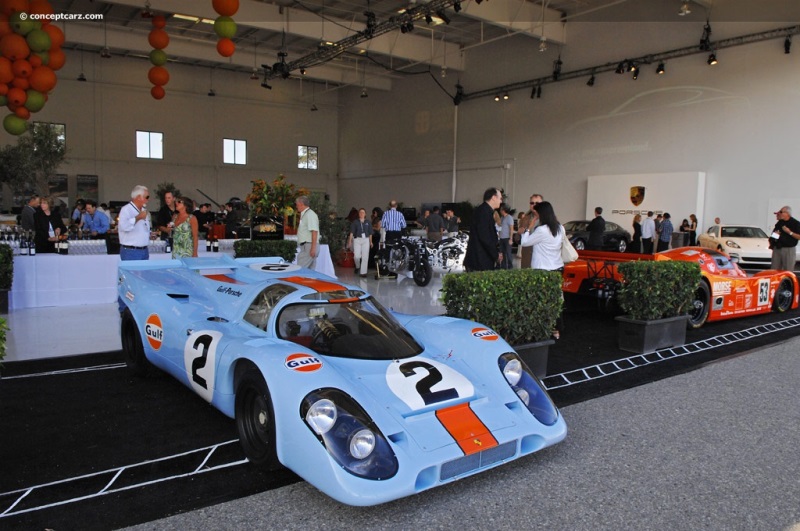
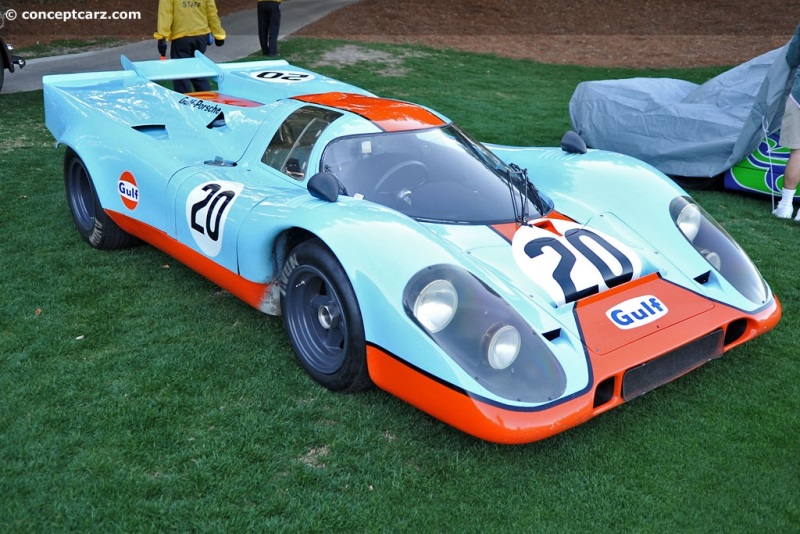
View info and historyThe first victory for the Porsche 917 came in the last race of the championship season, the 1000 km Zeltweg, with Jo Siffert and Kurt Ahrens driving the privately entered 917 of German Freiherr von Wendt. By this point the season, Porsche had withdrawn from racing, leaving those duties to be contested by customer teams, while they focused on development. This would continue into the 1970 season, with privateers being fully supported by the factory. The official Porsche team and development partner was the JWA Gulf Team of John Wyer.During testing sessions at the Osterreichring at Zeltweg, Wyer's chief engineer John Horsman noticed that portions of the bodywork had dead gnats, revealing the airflow. Since the tail was free of dead gnats, Horsman concluded that the air was not flowing over the tail. The car was brought to the pits and a make-shift solution with aluminum sheets taped together was added to the tail. This new short tail solution, and with the plastic engine intake cover removed, gave the 917 the downforce it required. This new and improved version was called the 917K (Kurzheck, or 'short tail'). At least twenty examples of the 917 were modified to 917K specification and another 12 new 917Ks were built-in 1970. For the 1970 season, the 917 was officially a Group 5 Sports Car after the FIA made another review of its classes. The compact 908/3 complied with FIA 3-litre Group 6 Prototype regulations. Together, the 917 and 908/3 were contenders at nearly every track, with the 908/3 performing well on the slow and twisty tracks while the 917 remained suitable for the high-speed circuits.
Kurzheck Coupe
Chassis #: 917.023
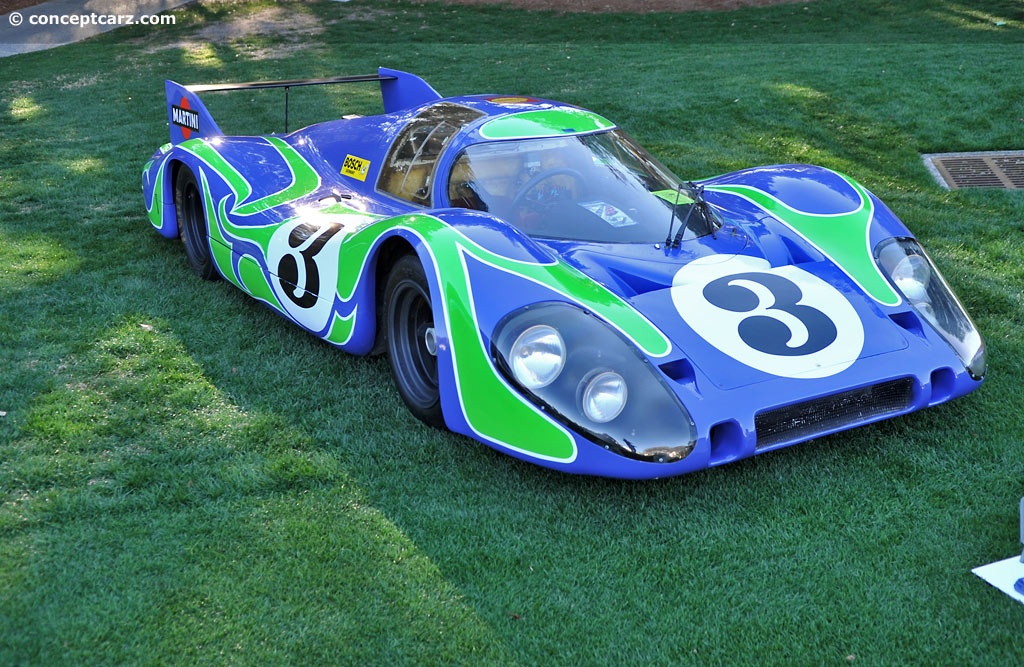
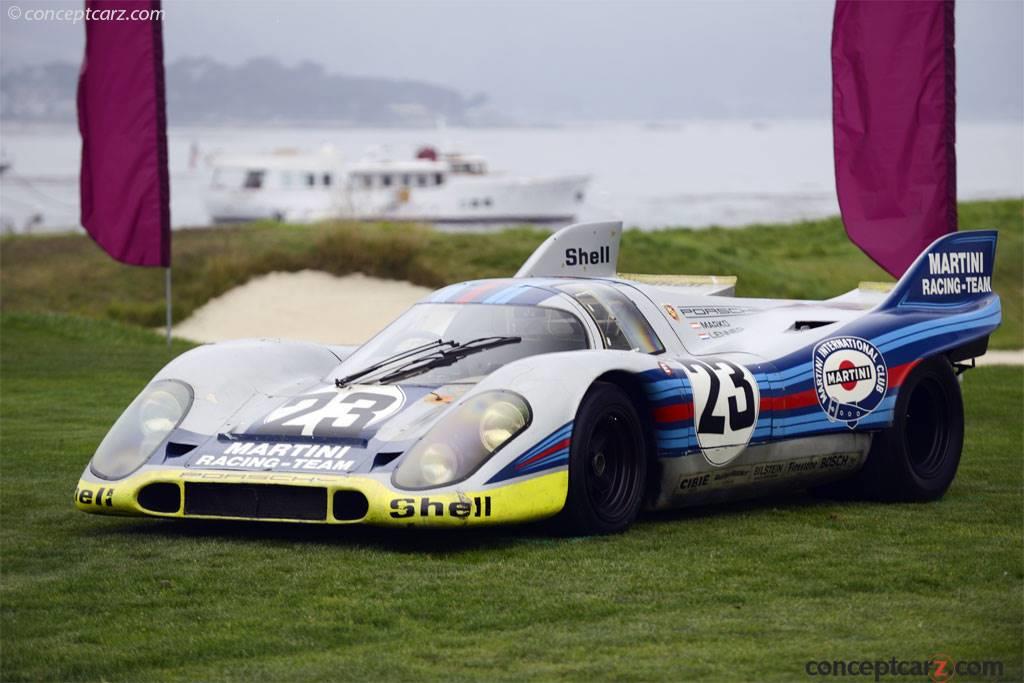
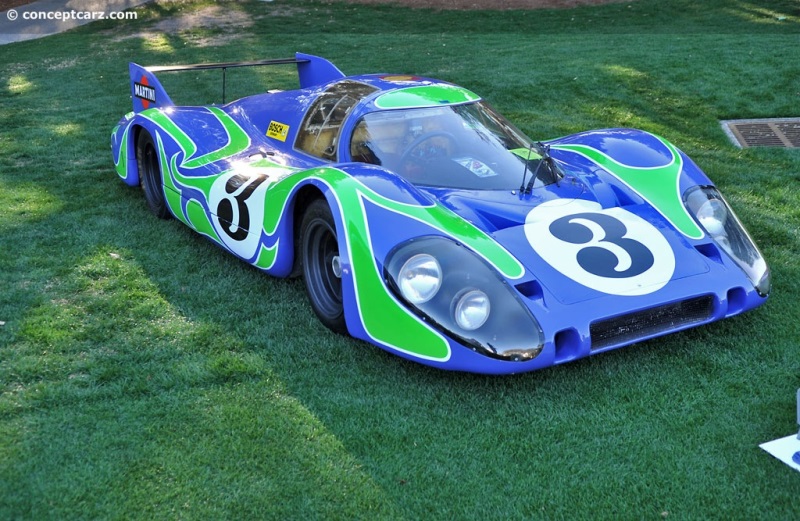
View info and historyThe Porsche Salzburg team was a factory team in 1969, and this role continued into 1970. The Martini Racing team also received support from Porsche AG. At LeMans, the favorite team to win was the Gulf-backed John Wyer Automotive, which brought three 917Ks, two with the 4.9-liter engine and one with the 4.5-liter unit. A new low drag version of the 917 had been developed for LeMans with support from the external consultant Robert Choulet. It had a new long-tail body that had very little drag, with more downforce than the 1969 long tail. Two 917 LK models were entered in LeMans, one in white and red trim by Porsche Salzburg. The car driven by Vic Elford and Kurt Ahrens claimed the pole position but during the race, the 4.9-liter engine dropped an inlet valve after 225 laps. Both of these drivers had also been entered on the team's other car, a red and white 917 K powered by a 4.5-liter engine, qualified by Hans Herrmann and Richard Attwood in the 15th spot, but they did not drive after their own car failed. Martini Racing had entered the other LH with Willy Kauhsen and Gerard Larrousse qualifying in 12th position. The livery of this car featured whirls and swoops of light green on a dark blue background, earning it the nickname the 'Hippie' or the 'Psychedelic' car.
Long Tail Coupé
Chassis #: 917-028
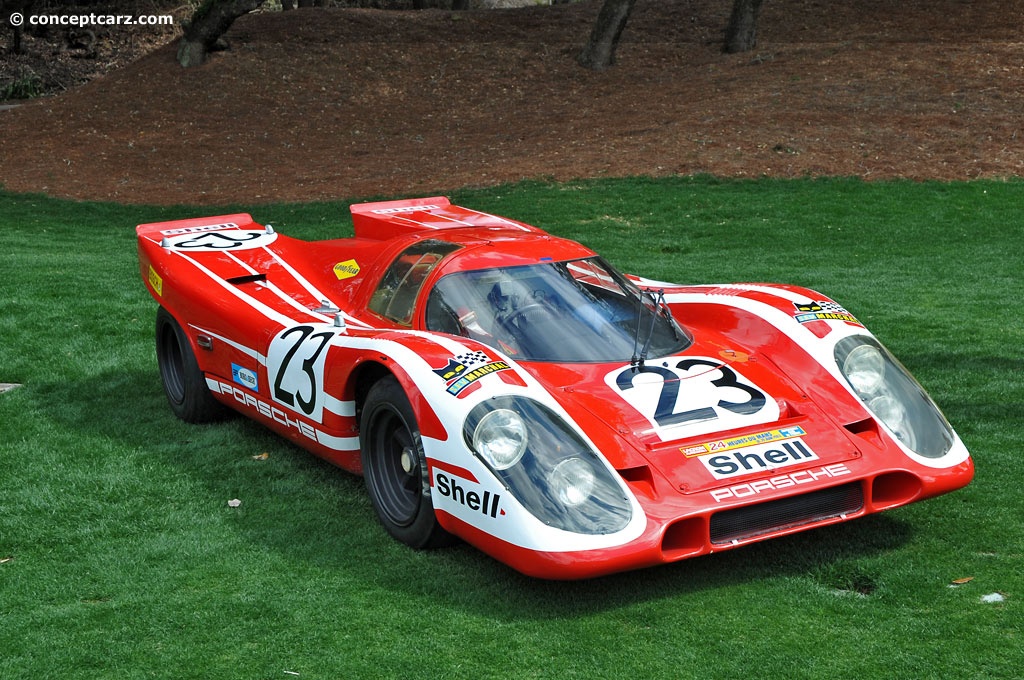
View info and historyPoor weather was responsible for several accidents, including many of the eleven Ferraris. The fastest Porsches and the sole remaining works Ferrari soon retired or crashed. All Wyer cars were out after 12 hours, leaving the Porsche Salzburg team with the red and white #23 917K with the standard 4.5-liter engine, driven by Hans Herrmann and Richard Atwood to score the first overall win at LeMans. Only 7 ranked finishers were able to complete the race. Martini's 917LH came in 2nd and a Porsche 908 came in third overall. A Porsche 914/6 finished in sixth overall and 1st in the GT class. A Porsche 911S was in seventh. The Ferrari 512s took fourth and fifth place. By the close of the season, the Ferrari 512 had been modified with similar bodywork to the 917K, earning it the name 512M (Modificata). The 512M was as fast as the 917s but without the reliability.At the close of the 1970 season, the FIA announced that Group 5 Sports Cars would be limited to a three-liter engine capacity maximum for the newly renamed World Championship of Makes in 1972. This meant the 917 and 512 models would be obsolete at the end of the 1971 season. With this news, Ferrari decided to focus its attention on the 1972 season, leaving the 917 to race against 512s entered by privateers, most of them using the M specification.
Long Tail Coupé
Chassis #: 917-024
Engine #: 917-021
View info and history
Auction entries : 1Porsche dominated the 1970 season, with the works teams of John Wyer Automotive and Porsche Salzburg winning 9 of the 10 championship races that season. Ferrari won at Sebring. The 917K won 7 of 8 events it was entered during 1970, and the 908/03 won the Targa Florio and the Nurburgring. At both of these events, the 917K was not entered by the works teams. During the 1971 season, the Porsche domination continued with the Gulf-Wyer and Martini Porsches winning many of the races. Porsche continued their efforts in research and development to keep the 917K and the 908/3 competitive throughout the season, as the Roger Penske-entered 512M 'Sunoco' and the Alfa Romeo T33/3 contested the overall lead at some events. With Mark Donohue driving, the Penske 512M qualified on pole at the 24 Horus of Daytona and the 12 Hours of Sebring. It finished 3rd at Daytona and 6th at Sebring after being involved in accidents at both events. The T33/3 won at Brands Hatch, the Targa Florio, and Watkins Glen. Porsche development led to the creation of a new magnesium chassis and aerodynamic improvements to the 917 LH. A test-bed and heavily modified car known as the 917/20 was built for future Can-Am parts and aerodynamic 'low-drag' testing. A 917/20 was painted in pike for the 24 Hour of LeMans, with names of cuts of meat written in German across it in a similar fashion to a butcher's carcass diagram, earning it the nickname 'Der Trüffeljager von Zuffenhausen' (The Trufflehunter of Zuffenhausen) or 'Pink Pig.' Its only race was at LeMans, and it qualified in 7th place, but during the night Reinhold Joest crashed the car after its brakes failed.
Coupé
Chassis #: 917-004
View info and historyThe 1971 LeMans was won by the number 22 Martini-entered 917K, chassis number 052, driven by Helmut Marko and Gijs van Lennep, with the magnesium frame. They set an overall distance record that remained until 2010 when the Audi R15 TDI driven by Romain Dumas, Mike Rockenfeller, and Timo Bernhard set a new record. Pedro Rodriquez had set a qualifying lap record which earned him pole position. His number 18 John Wyer Gulf LH was unable to finish the race. Another LH Martini car set a top speed record of 241 mph before being forced to retire due to engine failure. At the end of the 1971 season, the Porsche 917 was obsolete due to the reclassification and engine capacity limits. Instead of building a new car to 3-liter prototype regulations for the 1972 World Championship, Porsche modified the 917 for the North American Can-Am Championship. While the coupes dominated endurance racing in 1970-1971, open versions of the 917 were built for the Canadian-American Series. The 917/10K won the 1972 Can-Am championship and, together with the 917/30KL, won every round of the 1973 Can-Am, winning the championship and effectively killing the series.
by Daniel Vaughan | Mar 2020
Coupé
Chassis #: 917-043
Engine #: 015
View info and history

Spyder
Chassis #: 917.01.021
View info and history
Auction entries : 2
Coupé
Chassis #: 917-022
View info and history
Long Tail Coupé
Chassis #: 917.042
View info and history
Long Tail Coupé
Chassis #: 917-015
View info and history
Kurzheck Coupe
Chassis #: 917.023
View info and history
Long Tail Coupé
Chassis #: 917-028
View info and history
Long Tail Coupé
Chassis #: 917-024
Engine #: 917-021
View info and history
Auction entries : 1
Coupé
Chassis #: 917-004
View info and history
by Daniel Vaughan | Mar 2020
ATLANTA – March 9, 2009 – Forty years ago, on March 13, 1969 at the Geneva International Motor Show, today's Dr. Ing. h.c. F. Porsche unveiled a car that would exceed its creator's wildest dreams, and develop into one of the most iconic race cars of all time: The Porsche 917.
Coupé
Chassis #: 917-043
Engine #: 015
View info and historyProject 917 began in June 1968 in response to an edict from the international motor sports authority, known as the Federation Internationale de l'Automobile (FIA). They had announced a class for 'homologated sports cars' with up to a five-liter engine capacity and a minimum weight of 800 kilograms (1760 pounds).Under the supervision of Porsche family member and gifted engineer Ferdinand Piëch, the FIA-stipulated minimum 25 units of the new race car were to be completed by April 1969 so that the 917 could race during the 1969 international season. Initially, Porsche had built six cars and had 'all the bits and pieces to build 19 more for the homologation,' according to Rico Steinemann, Porsche's Racing Manager at the time, 'the FIA then decided, no!' All 25 cars would have to be built. As all of the racing department's resources were being utilized, the workers to build the cars would have to come from elsewhere. 'We put together apprentices, messenger boys, bookkeepers, office people and secretaries,' remembered Steinemann years later. 'Just enough people, taught just enough to put together 25 cars!'
Spyder
Chassis #: 917.01.021
View info and history
Auction entries : 2The original 25 'Secretary Cars,' as they came to be called, passed the FIA inspection with flying colors, despite the fact they would barely run on the street, let alone a race track. After the inspection, all but two of the cars were completely disassembled and rebuilt by the factory's race team mechanics.
The engine of the 917 was also unique. While the 917 retained Porsche's traditional horizontally opposed, air-cooled 'boxer-style' engine configuration, the 4.5 liter, 520 HP 12-cylinder engine was bigger than any engine Porsche had built until that time.
The frame, designed more for durability than lightweight was constructed of TIG-welded aluminum tubing (later switched to magnesium), while the fiberglass re-enforced resin bodywork weighed in at a total of 93 pounds.
The 917 shape underwent constant evolution, with Porsche engineers developing different body configurations to best meet the demands of the varied circuits on the World Championship calendar. In the late 60's and early 70's, the World Championship of Makes visited four different continents, all sporting many different styles of racetrack. The so-called short-tail, or 'Kurzheck' bodywork was designed for high downforce tracks, such as Watkins Glen and Brands Hatch, while the original 'Langheck' long-tail bodywork was further developed to optimize straight-line speed and stability on the long, ultra-high-speed tracks like Le Mans, with its 3.5 mile long Mulsanne Straight. The ultimate development of the 917 came with the open 917 Spyders, which later dominated both the CanAm and Interseries circuits.
Success was not immediate for the 917. After initially dropping out of its first three races due to technical problems, the 917 success story, as we know it, began in August 1969 at a 1,000-kilometer race at the Österreichring with a victory by Jo Siffert and Kurt Ahrens.Despite Piëch's desire that Porsche 'to be the best. Everywhere.' the delays and lack of development time prevented the 917 from winning the championship in 1969. But by the end of the 1970 race season, Porsche demonstrated the superiority of the 917 and the 908/03 models by taking the World Championship of Makes by winning nine of ten possible victories. This series of victories began with the Daytona 24 Hours and continued at Brands Hatch, Monza, Spa, the Nürburgring Nordschleife, the Targa Florio, Watkins Glen 6-Hour and at the Österreichring. However, the season's high point was the long-desired overall win at the Le Mans 24-hour endurance race, a trophy that Hans Herrmann and Richard Attwood brought home to Zuffenhausen on June 14, 1970. The number 23, 917K short-tail model, painted in the red and white colors of Porsche Salzburg, successfully fought off the combined factory efforts of Ferrari, Matra and Lola while battling horrible weather conditions during the race.
Coupé
Chassis #: 917-022
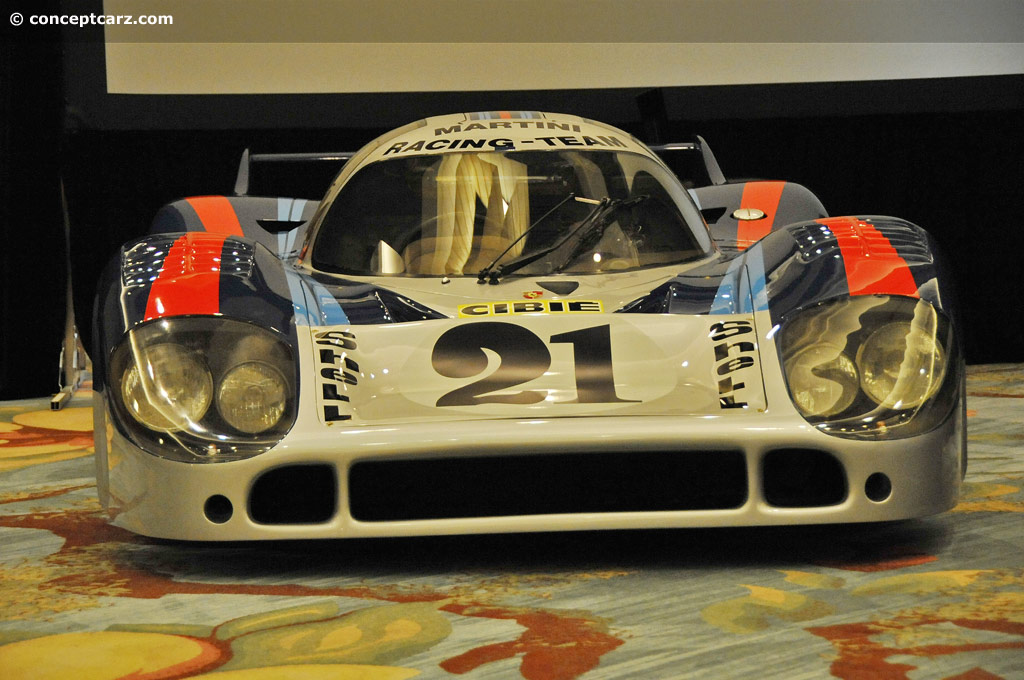
View info and historyThe 1971 season was once again dominated by the 917, as Porsche defended their World Championship of Makes crown by winning eight out of the ten races on the schedule. And, for the second year running, a Porsche 917 was victorious at the Le Mans 24-Hour race – this time with Gijs van Lennep and Dr. Helmut Marko driving, who set world records with an average speed of 222 km/h (137.6 mph) and a total of 5,335 kilometers (3,107.7 miles) driven, records that still stand today. The 917 long-tail coupe also set another record in 1971: Car number 21 turned in the highest speed ever recorded on the Mulsanne Straight of 387 kilometers per hour (240 mph). The 1971 race also marked the debut of one of the most fabled iterations of the 917. A cross between the short-tail and the long-tail models produced the 917/20. The car was distinguished by its wide cross section and its striking pink color. Although the car, nicknamed 'The Pink Pig', dropped out halfway through the race, its unusual paint scheme made it one of the most famous Porsche models ever, joining the 1970's 'Hippie Car' as a Porsche Racing classic.
When the European FIA regulation for '5-liter sports cars' expired at the end of the 1971 season, Porsche decided to enter the Sports Car Club of America's Canadian American Challenge Cup (CanAm). There had been exploratory efforts in the CanAm as early as 1969, but this was the first championship-level effort from PAG. Tony Dean, driving his own independently entered 908/2 took a surprise rain-soaked win at the Road Atlanta CanAm in 1970.After many months of testing and development in Weissach done in conjunction with Penske Racing's legendary driver and engineer, Mark Donohue, the 917/10 made its CanAm debut in June of 1972. Now turbocharged, the 12-cylinder boxer engine pumped out an incredible 1,000 horsepower but an early season testing accident caused Donohue to sit out most of the season. His replacement, George Follmer went on to dominate the series and won victories at Road Atlanta, Mid Ohio, Elkhart Lake, Laguna Seca and Riverside, thus clinching the 1972 CanAm championship and virtually chasing the formerly invincible Team McLaren from the series.
Long Tail Coupé
Chassis #: 917.042
View info and historyFor an encore, Porsche and Penske went to work on its 1973 challenger, the 917/30. In what turned into the ultimate development of the 917 platform, and with the engine, producing 1,200 horsepower it was the class of the field at every race. The superiority of the car, driven by Mark Donohue, was so obvious that the CanAm series regulations were changed at season's end in order to prohibit the 917/30 from competing in 1974. The 917/30 did live on in the Interserie series in Europe, where Herbert Mueller won the championship in 1974 and 1975. Also in 1975, at the Talladega Superspeedway in Alabama, Donohue set the World Closed Course Speed Record driving the Penske 917/30 at an average speed of 221.120 mph.As is typical of Porsche, the technologies developed during the racing career of the 917 were successfully transferred to its road cars; one of the most obvious examples is the original 911 Turbo, and why Porsche is synonymous with performance, efficiency and engineering excellence.The reputation of the 917 is legendary. When 50 international motor sports experts from the famous British trade magazine 'Motor Sport' were asked to name the 'greatest racing car in history' they cited the Porsche 917. Overall, Porsche built 65 units of the 917: 44 sports cars as short-tail and long-tail coupés, two PA Spyders as well as 19 sports cars as CanAm and Interseries Spyders with up to 1,400 HP turbo engines.
Long Tail Coupé
Chassis #: 917-015
View info and historyToday, seven of the most important 917 models – among them the Le Mans-winning cars from 1970 and 1971 and the 917/30 CanAm Spyder – are currently on exhibit in the new Porsche Museum in Stuttgart-Zuffenhausen. Most of the other 917s are in the hands of proud collectors around the world, and have been seen – and heard – at the most prestigious vintage events, including Goodwood, Amelia Island, Monterey Historics, and Porsche's three Rennsport Reunions in the U.S. in 2001, 2004 and 2007. Porsche Motorsport North America, the racing arm of Porsche in the U.S., services, restores, rebuilds and maintains many of these 917s for collectors at its shop in Santa Ana, California.Source - Porsche
Coupé
Chassis #: 917-043
Engine #: 015
View info and history
Spyder
Chassis #: 917.01.021
View info and history
Auction entries : 2
The engine of the 917 was also unique. While the 917 retained Porsche's traditional horizontally opposed, air-cooled 'boxer-style' engine configuration, the 4.5 liter, 520 HP 12-cylinder engine was bigger than any engine Porsche had built until that time.
The frame, designed more for durability than lightweight was constructed of TIG-welded aluminum tubing (later switched to magnesium), while the fiberglass re-enforced resin bodywork weighed in at a total of 93 pounds.
The 917 shape underwent constant evolution, with Porsche engineers developing different body configurations to best meet the demands of the varied circuits on the World Championship calendar. In the late 60's and early 70's, the World Championship of Makes visited four different continents, all sporting many different styles of racetrack. The so-called short-tail, or 'Kurzheck' bodywork was designed for high downforce tracks, such as Watkins Glen and Brands Hatch, while the original 'Langheck' long-tail bodywork was further developed to optimize straight-line speed and stability on the long, ultra-high-speed tracks like Le Mans, with its 3.5 mile long Mulsanne Straight. The ultimate development of the 917 came with the open 917 Spyders, which later dominated both the CanAm and Interseries circuits.
Success was not immediate for the 917. After initially dropping out of its first three races due to technical problems, the 917 success story, as we know it, began in August 1969 at a 1,000-kilometer race at the Österreichring with a victory by Jo Siffert and Kurt Ahrens.Despite Piëch's desire that Porsche 'to be the best. Everywhere.' the delays and lack of development time prevented the 917 from winning the championship in 1969. But by the end of the 1970 race season, Porsche demonstrated the superiority of the 917 and the 908/03 models by taking the World Championship of Makes by winning nine of ten possible victories. This series of victories began with the Daytona 24 Hours and continued at Brands Hatch, Monza, Spa, the Nürburgring Nordschleife, the Targa Florio, Watkins Glen 6-Hour and at the Österreichring. However, the season's high point was the long-desired overall win at the Le Mans 24-hour endurance race, a trophy that Hans Herrmann and Richard Attwood brought home to Zuffenhausen on June 14, 1970. The number 23, 917K short-tail model, painted in the red and white colors of Porsche Salzburg, successfully fought off the combined factory efforts of Ferrari, Matra and Lola while battling horrible weather conditions during the race.
Coupé
Chassis #: 917-022
View info and history
When the European FIA regulation for '5-liter sports cars' expired at the end of the 1971 season, Porsche decided to enter the Sports Car Club of America's Canadian American Challenge Cup (CanAm). There had been exploratory efforts in the CanAm as early as 1969, but this was the first championship-level effort from PAG. Tony Dean, driving his own independently entered 908/2 took a surprise rain-soaked win at the Road Atlanta CanAm in 1970.After many months of testing and development in Weissach done in conjunction with Penske Racing's legendary driver and engineer, Mark Donohue, the 917/10 made its CanAm debut in June of 1972. Now turbocharged, the 12-cylinder boxer engine pumped out an incredible 1,000 horsepower but an early season testing accident caused Donohue to sit out most of the season. His replacement, George Follmer went on to dominate the series and won victories at Road Atlanta, Mid Ohio, Elkhart Lake, Laguna Seca and Riverside, thus clinching the 1972 CanAm championship and virtually chasing the formerly invincible Team McLaren from the series.
Long Tail Coupé
Chassis #: 917.042
View info and history
Long Tail Coupé
Chassis #: 917-015
View info and history
Related Reading : Porsche 917 History
In July of 1968 Porsche began designing and building a new prototype for the Sport category. The FIA changed the regulations of the Sport category to allow vehicles with 5-liter engines, up from the prior 3-liter capacity. Instead of 50 examples, only 25 examples needed to be produced to satisfy homologation rules. With the 917, Porsche had high hopes for capturing an overall victory at the grueling....
Continue Reading >>
Continue Reading >>
- 1970 Porsche 917 Menu
- Article
- Image gallery
- Valuation
- Specifications
- Profiles
- Production figures
Porsche
Similar Vehicles
Similar Automakers
Similarly Sized Vehicles
from 1970


1970 Porsche 917 Vehicle Profiles




Recent Vehicle Additions


Related Automotive News

Mecum Unveils 1970 Porsche 917K, Steve McQueen's Hero Car from 'Le Mans' for Auction
917-022 to Headline The Worlds Largest Collector Car Auction® in Kissimmee This January
Highlights
Mecum unveils 1970 Porsche 917K (917-022), Steve McQueens Hero Car from Le Mans, announcing it will be auctioned at Kissimmee 2025...

Iconic and Legendary 1970 Porsche 917K Races to The Pebble Beach Auctions Presented by Gooding & Company
Formerly the property of famed driver Jo Siffert and used in the epic film Le Mans, this historic Porsche will headline the auction houses premier sale this August
SANTA MONICA, Calif. (June 22, 2017) – Gooding %26 Company, the official...

From Lucybelle to DHL: Historic Porsche Competition Cars Race to Gooding & Company's Pebble Beach Auctions
The very best of Porsche excellence will come to Pebble Beach with a 1959 Porsche 718 RSK, a 1969 Porsche 90802, a 2007 Porsche RS Spyder Evo, and more.
Gooding %26 Company, the official auction house of the Pebble Beach Concours dElegance®,...
All-Star Cast of Cars, Drivers at Porsche Rennsport Reunion V
The Porsche highlights for a weekend full of highlights
Atlanta, Georgia. For the Porsche Rennsport Reunion V taking place at Mazda Raceway Laguna Seca this weekend, both the men and the machines they drove are expected to outdraw one...

VIC ELFORD RECEIVES RRDC'S 2015 PHIL HILL AWARD
DAYTONA BEACH, Fla. (Jan. 22, 2015) - Vic Elford, considered one of the fastest race-car drivers of the Sixties and Seventies, was honored by the Road Racing Drivers Club with the 2015 Phil Hill Award. RRDC president Bobby Rahal made the presentation...

1969 24 Hours of Le Mans: A Traditional Statement Provides a Memorable Race
What if a statement ended up costing one of the biggest victories of ones career Would it be worth it Jacky Ickx would come close to finding out as he approached the checkered flag on the afternoon of the 15th of June in 1969.
Ford had determined...
RRDC VOTES IN 37 NEW MEMBERS FOR 2013
HILLIARD, Ohio (Nov. 7, 2013) - Thirty-seven race-car drivers and motorsports professionals have been voted into the Road Racing Drivers Club in 2013. The group includes 13 Regular Members from the open-wheel and sports-car racing ranks, 20 Associate...