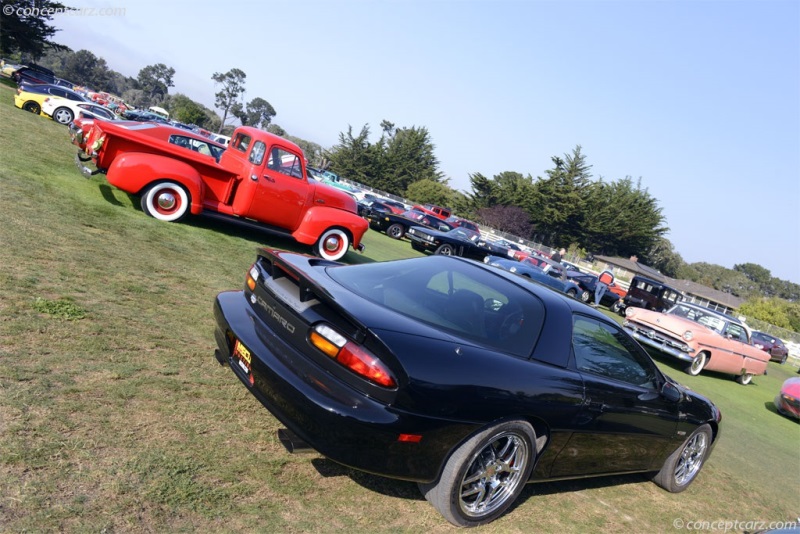
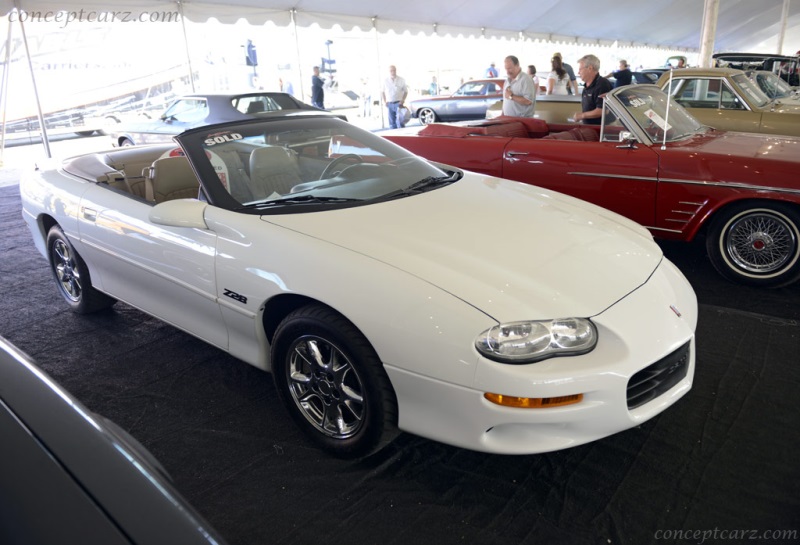
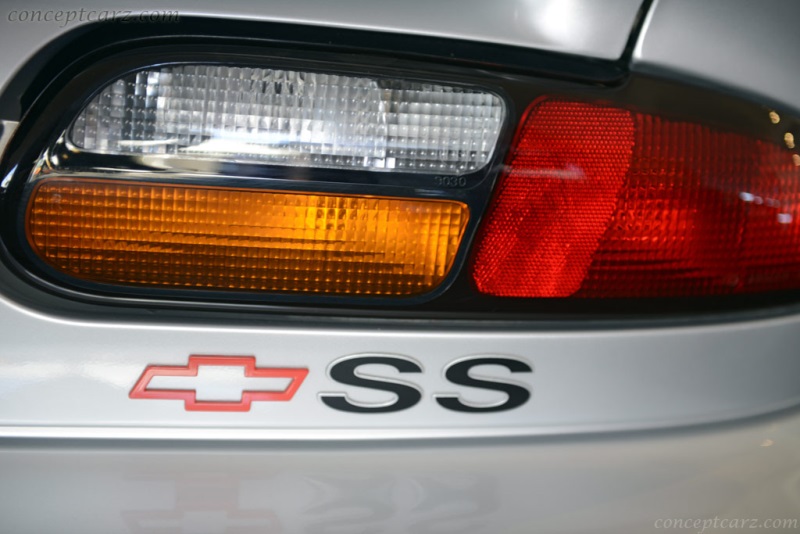
2001 Camaro |
Image credits: © Chevrolet. GM Corp
2002 Chevrolet Camaro news, pictures, and information | ||
| Tweet | ||
2002 CHEVROLET CAMARO CELEBRATES 35 YEARS AS AN AMERICAN CLASSIC
Camaro is the purest, most uncompromising expression of the breed, 'America's honest sports car.' And it celebrates its 35-year heritage by introducing a limited edition 35th Anniversary Package in 2002, available on SS Coupes and SS Convertibles. All are finished in Bright Rallye Red. Coupes include removable T-tops roof panels and body-color roof halo; convertibles have a black top. Wide dual stripes, fading solid silver into a checkered flag, run the length of the vehicle from the front fascia, over the hood and onto the rear decklid and spoiler.Other distinguishing features are black SS wheels wîth machine-faced surfaces, a silver debossed Camaro name on the front grille and rear fascia, and commemorative front fender emblems.
Inside, the 35th Anniversary logo is embroidered onto the front headrests and a special trophy/rear shelf mat. Also included is an Ebony leather interior trim wîth Medium Gray leather inserts as well as a special-issue owner's portfolio. And all 2002 Camaros sport a 35th anniversary badge on the dashboard.
Camaro continues in coupe or convertible form. Eager to perform, Camaro offers four unique models, a trio of transmission options and other option packages such as the SS. Customers have a choice of affordable performance-oriented sporty cars wîth traditional rear-wheel drive and muscular pushrod V8 engines versus higher-priced domestic or import models.
Choice of coupes & convertibles
The four available models are Camaro Coupe and Convertible, and Z28 Coupe and Convertible. Coupe models are also available wîth removable roof panels, exclusive among the non-GM vehicles in its market §egmènt.
In addition, two option packages transform Camaro into something sportier still. The Sport Appearance Package includes specific front and rear fascias and a rear spoiler extension, and is available on any Camaro model except the SS.
The SS Performance/Appearance Package adds even more ‘beef' to the already muscular Z28 coupe or convertible. It includes more power–325 horsepower vs. Z28's 310–a forced-air induction composite hood, unique rear spoiler and low-restriction/dual-outlet exhaust wîth larger pipes, and can be ordered wîth either a six-speed manual or four-speed automatic transmission. (posted on conceptcarz.com)
Additionally, a host of performance and appearance options are available on the Camaro SS, such as a grille insert, a 'cat-back' exhaust system wîth center-mounted rear exhaust outlets, special purpose suspension packages and more.
The Camaro RS package is also available on the Camaro V6 coupe.
Standard features list expanded
Several significant adjustments have been made to the list of standard equipment for Camaro in 2002. For instance, all V6-equipped models receive P235/55R-16 touring tires and painted 16-inch cast aluminum wheels, which replace P215/55R16 ties and bolt-on wheel covers. All V8-powered models benefit from wider speed rated P245/50ZR-16 Goodyear Eagle RS-A all-season tires for increased road-holding capability. The new tires replace P235/55R16 Goodyear Eagle GA non-speed rated tires.
Additionally, a four-speed automatic becomes standard issue on V6-equipped convertibles, and a power §teering cooler is outfitted on all Z28 models. Sebring Silver Metallic joins the Camaro exterior color palette, replacing Mystic Teal Metallic.
A well-equipped driver's car
Driving excitement is standard equipment wîth Camaro, yet Chevrolet has not overlooked comfort, convenience and safety.
High-back bucket seats, driver-oriented instrumentation and center armrest/console provide the front occupants wîth a cockpit-like feel. Every Camaro also features power-assisted four-wheel anti-lock disc brakes, power-assisted rack-and-pinion §teering, a tilt §teering column, air conditioning and a Firm Ride & Handling suspension.
Sound systems include an AM/FM stereo wîth in-dash CD player and extended range speakers for V6-equipped coupes. The V6 convertibles and all Z28s also get an upgrade wîth standard installation of a Monsoon AM/FM Premium Sound system wîth in-dash CD. All systems feature an electronically tuned receiver (ETR) and include TheftLock, seek-scan and auto tone control. A 12-disc remote CD changer is optional across the Camaro family.
Standard safety and security items include dual front air bags, battery run-down protection, a passive theft-deterrent system, engine oil life monitor and daytime running lamps.
During the preproduction stages of the Chevrolet Camaro, General Motors codenamed the vehicle 'Panther'. The name 'Camaro' was decided upon before production began. The word 'Camaro' in French is slang for 'friend' but in pony-car slang, the name means 'Mustang killer'.
During its production lifespan, there were four generations produced. The first generation lasted from 1967 through 1969. The second generation lasted from 1972 through 1981. The third generation lasted from 1982 through 1992. The fourth generation lasted from 1993 through 2002. The fifth generation is believed to begin production in 2007; a concept was shown at the 2006 Detroit Auto Show.
When the car was introduced in 1967, it was available in two bodystyles, a coupe and convertible. It shared many mechanics with the Chevrolet Nova and built atop a unibody chassis. The base engine was a 3.7 liter inline-six cylinder capable of producing 140 horsepower. Power was sent to the rear wheels courtesy of a Saginaw three-speed manual gearbox. A Muncie four-speed manual and a two-speed PowerGlide automatic were offered as optional equipment. Near the end of 1967, a Turbo Hydra-Matic 350 became available on the SS396. In 1969 the TH350 was offered on the Camaro as optional equipment, in place of the PowerGlide which was no longer offered. 14 inch wheels were standard.
To compete in the pony-car arena, General Motors offered a 5.7 liter eight-cylinder engine in 1967 that produced nearly 300 horsepower.
The Camaro was highly customizable, with over seventy factory and forty dealer options available. the z28 option was not mentioned in the sales literature so many buyers were unaware of its existence. Due to the lack of press about the Z28 option, only 602 examples were produced. The package included many performance enhancements such as a 4.9 liter small-block engine, front disc brakes, Muncie 4-speed gearbox, suspension improvements, 15 inch Rallye wheels, and power steering. The aesthetics of the vehicle were segregated from the other Camaro's with racing stripes being placed on the hood. The Z28 package was offered by GM specifically to comply with the Sports Car Club of America (SCCA) Trans Am racing series that required an engine size of five-liters or less. Also, the vehicle must be sold to the general public.
The SS (Super Sport) package included many performance and aesthetic upgrades and was popular with more than 34400 examples created. Under the hood was a 5.7 liter eight-cylinder engine with a 6.5 liter big-block offered as optional equipment in 1968. On the grille, horn button, and gas cap were SS badging. Non-functional air-inlets adorned the front hood.
The RS (Rally Sport) package was basically a cosmetic upgrade. The headlights were hidden, the taillights received minor alterations, and the exterior rocker trim was revised. RS badging could be seen throughout the vehicle. This was the most popular option ordered in 1967 with over 64840 examples produced.
The RS and SS packages could be ordered together, creating the RS/SS Camaro. The combination included both the aesthetics of the RS and the performance of the SS. A Camaro RS/SS convertible with a 6.5 liter engine paced the Indianapolis 500 race in 1967.
With over 220900 examples produced in 1967, the Camaro proved to General Motors that the public was starved for small, performance, pony-cars.
In 1968 the Camaro received minor aesthetic and mechanical improvements. Side market lights were added, the grille became more pointed, and the taillights were now segregated. The side vent windows were removed. Performance was improved slightly by the staggering of the shock absorbers. On some of the models, the single-leafs were replaced by multi-leaf springs.
Buyers became aware of the Z28 package in 1968 and ordered nearly 72000 examples. The RS continued to be the most popular option with 40977 examples produced. The SS accounted for 27884 of the 235147 total Camaro's produced in 1968.
For 1969 the Camaro became safer and faster. General Motors mandated that the Camaro could not come from the factory with engines larger than 6.6 liters. To bypass this rule dealerships such as Yenko Chevrolet, Dana Chevrolet, and Nickey Chevrolet offered the Camaro with the 7 liter, big-block, L-27 corvette engine producing 425 horsepower. These performance options became so popular that in 1969 Chevrolet began offering two Central Office Production Orders (COPO) options, numbers 9560 and 9561. The COPO 9561 option included the L-72 Corvette engine. In total, there were 1015 Camaros equipped with the L-72 Corvette engine.
The COPO 9560 option included a 7-liter, big-block, ZL-1 engine. The engine was constructed of aluminum to help reduce the overall weight. The engine was reported to have produced around 430 gross horsepower but in reality it was closer to 550. With only 69 examples produced it is one of the rarest and fastest of all Chevrolet Camaros.
Most of the 1969 Chevrolet Camaro mechanics remained unchanged. The aesthetics was a different story. The grille was redesigned and the headlights now sat farther back adding to the aggressive features of the car. Newly reshaped door, rear quarter panel, and rear valence gave the 1969 Camaro a smooth, low, and wide stance. The production of the 1969 Camaro, which continued into December of 1969, was the final year for the first generation Camaro.
The second generation Camaro began production near the middle of 1970. The body had been redesigned and the suspension was greatly improved. The rest of the mechanics remained mostly unchanged from the prior years. The biggest change was the base engine, which was now a 4.1 liter inline-six capable of producing 155 horsepower. There was no convertible option offered, only a 2+2 coupe configuration.
The big-block eight-cylinder had been bored to 402 cubic-inches but still retained its 396 badging. The Rally Sport, Super Sport, and Z28 packages were still available. The Z28 now featured a 5.7 liter engine that produced 360 horsepower.
1972 was not a good year for the Camaro. For 174 days production ceased at GM's assembly plant in Ohio due to a UAW strike. This resulted in 1100 Camaro's failing to meet 1973 Federal bumper safety standards. In total, only 68,656 examples were production. Less than a thousand were the SS package so General Motors decided to no longer offer the package after 1972. This meant the big-block 396 cubic-inch engine was no longer offered.
The Camaro, much like the rest of the industry, had to adapt to new government and insurance safety and emission regulations. This meant new safety features like larger bumpers needed to be affixed to the car that could protect the vehicle and its occupants at certain speeds. Engines were detuned to comply with safety and emission concerns. The cars became safer but their performance was seriously crippled. This was true for the Camaro in 1973 when its highest producing engine was a 350 cubic-inch V-8 that produced 245 horsepower.
New for 1973 was an LT option which included impact-absorbing bumpers. The Camaro grew in size in 1974 due to a forward sloping grille and new aluminum bumpers. Rectangular bumpers replaced the round taillight designs. Sales of the Z28 package continued to decline so the decision was made to discontinue the option after 1974.
Horsepower was measured in NET rather than gross rating beginning in 1975. This meant that the reported horsepower was much lower than in prior years. The 350 cubic-inch V8 was now rated at about 155 horsepower.
In 1977 the Z28 was re-introduced in an effort to revitalize the muscle-car persona of the Camaro. The base Camaro's were outfitted with air-conditioning and an automatic transmission. A Borg-Warner Super T-10 four-speed manual gearbox could be ordered as optional equipment.
1978 marked the first year for the T-top option on a Camaro. The Camaro was given larger taillights and new bumpers.
As vehicles became safer, they became slower. The public shifted from wanting performance to luxury. Oil embargos and rising fuel costs had made the engines smaller but more fuel efficient. For 1979 the LT package was replaced with a luxurious Berlinetta that included special wheels, paint, emblems, and interior.
1979 was a very strong year for Camaro sales with 282,571 examples being sold.
1980 and 1981 saw very few changes. The hood scope on the Z-28 was revised to help siphon air to the engine.
In 1981 sales were down considerable to just over 126,000. This would be the final year for the second generation Camaro.
In 1982 General Motors introduced the third generation of the Camaro. The vehicle was stylish and versatile, earning the coveted Motor Trend magazine's Car of the Year. Both aesthetically and mechanically, the vehicle was improved. The suspension was upgraded making it more capable in the corners and at speed.
This was the first year the Camaro was equipped with a factory fuel-injected engine. A four-speed automatic gearbox replaced the three-speed unit. A five-speed manual gearbox was also available. Due to rising concerns of oil shortage, a four-cylinder engine was offered for part of 1982.
6000 examples of the Z28 Camaro were sold to commemorate the return of the pony-car to the Indianapolis 500. The special-edition vehicles were painted in two-tone silver and blue paint with orange pin-striping.
To honor the International Race of Champions, Chevrolet introduced the IROC-Z in 1985. The package included an improved suspension, decal package, and a 305 cubic-inch L98 Tuned Port Injection system borrowed from the Corvette. The IROC-Z was featured on Car and Driver magazine's Ten Best List for 1985.
The L69 small-block engine was offered from 1983 through 1986. The LB9 small-block was introduced in 1985; the L98 small-block was introduced in 1987; the LO3 was introduced in 1988. The LB9, L98, and LO3 stayed in production until 1992.
1992 was the final year for the third generation Camaro. 1993 marked the beginning of the fourth generation which persisted until 2002.
New technology and material made the fourth generation greatly improved over the prior years. Weight was reduced with the use of plastic body panels sitting atop a steel space frame. Performance was increased thanks in part to a better suspension system. In 1993 Chevrolet offered the LT1 eight-cylinder engine, which had been in production for a year on the Corvette, on the Camaro. A six-speed manual gearbox was offered with the LT1 engine.
The Camaro returned to the Indianapolis 500 as the honorary pace car in 1993. To commemorate this historic accomplishment, Chevrolet offered a limited quantity of special edition Camaro's, painted in a black and white color scheme.
The design and mechanics remained mostly unchanged over the next few years. Minor revisions were made to comply with newly introduced emission standards. Mechanical changes were made to correct problems that had been found throughout the years.
In 1996 the RS package and the SS package were re-introduced. The RS was an appearance option for the six-cylinder Camaro's while the SS was both an appearance and performance package for the eight-cylinder cars.
1997 marked the 30th anniversary of the Camaro. A 30th Anniversary Package was offered to honor this accomplishment. The vehicles were painted white with orange stripes. 100 of the Anniversary Camaros were given the LT4 engine with 330 horsepower; a thirty-eight thousand dollar price tag accompanied the vehicle.
The interior of the Camaro was modernized in 1997 and again in 1998, although the 1998 improvements were minor in comparison to what transpired the prior year.
The body design was drastically changed in 1998, mainly in the front. Round headlights replaced the square design. The headlights were flush, inline with the rest of the body. A new grille and bumper were used, both positioned a little differently to mimic the headlight changes. A new powerful, lightweight, all-aluminum LS1 power-plant retired the LT1 unit. The OHV LS1 was borrowed from the Corvette and slightly detuned to produce just over 300 horsepower. To handle this extra power, the disc brakes were enlarged and the suspension was upgraded.
Total production for 1998 was 48490. This was disappointing for General Motors, especially with the newly revised body and powerful options. The lowest production year for the Camaro occurred in 2001 with just over 29000 examples being produced. This was due to low sales and production ceasing early to begin work on the 35th Anniversary 2002 cars.
2002 marked the final year for production of the fifth generation Camaro. The styling and mechanics were unmodified, carrying the same design from 1999.
A special 35th Anniversary Edition was offered and could be ordered on all trim levels and packages. The 35th Anniversary SS Camaro could only be ordered as a convertible or with T-Tops. Around 3000 examples of the 35th Anniversary Edition were created. Total production for the year was just over 42,000.
On August 27th, 2002 production ceased. The Camaro had accomplished its goal, to provide competition for the Ford Mustang and other compact, low-priced, sports cars. Outfitted with large, Corvette engines, matted to effective gearboxes and given great suspension and brakes, the Camaro was truly a performance machine that was capable and fun to drive. It was fairly practical with room for more than two passengers. It was economical with sticker-prices in the range that many could afford. The production of the Camaro has ceased, but its future has not yet been written. Expect to see this legendary vehicle on the roadways in the near future.
By Daniel Vaughan | Mar 2006
During the preproduction stages of the Chevrolet Camaro, General Motors codenamed the vehicle 'Panther'. The name 'Camaro' was decided upon before production began. The word 'Camaro' in French is slang for 'friend' but in pony-car slang, the name means 'Mustang killer'.
During its production lifespan, there were four generations produced. The first generation lasted from 1967 through 1969. The second generation lasted from 1972 through 1981. The third generation lasted from 1982 through 1992. The fourth generation lasted from 1993 through 2002. The fifth generation is believed to begin production in 2007; a concept was shown at the 2006 Detroit Auto Show.
When the car was introduced in 1967, it was available in two bodystyles, a coupe and convertible. It shared many mechanics with the Chevrolet Nova and built atop a unibody chassis. The base engine was a 3.7 liter inline-six cylinder capable of producing 140 horsepower. Power was sent to the rear wheels courtesy of a Saginaw three-speed manual gearbox. A Muncie four-speed manual and a two-speed PowerGlide automatic were offered as optional equipment. Near the end of 1967, a Turbo Hydra-Matic 350 became available on the SS396. In 1969 the TH350 was offered on the Camaro as optional equipment, in place of the PowerGlide which was no longer offered. 14 inch wheels were standard.
To compete in the pony-car arena, General Motors offered a 5.7 liter eight-cylinder engine in 1967 that produced nearly 300 horsepower.
The Camaro was highly customizable, with over seventy factory and forty dealer options available. the z28 option was not mentioned in the sales literature so many buyers were unaware of its existence. Due to the lack of press about the Z28 option, only 602 examples were produced. The package included many performance enhancements such as a 4.9 liter small-block engine, front disc brakes, Muncie 4-speed gearbox, suspension improvements, 15 inch Rallye wheels, and power steering. The aesthetics of the vehicle were segregated from the other Camaro's with racing stripes being placed on the hood. The Z28 package was offered by GM specifically to comply with the Sports Car Club of America (SCCA) Trans Am racing series that required an engine size of five-liters or less. Also, the vehicle must be sold to the general public.
The SS (Super Sport) package included many performance and aesthetic upgrades and was popular with more than 34400 examples created. Under the hood was a 5.7 liter eight-cylinder engine with a 6.5 liter big-block offered as optional equipment in 1968. On the grille, horn button, and gas cap were SS badging. Non-functional air-inlets adorned the front hood.
The RS (Rally Sport) package was basically a cosmetic upgrade. The headlights were hidden, the taillights received minor alterations, and the exterior rocker trim was revised. RS badging could be seen throughout the vehicle. This was the most popular option ordered in 1967 with over 64840 examples produced.
The RS and SS packages could be ordered together, creating the RS/SS Camaro. The combination included both the aesthetics of the RS and the performance of the SS. A Camaro RS/SS convertible with a 6.5 liter engine paced the Indianapolis 500 race in 1967.
With over 220900 examples produced in 1967, the Camaro proved to General Motors that the public was starved for small, performance, pony-cars.
In 1968 the Camaro received minor aesthetic and mechanical improvements. Side market lights were added, the grille became more pointed, and the taillights were now segregated. The side vent windows were removed. Performance was improved slightly by the staggering of the shock absorbers. On some of the models, the single-leafs were replaced by multi-leaf springs.
Buyers became aware of the Z28 package in 1968 and ordered nearly 7200 examples. The RS continued to be the most popular option with 40977 examples produced. The SS accounted for 27884 of the 235147 total Camaro's produced in 1968.
For 1969 the Camaro became safer and faster. General Motors mandated that the Camaro could not come from the factory with engines larger than 6.6 liters. To bypass this rule dealerships such as Yenko Chevrolet, Dana Chevrolet, and Nickey Chevrolet offered the Camaro with the 7 liter, big-block, L-27 corvette engine producing 425 horsepower. These performance options became so popular that in 1969 Chevrolet began offering two Central Office Production Orders (COPO) options, numbers 9560 and 9561. The COPO 9561 option included the L-72 Corvette engine. In total, there were 1015 Camaros equipped with the L-72 Corvette engine.
The COPO 9560 option included a 7-liter, big-block, ZL-1 engine. The engine was constructed of aluminum to help reduce the overall weight. The engine was reported to have produced around 430 gross horsepower but in reality it was closer to 550. With only 69 examples produced it is one of the rarest and fastest of all Chevrolet Camaros.
Most of the 1969 Chevrolet Camaro mechanics remained unchanged. The aesthetics was a different story. The grille was redesigned and the headlights now sat farther back adding to the aggressive features of the car. Newly reshaped door, rear quarter panel, and rear valence gave the 1969 Camaro a smooth, low, and wide stance. The production of the 1969 Camaro, which continued into December of 1969, was the final year for the first generation Camaro.
The second generation Camaro began production near the middle of 1970. The body had been redesigned and the suspension was greatly improved. The rest of the mechanics remained mostly unchanged from the prior years. The biggest change was the base engine, which was now a 4.1 liter inline-six capable of producing 155 horsepower. There was no convertible option offered, only a 2+2 coupe configuration.
The big-block eight-cylinder had been bored to 402 cubic-inches but still retained its 396 badging. The Rally Sport, Super Sport, and Z28 packages were still available. The Z28 now featured a 5.7 liter engine that produced 360 horsepower.
1972 was not a good year for the Camaro. For 174 days production ceased at GM's assembly plant in Ohio due to a UAW strike. This resulted in 1100 Camaro's failing to meet 1973 Federal bumper safety standards. In total, only 68,656 examples were production. Less than a thousand were the SS package so General Motors decided to no longer offer the package after 1972. This meant the big-block 396 cubic-inch engine was no longer offered.
The Camaro, much like the rest of the industry, had to adapt to new government and insurance safety and emission regulations. This meant new safety features like larger bumpers needed to be affixed to the car that could protect the vehicle and its occupants at certain speeds. Engines were detuned to comply with safety and emission concerns. The cars became safer but their performance was seriously crippled. This was true for the Camaro in 1973 when its highest producing engine was a 350 cubic-inch V-8 that produced 245 horsepower.
New for 1973 was an LT option which included impact-absorbing bumpers. The Camaro grew in size in 1974 due to a forward sloping grille and new aluminum bumpers. Rectangular bumpers replaced the round taillight designs. Sales of the Z28 package continued to decline so the decision was made to discontinue the option after 1974.
Horsepower was measured in NET rather than gross rating beginning in 1975. This meant that the reported horsepower was much lower than in prior years. The 350 cubic-inch V8 was now rated at about 155 horsepower.
In 1977 the Z28 was re-introduced in an effort to revitalize the muscle-car persona of the Camaro. The base Camaro's were outfitted with air-conditioning and an automatic transmission. A Borg-Warner Super T-10 four-speed manual gearbox could be ordered as optional equipment.
1978 marked the first year for the T-top option on a Camaro. The Camaro was given larger taillights and new bumpers.
As vehicles became safer, they became slower. The public shifted from wanting performance to luxury. Oil embargos and rising fuel costs had made the engines smaller but more fuel efficient. For 1979 the LT package was replaced with a luxurious Berlinetta that included special wheels, paint, emblems, and interior.
1979 was a very strong year for Camaro sales with 282,571 examples being sold.
1980 and 1981 saw very few changes. The hood scope on the Z-28 was revised to help siphon air to the engine.
In 1981 sales were down considerable to just over 126,000. This would be the final year for the second generation Camaro.
In 1982 General Motors introduced the third generation of the Camaro. The vehicle was stylish and versatile, earning the coveted Motor Trend magazine's Car of the Year. Both aesthetically and mechanically, the vehicle was improved. The suspension was upgraded making it more capable in the corners and at speed.
This was the first year the Camaro was equipped with a factory fuel-injected engine. A four-speed automatic gearbox replaced the three-speed unit. A five-speed manual gearbox was also available. Due to rising concerns of oil shortage, a four-cylinder engine was offered for part of 1982.
6000 examples of the Z28 Camaro were sold to commemorate the return of the pony-car to the Indianapolis 500. The special-edition vehicles were painted in two-tone silver and blue paint with orange pin-striping.
To honor the International Race of Champions, Chevrolet introduced the IROC-Z in 1985. The package included an improved suspension, decal package, and a 305 cubic-inch L98 Tuned Port Injection system borrowed from the Corvette. The IROC-Z was featured on Car and Driver magazine's Ten Best List for 1985.
The L69 small-block engine was offered from 1983 through 1986. The LB9 small-block was introduced in 1985; the L98 small-block was introduced in 1987; the LO3 was introduced in 1988. The LB9, L98, and LO3 stayed in production until 1992.
1992 was the final year for the third generation Camaro. 1993 marked the beginning of the fourth generation which persisted until 2002.
New technology and material made the fourth generation greatly improved over the prior years. Weight was reduced with the use of plastic body panels sitting atop a steel space frame. Performance was increased thanks in part to a better suspension system. In 1993 Chevrolet offered the LT1 eight-cylinder engine, which had been in production for a year on the Corvette, on the Camaro. A six-speed manual gearbox was offered with the LT1 engine.
The Camaro returned to the Indianapolis 500 as the honorary pace car in 1993. To commemorate this historic accomplishment, Chevrolet offered a limited quantity of special edition Camaro's, painted in a black and white color scheme.
The design and mechanics remained mostly unchanged over the next few years. Minor revisions were made to comply with newly introduced emission standards. Mechanical changes were made to correct problems that had been found throughout the years.
In 1996 the RS package and the SS package were re-introduced. The RS was an appearance option for the six-cylinder Camaro's while the SS was both an appearance and performance package for the eight-cylinder cars.
1997 marked the 30th anniversary of the Camaro. A 30th Anniversary Package was offered to honor this accomplishment. The vehicles were painted white with orange stripes. 100 of the Anniversary Camaros were given the LT4 engine with 330 horsepower; a thirty-eight thousand dollar price tag accompanied the vehicle.
The interior of the Camaro was modernized in 1997 and again in 1998, although the 1998 improvements were minor in comparison to what transpired the prior year.
The body design was drastically changed in 1998, mainly in the front. Round headlights replaced the square design. The headlights were flush, inline with the rest of the body. A new grille and bumper were used, both positioned a little differently to mimic the headlight changes. A new powerful, lightweight, all-aluminum LS1 power-plant retired the LT1 unit. The OHV LS1 was borrowed from the Corvette and slightly detuned to produce just over 300 horsepower. To handle this extra power, the disc brakes were enlarged and the suspension was upgraded.
Total production for 1998 was 48490. This was disappointing for General Motors, especially with the newly revised body and powerful options. The lowest production year for the Camaro occurred in 2001 with just over 29000 examples being produced. This was due to low sales and production ceasing early to begin work on the 35th Anniversary 2002 cars.
2002 marked the final year for production of the fifth generation Camaro. The styling and mechanics were unmodified, carrying the same design from 1999.
A special 35th Anniversary Edition was offered and could be ordered on all trim levels and packages. The 35th Anniversary SS Camaro could only be ordered as a convertible or with T-Tops. Around 3000 examples of the 35th Anniversary Edition were created. Total production for the year was just over 42,000.
On August 27th, 2002 production ceased. The Camaro had accomplished its goal, to provide competition for the Ford Mustang and other compact, low-priced, sports cars. Outfitted with large, Corvette engines, matted to effective gearboxes and given great suspension and brakes, the Camaro was truly a performance machine that was capable and fun to drive. It was fairly practical with room for more than two passengers. It was economical with sticker-prices in the range that many could afford. The production of the Camaro has ceased, but its future has not yet been written. Expect to see this legendary vehicle on the roadways in the near future.
By Daniel Vaughan | May 2011
| ALL-NEW 2014 FIAT 500L EXPANDS FIAT BRAND'S PRODUCT LINEUP AND COMMITMENT TO INNOVATIVE AND VALUE-LOADED ITALIAN CARS | |
![]() | ◾Loaded with value: all-new 2014 Fiat 500L arrives to FIAT studios this June with a starting price of $19,100 and four well-equipped models ◾Leveraging: taking the FIAT brand's DNA, the all-new Fiat 500L expands the appeal of the iconic 500 while adding two more doors plus best-in-class interior volume (120.1 cu. ft.) providing comfortable accommodations for five passengers ◾Large: a Fiat 500 designed on the new 'small-wide' vehicle architecture for 27 inches more length, plus six inches more ...[Read more...] |
| Batman JUKE Rolls into Hands of Welsh Baker in the UK | |
![]() | CARMARTHEN, Wales, UK – Some Hollywood glitz and glamour were sprinkled onto a corner of Wales recently, when Nissan handed over a very special one-off Batman-inspired Juke NISMO to its lucky new owner. Carmarthen residents were amazed to see the famous Tumbler drive through their town with Nissan's Dark Knight Rises™ Juke NISMO following just behind it. Bringing some big screen drama to west Wales, the two cars then took pride of place in front of Carmarthen Castle where the keys to ...[Read more...] |
| All-New 2014 Fiat 500L Expands The Fiat Brand'S Product Lineup And Its Commitment To Innovative And Value-Loaded Cars | |
![]() | ◾All-new 2014 Fiat 500L arrives to FIAT studios this June with a starting price of $19,100 and four value-loaded models ◾No-charge Premier Package on 500L Easy, Trekking and Lounge models ◾All-new Fiat 500L expands the appeal of the iconic 500, while adding two more doors, accommodations for five passengers, best-in-class interior volume (120.1 cu. ft.) and advanced European technology May 24, 2013 , Auburn Hills, Mich. - Expanding on the style, efficiency and driving enjoyment that ...[Read more...] |
| Mazda Cx-5 Named 'Top Family Choice Vehicle' By Greater Atlanta Automotive Media Association | |
| WASHINGTON, April 29, 2013 -- The Greater Atlanta Automotive Media Association (GAAMA) yesterday named the 2013 Mazda CX-5 its 'Top Family Choice Vehicle' and the all-new 2014 Mazda6 'Best Green Family Choice Vehicle' at its first annual Family Choice Challenge. GAAMA President Nick Palermo said, 'The CX-5 was the clear winner for the overall 'Top Family Choice Vehicle' award. It's stylish, affordable, has comfortable seating and great fuel economy and is fun to drive.' The 2013 CX-...[Read more...] | |
| Camaro 1LE Laps Virginia International Raceway in 2:58.34 | |
![]() | The 2013 road-racing inspired Chevrolet Camaro 1LE, with Camaro engineer Aaron Link behind the wheel, lapped the famed Virginia International Raceway (VIR) 'Grand Course' in 2:58.34 – a time previously accomplished by only the upper echelon of performance cars. The $3,500 1LE package is available on Camaro 1SS and 2 SS coupes, with a manual transmission. A Camaro 1SS with the 1LE package starts at $37,035, including destination, making it one of the most affordable, most capable performance...[Read more...] |
| Similar Automakers | |
| Cadillac | Chrysler |
| Dodge | Ford |
| GMC | Hummer |
| Jeep | Lincoln |
| Mercury | Pontiac |
| Saturn | |
| Similarly Sized Vehicles from 2002 |
| Acura RD-X |
| Acura TL Type-S |
| Alfa Romeo Brera Concept |
| BMW 740iL |
| BMW 760Li |
| BMW X5 |
| Buick LeSabre |
| Buick Park Avenue |
| Buick Rendezvous |
| Cadillac DeVille |
| Chevrolet: 2001-2010 |
| Similar Automakers |
| Chevrolet History |
| Other models by Chevrolet |
| Manufacturer Website |
| Vehicle Recall Information |
| Related Articles and Event Coverage |
| Watkins Glen Historic Sportscar Racing |
| 2006 Carlisle All-GM Nationals |
| 2005 Franklin Park Car Cruise |
| 2002 Richmond Va |
| 2001 Washington DC |
| ||||||||||||||||||||||||||||||||||||||||||||
2001 Camaro |


2001 Camaro


2002