1959 Cadillac Cyclone XP-74 Concept
1959 Cadillac Cyclone XP-74 Concept Navigation
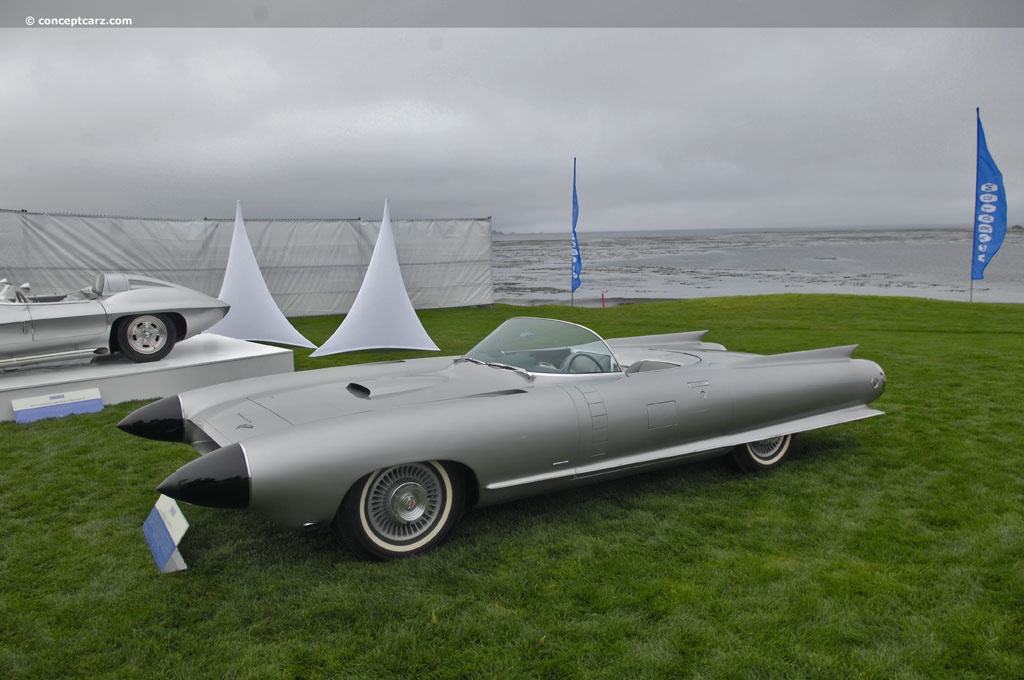
The Cadillac Cyclone was an indication of the United States' obsession with jet design and aerodynamics. During the early 1950's GM introduced its Firebird concepts which featured dramatic and bold designs powered by gas turbine engines.
Powering the Cyclone was a modified version of a V8 engine capable of producing 325 horsepower. The headlights could be completely hidden above the grill. Located in the nose cones were radars which aided in crash avoidance. The exhaust system was located directly behind the nose cone and in front of the front wheels. Located in the rear were large tail lights which gave the impression of jet exhausts. Small wings finished off the Cyclone and would eventually make it into production.
Getting in and out of the car was relatively easy, thanks in part to sliding doors. The practicality continued with small panels being located in each door, allowing for easy access to pay tolls.
by Daniel Vaughan | May 2006
Powering the Cyclone was a modified version of a V8 engine capable of producing 325 horsepower. The headlights could be completely hidden above the grill. Located in the nose cones were radars which aided in crash avoidance. The exhaust system was located directly behind the nose cone and in front of the front wheels. Located in the rear were large tail lights which gave the impression of jet exhausts. Small wings finished off the Cyclone and would eventually make it into production.
Getting in and out of the car was relatively easy, thanks in part to sliding doors. The practicality continued with small panels being located in each door, allowing for easy access to pay tolls.
by Daniel Vaughan | May 2006
- 1959 Cadillac Cyclone XP-74 Concept Menu
- Article
- Image gallery
- Specifications





1959 Cadillac Cyclone XP-74 Concept Vehicle Profiles

Designer: Harley Earl
Chassis #: DEST0001
Recent Vehicle Additions


Related Automotive News

Mazda At 100 | 60Yrs Of Great To Drive Family Cars
Mazda has a tradition of producing innovative saloons, hatchbacks, estates and MPV family cars.
Boring was never an option with Mazdas great to drive and engineering-led family cars.
Good to drive MPVs with clever and practical interior design f...

The Mid-Engine Corvette at the Amelia Island Concours d'Elegance
With the recent introduction of the Chevrolet C8 Corvette, the first production mid-engine Corvette sports car, the 2020 Amelia Island Concours dElegance took the opportunity to tell the story of the mid-engine Corvette legacy. The canvas...

New 2021 Chrysler Pacifica Adds To Extensive List Of FCA Segment Firsts
February 6, 2020 , Auburn Hills, Mich. - As the first company to introduce the minivan and through six generations of the vehicle, FCA has innovated 116 segment firsts – 38 of those innovations coming from the Chrysler Pacifica, including the...

ALL-NEW 2017 CHRYSLER PACIFICA DELIVERS UNPRECEDENTED FUNCTIONALITY, VERSATILITY AND TECHNOLOGY STARTING AT $28,595 MSRP
2017 Chrysler Pacifica lineup offers five highly equipped models, starting at %2428,595 U.S. Manufacturers Suggested Retail Price (MSRP)
2017 Chrysler Pacifica and Pacifica Hybrid revolutionize the minivan segment with nearly 40 new minivan firsts
...

CADILLAC CONCEPT CARS STAR at AMELIA CONCOURS d'ELEGANCE
There are limited production cars, there are rare cars and there are concept cars that never find their way to the showroom. A fleet of Cadillacs rare and mythic Motorama and Detroit Auto Show Concept Cars will take to the field at the 18th Annual...