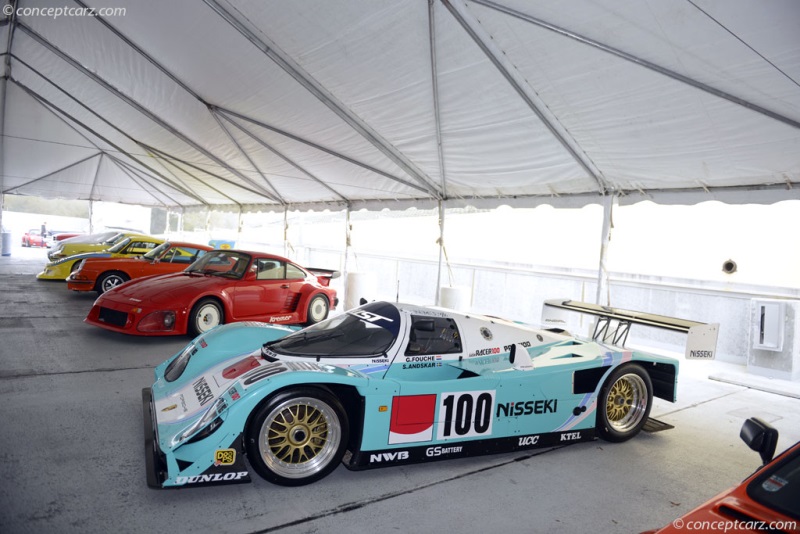
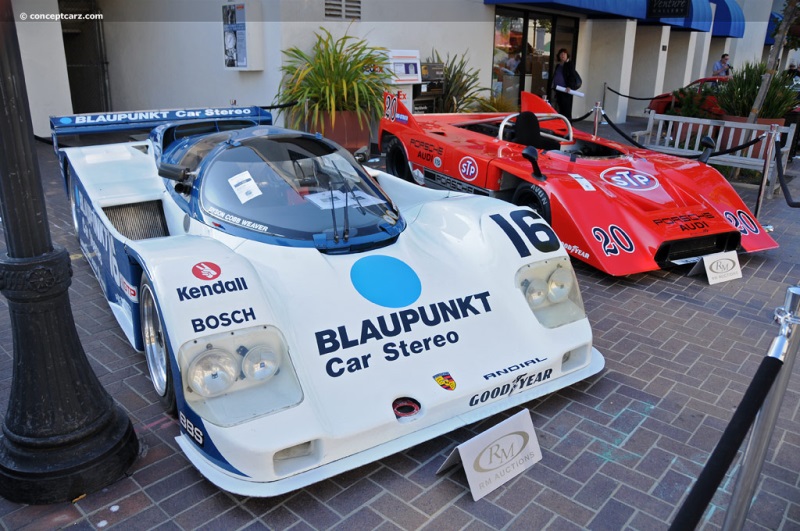
The Porsche 962 was designed for the International Motor Sports Association GTP racing and as a replacement for the Porsche 956. The 956 had been a highly successful race car and had captured many triumphs including the 24 Hours Le Mans and the FIA series.American John Bishop, the founder of the International Motor Sports Association, was responsible for the longer wheelbase on the 956. When the 956 was introduced, Bishop refused to accept the vehicle partly because of safety concerns. The pedals were mounted in front of the front axle line. To comply with safety concerns and new regulations, the 956 was stretched to make room for the pedal box. A roll cage was later added. The Porsche 962 was first raced by the factory in the 1984 season which opened at the Daytona 24 Hours. Driven by Mario and Michael Andretti, it was retired due to engine and gearbox problems. A total of five Porsche 962 models had been constructed for the 1984 season and all were powered by a 2.8-liter water-cooled power plant. Part-way through the season, a 3.2-liter Type 935 six-cylinder engine with the mechanically injected turbo was placed into one of the 962 models. A short-tail improved the aerodynamics and the Porsche 962 was poised to conquer the racing circuit. Which it did, capturing victories at the Daytona 24 Hours race five times.The Porsche 962C, introduced in 1985 for the World Endurance Championship, had a twin-turbocharged 3000 cc water-cooled engine producing 750 horsepower. The engines were built to last 26 hours. This included two hours for testing and then racing for 24 hours straight. The acceleration, braking, and road handling were impressive, thanks in part to its 900 kg bodyweight. The aerodynamics was effective at holding the car on the road. During a qualification run at LeMans during the 1985 season, it proved to be the quickest vehicle. However, at the end of the 24-hour race, it was in second place to a Porsche 956, the 956 having scored its fourth consecutive victory. The Porsche 956 chassis number 117 became one of the few in history to achieve back-to-back first place trophies at LeMans, winning in 1984 and 1985. The vehicle had been entered by Privateer Reinhold Joest.
CoupeThe World Endurance Championship, WEC, changed its name to World Sports Prototype Championship, WSPC, in 1986. The Porsche 962 had another successful season, similar to 1985. At LeMans, two of the three Porsche 962C's entered were retired due to mechanical problems. The final Porsche 962C was able to score a victory.In 1987, the FIA adopted the IMSA regulation requiring the pedal-box to be installed behind the front-axle, making the Porsche 956 obsolete. The Porsche 962 was showing its age as the Jaguars and Mercedes were beginning to outpace the vehicle at most of the World Championship races. For LeMans, however, the 962 captured its sixth consecutive victory after most of the field had been forced to retire. It was the last LeMans victory for the Porsche 962 until 1994 when enough examples had been produced making it eligible for the newly created GT1 class.For over ten years, the Porsche 962 dominated the racing circuit to include the 24 Hours of LeMans, Daytona, FIA, and IMSA racing. The Porsche 962 was so popular and so competitive that even their 1,000,000 price tag could not keep up with demand. Nearly 150 were sold and because of such a large customer program, every component was available off the shelf direct from Porsche.
by Daniel Vaughan | Oct 2011
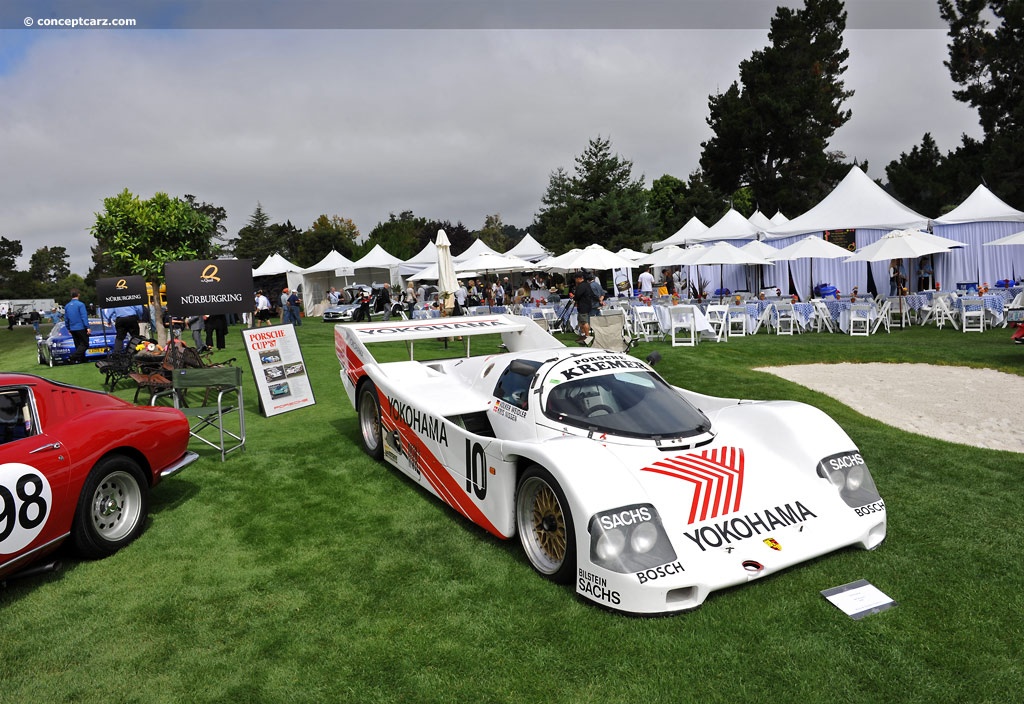
Coupe
by Daniel Vaughan | Oct 2011
Related Reading : Porsche 962C History
Porsche met Group C regulations introduced by FISA in 1982 with a fresh concept. This new car would be the focal point of factory racing efforts. These new Group C regulations led to the re-birth of the two-seat, special race sports car which no longer had to be declared a prototype for some future production car, but rather was seen as a high-performance vehicle in its own right. The 956 from....
Continue Reading >>
Continue Reading >>
Related Reading : Porsche 956 and 962 History
Porsche created the 956 during the early 1980s for FIA Group C competition. The design and components of the vehicle would further evolve over the years and become known as the 962. The 956 project was led by a very determined and experienced project manager named Norbert Singer, who had his sights set on winning the 24 Hours of LeMans race. With Derek Bell and Jacky Ixckx, the factory team drivers,....
Continue Reading >>
Continue Reading >>


1987 Porsche 962C Vehicle Profiles
Recent Vehicle Additions


Related Automotive News
Salon Privé to celebrate 100 years of Le Mans 24 Hours
Salon Privé will celebrate 100 years of the Le Mans 24 Hours race
Exclusive display to feature legendary cars from Porsche, Jaguar and Ferrari
Storied cars include a pole-sitting Porsche 962 and the last Jaguar to win at Le Mans
Salon Privé op...

1991 race winning Mazda 787B to take part in 24 Hours of Le Mans Centenary demonstration
The 1991 Le Mans winning Mazda 787B will be demonstrated at the Centenary 24 Hours of Le Mans*.
With other winning cars, the 787B will be displayed at the Le Mans Museum from 1st June to 2nd July.
At the 59th 24 Hours of Le Mans Mazda become the f...

Petersen Automotive Museum showcases the Porsche 956 and 962 in final Luftgekühlt exhibit
The seven-car display in the Petersen Vault, which runs now through November 19, includes the Miller 962 that won the Rolex Daytona 24 in 1989 and the Coke-liveried 962
The Petersen Automotive Museum has opened the second of two Luftgekühlt...

2021 marks the 30th Anniversary of Mazda's famous win at the 1991 Le Mans 24 Hours
Anniversary of the Mazda of Johnny Herbert, Volker Weidler and Bertrand Gachot winning Le Mans.
The composite chassis Mazda 787B was powered by a raucous 700bhp R26B four-rotor engine.
Victory in 1991 made Mazda the first Japanese manufacturer to...

PORSCHE MOTORSPORTS PRE-EVENT NOTES. 24 HOURS OF LE MANS
The #20 Porsche 919 Hybrid with drivers (left to right) Mark Webber, Timo Bernhard, and Brendon Hartley, at Le Mans tech inspection earlier today in the town of Le Mans.
Dateline. Le Mans, France
Circuit. Circuit de la Sarthe
Track LengthTurns....