


Convertible
Chassis #: JH27G1B363771
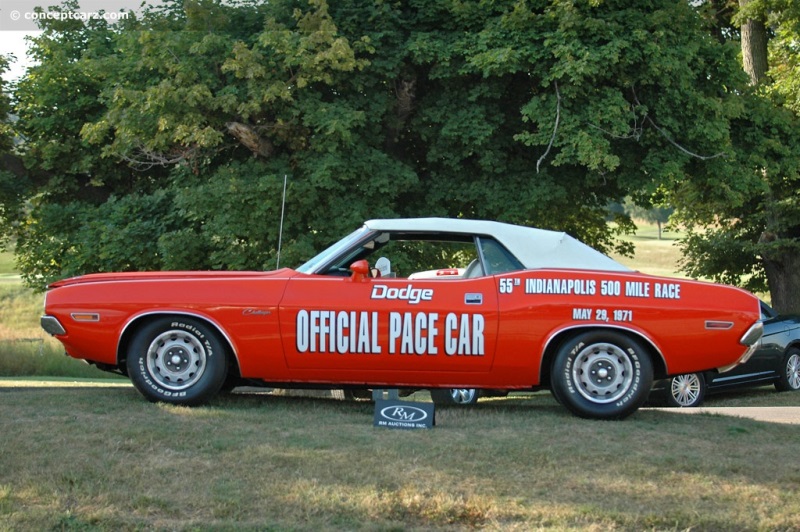
A local Dodge dealer named Eldon Palmer was chosen to drive the Indy Pace Car on race day for 1971. Unfortunately, Palmer entered the history books for causing the only pace car-related accident in Indy 500 history. After pacing the race cars to the green flag, he came into pit lane too fast, lost control, and crashed into the photographers' grandstand, injuring about 20 people. The race, however, was won by Al Unser at a record speed of 157.735 mph.There were 2,165 Challenger Convertibles built in 1971 and 167 of those were given the 383 cubic-inch V8 engine. The exact number of pace car replica's is not known but some estimates are around 50. All of the Pace Car Replica's were painted in bright Hemi orange with a white convertible top and white interior, just like the two cars chosen to pace the race. Power was from the 300 horsepower, 383 V8 with 10:1 compression, mated to Chrysler's three-speed Torqueflite transmission. This example was in the same ownership until 2007. It is equipped with power steering, a power top, and factory air conditioning. Since new, it has been given a cosmetic restoration. Even though it is powered by a 383 V8 engine, the VIN number indicates that this was not one of the 167 Convertibles equipped from the factory with that engine.
In 2009, this Indy 500 Pace Car Convertible was offered for sale at the Vintage Motor Cars of Meadow Brook presented by RM Auctions. It was estimated to sell for $35,000 - $50,000 and offered without reserve. The lot was sold for the sum of $25,300 including buyer's premium.
By Daniel Vaughan | Sep 2009
In 1968 Dodge began creating prototypes for the Challenger. Designs had been created since 1965 and by the middle of 1969 Dodge was producing the Challenger, complete with nine engines to select. The base engine was the slant six with the top of the line engine being the 426 Hemi. Along with the engine choices, there were various body styles, optional equipment, and interior/exterior colors. Dodge offered both a hardtop and a convertible version. The platform had been borrowed from the Plymouth Barracuda and then stretched by a couple of inches to provide the passengers with extra interior room.Dodge offered an SE package that included luxurious items, configuration, and amenities. The R/T, representing Road/Track, was the performance package. It came equipped with dual hood scoops, a heavy-duty suspension and the 383 cubic-inch engine producing 335 horsepower. Other engines offered were the 440, 340 and 426 cubic-inch engines. The base engine was the 225 cubic-inch slant six that produced 145 horsepower. Power steering and disc brakes were offered as optional equipment. During the introductory year in 1970, 53,337 examples were created with the base engine. A little over 13,800 units were created in the R/T configuration in both coupe and convertible form. Nearly 3,700 examples were built with the SE configuration.
For 1971 Dodge discontinued the T/A package and the R/T was no longer offered in convertible form. A new grille was the most distinguishable change when compared with the 1970 Challenger. Government safety and emission regulations, and increasing insurance premiums meant the horsepower rating and size for all manufacturers were on the decline. To comply with the new requirements, many of the engines were detuned. This was true for Dodge as well. The 383 cubic-inch engine was now producing 300 horsepower, a loss of 30 horsepower over the prior year. The 440 Six Pack was detuned by five horsepower. The base 440 was no longer offered. The good news was that the Hemi was still available and kept its 425 horsepower rating. Sales for 1971 were devastating. There were just over 25,000 units of the six-cylinder Challenger sold in 1971. A sharp decline in interest for the vehicle in only its second year sent the dealers trying to unload their inventory. Fifty vehicles were offered as 'official pace cars' for the Indianapolis 500 race. These specialty series were painted in Hemi orange and had white interiors. All were convertibles. The front of the Challenger was reworked for 1972 including the addition of a new grille. Dodge dropped the R/T package and the convertible option. A Rallye edition was added in place of the R/T. It was outfitted with a 318 cubic-inch 150 horsepower. This would be the only year the Rallye option would be offered. The horsepower rating was now measured in net SAE which meant all horsepower figures were decreased dramatically. Dodge did not offer the Hemi or the 440 for 1972. This left the 340 with a horsepower rating of 240. The zero-to-sixty run could be accomplished in 8.5 seconds and the quarter-mile took sixteen seconds. Sales were slow with less than 25,000 units being produced.The big news for 1973 was the introduction of the 360 cubic-inch eight-cylinder engine which appeared mid-way through the year. It produced 245 horsepower but it also increased the overall weight of the vehicle. Sales continued to be slow but they did increase over the prior year. In 1974 Dodge decided to cancel the Challenger series. Motivated by only 16,400 units sold, the decision was easy but sad, with only five years of production under its belt. Two engines were offered, the 318 cubic-inch and the 360 cubic-inch. Horsepower ranged from 150 to 245.The Challenger had been introduced at the close of the muscle car era. It faced stiff competition from the pony cars, and the high-performance, economical, and lightweight machines. By offering both a luxury component and a performance package, the Challenger was a versatile machine. Its stylish designs and large Hemi engines are legendary.
By Daniel Vaughan | Aug 2009
The Dodge Challenger T/A series, meaning Trans AM, was Dodge's attempt to build a street-worthy version of its race car. It was only offered in 1970 because the racing version did not perform well on the track and Dodge left the Trans Am racing at the end of the season. The street version was fitted with a 340 Six Pack created by the addition of an Edelbrock aluminum intake manifold and three two-barrel carburetors. The result was 350 horsepower. Disc brakes were standard as was a heavy-duty Ralley suspension with wide tires in the rear and thinner tires in the front. Dodge offered a TorqueFlite automatic or a Hurst four-speed transmission. 2,142 examples of the T/A series were created. The quarter-mile was accomplished in just fourteen-and-a-half seconds and zero-to-sixty was around six seconds.
By Daniel Vaughan | Aug 2009
Similarly Sized Vehicles
from 1971
Similarly Priced Vehicles
Dodge Monthly Sales Volume
March 2023
50,975


1971 Dodge Challenger Pace Car Vehicle Profiles
Recent Vehicle Additions


Related Automotive News

Mecum Auctions Returns To Harrisburg August 3-5 For Huge Collector-Car Auction
Unprecedented Selection of Quality Muscle Cars among 1,000 Vehicles on Offer
Walworth, Wis. – July 20, 2017 – Mecum Auctions, the worlds largest collector-car auction company, will return to Harrisburg, Pennsylvania, August 3-5 at...

Dream Car Saturday Ready to Launch at Russo and Steele's 15th Anniversary Scottsdale Auction Event!
Scottsdale, Arizona (January 17, 2015) – Following 2 great days of record attendance, stratospheric sell through and a world class seminar moderated by SEMA Hall of Fame member Wade Kawasaki and featuring an all-star panel of guest experts which...

Russo and Steele Collector Automobile Auctions Kicks Off 15th Anniversary with Eight Initial Offerings to Watch
Scottsdale, Arizona (December 1st, 2014) – For Enthusiasts – By Enthusiasts. ™ This is far more than a tagline at Russo and Steele Collector Automobile Auctions. Its a lifestyle, and we are gearing up to deliver that singular passion to the High...

THE COUNTDOWN TO AUCTIONS AMERICA'S FORT LAUDERDALE SALE NOW UNDERWAY
Auctions America kicks off its 2014 collector car calendar March 14-16 in Fort Lauderdale
Regarded as South Floridas premier collector car auction, the multi-day sale features nearly 500 cars spanning all segments of the collector car market
J...

Final Countdown Underway To South Florida's Premier Collector Car Auction
Auctions America kicks off its 2013 auction season, March 22-24 with its highly anticipated Fort Lauderdale Collector Car Auction
Celebrating its 11th year, the multi-day auction features more than 550 quality collector cars
Latest feature attr...