1955 Jaguar XK-D D-Type
1955 Jaguar XK-D D-Type Navigation
The Swallow Coach Building Company was founded by William Lyons with the purpose of creating aftermarket bodies for the 1920s Austin Motor Car. He began creating his own 'SS' cars during the early 1930s using various chassis, engine, and transmission configurations clothed with elegant bodies. After World War II, production resumed by October of 1945 under the name Jaguar Cars Ltd. Initially, production focused on prewar models with slight mechanical enhancements. 
Roadster
Chassis #: XKD502In 1948, the first truly new Jaguar was introduced, the XK 120 available as a saloon or drophead. It came equipped with a new double overhead camshaft six-cylinder engine, which was destined to power Jaguar motor cars in various configurations for nearly four decades. After several privateers proved the racing competitiveness of the XK 120, it convinced Sir William Lyons and engineer Bill Heynes to create a purpose-built version of the XK 120. Mechanical improvements and lightweight components resulted in the XK120C (C-Type), with the C representing Competition. Three examples made the racing debut at LeMans in 1951, with one finishing in first place overall. The team was disappointed the following year when all three cars retired early at LeMans. The cars had been given new bodywork, which appeared more aerodynamic but did not provide sufficient airflow at speed, thus causing cooling system issues.The XK-120C (C-Type) returned to LeMans in 1953 where they finished in first, second, and fourth place. Part of this success was attributed to the C-Type's disc brakes, the first such-equipped entrants to ever run LeMans. The car's low weight coupled with the disc brakes made the C-Types essentially unmatched through the cars.
Roadster
Chassis #: XKD 501
Engine #: E 2036-9
View info and history
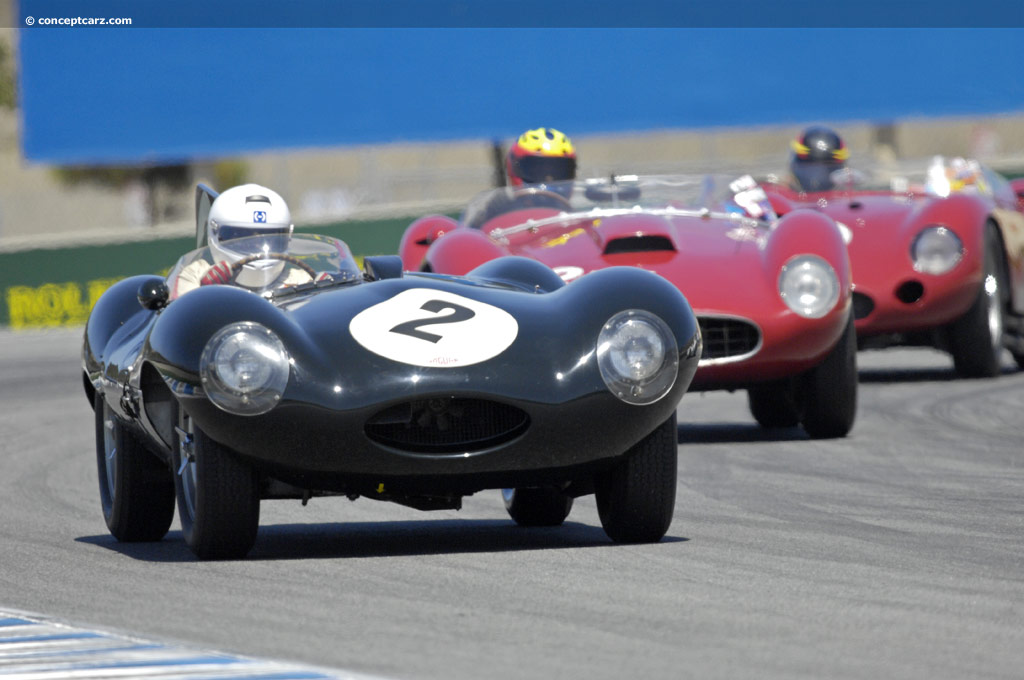
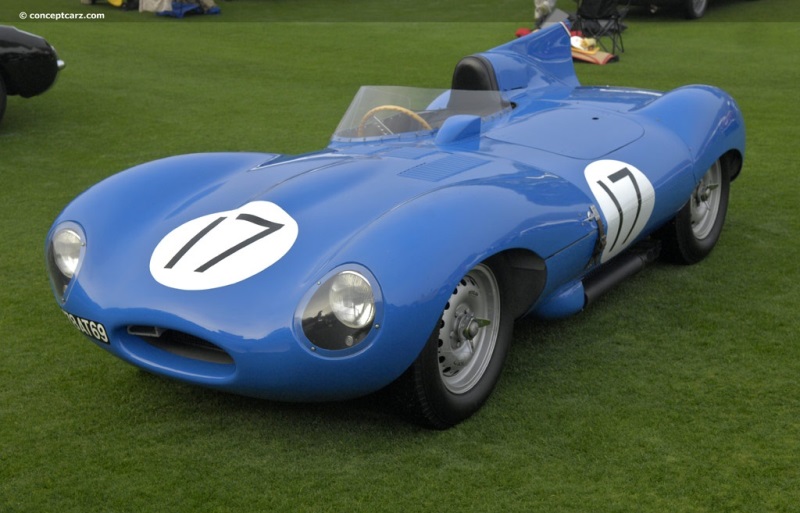
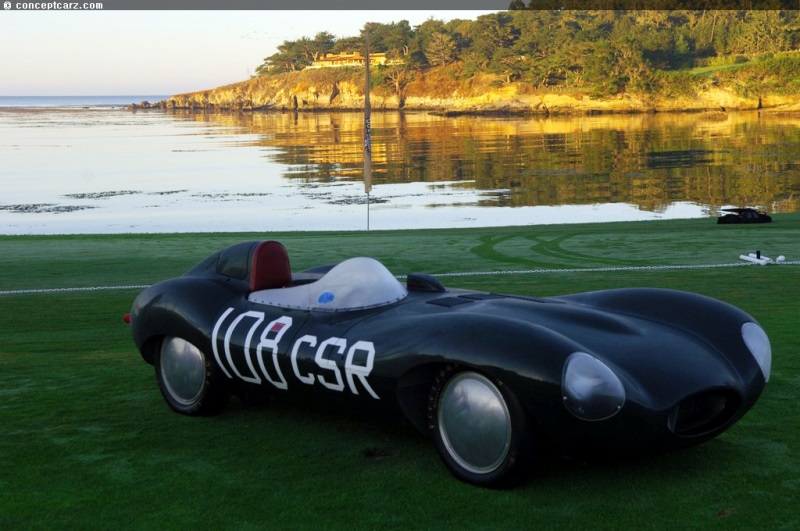
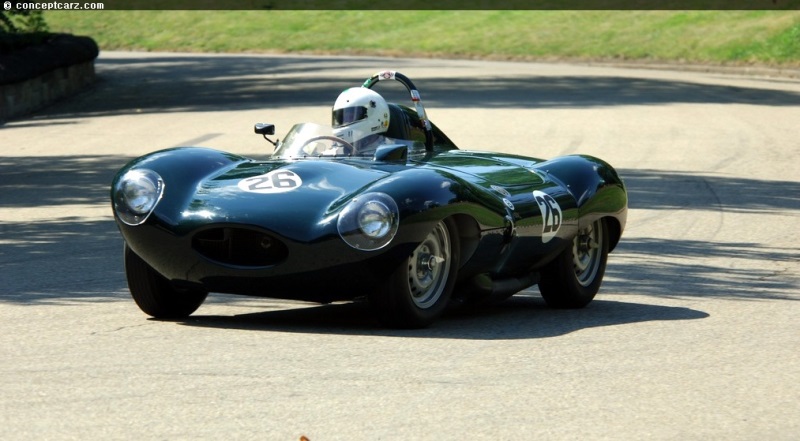
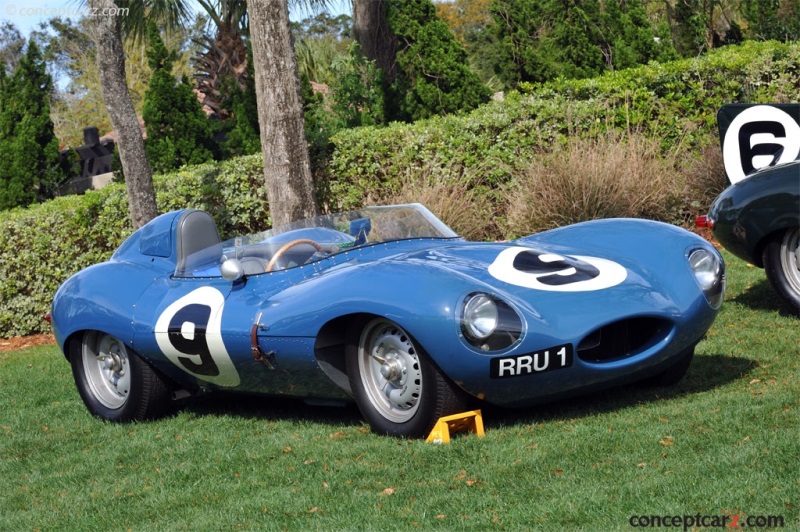
Auction entries : 1Following the 1953 LeMans, it was quickly evident that the limits of the XK 120-based race car had been reached. To continue to compete for the overall victory at lemans, a new car was required. The C-Type had been one of the earliest cars to be fitted with a steel-tube space-frame chassis. The car that followed, the D-Type, would be perhaps the first to use unitary monocoque construction, with the body and frame combining for structural integrity. The all-new, riveted aluminum-magnesium alloy monocoque was designed by Jaguar's chief designer and aerodynamicist, Malcolm Sayer. The engine in the D-Type was the same from the C-Type, but given triple Weber carburetors which brought horsepower to 245 bhp. The seven main bearing Jaguar engine was attached to a welded aluminum front sub-frame of square-section tubes, bolted to the monocoque. The engine was canted eight degrees from vertical to clear the low bonnet. With a dry-sump lubrication system installed, the engine was able to be mounted lower, reducing the overall profile and coefficient of drag. The D-Type was five inches shorter and more svelte than a C-Type. A thin body panel permanently divided the two-seat cockpit interior. The C-Type only had a door for the driver, but the D-Type had a door for the driver and passenger, albeit they were both very small. The engine was backed by a new, all-synchromesh, four-speed Jaguar gearbox with a three-plate clutch. Dunlop provided the disc brakes with multi-piston calipers, and the knock-off magnesium alloy wheels, which were drilled for lightness and brake cooling. The rack-and-pinion steering was based on the XK140 road car. Two lightweight, rubber fuel tanks were placed in the rear of the car and could be accessed via a quick-release filler cap located in the driver's faired headrest, to which a slim tailfin was riveted to ensure high-speed straight-line stability.
Roadster
Chassis #: XKD 531
View info and historyNear the close of 1953, Jaguar's test driver, Norman Dewis, managed nearly 180 mph on the Jabbeke Highway in Belgium in a C/D-Type prototype. At the LeMans trials in April of 1965, the new D-Type hit 169 mph on the Mulsanne Straight. During the race, Stirling Moss managed 172.97 mph on the Mulsanne Straight.Over a three-year period, 54 customer cars and 6 factory team cars were built. Four D-Types were entered by the factory for the 1954 LeMans. Three of the cars were forced to retire early due to brake and engine issues. Despite spending considerable time in the pits, the D-Type driven by Tony Rolt and Duncan Hamilton finished in second place, just 105 seconds behind the much larger-engined Ferrari 375 Plus driven by Gonzales / Trintignant
Roadster
Chassis #: XKD 501
Engine #: E 2036-9
View info and history
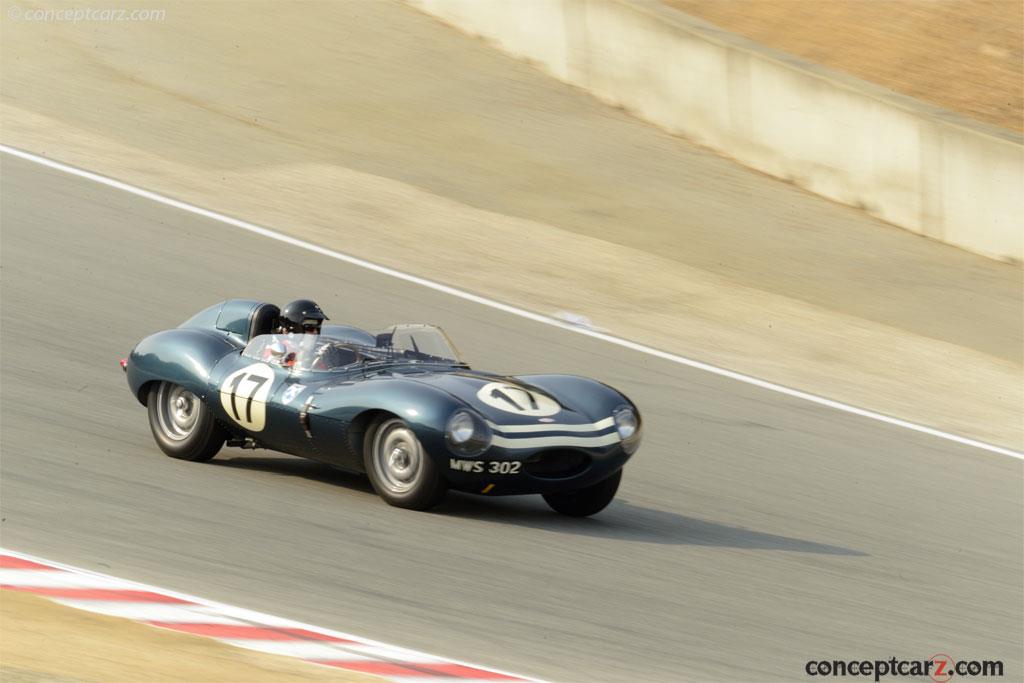
Auction entries : 1A month after LeMans, the D-Type earned its first victory, at the 12 Hours of Reims, with a 1st and 2nd place finish. In the United States, a D-Type on loan to Briggs Cunningham won the Sebring 12 Hours while being driven by Mike Hawthorn and Phil Walters. In preparation for the 1955 season, the D-Type received several modifications, including a brazed steel front sub-frame that was stronger and lighter than the previous aluminum unit. Along with structural improvements, new 'long-nose' bodywork was fitted (lengthening the car by 7.5 inches), with large cooling ducts in the front. The Works long-nose D-Type received a wraparound windscreen that faired into the driver's headrest and a tapered fin that blended into the rear of the body. Cylinder head medications brought horsepower to 285 bhp at 5,750 RPM.The body modifications made by Sayer improved stability and increased the top speed, now in excess of 180 mph. With these changes, the D-Type claimed the marque's third victory. It had faced strong competition from the Mercedes-Benz SLRs, but the team withdrew after one of their cars crashed and was launched into a crowd of spectators, killing dozens. After Mercedes retired, there was little competition for Jaguar. The powerful Ferraris had retired due to mechanical failures or accidents, leaving the Jaguar to claim the victory.
Roadster
Chassis #: XKD 501
Engine #: E 2036-9
View info and history
Auction entries : 1For the 1956 Le Mans race, 49 cars lined up to contest the overall victory. As was tradition, the race began at four o'clock in the afternoon with the drivers sprinting across the front stretch and jumping into their cars. The start began in the rain, making this dangerous race even more treacherous. The list of drivers included legends such as de Portago, Trintignant, Maglioli, Gendebien, Behra, Fangio, von Trips, Hill, and Castelloti. The list of manufacturers contesting the race included Talbot, Porsche, Lotus, Jaguar, Ferrari, Gordini, and Aston Martin. Of the 49 cars that started, only 14 will finish, and one life was lost. Jaguar entered three factory D-Types, with only one finishing the race, in sixth place. The race was won by a D-Type entered by the Edinburgh-based team Ecurie Ecosse and driven by Ron Flockhart and Ninian Sanderson. The Ecurie Ecosse team would win again in 1957. For the 1958 season, rule changes were implemented which limited displacement to 3-liters, which made the D-Types virtually obsolete. Jaguar did create a three-liter version of the XK-engine, but it was unable to keep pace with the stiff competition. The short-nose production D-Types were raced with much success by privateers on both sides of the Atlantic. The remaining unsold chassis was equipped for road use by Jaguar and sold as the XKSS. Sixteen examples were built prior to a fire that ended the production run.
by Daniel Vaughan | Feb 2020
Roadster
Chassis #: XKD502

Roadster
Chassis #: XKD 501
Engine #: E 2036-9
View info and history
Auction entries : 1

Roadster
Chassis #: XKD 531
View info and history

Roadster
Chassis #: XKD 501
Engine #: E 2036-9
View info and history
Auction entries : 1

Roadster
Chassis #: XKD 501
Engine #: E 2036-9
View info and history
Auction entries : 1
by Daniel Vaughan | Feb 2020
Related Reading : Jaguar D-Type History
The Jaguar D-Type sports cars were produced from 1954 through 1957. These factory-built race cars were similar to the C-Type, but given more powerful engines, improved chassis, and aerodynamic bodies. Walter Hassan was tasked with designing a sportscar for Jaguar. The result was the XK-120 which showed promise on the racing circuit. Although the alloy bodied cars were fast, it would not be a serious....
Continue Reading >>
Continue Reading >>
- 1955 Jaguar XK-D D-Type Menu
- Article
- Image gallery
- Valuation
- Specifications
- Profiles
Jaguar
Similar Automakers
Similarly Sized Vehicles
from 1955


1955 Jaguar XK-D D-Type Vehicle Profiles







Recent Vehicle Additions


Performance and Specification Comparison
Price Comparison
$3,455 - $4,100
$4,250
D-Type Specification Comparison by Year
Year
Production
Wheelbase
Engine
Prices
Related Automotive News

Purebred Competition Cars Head To Auction: Jaguar D-Type Joins Aston Martin-Campaigned DB3S Special
A pair of spectacular British competition cars, a 1955 Jaguar D-Type and a 1956 Aston Martin DB3S Special, add to the already impressive sporting lineup set to cross the block in Monterey, California, 17 – 19 August 2023
Benefitting from 21...

Historic 1955 Jaguar D-Type Joins Starting Grid at RM's Amelia Island Concours d'Elegance Sale
RM Auctions announces final entries for its Amelia Island, Florida sale, March 14
Representing RMs finest Amelia Island offering to date, recent highlights include a 1955 Jaguar D-Type, a 1971 Lamborghini Miura SV and a 1972 Ferrari 365 GTB4 Da...

Historic Jaguar D-Type Leads Growing List of Significant Entries for RM's Monterey Sale
RM Auctions building towards a spectacular roster of cars for its flagship Monterey sale held during the famous Pebble Beach Concours dElegance motoring week, August 16–17, in California
Historic 1955 Jaguar D-Type leads a superb roster of the...

Historic Lotus 19 Raced By Moss, Hill, Ireland And Clark Comes To The Open Market For The First Time In 57 Years
1960 Lotus 19 Monte Carlo, Chassis 953
Raced by some of the greatest British racing drivers
Jim Clark won in this car at Oulton Park in 1964
Signed by Sir Stirling Moss and the last car driven by him as a professional race driver
First raced in 1...

Ferrari Museum Celebrates Scuderia Ferrari's Landmark Anniversary With The '90 Years Exhibition'
Hypercars the story of Ferraris technological evolution told through milestone cars
Maranello, xx May 2019 – One of the great iconic names in motorsport with the power to unite an entire country and millions of fans from all over the...
Luigi Musso: Talented, Tempting and Troubled
Following Alberto Ascaris back-to-back titles in 1952 and 1953 there have been no Italian Formula One World Champions. While there has been a great amount of hope throughout the years, Italians have been left without a World Champion. Perhaps, it could...
1956 Sebring 12 Hours: Musso Impresses on American Soil
Having more than proven himself within the 2.0-liter category with the factory Maserati team, Luigi Musso makes the short trip west from Modena to Maranello to drive for Ferrari. This would be a big step up in performance, for car and driver. Here Mussos...
RRDC VOTES IN 37 NEW MEMBERS FOR 2013
HILLIARD, Ohio (Nov. 7, 2013) - Thirty-seven race-car drivers and motorsports professionals have been voted into the Road Racing Drivers Club in 2013. The group includes 13 Regular Members from the open-wheel and sports-car racing ranks, 20 Associate...