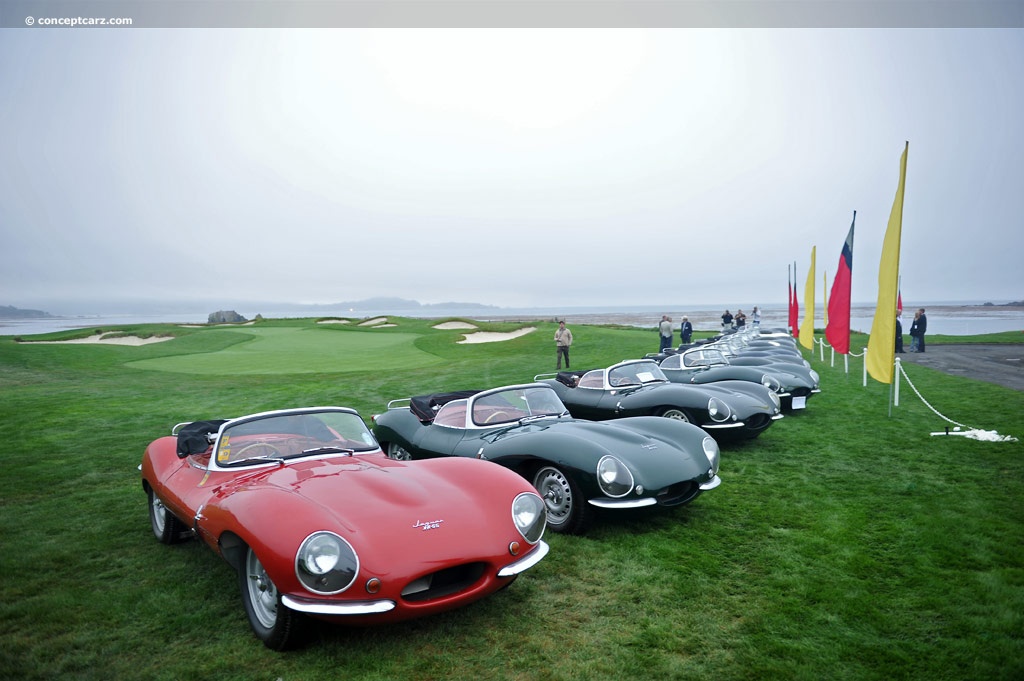
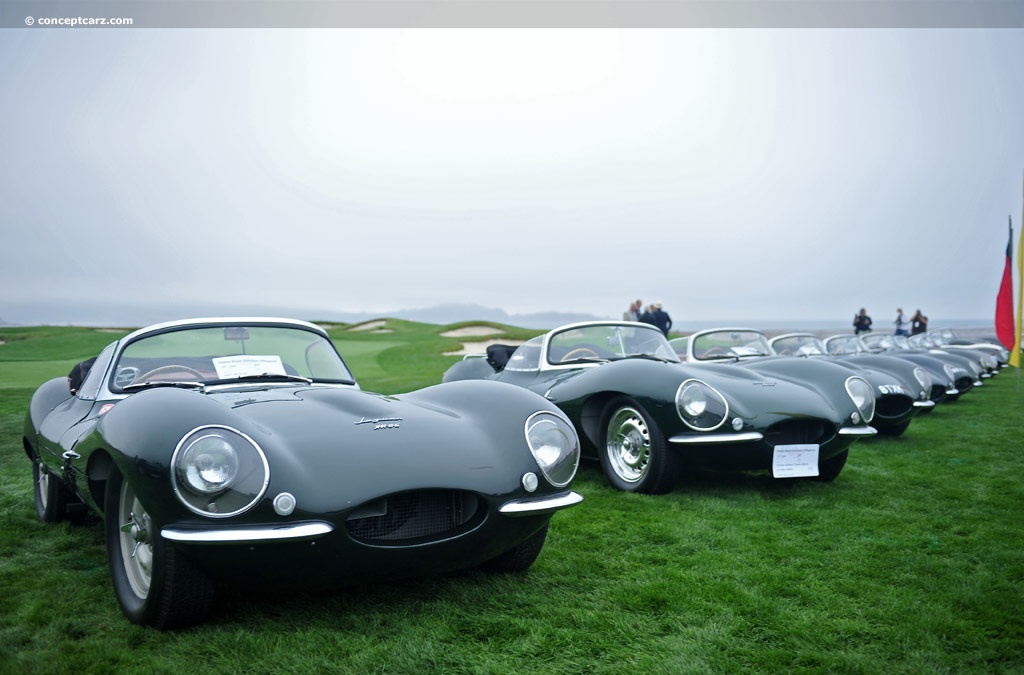
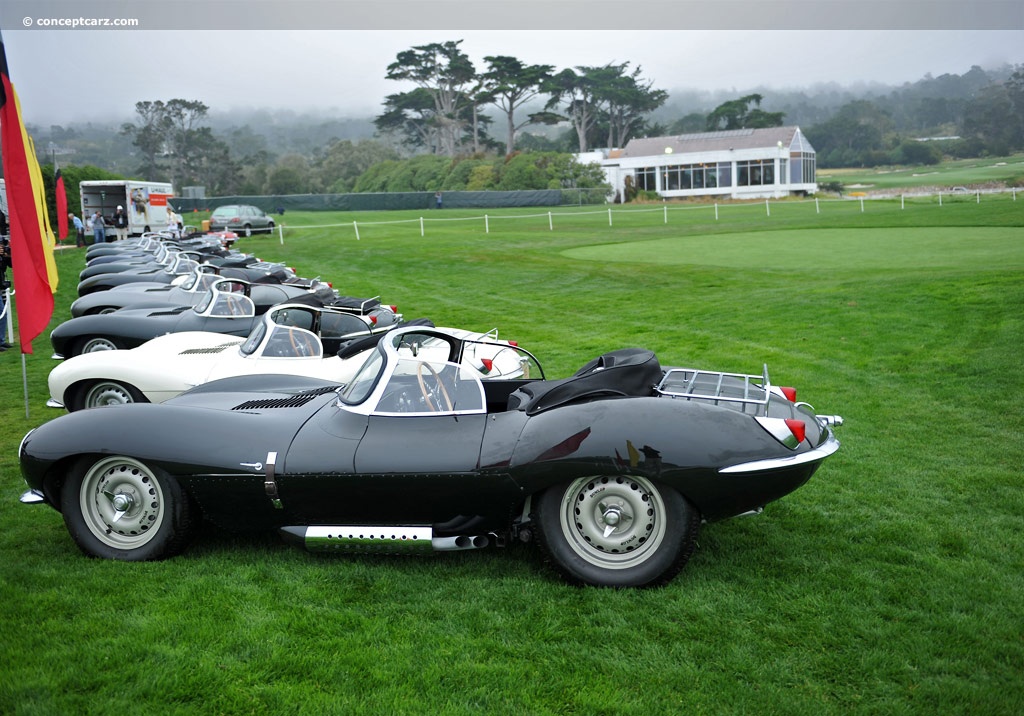
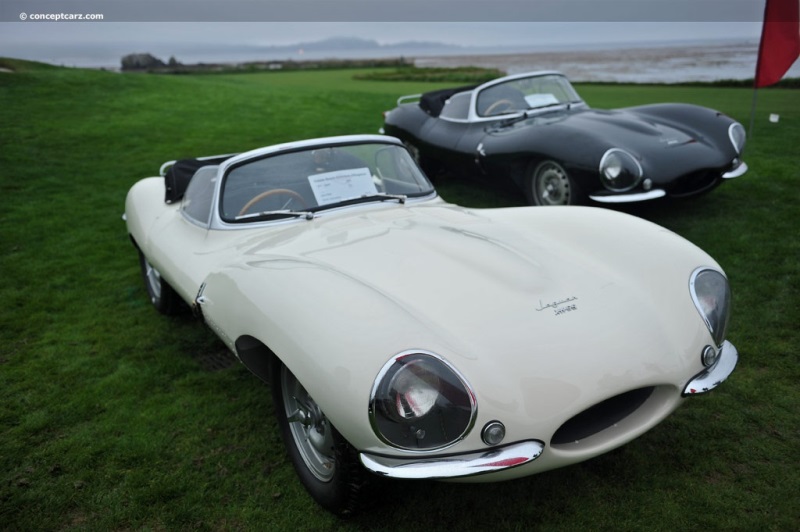
Twenty-five of the 68 Jaguar D-Type race cars were left unsold when Jaguar decided to cease its participation in the International Sports Car Racing program. Jaguar decided to convert the 25 remaining vehicles into road-worthy sports cars. The rear fin was removed, bumpers were added, and the single-seater was left topless with a canvas hood available to protect the driver from the elements. A windscreen was designed and a second door was added to accommodate passengers. 
Roadster
Chassis #: 763
View info and historyThe XKSS was the road-going version of the Jaguar D-Type, itself a development of the C-Type (called the XK120-C with the 'C' representing competition) of 1951 through 1953. The C- and D-Type firmly established the Coventry firm's international reputation with wins at the 24 Hours of Le Mans in 1951 and 1953. Fifty-three examples of the C-Type were constructed with 43 being sold to privateers, many from the United States. The C-Type was powered by the road-going XK120's 3.4-liter twin-cam, straight-6 engine that offered approximately 160 to 180 bhp. The early C-Types were equipped with SU carburetors helping to produce 205 horsepower, with stopping power by drum brakes. C-Types built closer to the end of production received triple twin-choke Weber carburetors, high-lift camshafts, and four-wheel disc brakes. The body used thinner aluminum which reduced weight even further, taking full advantage of the 220 horsepower produced by the engine. The lightweight tubular structure was designed by Jaguar Chief Engineer William Heynes and clothed with aerodynamic aluminum coachwork developed by Williams Heynes, R.J. Knight, and later Malcolm Sayer. Mr. Sayer was an expert aerodynamicist who had left the Bristol Aeroplane Company to work for Jaguar. He described his design belief as 'functional efficiency at all costs.' The Jaguar C-Type's inaugural race was the 1951 24 Hours of LeMans where three factory entries were driven by Stirling Moss and Jack Fairman, Leslie Johnson and Clemente Biondetti, and Peter Walker and Peter Whitehead who drove the race-winning car. The other two cars retired prematurely. The C-Type won a second time in 1953 and also placed second and fourth.
Roadster
Chassis #: 710
View info and historyJaguar raised the 'performance bar' even further with the introduction of the D-Type, developed under the direction of company founder Sir William Lyons and chief engineer William Heynes. It incorporated the latest technology available, including from the aircraft industry, equipped with a high-strength alloy monocoque chassis, with load-bearing external panels and tubular subframes fore and aft. This design was a radical and revolutionary approach to chassis bearing compared to conventional automotive designs of the era, and many automobile manufacturers would not implement the technology until decades later. Additionally, the D-Type received numerous aviation-inspired features, including dry-sump lubrication, a deformable fuel bladder, and four-wheel Dunlop disc brakes. The Malcolm Sayer-designed coachwork incorporated lightweight aluminum and its design was perfected in the wind tunnel, with ideal proportions, compound curves, and undeniable beauty. Powering the D-Type was a development of the XK twin-cam, straight-six engine first introduced in 1948. It used three Weber 45 DCO3 carburetors, high-lift camshafts, an asymmetrical wide-angle cylinder head, high-compression pistons, and developed 250 horsepower, allowing for a top speed in excess of 170 mph. The D-Type enjoyed tremendous success during its racing career, including three overall victories at the 24 Hours of LeMans, from 1955 through 1975, and twin wins at the 12 Hours of Reims, in 1954 and 1956. It captured outright victories at the 1955 12 Hours of Sebring and the 1956 Grand Prix of Spa, along with numerous other sports car races worldwide. The cars were raced by the Jaguar factory team and top-level privateers, including Briggs Cunningham and Ecurie Ecosse. At the pinnacle of its development and career, Jaguar announced that it would focus primarily on production cars, meaning temporary retirement from motorsports. At the time, most of the D-Types had been delivered to customers, and 25 remained unsold. Sir William Lyons embraced the opportunity to recoup some of the substantial development costs and expenses related to its racing program by converting the D-Type into a limited-production, road-going version of the race-winning LeMans D-Type. On January 21, 1957, Jaguar Cars Ltd. issued the following statement: 'Jaguar are to produce a new 2-seater sports-racing car as a result of the increasing demand from America for a type of vehicle equally suitable for normal road use and sports car racing. The new model which, initially, will be for export only, will be based on the already famous Le Mans type Jaguars and will be known as the Jaguar XK 'SS' type.'
Roadster
Chassis #: XKSS 716
Engine #: E 2080-9
View info and history
Auction entries : 1'The new model will depart from the somewhat spartan simplicity of the 'D' type by the incorporation of a full-width orthodox windscreen, folding hood, completely equipped touring-type instrument panel, well-upholstered seating, luggage grid, bumpers, and other refinements appropriate to a car intended for fast touring as well as for sports car racing. The car will be fitted with Dunlop disc brakes and the general construction and mechanical specification will follow closely that of the outstandingly successful 'D' type. The new model will be an addition to the Jaguar range and will not supplant any existing models. First deliveries to America are planned to commence in February. Price in USA $6,900.'A fire on the evening of February 12th of 1957 engulfed the Browns Lane plant, after just 16 examples of the XKSS had been constructed. The nine unfinished chassis were destroyed. Many years later, in March of 2016, Jaguar announced that it would complete the original 25-car order from 1957 by building the remaining 5 XKSS roadsters to the exact original specification and using the chassis numbers of the nine cars destroyed in the fire.
by Daniel Vaughan | Sep 2010
Roadster
Chassis #: 763
View info and history
Roadster
Chassis #: 710
View info and history
Roadster
Chassis #: XKSS 716
Engine #: E 2080-9
View info and history
Auction entries : 1
by Daniel Vaughan | Sep 2010
Related Reading : Jaguar XKSS History
The Jaguar D-Type sports cars were produced from 1954 through 1957. These factory-built race cars were similar to the C-Type, but given more powerful engines, improved chassis, and aerodynamic bodies. Walter Hassan was tasked with designing a sportscar for Jaguar. The result was the XK-120 which showed promise on the racing circuit. Although the alloy bodied cars were fast, it would not be a serious....
Continue Reading >>
Continue Reading >>
Similar Vehicles
Similar Automakers


1957 Jaguar XKSS Vehicle Profiles




Recent Vehicle Additions


Performance and Specification Comparison
XKSS Specification Comparison by Year
Year
Production
Wheelbase
Engine
Prices
Related Automotive News

Jaguar's Brilliant Solution: Converting Surplus Le Mans D-Types Into The Iconic XKSS, And Now, One Heads To Auction
An Iconic 1957 Jaguar XKSS heads to auction through RM Sothebys 2023 Monterey auction during Monterey Car Week 2023
The most sought after of all roadgoing Jaguars, a slightly modified Le Mans D-Type exported for street use in America
One...

Iconic and Legendary 1957 Jaguar XKSS Headlines Gooding & Company Amelia Island Auction
The First Jaguar XKSS to be Offered at Public Auction in Over a Decade
SANTA MONICA, Calif. (February 14, 2017) – Gooding %26 Company, the auction house acclaimed for selling the worlds most significant and valuable collector cars, is...

JAGUAR TO BUILD ICONIC XKSS - 'THE WORLD'S FIRST SUPERCAR'
Ultra-exclusive sports car to be hand-built by Jaguar Classic
All nine cars built to exact same specification as those made in 1957, replacing cars lost due to the Browns Lane fire
Jaguar originally made the XKSS as a road-going version of the Le...
Pedigreed 500 Mondial Series I Spider, ex-Jo Siffert, Unrestored 275 GTB/4, and Dark Green 365 GTB/4 Daytona Spider Lead Ferrari Offerings at the Amelia Island Auction
Star Ferraris at Gooding %26 Companys Amelia Island Auctions include a 1954 Ferrari 500 Mondial Series I Spider, a garage-find 1967 Ferrari 275 GTB4, and a low-mileage 1972 Ferrari 365 GTB4 Daytona Spider
Gooding %26 Company has announced an...

Platinum Award-Winning Ferrari 275 GTB and Aston Martin DB5 Convertible Lead Gooding & Company's Blue-Chip Icons for Upcoming Pebble Beach Auctions
The official auction house of the Pebble Beach Concours dElegance® will present a 1966 Ferrari 275 GTB, a 1965 Aston Martin DB5 Convertible, and a 1968 Lamborghini Miura P400 among other ultra-collectible 1960s sports cars.
Gooding...

Le Mans Winning Ex-Ecurie Ecosse Jaguar D-Type and Works Ferrari 268 SP Headline RM Sotheby's Monterey Auction
Le Mans heritage historic 1955 Jaguar D-Type—overall winner of the 1956 24 Hours of Le Mans—announced as latest headline attraction for RM Sothebys Monterey, California sale, August 19-20
Chassis no. XKD 501 was the first D-Type supplied by Jag...
RRDC VOTES IN 37 NEW MEMBERS FOR 2013
HILLIARD, Ohio (Nov. 7, 2013) - Thirty-seven race-car drivers and motorsports professionals have been voted into the Road Racing Drivers Club in 2013. The group includes 13 Regular Members from the open-wheel and sports-car racing ranks, 20 Associate...

Sonoma Historic Motorsports Festival Celebrates Corvette'S 60 Years At Sonoma Raceway
Fast cars, fine food and wine highlight May 18-19 weekend
Paul Reinhart is honored guest, popular racing seminar scheduled for second year
SONOMA, Calif. (April 27, 2013) - The Sonoma Historic Motorsports Festival returns to Sono...