1956 Continental Mark II news, pictures, and information | ||
| Tweet | ||
![]() | ![]() | Coupe |
The Continental Mark II Story
The Continental Mark II was the elite automobile of the 1950s' rich and famous: Elvis Presley, Frank Sinatra, Louie Prima, Dwight Eisenhower, Barry Goldwater, Spike Jones, Nelson Rockefeller, Henry J. Kaiser, Howard Johnson, the Shah of Iran, and many other celebrities owned them.The Mark II wasn't made by Lincoln, but by the short-lived Continental Division of the Ford Motor Company. Its general manager was William Clay 'Bill' Ford, son of Edsel Ford and grandson of Henry Ford.
Fact: there never was a model designated as a Lincoln or Continental Mark I.
The Mark II's sticker price was $10,400, twice the price of the 1956 Lincoln. Much of the car was assembled by hand and Ford claimed it lost $1,000 on each Mark II it sold. The unprofitable Mark II and the Continental Division were discontinued after Ford went public in 1956, even though these cars brought people into showrooms to buy other Ford products.
Ford originally planned to build about 2,000 Mark IIs a year for five years. 2,550 Mark IIs were built during the 1956 model year (June 1955 through September 1956) and 446 (including 2 convertibles) during the 1957 model y ear (October 1956 through May 1957) for a total of 2,996 Mark IIs. About 1,500 Mark IIs are still in existence. (About half are roadworthy) Their current market value ranges from $15,000 to $100,000, depending on condition. (Although some have sold in the low-to-mid $100s)
![]() | ![]() | ![]() | Coupe |
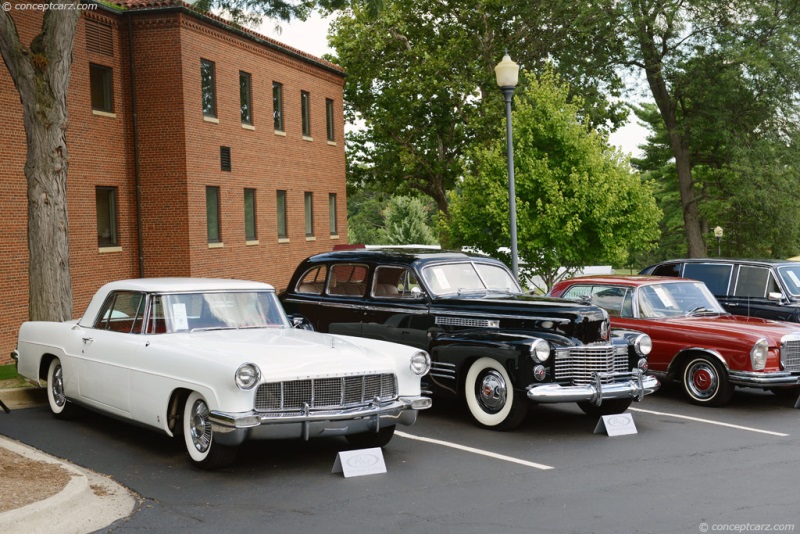
Generally regarded as the last car built in America without regard to cost, the Mark II was intended to be the 'American Rolls Royce.' Even with a factory list price of $10,000, it was said that Ford still lost $1,000 per car.
Much anticipated as the successor to the original Lincoln Continental of 1940-42 and 1946-48, the new version would remain a very exclusive car. Just over 3,000 were produced, as 1956 and 1957 models.
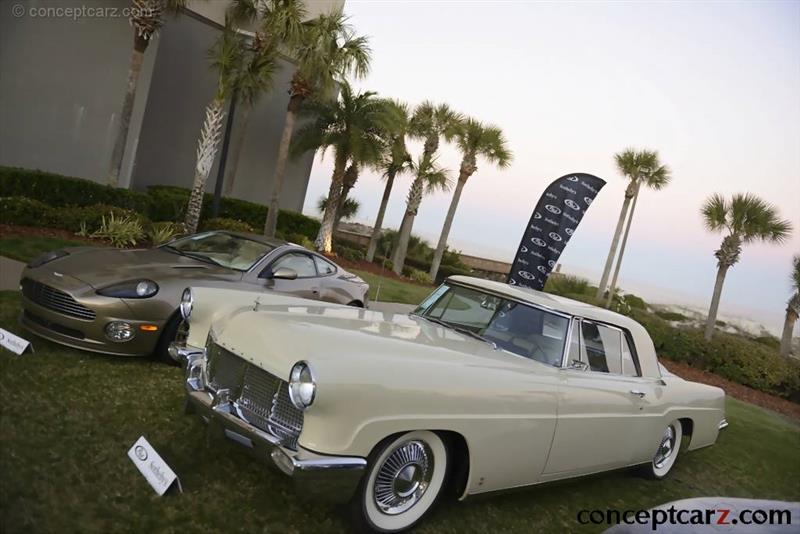
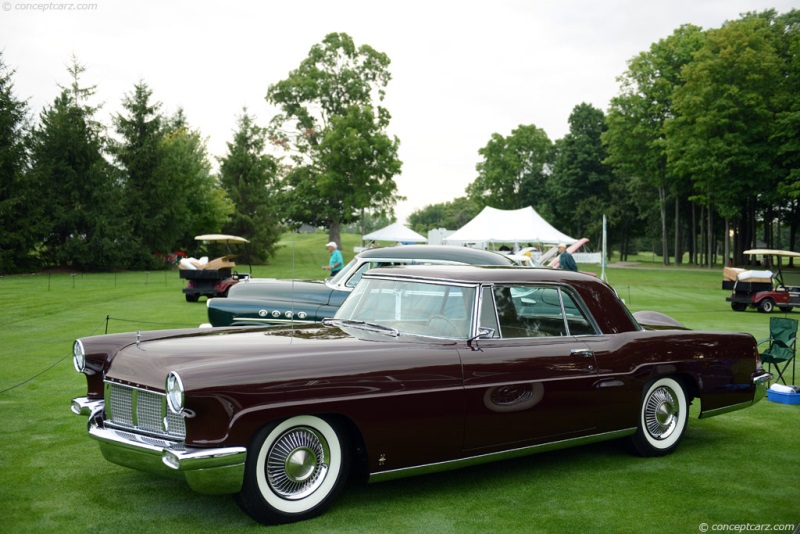
Originally delivered to Thompson Motors, Alliance, Ohio, this Continental's invoice is dated December 14, 1955. Little is known of its subsequent history until the car appeared at an auction in Florida in 1998. It was purchased by the current owner at auction in Auburn, Indiana that same year, showing just over 18,000 actual miles.
This Continental was systematically restored including paint, partial interior and mechanical restoration. The owners have used the car regularly but sparingly since 2005 and the odometer now reads just over 19,000 miles.
| Coupe |
![]() | Coupe Chassis Num: C5602845 | |
| Sold for $44,000 at 2007 Gooding & Company. | ||
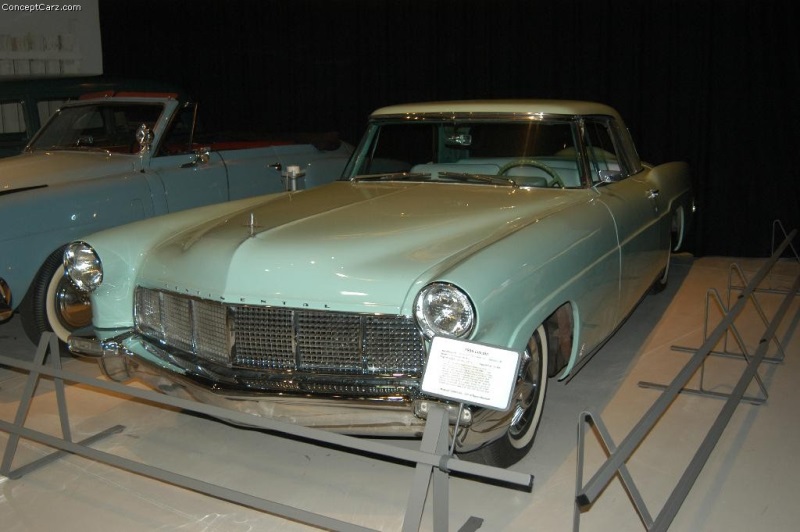
This car spent many years in storage while in the Klein Kars collection. It has traveled 39,744 miles since new, and is a well preserved and original example. It has power steering, power brakes, power seat, radio and heater - which were standard at the time.
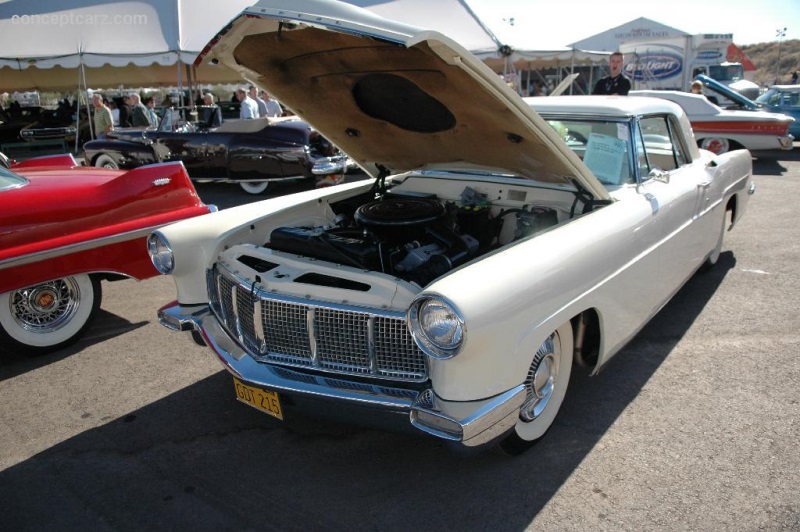
In 2007 this Mark II Hardtop was brought to the Gooding & Company auction held in Pebble Beach, CA where it was estimated to sell for $40,000 - $70,000. It was offered without reserve. The estimates were proven accurate as the lot was sold for a high bid of $44,000 including buyer's premium.
By Daniel Vaughan | May 2008
![]() | ![]() | ![]() | Coupe |
The price and exclusivity attracted celebrities, business leaders and politicians who chiefly bought these cars. Frank Sinatra, Spike Jones, Louie Prima, Dwight Eisenhower, Barry Goldwater, Elvis Presley and local favorite, Doris Day, were notable owners. Despite the loss of each car, Ford felt that some of the goals of the project had been successful. The image created a very positive influence for Ford's position in the competitive world of luxury autos. The best validation came as the mark II served as a stimulus for GM to develop the even pricier Eldorado Brougham. The hand assembly and array of custom choices in finish makes this the last bespoke car for any major US automaker.
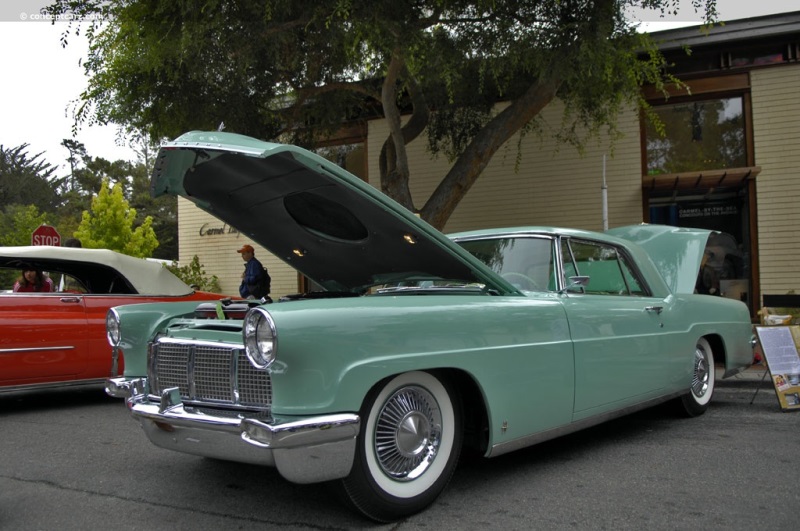
This example was acquired from the original owner's widow in Riverside California by Richard and Carolyn Gray in 1989. Dr. and Mrs. Melvin Judkins purchased the car new from the Lincoln Mercury dealer in Lodi, California on January 3rd 1956, making it a fairly early car. Dr. Judkins was a well known Radiologist who invented the special catheters used to perform coronary angiograms and to place coronary stents. This fact was not lost on Dr. Gray, a Cardiologist living in Los Angeles at the time.
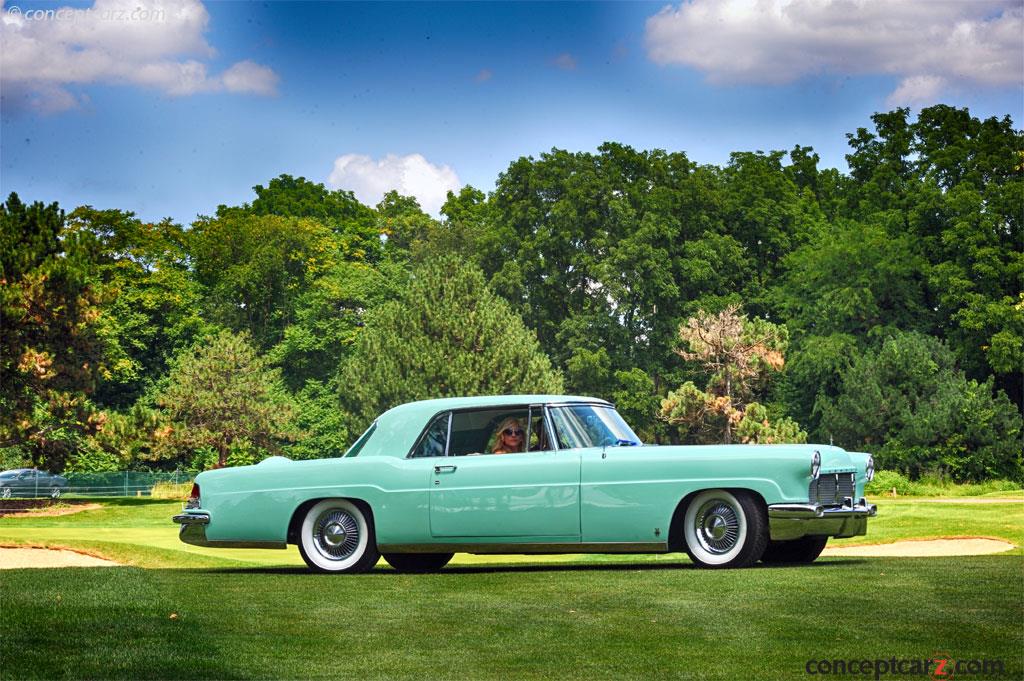
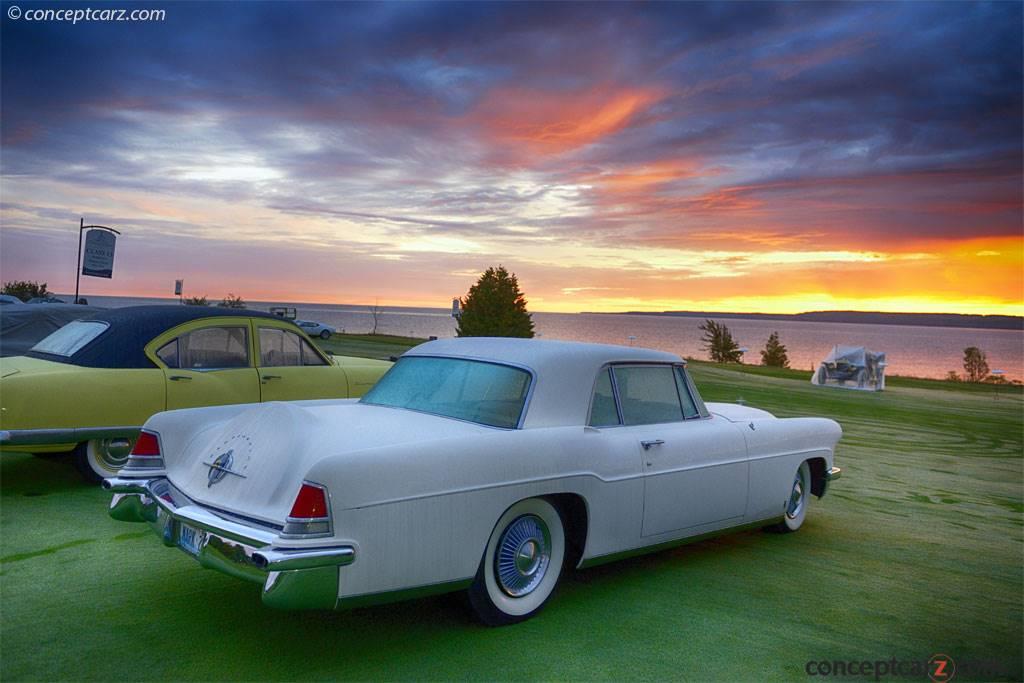
The car is largely original, but deterioration of a non original shade of green applied in 1962 necessitated a repaint in the original light green. Actually the data plate indicates black exterior, but disassembly reveals no track of black whatsoever, suggesting an error in the data plate. With the exception of the bumpers, all of the chrome and stainless is original, the interior and the running gear are all original although there has been an engine-out detailing under the hood and door weather striping was replaced only because of the repaint.
![]() | Coupe |
The Continental in 1956
Ford Motor Company's 1956 Continental MKII had two missions: to recapture the magic of the original Continental and to displace Cadillac as North America's most sought-after luxury car (even at a financial loss). In an era of excess, chrome trim was used sparingly, and no two-tone paint jobs were available. The fuel filler cap was concealed behind the left taillight, a la Cadillac. Extensive preparation and car went into body finishing, as panels were painted and hand-sanded several times, then two coats of lacquer were applied. Chrome plating was used extensively, not for appearance, but to protect such areas as the door end panels and doorjambs.Even though it said to be the most expensive production car of its time, about 1,300 Continentals were sold during the last quarter of 1955, many to celebrities such as politician Barry Goldwater, actor Frank Sinatra and the Shah of Iran. But after strong initial sales, the popularity of this Continental began to dwindle. Only about another 1,300 were built during all of 1956, and only 450 in 1957, when production ceased.
In spite of its lack of market success, the Continental MK II is a beautiful example of classic elegance married to modern engineering. It was a valiant attempt to recapture the spirit of the great cars of the '30s, but unfortunately for Ford, that era had passed.
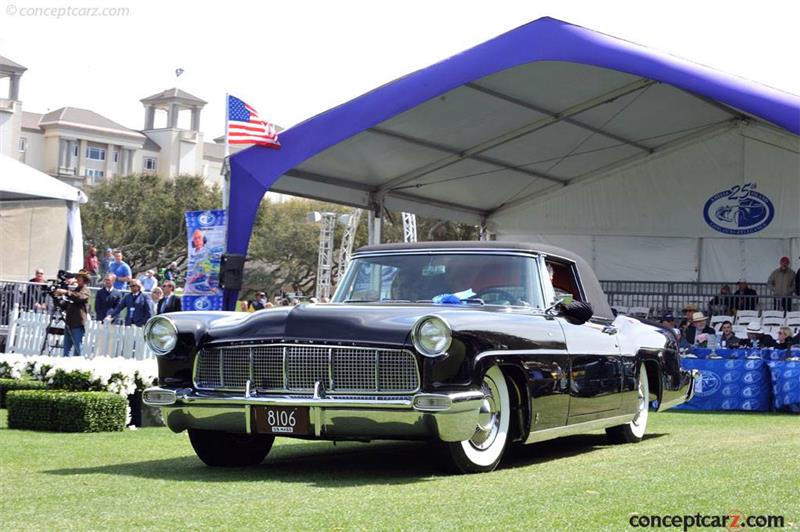
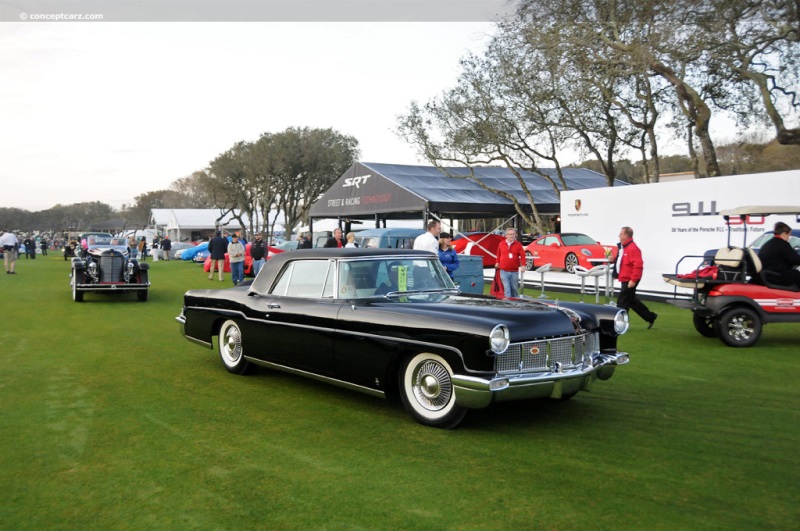
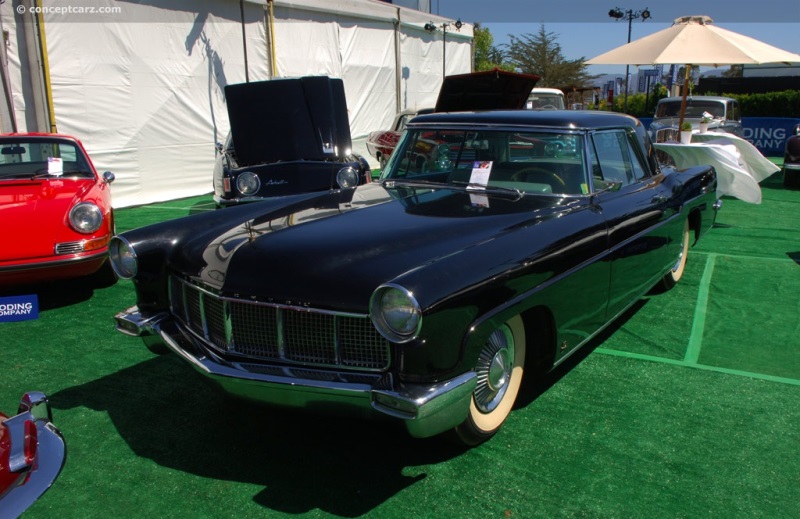
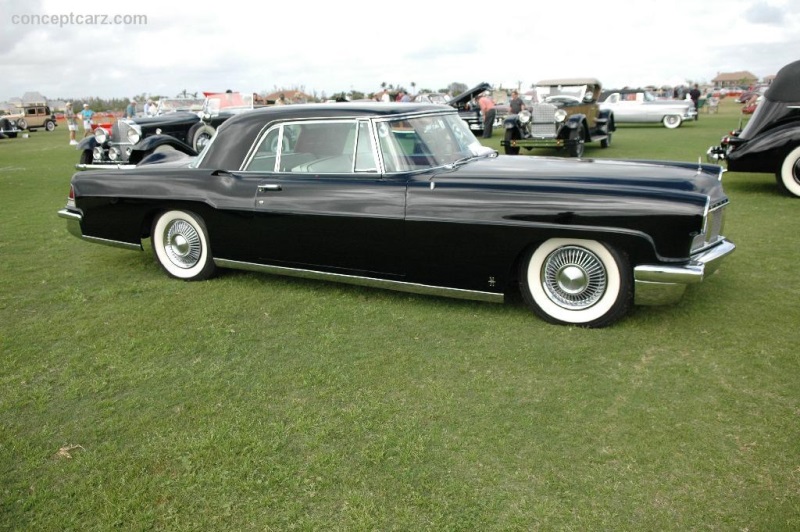
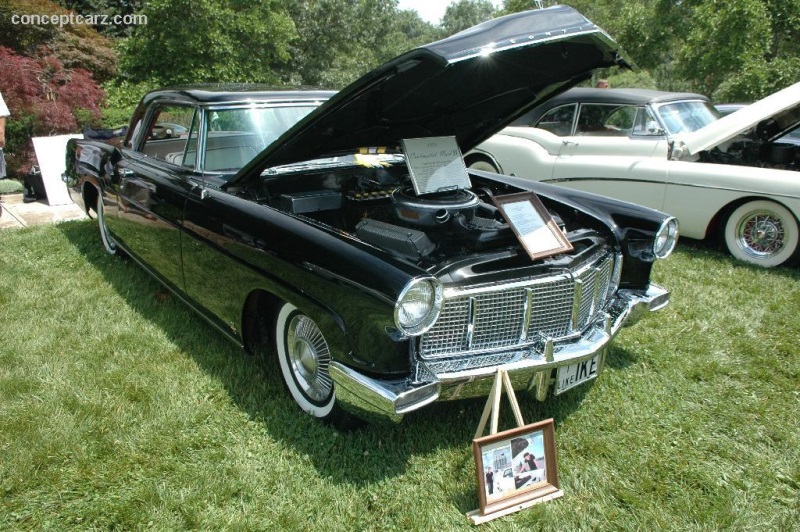
This CarThis stunning black MK II has the easily recognizable understated egg-crate grille, and the long-hood/short-deck motif of cars of the era. Horizontal fender lines sweep back to a point just ahead of the rear wheels, and then kick up slightly before continuing to the taillights. Lincoln's new-for-1956 6-liter V-8 is fitted to the standard equipment 3-speed automatic transmission. (posted on conceptcarz.com)
The Continental is quietly elegant inside. When the leather upholstery was ordered, it was from Bridge of Weir in Scotland; and the brushed-finished instrument panel holds four round gauges of equal size, including a tachometer.Source - Gooding & Company
![]() | ![]() | Coupe Chassis Num: C56G3181 |
| Sold for $72,600 at 2009 RM Auctions. Sold for $62,700 at 2010 RM Auctions. | ||
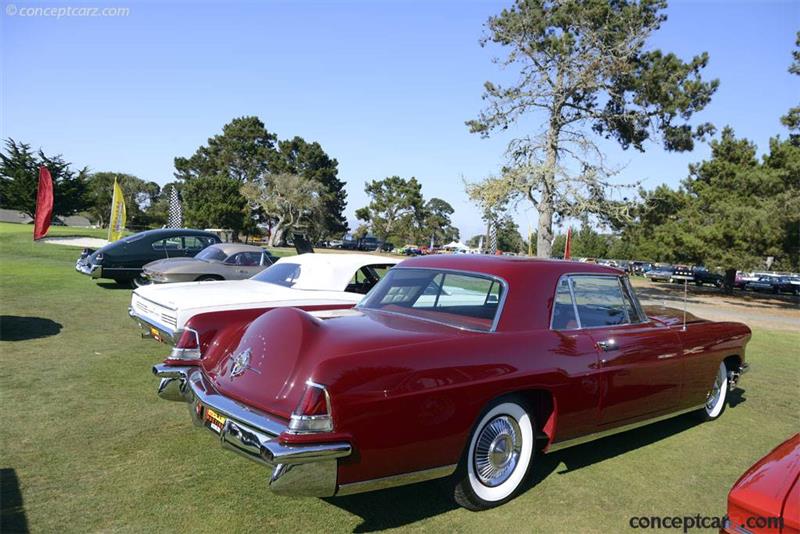
Standard equipment included power steering, power brakes, Turbo-Drive automatic, power seat, white wall tires, radio, and heater. The only real option available was the factory air conditioning and this car is equipped with that feature. This car is finished in Dubonnet Burgundy with white leather interior with burgundy inserts, piping and carpeting. It has been given a professional restoration and remains in superb condition in modern time.
In 2008, the car was brought to the Hilton Head Sports & Classic Car Auction presented by the Worldwide Auctioneers. It was estimated to sell for $90,000 - $110,000. Bidding failed to reach those estimates and the lot was left unsold.
By Daniel Vaughan | Nov 2008
![]() | ![]() | ![]() | Coupe Chassis Num: C56A1771 |
| Sold for $24,200 at 2005 RM Auctions. Sold for $35,200 at 2009 RM Auctions. | |||
In 2009, this 1956 Lincoln Continental Mark II was offered for sale at the Automobiles of Amelia Island auction presented by RM Auctions. It was expected to sell for $40,000 - $50,000 and offered without reserve. The lot was sold for a high bid of $35,200, including buyer's premium.
By Daniel Vaughan | Apr 2009
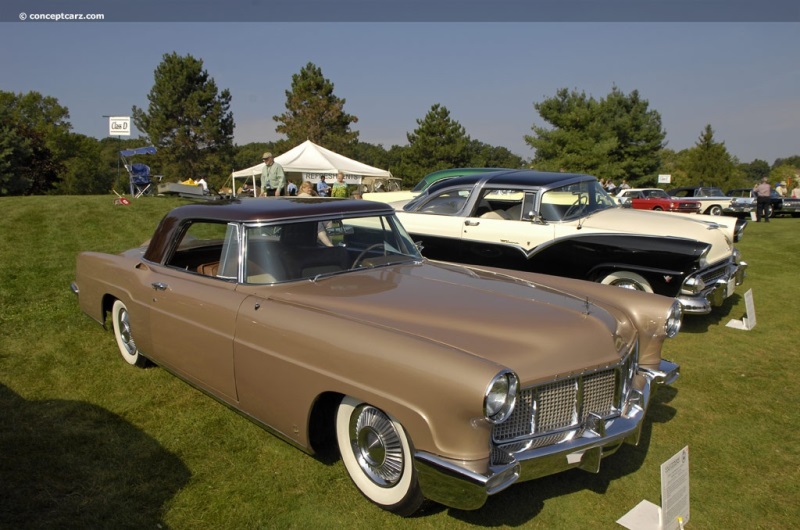
![]() | Coupe |
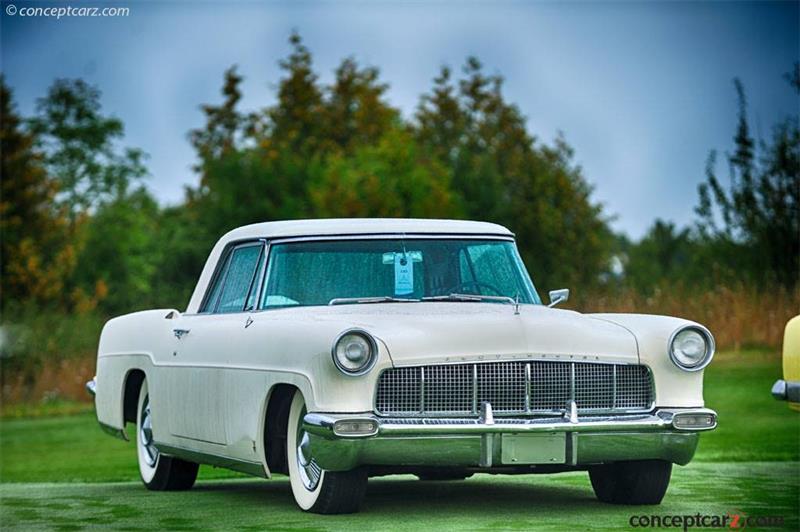
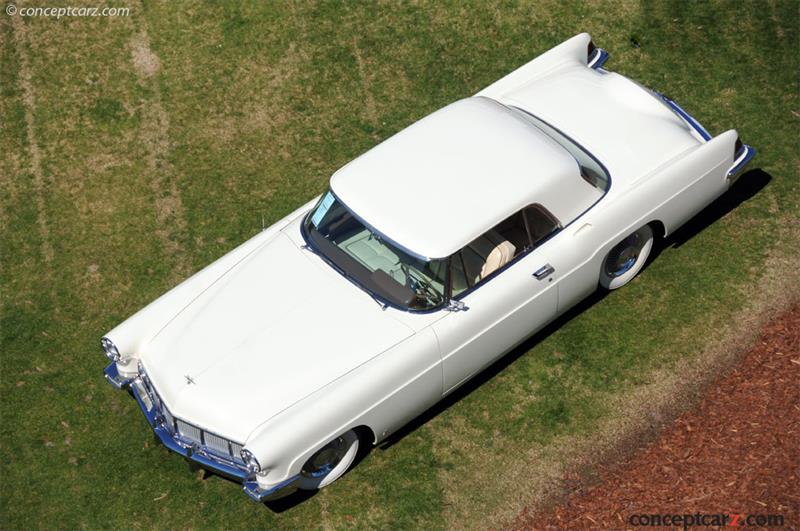
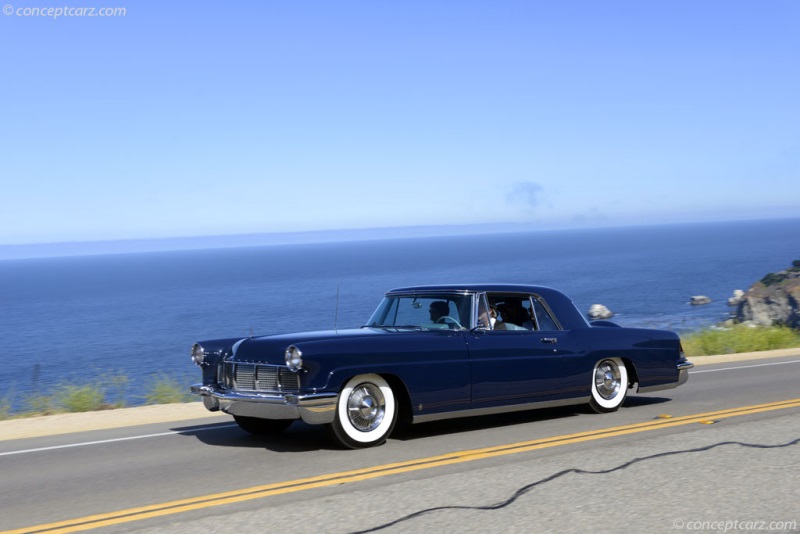
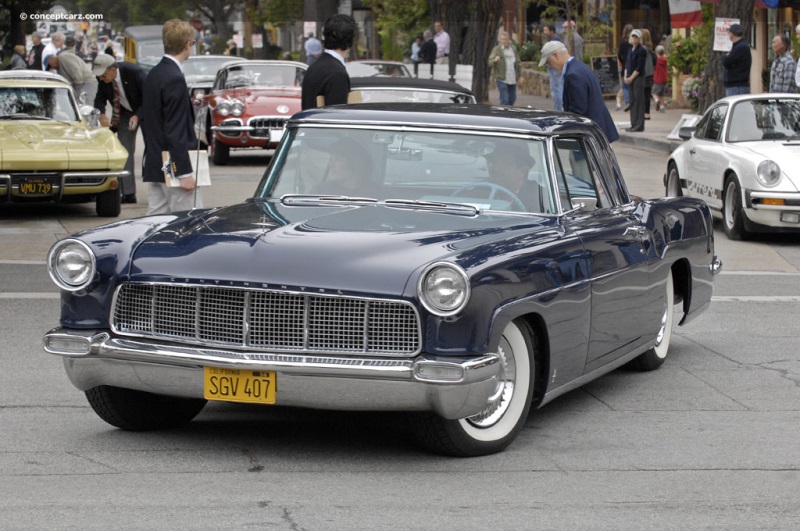
Like its predecessors, the Mark II was an instant classic. Unlike the flashy American style of the time, there was no need for the Mark II to be flamboyant. It did not use chrome or sharp styling cues. Instead, it had a long hood, short deck, and near perfect proportions.
Continentals were loaded with convenience features. Power was supplied by a 368 cubic-inch V-8 engine that developed 300 horsepower. These luxurious rolling woks of art came with a hefty price tag: the Mark II factory price was nearly $10,000 - equivalent to that of a Rolls-Royce. Interestingly, this Mark II is one of only 16 originally painted two-tone brown and may be the only one left in that color.
![]() | ![]() | ![]() | Coupe Chassis Num: C56A1762 |
The restoration of this one-of-a-kind Continental has required several years of often challenging effort and appears today exactly as it was delivered.
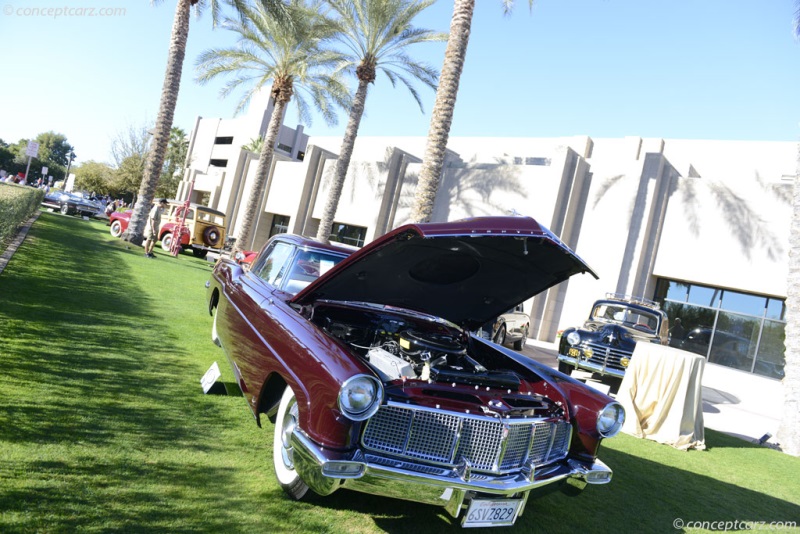
The car remains powered by the regular production 368 cubic-inch 285 horsepower, Y-block it shared with Lincoln products.
The 1956-57 Continental was styled by a team, which included John reinhart, William Clay Ford, and Gordon Buehrig. The car was given a classic long hood/short deck profile along with a simulated spare tire bulge on the deck lid - a subtle reminder of its predecessor, the luxurious Lincoln Continental of 1940-48. To further differentiate the model, Ford established a separate Continental division to add exclusivity to the luxury marque.
Drivetrain items were machined to high tolerances and heavily tested. Each chassis was tuned and tested before mounting the body, which demanded 60 hours of metal finishing - five times that of the typical car. Once all the testing and inspections were completed, the cars were shipped in fleece-lined cover and wrapped in a plastic bag. Priced at $10,000 per copy, Ford spent millions in engineering reportedly losing money on each one sold. Just 2,550 Mark IIs were delivered in 1956 with another 444 in 1957 before being discontinued.
![]() | ![]() | Coupe Chassis Num: C56I 3278 |
Benson kept his special Mark II for years and during the winter of 1958/59, had Ford Motor Company engineering staff replace the original 368 cid engine with the then new Lincoln 430 cid engine having 10:1 compression along with chroming of accessory items.
This car into the possession of the current owner from the family of the late Edson Williams, retired Ford Motor Company Vice-President for Customer Service. It has received a comprehensive restoration completed in 2009, which retained all engineering staff modifcaitons.
![]() | ![]() | ![]() | Coupe |
The 1956 Mark II effort was led by William Clay Ford. His charter was to improve Lincoln's luxury cachet. The Mark II made its long-anticipated debut at the 1955 Paris Auto Show. Enthusiastic reviews called it a timeless exercise in automobile styling and each of the Ford brothers (Benson, Henry Ford II, and William Clay Ford) were quick to order one. Benson's was retrofitted with a 430 cubic-inch 350 horsepower V8. It was resplendent with chromed accessories that gave it very noticeable and desirable appearance. Lincoln boss William Clay Ford had his custom built, and then updated again in 1968-69 with a 460 cubic-inch big block, C6 transmission, and disc brakes. Henry Ford II, unlike his brothers, did not feel the need for more power as the car was intended for his wife. Instead, his custom touches included a simulated landau top of black canvas and a high quality broadcloth interior.
The Mark II was expensive, more than a Rolls-Royce in fact. This contributed to an early demise for a car that some still view as the most elegant Lincoln of all time.
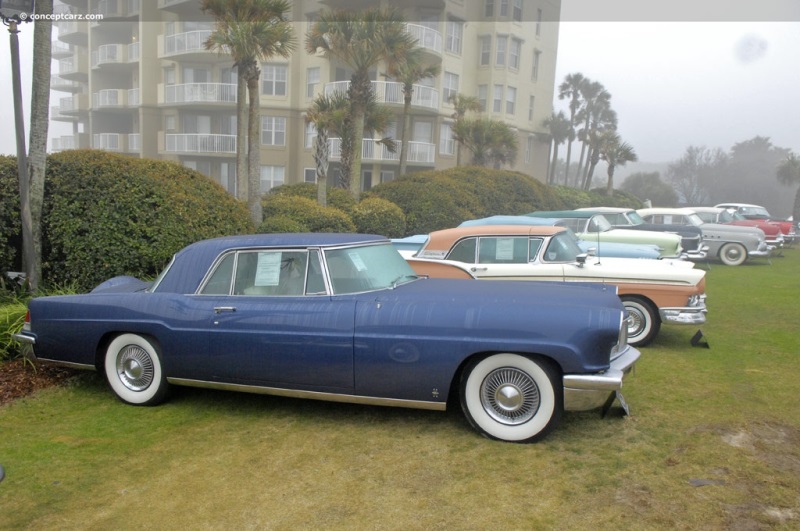
![]() | ![]() | ![]() | Coupe |
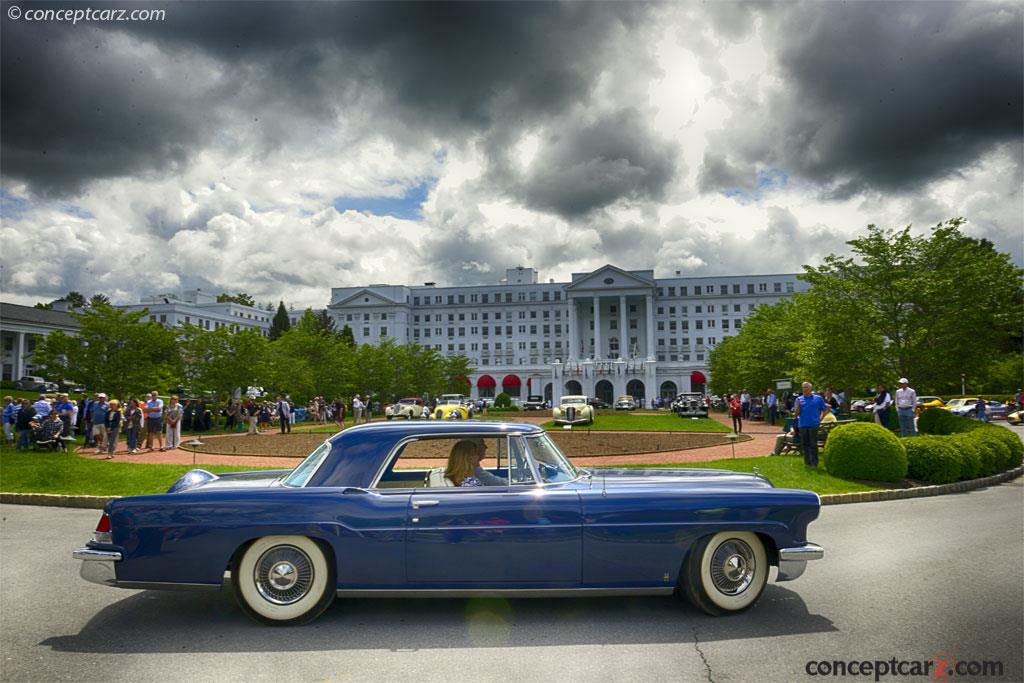
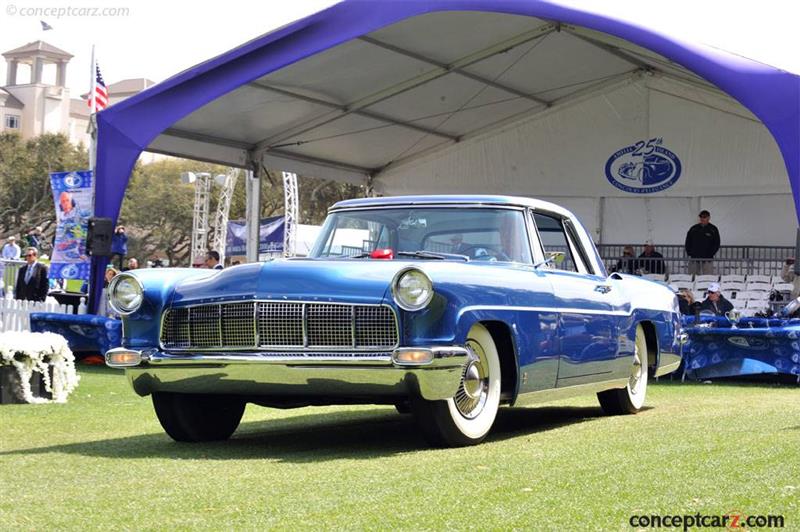
This example was built on January 23rd, 1956 and was sold alter that year by Harris Miller Lincoln Mercury in the Bronx, New York to its original owner, Michael Swartz. This car is very original and has won multiple awards with the Lincoln and Continental Club. Congressman Campbell is the car's 8th owner. it has 65,000 original miles. It's Deep Blue (paint code 02) with a sea biscuit-light blue interior. There were only 124 Mark IIs built in this color and only 31 built with this exterior/interior combination. It has had a complete frame-off restoration.
![]() | ![]() | Coupe |
The car is powered by a water-cooled, overhead-valve, V8, developing 300 horsepower and coupled to a 3-speed Turbo-Drive automatic transmission, was capable of 118 miles-per-hour. The secret of the Mark II lay in the way it was built, with no expense spared on materials or manufacture. Ford lost thousands of dollars on every Mark II produced. As a result of this costly indulgence: only 3,012 examples were produced.
The name 'Continental' was inspired by the 1940's Lincoln Continental powered by a large 12-cylinder engine. Bentley had used the name Continental on their model line, adding to the ambiance and prestige. In 1956 the Ford Motor Company formed the Continental Division for the production of the Mark II. Its general manager was William Clay 'Bill' Ford, son of Edsel Ford and grandson of Henry Ford. Many people associated the Continental as a Lincoln because it featured the trademark Lincoln spare-tire hump in the trunk lid and it was sold and serviced at Lincoln dealerships. Many of the mechanical components were courtesy of Lincoln such as the drivetrain. The Continental Division lasted until 1957 when it was merged with Lincoln and the Continental Mark II was added as Lincoln's flagship model. The name 'Continental' would stay with the Mark line until the introduction of the Mark VII in 1984.
There never was a model designated as a Lincoln or Continental Mark I.
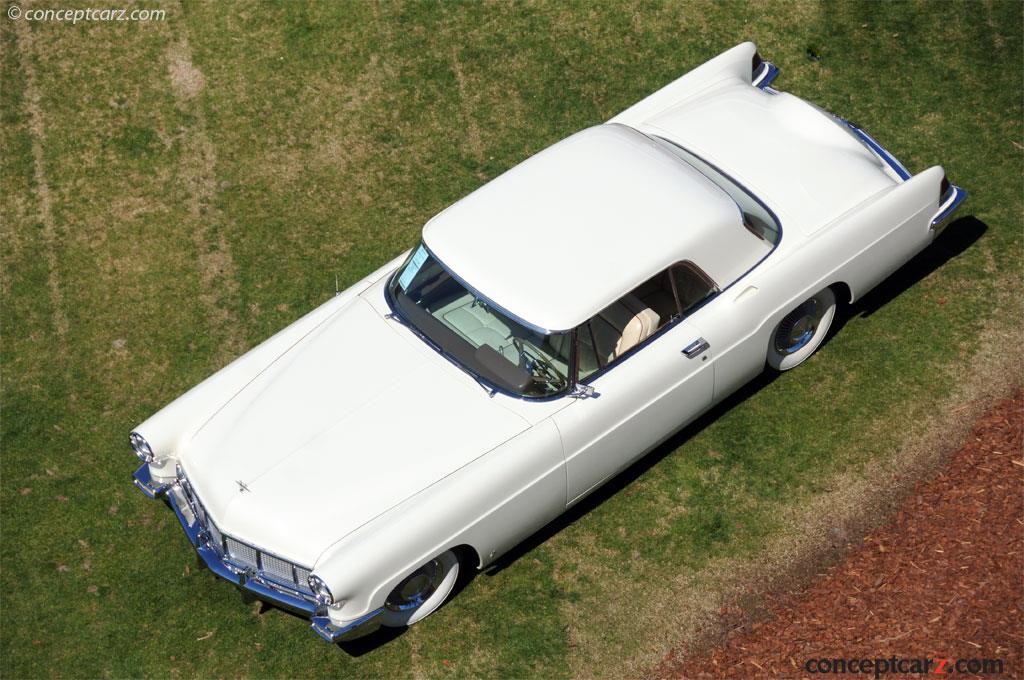
The Continental Mark II had an understated beauty; it was elegant without the need to be flamboyant. Unlike the flashy American style of the time, it was very tasteful in its design. It did not use chrome, two-tone paint, or sharp styling cues to accentuate its beauty. At the front was an egg-crate style grille and straight fenders. The hood was long and curvy, perfect for concealing the 6-liter engine. Mounted on the hood and in the back was the four-pointed star that later became Lincoln's emblem. The Lincoln 368 cubic-inch V8 was matted to a Lincoln three-speed automatic transmission. The back had the signature Lincoln spare-tire hidden in the trunk lid. Though sharing many similarities with the Thunderbird, these were completely different machines. The Continentals were mostly hand made; the paint was applied multiple times and then sanded, double-lacquered, and polished.
These rolling works of art were very costly. The $10,000 sticker price was equivalent to a Rolls-Royce. Top-of-the-line American luxury brands, such as Cadillac, were selling for around $5000. Even at these high prices, Ford still lost an estimated $1,000 per car. At the time Ford was a private company and was willing to incur these losses but when Ford became a public company, losses were not permitted. A stock Mark II was $10,000 in 1956. Derham and Hess & Eisenhardt both estimated a convertible conversion to cost $18,000 to custom build. That's why there were so few Mark II convertibles.
The Continental was sold to the rich and famous. Anyone who could afford the cost was welcome. Famous buyers included Elvis Presley, Frank Sinatra, Louie Prima, Dwight Eisenhower, Barry Goldwater, Spike Jones, Nelson Rockefeller, Henry J. Kaiser, Howard Johnson, the Shah of Iran, and many other celebrities owned them.
The Continental Mark II was debuted to the public at the Paris Motor Show in 1955. During the close of 1955, around 1300 Mark II's were sold. For the entire 1956 model year, another 1300 were sold. In 1957, around 450 were produced for a total of just over 3000. Around 1500 still exist in modern time. Only three convertibles were created.
Mark III
The Lincoln Continental Mark III was produced from 1969 through 1971. Actually, in 1958 the Continental Division of Ford tried to produce the Continental Mark III but sales and production never really materialized. The onset of the 1958 recession accelerated the demise of the Continental Division.
The 1969 Mark III was introduced in 1968 as a 1969 Model year. It was positioned to compete with Cadillac's Eldorado. The Mark III was, in many ways, a luxury version of the Ford Thunderbird. The Mark III and Thunderbird shared many mechanical components; their styling was similar and both were built at Ford's Wixom, Michigan plant. The engine was a Ford 429 enlarged to 460 cubic-inches.
In the back was the signature spare-tire bulge, though no spare-tire was housed in this enclosure. The design was rectangular and smooth. It was taller, larger, 300 pounds heavier, more powerful and luxurious than the Thunderbird. Power brakes, steering, windows, headlamps and front seats were all standard. Vinyl with cloth inserts was standard with leather being optional. The door trim panels and instrument panels were either rosewood or oak, depending on the interior color chosen.
The vinyl roof was popular, even though it was optional. Other options included a variety of radios, 8-track tape players, and air conditioning. Both front seats were power adjustable, but for an additional cost additional power adjustments could be installed. An automatic headlamp dimmer could be ordered, meaning that it would dim automatically for oncoming cars. Anti-lock brakes, cruise control, and a limited slip differential were available for an additional cost.
In its introductory year, nearly 31,000 examples were produced. Though the Eldorado had better slightly stronger sales, this was still a very respectable start for a long and successful series.
In 1970, 21,432 examples were sold. The following year, 27,091 were sold. Even though the best year was in 1968, sales had begun in 1968. Meaning that the sales sold in 1968 and 1969 were counted together.
In 1970 the vinyl roof became standard and the windshield wipers were made recessed. The interior trim was now real wood. A locking steering column was introduced. Radial tires were standard equipment.
1971 was the final production year for the Mark III. Tinted glass, SureTrak anti-lock brakes, and automatic climate-controlled air-conditioning became standard.
Mark IV
In 1972, the Lincoln Continental Mark IV was introduced and would stay in production until 1976. It was similar to its predecessor but grew in both length and width. It still shared a platform with the Thunderbird and in many respects, were similar.
There were few differences of the Mark III and the Mark IV. The Mark IV was slightly rounder, the wheel openings were a little different, and optional opera windows were installed. The grille was longer and a new bumper adorned the front of the vehicle. The popular vinyl roof was now standard. In 1973, a new federally mandated 5 mph bumper was installed.
Under the hood was a 460 cubic-inch Ford 385 Series V8 capable of producing just over 210 SAE horsepower. Power was sent to the wheels courtesy of a C6 3-speed automatic transmission.
Sales were strong for the Mark IV with the lowest production year being in 1975 with 47,145 units sold. 1973 was the strongest year for sales with 69,437. With total sales amounting to 278,559 for the five years of production, the average total sales per year was 55719.
1976 had strong sales partly because of the newly introduced Designer Series. These were special edition Mark IV that were given color, trim and interior choices by famous designers. The designers' signature was placed on the opera windows and a 22 karat gold plated plaque could be found on the instrument panel. The gold plaque could be engraved with the original owners' name.
There were four designer editions offered: Bill Blass Edition, Cartier Edition, Givenchy Edition, and Pucci Edition. The Bill Blass Edition was dark blue with cream accents; the Cartier Edition was dove grey; The Givenchy Edition was aqua blue; and the Pucci Edition was in red and silver.
Mark V
In 1977, In Lincoln Continental Mark V replaced the Mark IV, and would stay in production for only three years, ending in 1979.
In comparison to its predecessor, it was rounder, longer and wider and no longer built on a Ford Thunderbird platform. The engine was downgraded to a Ford 400 cubic-inch small-block engine. The Ford 385 460 cubic-inch was available, except in California, as optional equipment until 1978.
The Continental Mark V was a big and heavy car. It averaged 7 mpg under normal driving conditions and 3.5 mpg under full acceleration. Ford was close to violating the Corporate Average Fuel Economy law so in 1980, a smaller Continental was introduced.
Mark VI
The Lincoln Mark VI was introduced in 1980 and stayed in production until 1983. It was smaller version of its predecessor with minor design revisions. The headlight covers and steering wheel were new. Under the hood was a 5-liter eight-cylinder engine. With the reduced weight and a smaller engine, fuel economy improved.
Mark VII
The Lincoln Continental Mark VII, later just called the Mark VII, was introduced in 1984 and produced until 1991. The Mark VII sat atop the Ford Fox platform, had originally been used for the Ford Fairmont and Mercury Zephyr.
From 1984 through 1985, a special edition Versace Designer Edition could be ordered. A Bill Blass Designer Edition was produced from 1984 through 1992. The Luxury Sport Coupe was produced from 1984 through 1992 while the LSC SE was produced from 1990 through 1992.
The Mark VII continued the ambiance set-forth by its predecessors. Leather seating and all-power options were standard. This included a computer message center, digital instruments, keyless entry and more. The luxury sport coupe (LSC) version after 1986 was did not receive all these amenities.
The ride was smooth thanks in part to a full airbag suspension and electronic ride control system. Power was sent to the wheels courtesy of a four-speed automatic transmission. Under the hood was a 5-liter High Output SEFI or throttle body fuel injected V8 capable of producing nearly 230 horsepower. In 1998 the horsepower was further increased after the throttle body was enlarged and better flowing cylinder heads were adapted.
The Mark VII had electronic 4-channel antilock brakes and composite headlights; the first American vehicle to use these features.
Mark VIII
The Mark VIII was the next iteration in the long line of the Mark Series. It was produced from 1993 through 1998. The base 2-door coupe was powered by a 4.6 liter DOHC V8 producing 280 horsepower while the LSC models produced 290 horsepower. The LSC model versions, produced from 1995 to 1996 was the first American vehicle to be equipped with HID headlights. The 1997 through 1998 LSC models continued the HID headlights but with larger housings.
Slow sales resulted in the cancellation of this luxury car series. A Lincoln MK9 Concept was introduced in the early 2000's, but plans of production seem doubtful.
By Daniel Vaughan | Nov 2008
For more information and related vehicles, click hereThere never was a model designated as a Lincoln or Continental Mark I.
The Continental Mark II had an understated beauty; it was elegant without the need to be flamboyant. Unlike the flashy American style of the time, it was very tasteful in its design. It did not use chrome, two-tone paint, or sharp styling cues to accentuate its beauty. At the front was an egg-crate style grille and straight fenders. The hood was long and curvy, perfect for concealing the 6-liter engine. Mounted on the hood and in the back was the four-pointed star that later became Lincoln's emblem. The Lincoln 368 cubic-inch V8 was matted to a Lincoln three-speed automatic transmission. The back had the signature Lincoln spare-tire hidden in the trunk lid. Though sharing many similarities with the Thunderbird, these were completely different machines. The Continentals were mostly hand made; the paint was applied multiple times and then sanded, double-lacquered, and polished.
These rolling works of art were very costly. The $10,000 sticker price was equivalent to a Rolls-Royce. Top-of-the-line American luxury brands, such as Cadillac, were selling for around $5000. Even at these high prices, Ford still lost an estimated $1,000 per car. At the time Ford was a private company and was willing to incur these losses but when Ford became a public company, losses were not permitted. A stock Mark II was $10,000 in 1956. Derham and Hess & Eisenhardt both estimated a convertible conversion to cost $18,000 to custom build. That's why there were so few Mark II convertibles.
The Continental was sold to the rich and famous. Anyone who could afford the cost was welcome. Famous buyers included Elvis Presley, Frank Sinatra, Louie Prima, Dwight Eisenhower, Barry Goldwater, Spike Jones, Nelson Rockefeller, Henry J. Kaiser, Howard Johnson, the Shah of Iran, and many other celebrities owned them.
The Continental Mark II was debuted to the public at the Paris Motor Show in 1955. During the close of 1955, around 1300 Mark II's were sold. For the entire 1956 model year, another 1300 were sold. In 1957, around 450 were produced for a total of just over 3000. Around 1500 still exist in modern time. Only three convertibles were created.
Mark III
The Lincoln Continental Mark III was produced from 1969 through 1971. Actually, in 1958 the Continental Division of Ford tried to produce the Continental Mark III but sales and production never really materialized. The onset of the 1958 recession accelerated the demise of the Continental Division.
The 1969 Mark III was introduced in 1968 as a 1969 Model year. It was positioned to compete with Cadillac's Eldorado. The Mark III was, in many ways, a luxury version of the Ford Thunderbird. The Mark III and Thunderbird shared many mechanical components; their styling was similar and both were built at Ford's Wixom, Michigan plant. The engine was a Ford 429 enlarged to 460 cubic-inches.
In the back was the signature spare-tire bulge, though no spare-tire was housed in this enclosure. The design was rectangular and smooth. It was taller, larger, 300 pounds heavier, more powerful and luxurious than the Thunderbird. Power brakes, steering, windows, headlamps and front seats were all standard. Vinyl with cloth inserts was standard with leather being optional. The door trim panels and instrument panels were either rosewood or oak, depending on the interior color chosen.
The vinyl roof was popular, even though it was optional. Other options included a variety of radios, 8-track tape players, and air conditioning. Both front seats were power adjustable, but for an additional cost additional power adjustments could be installed. An automatic headlamp dimmer could be ordered, meaning that it would dim automatically for oncoming cars. Anti-lock brakes, cruise control, and a limited slip differential were available for an additional cost.
In its introductory year, nearly 31,000 examples were produced. Though the Eldorado had better slightly stronger sales, this was still a very respectable start for a long and successful series.
In 1970, 21,432 examples were sold. The following year, 27,091 were sold. Even though the best year was in 1968, sales had begun in 1968. Meaning that the sales sold in 1968 and 1969 were counted together.
In 1970 the vinyl roof became standard and the windshield wipers were made recessed. The interior trim was now real wood. A locking steering column was introduced. Radial tires were standard equipment.
1971 was the final production year for the Mark III. Tinted glass, SureTrak anti-lock brakes, and automatic climate-controlled air-conditioning became standard.
Mark IV
In 1972, the Lincoln Continental Mark IV was introduced and would stay in production until 1976. It was similar to its predecessor but grew in both length and width. It still shared a platform with the Thunderbird and in many respects, were similar.
There were few differences of the Mark III and the Mark IV. The Mark IV was slightly rounder, the wheel openings were a little different, and optional opera windows were installed. The grille was longer and a new bumper adorned the front of the vehicle. The popular vinyl roof was now standard. In 1973, a new federally mandated 5 mph bumper was installed.
Under the hood was a 460 cubic-inch Ford 385 Series V8 capable of producing just over 210 SAE horsepower. Power was sent to the wheels courtesy of a C6 3-speed automatic transmission.
Sales were strong for the Mark IV with the lowest production year being in 1975 with 47,145 units sold. 1973 was the strongest year for sales with 69,437. With total sales amounting to 278,559 for the five years of production, the average total sales per year was 55719.
1976 had strong sales partly because of the newly introduced Designer Series. These were special edition Mark IV that were given color, trim and interior choices by famous designers. The designers' signature was placed on the opera windows and a 22 karat gold plated plaque could be found on the instrument panel. The gold plaque could be engraved with the original owners' name.
There were four designer editions offered: Bill Blass Edition, Cartier Edition, Givenchy Edition, and Pucci Edition. The Bill Blass Edition was dark blue with cream accents; the Cartier Edition was dove grey; The Givenchy Edition was aqua blue; and the Pucci Edition was in red and silver.
Mark V
In 1977, In Lincoln Continental Mark V replaced the Mark IV, and would stay in production for only three years, ending in 1979.
In comparison to its predecessor, it was rounder, longer and wider and no longer built on a Ford Thunderbird platform. The engine was downgraded to a Ford 400 cubic-inch small-block engine. The Ford 385 460 cubic-inch was available, except in California, as optional equipment until 1978.
The Continental Mark V was a big and heavy car. It averaged 7 mpg under normal driving conditions and 3.5 mpg under full acceleration. Ford was close to violating the Corporate Average Fuel Economy law so in 1980, a smaller Continental was introduced.
Mark VI
The Lincoln Mark VI was introduced in 1980 and stayed in production until 1983. It was smaller version of its predecessor with minor design revisions. The headlight covers and steering wheel were new. Under the hood was a 5-liter eight-cylinder engine. With the reduced weight and a smaller engine, fuel economy improved.
Mark VII
The Lincoln Continental Mark VII, later just called the Mark VII, was introduced in 1984 and produced until 1991. The Mark VII sat atop the Ford Fox platform, had originally been used for the Ford Fairmont and Mercury Zephyr.
From 1984 through 1985, a special edition Versace Designer Edition could be ordered. A Bill Blass Designer Edition was produced from 1984 through 1992. The Luxury Sport Coupe was produced from 1984 through 1992 while the LSC SE was produced from 1990 through 1992.
The Mark VII continued the ambiance set-forth by its predecessors. Leather seating and all-power options were standard. This included a computer message center, digital instruments, keyless entry and more. The luxury sport coupe (LSC) version after 1986 was did not receive all these amenities.
The ride was smooth thanks in part to a full airbag suspension and electronic ride control system. Power was sent to the wheels courtesy of a four-speed automatic transmission. Under the hood was a 5-liter High Output SEFI or throttle body fuel injected V8 capable of producing nearly 230 horsepower. In 1998 the horsepower was further increased after the throttle body was enlarged and better flowing cylinder heads were adapted.
The Mark VII had electronic 4-channel antilock brakes and composite headlights; the first American vehicle to use these features.
Mark VIII
The Mark VIII was the next iteration in the long line of the Mark Series. It was produced from 1993 through 1998. The base 2-door coupe was powered by a 4.6 liter DOHC V8 producing 280 horsepower while the LSC models produced 290 horsepower. The LSC model versions, produced from 1995 to 1996 was the first American vehicle to be equipped with HID headlights. The 1997 through 1998 LSC models continued the HID headlights but with larger housings.
Slow sales resulted in the cancellation of this luxury car series. A Lincoln MK9 Concept was introduced in the early 2000's, but plans of production seem doubtful.
By Daniel Vaughan | Nov 2008
| Magnificent Series of Coachbuilt Classics To Grace RM's Amelia Island Concours D'Elegance Sale | |
![]() | • RM Auctions returns as the official auction house of the Amelia Island Concours d'Elegance, March 9, 2013 • Single-day sale features breathtaking roster of more than 80 investment-quality collector cars • Notable highlights include an outstanding series of coachbuilt classics headlined by a multi-million-dollar 1935 Duesenberg Model SJ Walker-LaGrande Convertible Coupe and a trio of Cords from the personal collection of Jim Fasnacht • Frequently updated list of entries available online at r...[Read more...] |
| Breaking news from Coys | |
![]() | 1966 AC Shelby Cobra - Now selling at No Reserve! Coys are pleased to announce that a 1966 AC Shelby Cobra will now be selling at No Reserve later today at the Autosport International show at the NEC in Birmingham. Featured on the front cover of Classic & Sportscar magazine in September 2012, this Cobra is beautifully presented in Rangoon Red paintwork with black leather upholstery and hood and tan tonneau and sidescreens, and the car still displays a delightful patina. The 427ci b...[Read more...] |
| Lincoln at Los Angeles Auto Show Press Days: Celebration of Its Past and Future As Brand Rolls Out Its Reinvention | |
![]() | > The brand pays tribute to its heritage today, displaying seven of the most influential Lincoln designs > Thursday sees a display full of the all-new MKZ premium midsize sedan and MKZ Hybrid, the future of Lincoln, on the Lincoln stand > Lincoln launches on Tumblr http://lincolnnow.tumblr.com beginning with the visually stunning classic Lincolns shown on the stand and select images from archives. Continues with an all-new collection of photographs by photographers Jamie Beck and Kevin Burg ...[Read more...] |
| COLLECTORS SET TO DESCEND ON FLORIDA FOR RM'S HIGHLY ANTICIPATED SALE | |
![]() | • Final countdown underway to RM's John Staluppi Cars of Dreams Museum sale, December 1, in North Palm Beach, Florida • Auction features nearly 120 automobiles without reserve, with a strong emphasis on American convertibles of the '50s and '60s • Selection rounded out by more than 60 lots of memorabilia, including a historic 1918 Herschell-Spillman 32' Carousel, an elaborate Lionel Train Set, and a Cretors Antique Popcorn Wagon • Digital catalogue and collection vide...[Read more...] |
| Gooding & Company's Annual Pebble Beach Auctions | |
![]() | Gooding & Company, the acclaimed auction house celebrated for selling the world's most significant and valuable collector cars, will host its annual Pebble Beach Auctions on August 18th & 19th in association with the prestigious Pebble Beach Concours d'Elegance. Once again, Gooding & Company is poised to present an outstanding array of blue chip and concours-quality collector cars on its record-setting stage, including the elegant 1955 Maserati A6G/54 Frua Berlinetta owned by Grammy Award-winni...[Read more...] |
1956
Continental
models |
| Continental Mark II Convertible |
| Similar Vehicles | |
![]() | 1956 Continental Mark II Convertible |
| Similarly Sized Vehicles from 1956 |
| Continental Mark II Convertible |
| DeSoto Fireflite |
| Maserati 250F |
| Packard Caribbean |
| Packard Four-Hundred |
| Packard Patrician |
| Rolls-Royce Silver Wraith |
| Similarly Priced Vehicles from 1956 |
| Continental Mark II Convertible ($9,966-$9,966) |
Average Auction Sale: $35,087 |
| Continental: 1951-1960 |
| Similar Automakers |
| Other models by Continental |
| Mark II |


1956