Concept Cars Home
 
Image credits: © Bugatti.

2004 Bugatti EB 16/4 Veyron news, pictures, and information
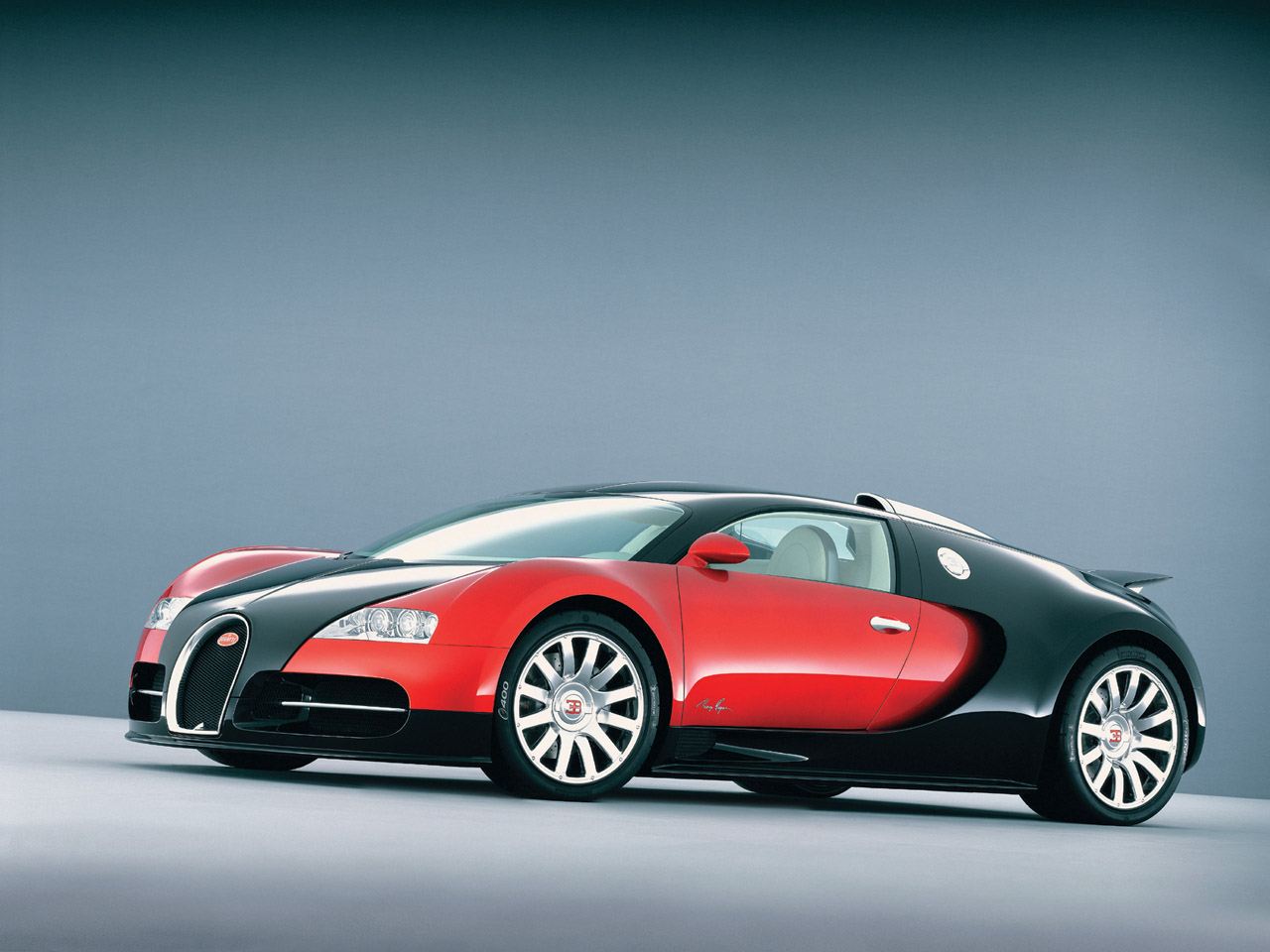
At the 2003 Frankfurt Motorshow Bugatti displayed a production ready version of their latest supercar. Both the power train and the body of the new design study are much closer to production maturity. The theoretical performance figures have been determined, according to which this 16-cylinder sports car, due to go on sale late in 2003, will have a top speed of 406 kilometres per hour and accelerate to 300 km/h in under 14 seconds.

The 16/4 Veyron rides on tyres featuring the new Pax system developed by Michelin. These high-speed tyres for the 400-km range have a pressure monitoring system and run-flat characteristics, so that safe handling and a remaining distance of more than 200 kilometres are assured in the event of air loss.

Compared to the version exhibited at the March 2001 Geneva Automobile Salon, the wheelbase is now 2,700 millimetres, 50mm longer than before, the extra space is used for increased cabin space.

This 16/4 Veyron also has an upgraded aerodynamics package, both to solve cooling problems and to increase the handling characteristics. The rear of the car has two air outlets not seen on the previous concept. Together wîth the front-end airflow, the fully panelled undertray and a new, automatically extending rear spoiler, a diffusor effect has been obtained that counteracts body lift.

The alloy-block W16 engine is made up of two exceptionally narrow V8 cylinder blocks, using the VR principle combined at an included angle of 90 degrees.

The gear shifts of the seven speed gearbox take place sequentially at paddles behind the §teering wheel, and there is no clutch pedal. The double clutch transmission (DCT) shifts from one gear to the next in a maximum of 0.2 of a second. Power from the engine reaches the wheels through a permanent all-wheel drive system.

Source - Bugatti Media
At the end of 2003 the first 21st-century Bugatti, a blend of traditional craftsmanship and ultra-modern industrial production, will leave the factory - the Bugatti EB 16·4 Veyron, a production car of exceptionally unusual design that will be based on the design study of the same name displayed by BÚGATTI Automobiles S.A.S. at the 72nd Geneva Motor Show in 2002.

At the time of writing, in the spring of 2002, the 736 kW (1001 bhp) Bugatti EB 16·4 Veyron, although exhibited as a design study, has already reached a degree of driveline and body development that is close to series production status. The first theoretical performance figures are also available: the new 16-cylinder sports car should reach a top speed of 406 km/h and accelerate from 0 to 300 km/h in under 14 seconds.

The study exhibited at the 2002 Geneva Motor Show incorporates a large number of technological highlights. As on Formula 1 and Le Mans racing cars, the load-bearing chassis of the EB 16·4 is reinforced wîth carbon fibre for maximum strength and rigidity as well as minimum weight. This principle also ensures optimum passive safety for the car's occupants. The outer skin of the body is of mixed aluminium and carbon-fibre construction. The W16 turbocharged engine, which has dry sump lubrication and four continuously variable camshafts, surpasses the power output of even the latest Formula 1 engines. Power is transmitted to the wheels through a new type of sequential-shift seven-speed gearbox wîth twin clutches.

The EB 16·4 Veyron runs on tyres that use the new Pax system developed by Michelin. These high-speed tyres for speeds in the region of 400 km/h have a pressure monitoring system and run-flat capability, so that safe handling is maintained and the car can be driven for more than 200 kilometres in the event of pressure loss.

The dimensions of the Bugatti EB 16·4 Veyron are equally impressive: the wheelbase is 2,700 millimetres, the car's overall length 4,466 mm, its width 1,998 mm and its height only 1,206 mm.

In addition to this design study, BÚGATTI Automobiles S.A.S. is drawing attention to Bugatti's origins at the 2002 Geneva Show, by exhibiting a 16-cylinder racing engine dating from 1928. This engine documents an exciting era in automobile engineering during the early part of the 20th century: wîth its two Zenith carburettors and double magneto ignition, it represented the leading edge of automobile engine development in its day.

Source - VW
The trials of the fastest road sports car in the world have been successfully completed. One of the most ambitious projects in automobile history is entering its production phase. The first Bugatti Veyron 16.4 cars, built mainly by hand, are already being completed and will be delivered to customers this year.

The sports car, capable of more than 400 km/h, is driven by a 16-cylinder mid-engine, that at 710 mm long is no larger than a conventional V12 unit, and due to its lightweight construction weighs only about 400 kilos. Its compact dimensions are due to the unique arrangement of its cylinder banks in a W configuration. Two VR8 blocks, each wîth a fifteen degree bank angle, are joined in the crankcase to form one engine. Both eight cylinders are set at an angle of ninety degrees to each other and are aspirated by a total of four exhaust gas turbochargers. The engine delivers 1001 HP at 6,000 r.p.m. and provides a maximum torque of 1250 Newton metres at between 2,200 and 5,500 r.p.m.

To apply the power of the 64-valve unit to achieve satisfactory driving dynamics both in everyday traffic and on the racetrack, the Bugatti development team of Dr. Franz-Joseph Paefgen and Dr. Wolfgang Schreiber has realized a propulsion unit that is without parallel in its complexity. If the extreme engine power is a master stroke of genius, its conversion for road use is an equally tough challenge. As Dr. Schreiber says 'For 1000 HP propulsion power, the system demands approximately 2000 HP to be additionally generated as heat energy during combustion. Half in each case is dissipated in the exhaust gas and cooling water'.

To do this, the Bugatti engine has two water circuits. The larger of the two wîth 40 liters of cooling water has three coolers in the front section of the car, to keep the engine at operating temperature. The second circuit, called the low-temperature system, has a separate water pump and contains 15 liters of cooling water. These are used to cool, by up to 130 degrees, the charged air, heated during compression in the turbochargers, in two heat exchangers mounted on the engine. The cooled, charged air then passes through two 'air manifolds' into the combustion chamber, which it then leaves as exhaust gas at approximately 1,000 degrees. It then passes through the turbines of the exhaust gas turbochargers. This causes the exhaust gas to expand, so that it is cooled by up to about 150 degrees, is then cleaned in the catalyzer and exhausted.

In addition to its unique compactness, the high performance of the power unit is the centrepoint of the dvelopment. Lightweight materials are used that not only result in a low power-to-weight ratio but also particularly provide the spontaneous response of the moving engine-internal masses. In addition to piston rods of titanium, the so called 'easy runners', the eight-stage oil pump integrated into the crankcase for dry sump lubrication has light aluminum gears. Because the arrangement of the 16 cylinders ensures extremely quiet running, only a small flywheel is needed. The use of motor sport technology is evident not only from the plasma-coated running faces of the cylinders but also by the use of high-strength steel for the shafts and gears in the aluminum crankcase.

Únique in engine design is the integration of knock and misfiring detection in an ion current system. Because the multiplicity of cylinders means very quiet running and ensures that the velocity difference will be extremely small in the event of a cylinder misfire, cylinder-selective detection by measuring rough running is not reliable enough. Therefore, Bugatti Ion Current Sensing (BIS) is used. The ion current flowing at each spark plug at the timepoint of ignition is monitored by a separate evaluation sensor system. The data obtained is passed to both engine control units. If knocking combustion or a misfire is detected, the associated control unit immediately initiates countermeasures, such as retardation of the ignition timepoint, shutdown of the cylinder or reduction of the charge pressure. According to the head of Bugatti Únit Development Gregor Gries, 'The aim of our technology is
to generate the maximum performance from the engine in a stable, clean manner'.

The power generated in the engine is transferred to the flange-mounted direct manual gearbox (DSG). The torque and speed is then transmitted, through the gearing of seven forward and one reverse gear, via a universal drive to the front axle gearbox and via a second universal drive, along the right side of the engine to the rear axle gearbox. Both the DSG and both axle gearbox housings are of lightweight aluminum construction. The drive power is distributed to the front and rear axles by means of a Haldex coupling, an actively-controlled multi-disk, inter-axle lock directly connected to the front axle gearbox. The following front axle differential distributes the power to both front wheels. In the rear axle differential the power is distributed to the rear wheels via a bevel gear and a further differential. In addition, an actively-controlled, hydraulically-actuated, multi-disk differential lock is installed here. When necessary, it prevents speed differences between the rear wheels and ensures optimum directional stability when accelerating and when cornering under load. All load distribution functions are completely automatic and are undetected by the driver.

The Bugatti marque has since earliest times been regarded as a central force in the advancement of automobile development by innovative solutions. A position deservedly maintained by the first high-performance sports car of the modern Bugatti.

Source - Bugatti
1967 Can-Am Road America: The Beginning of the 'Bruce and Denny Show'
While Formula One will be forever considered the pinnacle of motorsport, from a period between 1966 and 1986 there existed a series that would likely be the closest to 'anything goes' as any motor racing series could truly get. Based upon the FIA Group 7 cars but allowed to showcase unlimited engine sizes and unfettered aerodynamics, the Can-Am cars would have to be considered the pinnacle of motorsport technology and power of their era. And for more than a couple of years there would be one tea...[Read more...]
Home again: the last Auto Union Type D twin-supercharger Silver Arrow returns to Audi
• Audi Tradition buys back the second 'Karassik restoration' car
• Auto Union Type D built in 1939, then lost in the USSR for many years
• Thomas Frank, Head of Audi Tradition: 'One of the most emotional moments in our heritage work for AUDI AG'
'This is one of the most emotional moments in our heritage work for AUDI AG – we have come full circle,' says Thomas Frank, Head of Audi Tradition. A few weeks ago, the car manufacturer was able to repurchase an extremely rare...[Read more...]
Vicari to Auction 2009 Mustang GT500KR Owned by Carroll Shelby at Oct. Biloxi Event
Car enthusiasts will have an opportunity to purchase a rare Mustang personally owned by American automotive legend Carroll Shelby when it goes up for bid at The Vicari Auction Company's 16th annual Biloxi Auction, Oct. 12-13, 2012, at the Mississippi Coast Coliseum & Convention Center in Biloxi, Miss. Vicari will auction a 2009 Ford Mustang Shelby GT500KR that was delivered to the late Shelby for his home/ranch as CSM #445. The vehicle comes well documented with a copy of the previous title...[Read more...]
Camaro 1LE Laps Virginia International Raceway in 2:58.34
The 2013 road-racing inspired Chevrolet Camaro 1LE, with Camaro engineer Aaron Link behind the wheel, lapped the famed Virginia International Raceway (VIR) 'Grand Course' in 2:58.34 – a time previously accomplished by only the upper echelon of performance cars. The $3,500 1LE package is available on Camaro 1SS and 2 SS coupes, with a manual transmission. A Camaro 1SS with the 1LE package starts at $37,035, including destination, making it one of the most affordable, most capable performance...[Read more...]
1963 Andre Simon/Lloyd Casner Maserati Tipo 151/2
At a time when Maserati's financial picture couldn't have looked more bleak, it would be enticed to build what many would end up considering to be one of their finest sportscars ever. It would even be suggested it could have been one of the greatest of all time if Maserati had had the money to develop it. Unfortunately, the Maserati Tipo 151 forever lives in relative obscurity when it truly deserves to be remembered as much more. It is often remarked that for a race team to win a championship...[Read more...]
8-Liter
EB110
Royale
Type 101
Type 13
Type 23
Type 35
Type 37
Type 38
Type 39 and Type 39A
Type 40
Type 46
Type 50
Type 51
Type 55
Type 57
Type 59
Veyron

© 1998-2012. All rights reserved. The material may not be published, broadcast, rewritten, or redistributed.