
Volkswagen Concept C at Geneva
02 March 2004
World premiere of Volkswagen's cabriolet-coupé: New technology in a cabriolet-coupé design study for the mid-class segment
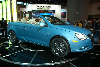
At the 74th Geneva Automobile Salon, Volkswagen will be showcasing its new (semi-series-mature) cabriolet, the concept C design study. (C stands for cabriolet and coupé.) The vehicle features a new generation of fold-away steel roof, which transforms this four-seat Volkswagen from an elegant coupé to a stylish cabriolet in a matter of only seconds. Or vice-versa, of course. The roof also features an integrated glass sunroof. This exciting new automobile provides a view on things to come, on how a new Volkswagen cabriolet in the next-higher vehicle class to the successful New Beetle Cabriolet could ultimately look. And performance? The concept C is driven by a 110-kW / 150-hp FSI engine.
A new generation of automobile
Taking a fresh approach to the interplay of dimensions.
The progressive concept of this design study, with its 'Pure Essence' silver metallic finish, features an array of newly developed components, the use of which enables an exceptionally intelligent interplay of vehicle dimensions. The concept C has moved away from the class of cabriolet found in the A segment. Positioned in the lower mid-class segment, it is as much a cabriolet as it is a coupé. And the concept C is wider than any other cabriolet in the A or B segment - which makes for new dimensions in dynamics. Because of its extreme width of 1.81 metres (1.43 m high / 4.41 m long), this design study rests as sturdily upon its wheels as would a beefy, high-calibre sports car.
A fully-fledged four seater.
Indeed, the liberal dimensions of the body shell also create a sumptuous feeling of spaciousness in the vehicle's newly designed leather- and timber-enhanced interior, with ideal ergonomics and generous amounts of space in both the front and rear passenger compartments.
Indeed, the liberal dimensions of the body shell also create a sumptuous feeling of spaciousness in the vehicle's newly designed leather- and timber-enhanced interior, with ideal ergonomics and generous amounts of space in both the front and rear passenger compartments.
Coupé and cabriolet roof:
The way in which this five-level roof system tucks away out of sight is truly astonishing. Once the lock-in mechanism is released, the sunroof retracts to the back of the car (stage 1). The rear end of the roof (the C pillar, including the rear windscreen) then lifts up and glides forward (stage 2). By this time, the glass sunroof is moved underneath the rear end of the roof, forming a compact sandwich unit. The system hydraulics now fold the boot lid, to which the rear shelf is attached, up and back (stage 3).
The roof rails release themselves from the windscreen frame, retracting into the available cavities in the sandwich unit (adjacent to the rear side windows). Et voila! The coupé has now been transformed into a cabriolet.
Volkswagen future design
The front end.
The concept C's robust architecture and the principles employed to design its contours produce a clear outlook on the new design for future Volkswagen automobiles. The unmistakable look of the aluminium radiator grille combined with striking round headlights are the progressive new 'face' of the front end. The positioning of the headlights and radiator grille has also substantially influenced the modulation of the concept C's bonnet, with the V-contour of the grille reproduced in a wide depression on the bonnet. The sides along these V-contours are raised to a slight curve, giving the concept C distinctly contoured wings and wheelhouses. The result is an exquisitely muscular shoulder section.
The rear end.
The rear section of this vehicle is similarly athletic, with the wings gently curving up over the wheelhouses - which is why the aerodynamically fashioned lower edge of the boot lid (which, when lifted, reveals 400 litres of stowage space) is embedded between the wings.
The silhouette.
The concept C's silhouette is determined chiefly by the tapered design of the vehicle's rear end. Particularly conspicuous features are the joints running along the vehicle's side and the fact that both the bonnet and the boot lid reach all the way down into the wings. The line dividing the bonnet and the front wings extends quasi seamlessly into the line marking the lower edge of the side windows. The rear one of these lid joints extends the sweep of the side window in a dynamic contrary motion. When the roof is up, the interplay of all the forms visible at the side of the vehicle produces an extremely elegant, aesthetically appealing coupé contour. When it is down, a side view of the concept C reveals all the charismatic charm of a classic cabriolet. Convention was not at play in the homogeneous design of the windscreen frame, which, because it does not extend all too far into the passenger compartment, affords vehicle occupants unadulterated open-air-driving pleasure.Source - Volkswagen Media
Similar Vehicles
Volkswagen Monthly Sales Volume
March 2023
67,853

Recent Vehicle Additions


Related Automotive News
AUDI R8 V10 ANNOUNCED AS OFFICIAL SAFETY CAR FOR 2014 ROLEX 24 AT DAYTONA
Audi R8 V10 Official Safety Car For Second Year In A Row At Rolex 24
Audi To Lead Field For Inaugural Race Of TUDOR United SportsCar Championship
DAYTONA BEACH, Fla. (Jan. 22, 2014) – For the second year in a row, the Audi R8 V10 will lead the fie...

Audi R8 V10 announced as Official Safety Car for 2014 Rolex 24 Hours at Daytona
Audi R8 V10 is the Official Safety Car for second year in a row at the iconic 2014 Rolex 24 Hours at Daytona
Audi excited to lead the field for inaugural race of the TUDOR United SportsCar Championship with the R8 V10 road car
Audi R8 V10 offer...

Audi At Le Mans: Engine Technology Forges Close Links To Production
Fuel consumption of the TDI units reduced by more than 20 percent
Direct technology transfer between motorsport and products
Piston area output significantly increased
Ingolstadt, June 13, 2013 – One more week before the Le Mans 24 Hours c...

VOLKSWAGEN CONTINUES PROMOTION OF JUNIORS IN FORMULA 3
In 2013, Volkswagen engines will once again be in use in the FIA Formula 3 European Championship, which gets underway with the opening round of the season in Monza this weekend. Volkswagen will also line up at the British Formula 3 Championship (season...

One-two victory for Audi customer teams at Daytona
- Alex Job Racing achieves GT class win
- APR Motorsport completes one-two success of the Audi R8 GRAND-AM
- All three race teams in contention for victory till the end
At the Daytona 24 Hours, the Audi R8 GRAND-AM has made its best showing to date...