Concept Cars Home
 

1966 Ferrari 206 S news, pictures, and information

Competition Spyder
Chassis Num: 006
 
Sold for $3,255,604 (€2,520,000) at 2012 RM Auctions.
Dino Ferrari, son of Ferrari founder Enzo, conceived of a 65-degree V-6 engine prior to his untimely death in June of 1956. The engine was co-engineered by Alfa Romeo designer Vittorio Jano, then working as a consultant for Ferrari. The Dino V-6 engine was badged with a hand scripted autograph based on the Dino Ferrari's signature.

In early 1966, Ferrari introduced a new spots-racing car formulated for the FIA's 2-liter Group 4 class. They were dubbed the Dino 206S and were powered by the development of the Dino V-6 engine. Ferrari had hopes of winning over the successful privateer teams, many of whom were winning with Porsches.

The engine was introduced as a Formula 2 powerplant, an enlarged version was subsequently used in the Formula 1 cars. One example driven by works driver Mike Hawthorn was rewarded with a Driver's World Championship in 1958

The V-6 continued to be development and enlarged throughout its lifespan, and used in various experimental sports prototypes, including the 246 SP, the 206 SP, the 196 SP and the 166 P.

The Dino 206 S was introduced for the 1966 racing season. It wore similar coachwork to the 330P. The car was clothed by Piero Drogo's Carrozzeria Sports Cars in Modena. The design was aerodynamic and featured a combination of stressed alloy panels and fiberglass over a welded tubular semi-monocoque.

At the close of the 1966 race season, the 206 S had proven to be a fierce competitor, earning a 2nd place finish at the Targa Florio, 2nd and 3rd at the Nurburgring and a 6th place finish at Spa.

The 206 S had originally been slated for a homologation of 50 examples, but labour problems prematurely interrupted production after only 18 examples had been assembled.

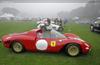
Not including the Factory Works prototype, this 206 S is the third example produced. It is a restored car that was initially purchased on April 233rd of 1966, by Colonel Ronnie J. Hoare of Maranello Concessionaires Racing Team of Egham, Surrey, England, an authorized Ferrari dealer and racing concern originally founded by driver Mike Hawthorn. The car was painted Ferrari Racing Red and given a Maranello Concesionairs blue stripe.

Chassis number 006 made its racing debut at the RAC Tourist Trophy in Oulton Park, England. It was piloted by Michael Parkes and wore racing number 42. Unfortunately, the car retired early due to final drive issues, but it still placed 21st overall.

The following June, at the 1,000 Kilometers of Nurburgring, the car started 12th on the grid and was piloted by British drivers, Richard Attwood and David Piper. By lap 28, the car was in 5th in class and 8th place overall. Unfortunately, it would again retire early due to mechanical issues. After sorting out the mechanical problems, the car was brought to the British Grand Prix at Brands Hatch, where Mr. Parks drove the car to 6th place overall and 1st in class.

The car was sold in August of 1967 to Gustaf Dieden, through Tore Bjurstrom, the official Ferrari concessionaire of Sweden. Mr. Dieden subsequently advertised the car in Road and Track. It was purchased by Hans Wangstre of Malmo, Sweden, who brought in driver Evert Christofferson as a co-owner. Under the name Team Bam-Bam, Mr. Wangstre and Christofferson campaigned the car in several international venues over the following year. Highlights were a 15th place finish at the Good Friday Meeting at Oulton Park on April 12th of 1968 and a 22nd place finish at the Targa Florio on May 5th.

In 1969, the Dino V-6 engine suffered problems due to the imbalance of the crank shaft. A replacement block was deemed too expensive, so an experimental Volvo B20 engine was installed, effectively ending the cars racing career.

The car was sold to the current owner in 1970. The purchase included all of the components of the original engine. The car was then put into storage. A search for the correct-type replacement engine began. In 1974, the owner contacted the factory and was delighted to find that one engine was left over in the Maranello works. Unfortunately, the price was very steep. In 1988, a decision was made to restore the car back to its original glory. The owner eventually managed to obtain a set of drawings for the specialized 206 S block. The plan was to cast a new series of four blocks using another car in. The owner, at the time, also owned Dino 206 S chassis 016, which also had a cracked block. The blocks were cast at the factory foundry and machined to the correct specifications before the unit intended for chassis 006 was installed in the car.

The restoration of 006 took several years, including the testing of the new engine. The car has been returned to its original livery, as it was campaigned by Maranello Concessionaires at the 1966 1,000 km of Nurburgring, wearing number 14.

The 1987cc dual overhead valve V-6 engine offers 218 horsepower which is sent to the rear wheels via a five-speed manual gearbox. There is an independent double wishbones suspension and four-wheel disc brakes.

In 2012, the car was scheduled to cross the auction block at RM Auction's Monaco sale. The car is estimated to sell for €2.200.000-€2.800.000.

By Daniel Vaughan | Apr 2012
Chassis Num: 032
 
This Ferrari 206 S Dino Spyder with chassis number 032 was shown at the 2005 Cavallino Classic. Its earliest reported owner is Vincenzo Arcuri who acquired the car in October of 1969. It passed through a few more owners before appearing on stage at the Poulain Le Fur Paris auction where it found a new owner for the price of $1,615,000.

In 1991 Rober Lamplough became the cars next owner. He sold it to Jacques Setton in 1993 but re-acquired the car in 1995. In 1996 it was sold to Logalos and then to Brandon Wang in 1997.

In 2001 it was purchased by Carlos Monteverde of the UK. It was shown at the 2003 Goodwood Revival Meeting.

By Daniel Vaughan | Jan 2007
Competition Spyder
Chassis Num: 026
Engine Num: 15
Gearbox Num: 13
 
Early in February 1966 Ferrari introduced the 4-liter 330P3 to the press at Maranello. Alongside it was a smaller sister, the all new Dino 206SP. It was Ferrari's intention to build 50 of these smaller V6 cars to qualify them for homologation as 2-liter Group 4 sports cars. Únfortunately, during the summer of that year, there were a number of labor troubles which effectively ruined any chance of the Dino achieving its production target. In the long run only 17 examples were completed.

A 2-liter engine which had appeared in the 206P was also retained for the 206SP, however it had undergone several changes including a redesigned combustion chamber, lower compression ratio and reversion to single-plug ignition. Initially these vehicles were fitted wîth carbureted engines, however on a number of occasions fuel injection was tried using a Lucas indirect, side-valve system. Apart from these changes the specification was mechanically much the same as for the previous cars. Later, several of these vehicles also received improved three valve cylinder heads.

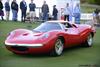
The brand-new bodywork was by Pierro Drogo's Carrozzeria Sports Cars in Modena and was simply a scaled-down version of that used by the P3. On a number of cars, a section of the roof over the driver's head was removed to give a targa-type top. A roll-bar was molded into the roof section behind the driver.

The chassis of these new Dino Racers was a revised semi-monocoque structure formed over a welded tubular frame that was stiffened by stressed alloy panels riveted into place. Some glass fiber panels were also used, particularly in the cockpit area where bag-type fuel tanks were fitted into the sills.

By mid-1967 the Ferrari Factory Team turned over their remaining vehicles to private hands. Chassis 026 was sold directly by the SEFAC Ferrari to the Swiss Scuderia Filipinetti Race Team. The car was first raced by the Scuderia Filipinetti in the prestigious 12 Hours of Sebring on April 1st ('April Fools Day'), 1967. Driving duties were assigned to Herbert Mueller and Gunther Klass who were hopeful that the little Dino would maneuver well amongst the numerous Porsche 904, 906, and 910s from Stuttgart.

German newcomer, Klass was working hard to establish his reputation as an exceptional driver. This was in fact his first season wîth the Ferrari Factory Team and his expectations remained high. Swiss born, Mueller on the other hand was well known in all racing circles and simply determined to win at every level.

For the race, Klass was loaned to the Scuderia Filipipetti by the SEFAC Ferrari Factory Team. Wearing race number 34, the two did well in practice, qualifying 15th overall. The two would have done even better hand not minor mechanical problems limited the car's overall top speed down the straights. Race day saw the two quickly move into the front of the pack and by the close of the first hour the two had moved well up on the field, finding themselves in 11th spot.

By the third hour, Klass and Mueller were fighting it out amongst the two class leading Factory Porsche 910s of Siffert and Hans Herrmann. Running third in class and tenth overall, Mueller continued to push even harder. Some say maybe too hard. On lap 63, going into the fourth hour, the front right 'A' arm cracked a bushing which caused the car to vibrate excessively under braking. Despite this Mueller and Klass pushed on, however they were never again in contention. The two were eventually forced to settle for a rather poor 49th overall out of the original 61 entries.

After Sebring, chassis 026 was returned back to the Ferrari Factory for service and sorting in preparation for the upcoming 1000 kilometer race at the Nurburgring track.

The Scuderia Filipinetti again entered chassis 026 in this Championship points race, the 1000 kilometer race at Nurburgring, Germany which was held on May 27th, 1967.

The SEFAC Ferrari Factory Team driver, Jean Guichet was paired up wîth the ever enthusiastic, Herbert Mueller and as at Sebring, chassis 026 was wearing race number 34.

In practice Guichet quickly began putting chassis 026 through it's paces. Tragically an undetected leak in the fuel injection system began pooling fuel between the twin banks of cylinders. A first soon erupted while Guichet was approaching the Hatzenback Woods. Guichet pulled off to the side of the track, however he was unable to extinguish the flames. Help arrived in an untimely fashion wîth the fire severely damaging the engine, gearbox and much of the rear bodywork.

The damaged racer was then returned to the Ferrari factory to await repairs, however the damage was to such an extent that it was deemed not worth the expense to repair as the season was at this point mostly over.

IN 1969, chassis 026 remained at the Ferrari Factory untouched and un-repaired until being purchased by the well known French collector, Pierre Bardinon. While wîth Bardinon, the car remained untouched and un-repaired until being purchased in 1982 by the Italian Ferrari enthusiast, Currado Cupellini. Cupellini then initiated and completed a length and comprehensive restoration wîth the direct assistance from the Ferrari Factory, bringing the car back to it's original specifications and former beauty. The engine however supplied by Ferrari this time was an Ex-Tasman 246 F2 unit wîth Hewland Transaxle.

This initial rebuild made use of the updated Ferrari Formula Two engine and Hewland Gearbox and in this configuration, Cupellini raced the car on several occasions including the Tutte le Ferrari in Pista, Mugello in 1995 as well as at the 1996 running of the Ferrari Spa Days and Ferrari / Maserati Shell HIstoric Challenge Races. Later in 1996 he ran in the same series at the Nurburgring. In 1997, the car was invited and participated in the Ferrari Factory's official 50th Anniversary Celebration event. Shortly thereafter, the car was purchased by Bernie Carl of Washington, DC ÚSA.

Únder Carl's care the car was delivered to Terry Hoyle Engineering in Malden, ÚK for a restoration that saw a correct and original Ex-Factory Team (SEFAC) Tipo 231B 206S engine (No 15) and proper Tipo 537 gearbox refitted back to the car. The new engine was one of the rare 'twin-plug, fuel-injected' units producing upwards of 240 bhp!

Source - Symbolicmotors.com
The 206 Dino was built by Enzo Ferrari as a tribute to his son who passed away in 1956 at the age of 24 due to kidney disease. Alfredo Ferrari, more commonly known as Dino, was Enzo Ferrari's only son (Alfredo was also Enzo's brother and fathers' name). Afredo had been trained in Switzerland as an engineer, after which he returned to the family business and received tutoring from his father. It was Enzo's dream to one-day hand over the keys to the company to his son. Sadly, that never transpired.

The 206S first debuted in 1965 at the Paris Salon. The Dino Berlinetta GT Prototype was debuted later in 1966 at the Turin Show and again in 1967 at the same show but this time as a production model. The Dino Berlinetta was Ferrari's first transverse-mounted mid-engine vehicle.

The design was done by Pininfarina and built by Scaglietti at the Maranello assembly facility. The body was alloy and the frame was steel.

The Dino 206 did not receive any Ferrari marque. It was void of the signature 'horse' logo, making it never officially a Ferrari. Rather, it was marketed as a separate marque.

The Dino was also built to compete against the Porsche 911. In order to meet the Formula Two racing regulations, over 500 production units had to be made. Ferrari was not capable of producing such numbers. So Ferrari relied on other resources. The engine was supplied by Fiat with half the number of cylinders that Ferrari was accustomed to working with. It was an all-alloy 2-liter, quad-cam, V-6 engine capable of producing between 140 and 180 horsepower. Side vents were located on the car which helped with cooling the engine.

Production continued until the end of 1969.

By Daniel Vaughan | Mar 2008
Historic Jaguar D-Type Leads Growing List of Significant Entries for RM's Monterey Sale
• RM Auctions building towards a spectacular roster of cars for its flagship Monterey sale held during the famous Pebble Beach Concours d'Elegance motoring week, August 16–17, in California • Historic 1955 Jaguar D-Type leads a superb roster of the world's finest sports and racing cars poised for the RM podium • Additional star lots include a 1955 Ferrari 750 Monza Scaglietti Spider, a 1950 Ferrari 166 Touring Barchetta, a 1961 Ferrari 400 Superamerica SWB Coupe Aerodinamico and a 1953 Masera...[Read more...]
Final Countdown Underway To South Florida's Premier Collector Car Auction
• Auctions America kicks off its 2013 auction season, March 22-24 with its highly anticipated Fort Lauderdale Collector Car Auction • Celebrating its 11th year, the multi-day auction features more than 550 quality collector cars • Latest feature attractions include an outstanding 1963 Shelby Cobra and a 1974 Ferrari Dino 246 GTS • Digital catalog now available for download at auctionsamerica.com AUBURN, Indiana (February 27, 2013) – With the final countdown underway to its highly an...[Read more...]
1958 German Grand Prix: So Close Never Felt So Good!
On the 19th of July, at the 11th RAC British Grand Prix, Roy Salvadori would climb to the 3rd step on the podium. It would be the greatest result of his career in Formula One and it would be a most exuberant moment for the man from Dovercourt joining two other Brits on the podium of their home grand prix. However, it would be the race just two weeks later that would provide Salvadori with one of his greatest, and most disappointing, moments in Formula One. Salvadori's World Championship debut...[Read more...]
1957 Italian Grand Prix: A True Nobleman Stands Amongst Two of F1's Most Noble
The sea of spectators overwhelming the circuit would be a truly awe-inspiring sight to behold. The vast majority of this horde was there to celebrate the car adorned in red finishing in the top three. The car's driver, a true royal, would stand amongst the crowd as if standing amongst adoring and loving subjects. For the first time in his career, Wolfgang von Trips would be able to count himself amongst the elite of Formula One. Wolfgang von Trips had been born into a noble German family in ...[Read more...]
1958 Moroccan Grand Prix: British All the Way
After years of frustration, and well past his life-expectancy, Mike Hawthorn would be on the verge of his first World Championship. This was more than likely Hawthorn's last and best hope at a World Championship title. Just one last race, and a fellow Brit, would separate Hawthorn from his World Championship. Emotionally, Hawthorn was done. The last few seasons had seen Hawthorn fail to experience anywhere near the level of success he had even in his rookie year of 1952. In 1952, with an unde...[Read more...]
156
166
166 F2
195
196
212
246
250 GT
250 Monza
250 Testarossa
275
288
308
312
328
330
333 SP
335
342 America
348
360
365
375
400
410
410 S
456
458
500 F2
500 Superfast
500 TR
512
512 BB/LM
550
553
575
599
612 Scaglietti
625
California
Dino
Enzo
F12berlinetta
F355
F40
F430
F430 GTC
F50
FF
LaFerrari
Mondial
Mondial 500
Testarossa
Type 340

© 1998-2012. All rights reserved. The material may not be published, broadcast, rewritten, or redistributed.