Concept Cars Home
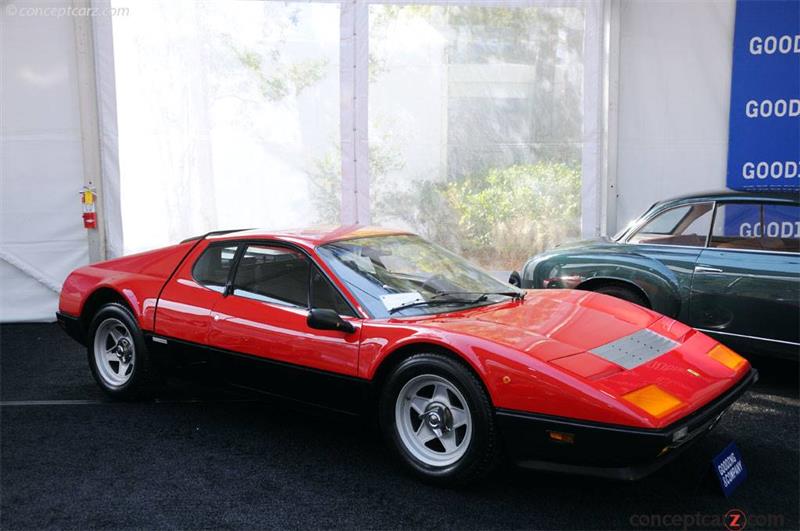
Image Left 1981 512BB1983 512 BBi Image Right
 

1982 Ferrari 512 BBi news, pictures, and information

Coupe
 
BB stands for Berlinetta Boxer. Berlinetta in Italian means 'little saloon' and came to refer to any especially sporty coupe, typically a two-seater but often 2+2 as well. The term Boxer refers to a horizontally-opposed engine layout where two banks of cylinders lay at 180-degrees from each other sharing the crankshaft. The 512 designation means this one has a 5.0-liter, 12-cylinder engine.

The 512 BB Coupe is a mid-engine car, a layout that became accepted as the most stable and versatile for racing with the engine ahead of the rear axle and behind the driver. With the bulk of the weight and center of gravity so near the center of the car it could hold the road or track much better. Enzo Ferrari was reluctant to use this layout for street cars fearing the common driver would not be able to handle it safely, though he had been making mid-engined race cars for some time.

The BB was never sold in North America as Enzo did not see the value of federalizing the cars. Many enthusiasts, though, made conversions resulting in quite a few cars ending up i the United States. Less than a thousand BB 512 models were produced.
The Ferrari Berlinetta Boxer was produced between 1973 through 1984 with a total of 2,323 examples of all 'BB' models produced. This was a very important model for the Ferrari marque, and one that followed in the footsteps of the mid-engined road car, the 206 GT Dino. Mid-engine placement had been proven to be a useful technique in improving handling and performance; Cooper was one of the first marque's to showcase the potential in motor sports.

When Ferrari introduced their 206 GT Dino, they also introduced a model that stayed true to their heritage, with the 'cart before the horse.' The 365 GT/4 Daytona front-engined car was a phenomenal vehicle, equipped with a V12 power plant, and soon became legendary.

The 365 GT4 BB, for Berlinetta Boxer, was introduced at the 1971 Turin Motor Show. It incorporated many design features from the P6 Show Car of 1968. Mounted mid-ship was a flat-12 engine which shared its design and construction with Ferrari's racing program. It was introduced to rival Lamborghini's Miura. The production version was shown at the 1973 Paris Motor Show with sales beginning that same year. A total of 386 were constructed with 58 being right hand drive.

The flat-12 engine was longitudinally mounted in the engine bay at a 180-degree angle with the gearbox mounted directly under the engine. The flaw in this design was too much weight in just one place and not evenly dispersed throughout the vehicle. Sixty percent of the weight was in the rear, as well as the engine sitting rather high since it was above the gearbox.

In 1976 at the Paris Motor Show Ferrari introduced their next iteration of the BB series, the 512 BB. This version brought changes to the vehicles design along with a five-liter power plant. The triple tail lights were replaced with double units.

In 1981 the 512 BBi was introduced. The 'i' signified a fuel injection system. The 512 BBi remained in production until 1984 when it was replaced by the Ferrari Testarossa.

By Daniel Vaughan | Nov 2007
Raced in 1970 and 1971, the Ferrari 512 was a sports vehicle, related to the Ferrari P series of sports prototypes that was eventually withdrawn from competition after a change in regulations in 1968. A year later Ferrari decided to do what Porsche did six months earlier and build 25 5.0 L cars at one time to be homologated as sports car prototypes. The surplus vehicles were intended to be sold to racing customers.

The 512 S carried a motor with a new V12 with 560 PS output. Unfortunately not air-cooled like the Porsche's flat-12 the 512 was equipped with a variety of cooling pipes and a heavy radiator. Weighing more than 100 kg than the alloy-framed 917, the chassis was of sturded steel that was reinforced with aluminum sheet. Despite the weight difference, the Ferrari 512S and Porsche 917 were evenly matched.

Predictable teething problems and a weak suspension and transmission were the main issues with the Ferrari 512s in the beginning of 1970.

Produced between 1973 and 1984, the Berlinetta Boxer, or the Ferrari 512 was the name for a series of vehicles produced by Ferrari in Italy. A huge venture for Enzo Ferrari, the Boxer was a mid-mounted flat-12 engine that replaced the FR Daytona and succeeded in the Ferrari stable by the Testarossa.

Though Enzo feared that the mid-engined road car would be too difficult for his buyers to handle, he eventually agreed to his engineers request that he adopt the layout. In the late 1950s this attitude began to change as the marque lost its racing dominance to mid-engined competitors. The result of all this was the mid-engined 4, 6 and 8 cylinder Dino racing vehicles that Ferrari eventually allowed for the production Dino road cars to use the layout also. While the Daytona was launched with its engine in front, the company moved its V12 engines to the rear with its P and LM racing vehicles. Finally in 1971 a mid-engined 12-cylinder road vehicle came on the scene.

Released at the 1971 Turin Motor Show, the first Boxer was the 365 GT4 BB with the production intent to rival Lamborghini's Miura. In 1973 it was finally released for sale at the Paris Motor Show. A total of 386 units were sold with only 58 of them being right hand drive. The most prestigious of all Berlinetta Boxers, this was the fastest and most rare model.

The Boxer was as unique as possible, though it shared its numerical designation with the Daytona. Like the Dino, the Berlinetta Boxer was a mid-engined vehicle that housed the now flat -12 engine mounted longitudinally rather than transversely. Sharing the internal dimensions of the Daytona V12, the engine was spread out to 180_ as on Ferrari's 1970 Formula One car. Mounted above a five-speed manual transmission the engine produced 344 hp at 7200 rpm and 302 ft_lbf of torque @ 3900 rpm. This engine also used timing belts instead of chains.

In 1976 the 365 was updated as the Ferrari 512 BB, resuming the name of the previous Ferrari 512 racer. A total of 929 of the 512 BBs were produced. Though peak horsepower was off slights to 340 hp @ 6200 rpm (redline 7000 rpm), the engine was larger at 4942 cc. Due to a larger displacement and a longer stroke, torque was now up to 46 kgf_m from 44 kgf_m at 4600 rpm. To achieve a lower center of gravity dry sump lubrication was used. New external features were a front spoiler, added NACA side air vents that ducted air to the brakes, four tail lights instead of six and wider rear tires.

In 1981 the Bosch K-Jetronic fuel injected 512Bbi was released. The end of the series, the new fuel injected motor released cleaner emissions and 340 hp at 6000 rpm and produced 333 ft_lbf of torque at 4200 rpm. New updates included badging and a change to metric sized wheels along with the Michelin TRX metric tire system, red rear fog lamps outboard of the exhaust pipes in the rear valence and small running lights in the nose. A total of 1,007 512Bbi units were produced.

A total of 25 512S Ferrari's were produced within the first nine months with even chassis numbers from 1002 to 1050. In 1970, 19 of those units were raced, with five of them being spyders. At the end of the season, the 1020 was converted as a 512M and sold to NART which entered it in competition a year later.

By Jessica Donaldson
After the 312 P project, Ferrari completely withdrew from sportscar and GT racing and began to focus completely on Formula 1. U.S. distributor Luigi Chinetti took Ferrari's first mid-engine 12-cylinder road car, the 365 GT4/BB and with minimal to no factory input and was modified for use by his North American Racing Team. Larger wheels and tires were fitted, rear body work was widened and weight-adding luxury amenities were removed.

At the 1976 Paris Motorshow, Ferrari unveiled its replacement for the 365 GT4 BB, the 512 BB. While very similar aesthetically to the 365, the 512 BB had a larger engine that increased in size from 4.4 to 5 liters. Three of Ferrari's best known privateers, Luigi Chinetti's NART in the U.S., Pozzi in France and Garage Franchochamps in Belgium modified four 512s for the 1978 Le Mans. Unfortunately none of them survived the race and the only Ferrari to finish was NART's older 365.

From 1975 until 1977 Ferrari received two driver's title and three constructer's titles and Ferrari finally found time again for other competition efforts. After much persuasion, they set out to create a racing version of the 512. To allow for high speeds at Le Mans' long straights Pininfarina was entrusted to create an ultra streamlined silhouette body. Ferrari brought the weight down on the 512 BB by about 200 lbs with the chassis, but unfortunately the huge new body added around the same, so really no weight was saved. Power was increased to 460-480bhp and the flat 12 engines were fitted with Lucas fuel injection. By the end of its production, power was up to 500 bhp.

Ferrari introduced in 1979, a factory-developed machine shaped in the Pininfarina wind tunnel that was a more thoroughly prepared set of competition 512 BBs, the Ferrari 512 BB LM. The LM was enhanced with a new wing for additional downforce at the rear, an extended nose and a new roofline that ran to the back of the extended tail. The LM was almost 18 inches longer than the road-worth 512 Boxer and it weighed around 1,235 lbs less. In the back of the LM were 13-inch wheels and up front where 13 inch wheels with flared fenders. Producing 480 hp, the fuel-injected 5.0-liter flat -12 had 120 above the stock motor.

Unfortunately Porsche and the 512 BB's gearbox prevented the 512 BB LM from ever becoming a grand success. The problems with the gearbox were two-fold, since to reduce the wheelbase, Ferrari mounted the 12 cylinder engine atop of the gearbox, but so much weight, so high, made the car handling severely hampered. The second issue was that it lacked reliability since Ferrari increased the engine output by over 100 bhp, but didn't modify the gearbox to handle the additional power.

The competition entered 700+ bhp Porsche 935s while Ferrari clients fielded the 480 bhp BB LMs. During the first Le Mans 24 Hours that the 412 BB LMs were involved in, the first four spots were filled with Porsches while the Garage Franchorchamps 512 finished at a very low 12th position.

The LM continued to be developed for the next several years and further innovations included a stronger gearbox, more power and less weight. In 1981 the 512 BB LM's has a class victory in the Le Mans where a Pozzi entered LM beat the 935s. It was becoming to difficult for a production-based car to compete at the highest levels of endurance racing, especially without full factory participation. Regulation changes caused the 512 BB LM to be left obsolete.

By Jessica Donaldson
'Ferrari Supercar. Technology. Design. Myth' Exhibition Opened Today
Maranello, 8 March - Today saw the official inauguration at the Ferrari Museum in Maranello of the 'Ferrari Supercar. Technology. Design. Myth' exhibition which includes the new LaFerrari, unveiled just a couple of days ago at the Geneva Motor Show, as well as all of the other limited edition special series cars that helped establish the Prancing Horse legend. Opened by Chairman Luca di Montezemolo, 'Ferrari Supercar. Technology. Design. Myth' retraces the story of all of the limited ...[Read more...]
TOYOTA GT86 IS CAR BUYER'S COUPE OF THE YEAR
Announcing the award on Friday (1 March), Steve Fowler, Car Buyer Editor-in-Chief, said: 'The GT86 is a fine example of Toyota doing what it does best: understanding the needs of a target market and delivering – in this case a focused sports car that's all about driving enjoyment, yet at an affordable price.' It's a neat summary of the essential qualities that have made the low, light and lithe GT86 an instant hit with media and motorists alike. Giving the Toyota a 4.8-out-of-five rating...[Read more...]
Final Countdown Underway To South Florida's Premier Collector Car Auction
• Auctions America kicks off its 2013 auction season, March 22-24 with its highly anticipated Fort Lauderdale Collector Car Auction • Celebrating its 11th year, the multi-day auction features more than 550 quality collector cars • Latest feature attractions include an outstanding 1963 Shelby Cobra and a 1974 Ferrari Dino 246 GTS • Digital catalog now available for download at auctionsamerica.com AUBURN, Indiana (February 27, 2013) – With the final countdown underway to its highly an...[Read more...]
ENZO FERRARI – AN EXAMPLE FOR THE FUTURE
Maranello, 18 February - Today is a special date. On 18 February 115 years ago a man was born in Modena, who, thanks to his passion, his determination and his ability to look ahead created a legend which continues to grow day after day: Enzo Ferrari. After his career as a racing driver, the still young Enzo founded the Scuderia in 1929, the team, still carrying his name today. In 1947 the first car with the name Ferrari was born - thus creating a symbol of Italian excellence in the world – t...[Read more...]
Buyers in abundance for another strong sale at Brooklands
Amidst some speculative recent market results, the heat was on Historics, but with Brooklands bathed in sunshine, the classic and sports car auctioneer again delivered another strong sale. In total 60 of 103 vehicles were seen away for a sale ratio of 58% and a final sale figure of £1,159,070. As pre-sale publicity predicted, Bentley's blazed a trail, with the star of the show an R-Type Coupé by Abbott of Farnham, which sold for £100,000. A 1937 4¼ litre Sports Special sold for £47,500, wh...[Read more...]
156
166
166 F2
195
196
212
246
250 GT
250 Monza
250 Testarossa
275
288
308
312
328
330
333 SP
335
342 America
348
360
365
375
400
410
410 S
456
458
500 F2
500 Superfast
500 TR
512
512 BB/LM
550
553
575
599
612 Scaglietti
625
California
Dino
Enzo
F12berlinetta
F355
F40
F430
F430 GTC
F50
FF
LaFerrari
Mondial
Mondial 500
Testarossa
Type 340

Image Left 1981 512BB1983 512 BBi Image Right
© 1998-2012. All rights reserved. The material may not be published, broadcast, rewritten, or redistributed.