The technology and mechanical sophistication used by Ferrari in its pursuit of motorsport perfection at the highest level of competition often trickled down into other various racing endeavors. Alberto Ascari won the F1 World Championship for Scuderia Ferrari in 1952 and 1953 following the decision to run all Grand Prix events counting towards the World Championship of Drivers to Formula Two unsupercharged regulations. The 2.5-liter, four-cylinder engine that powered Ascari's race car had been designed by Aurelio Lampredi, and subsequently, a 2-liter, version would be dropped into their deDion tube sports car chassis and compete in the under-two-liter category. In this guise, they contested the overall victories at hill climbs and circuit races, and perhaps their greatest achievement was a 2nd overall finish at the 1954 Mille Miglia driven by Vittorio Marzotto. 
Spyder
Chassis #: 0408
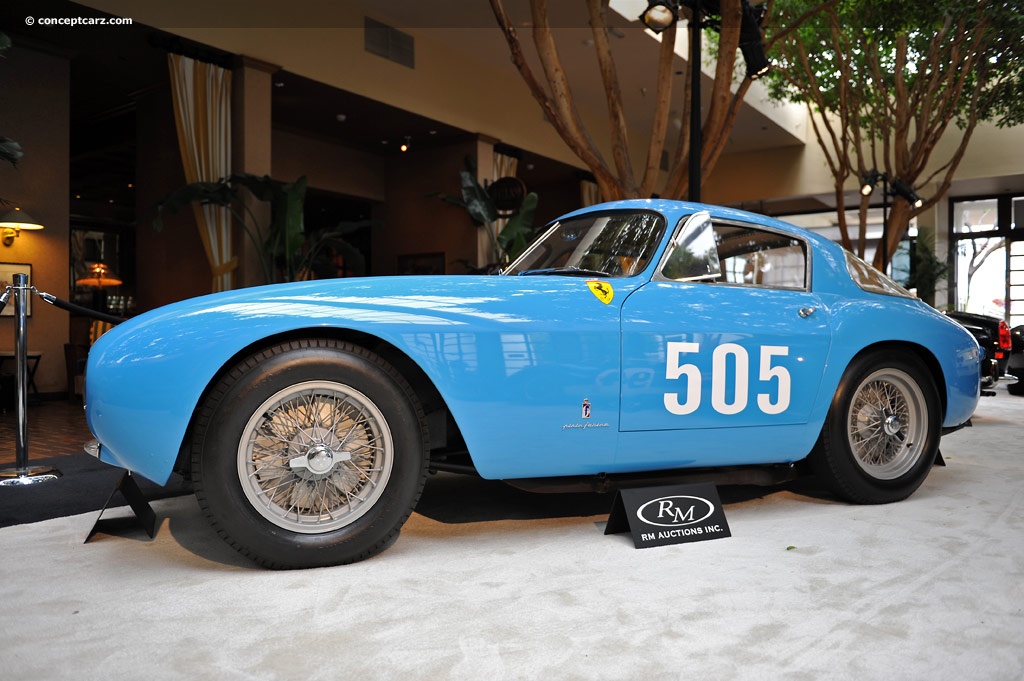
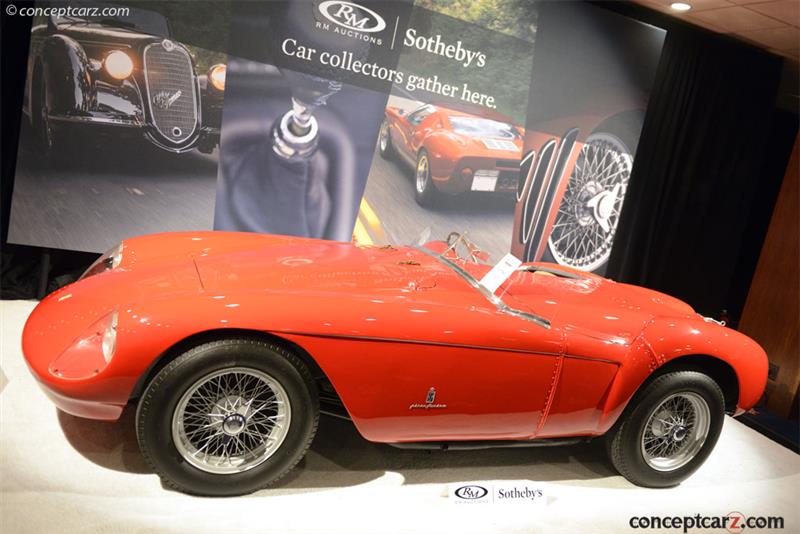
View info and historyBefore the four-cylinder unit, Aurelio Lampredi had created a series of new, naturally-aspirated twelve-cylinder engines. The names of the models adhered to the traditional company nomenclature, signifying the unit capacity of a single cylinder, and in regards to the 500 Mondial, that being approximately 500cc. The word 'Mondial' was in reference to Alberto Ascari's World championships. The 1984.86cc Lampredi engine was cast in light alloy and used hemispherical heads, screw-in steel liners, and dual magneto ignition. It continued to use the same basic design as the Grand Prix engine, including the dry sump lubrication but used flat-top pistons to lower the compression, increase longevity, and for use with lower-grade fuels. Although detuned from its 500 F2 sibling, the engine offered 170 horsepower with a pair of Weber 40 DCOA/3 carburetors (initially it developed 155 hp). Mated to a four-speed manual (Tipo 501) transaxle, it was installed in a conventional tubular chassis with the 'Series I' cars using oval tubing while the 'Series II' had rounded tubing. The suspension was an independent front and a deDion rear setup with transverse leaf springs all round. Later examples used a revised front suspension that replaced the leaf springs with separate coils on both sides. Braking was via four-wheel hydraulic drums. The early examples wore coachwork created by Pinin Farina while later examples received theirs from Scaglietti to a design penned by Dino Ferrari. The Pinin Farina-styled cars evoked the styling previously applied to the 375 MM, particularly with the pronounced noses, with early examples having their windshields running flat across the scuttle. Twenty-nine (possibly 30) examples of the 500 Mondial were built between 1953 and 1955 with Pinin Farina creating 13 spiders and two Berlinettas (other sources state as few as 14 total examples were bodied by Pinin Farina). Of those, 5 were the earlier Series I with covered headlights. A total of 22 were Series I Mondials.
Berlinetta by Pininfarina
Chassis #: 0452MD
View info and history
Auction entries : 1The 'torquey' four-cylinder model complemented the lightweight frame and bodywork, making it agile and nimble, and could accelerate quicker out of corners than the Ferrari V12. It proved to be a worthy adversary and contested numerous outright victories. Eventually, it would spawn a whole generation of sports racers that would continue to foster and grow the company's competitive reputation to new segments of the motorsport community. It was integral in winning Ferrari's second Sports Car World Championship in 1954.Albert Ascari and Luigi Villoresi drove the 500 Mondial on its inaugural competition debut on December 20th of 1953 at the 12 Hours of Casablanca where they placed second behind the winning 375 MM. Four Mondials raced at the 1954 Mille Miglia with the best result being second overall after a Lancia D24 (ironically driven by Ascari). The Mondial earned a class victory in 1956 at the 12-Hours of Sebring. The evolution of sports car racing was brisk, and as the competitiveness of the 500 Mondial began to wane, it was replaced in 1956 by the 500 TR which featured a revised chassis and more potent powerplant. Its 'Testa Rossa' (TR) name was in reference to its red-painted cylinder heads.
by Daniel Vaughan | Nov 2022

Spyder
Chassis #: 0408
View info and history
Berlinetta by Pininfarina
Chassis #: 0452MD
View info and history
Auction entries : 1
by Daniel Vaughan | Nov 2022
Related Reading : Ferrari Mondial 500 History
The Ferrari 500 Mondial Spyder was produced from 1954 through 1956 with 14 being bodied by Pinin Farina and 16 by Scaglietti. There were two series for the 500 Mondial, the Series 1 and Series 2. The Series 1 lasted from 1953 through 1954 with 20 examples being created. During this time Pinin Farina was tasked with providing the coachwork on 14 Berlinettas and Spyders. The designs produced were....
Continue Reading >>
Continue Reading >>


1954 Ferrari 500 Mondial Vehicle Profiles





Recent Vehicle Additions


Performance and Specification Comparison
Mondial 500 Pininfarina Specification Comparison by Year
Year
Production
Wheelbase
Engine
Prices
Related Automotive News

James Dean, Porfirio Rubirosa, John Von Neumann, Phil Hill
The Ferrari That Linked Them All Is Coming To Auction
Rare, fast and loaded with history, the photogenic Italian racecar will be a star of Scottsdale Car Week in January
Los Angeles – 19 December 2018 – Bonhams is delighted to ann...

The Quintessential Gentleman's Lineup of Italian Sports Cars Coming to The Pebble Beach Auctions Presented by Gooding & Company
Highlights Include the 1959 Ferrari 250 GT Series I Cabriolet, the 1956 Maserati A6G54 Berlinetta, and the 1954 Ferrari 500 Mondial Series I
SANTA MONICA, Calif. (July 7, 2017) – Gooding %26 Company, the official auction house of the Pebble...

Triple whammy for the 500 Mondial
From restoration in Maranello to victory at Pebble Beach
Maranello, 30 September – It got to Pebble Beach by the skin of its teeth, barely a week before the legendary Concours dElegance, but then it dominated the scene, winning no less...

Gooding & Company Releases Entire Catalogue for Upcoming London Sale, Led by a 1953 Ferrari 166 MM/53 Spider Offered from Long-Term Ownership
The London Auction at Hampton Court Palace will present an unrestored Ferrari 166 MM53 Spider and Ferrari 250 Europa, as well as a desirable Fiat 8V Berlinetta and right-hand-drive Aston Martin DB5 Convertible.
Gooding %26 Company, the international...

RM Sotheby's Unveils The Ultimate 'Barn Find,' Featuring 20 Ferraris Lost To Time
The Lost %26 Found Collection
TO BE AUCTIONED LIVE IN MONTEREY, CALIFORNIA, ENTIRELY WITHOUT RESERVE DURING MONTEREY CAR WEEK, ON 17 AUGUST 2023
Today, RM Sothebys unveils a once-in-a-generation collection of barn find Ferraris,...

1962 Ferrari 250 GT SWB California Spider to Lead Gooding & Company's Amelia Island Auctions Alongside Stable of the Finest Ferraris
The star car of the auctions will be a one-off 1962 Ferrari 250 GT SWB California Spider, joined by a 250 GT Tour de France Berlinetta, a 250 MM Vignale Spider, and other examples of Maranellos finest models.
Leading international auction...

Phenomenal Ferraris and Italian Thoroughbreds Offered at Gooding & Company's Pebble Beach Auctions
The auction house announced a stable of Italian star cars, including a 1950 Ferrari 166 MM Berlinetta Le Mans, a 1961 Ferrari 400 Superamerica Series I Coupe Aerodinamico, and a 1954 Ferrari 500 Mondial Series I Spider.
A stunning group of star...
Luigi Musso: Talented, Tempting and Troubled
Following Alberto Ascaris back-to-back titles in 1952 and 1953 there have been no Italian Formula One World Champions. While there has been a great amount of hope throughout the years, Italians have been left without a World Champion. Perhaps, it could...