Racing engines during the mid-to-late-1960s produced incredible amounts of horsepower, so manufacturers who competed in NASCAR turned to aerodynamics to increase the performance of their cars. Ford's entry was the Torino Talladega, based on the production Torino SportsRoof, and the first of the so-called 'aero cars.' Prior to racing, it needed to comply with homologation requirements that dictated at least 100 examples be constructed (500 overall in 1969), however, legend has it that only 40 cars were completed by the deadline. It is said that NASCAR president Bill France was fooled into counting each of the completed cars multiple times when NASCAR legend Ralph Moody played a trick on France at the Ford factory. By ruse or otherwise, the Torino Talladega was homologated and went on to win 26 races and both the driver's and manufacturer's championships for the 1969 season. 
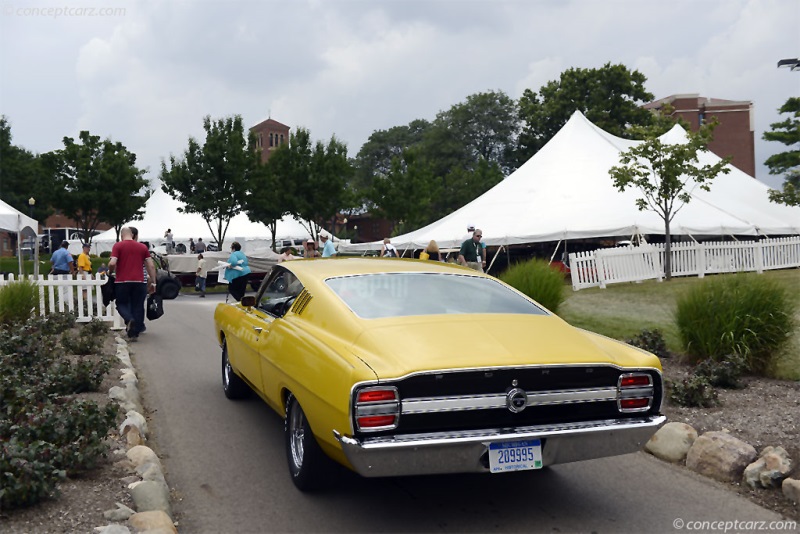
GT Cobra FastBack Coupe
View info and historyPlymouth did not have a super-speedway entry in its plans for the 1969 models, and when Dodge would not put Richard Petty into a Charger 500, the 'King' did the unthinkable and switched to the blue oval. His time with Ford was brief, lasting a single season, but Richard won 10 events and had 38 top 10 finishes that year, piloting the long-nosed Talladegas on the big tracks and fastback Torino GTs on the smaller ones.According to Ford advertising of the period, 'Heading the pack to the Performance Corner in your dealership is the exotic new aerodynamic-design Torino Talledega...an exciting development of the 1968 NASCAR and USAC Champion Torino. The Talledega's aerodynamic design features, developed after extensive high-speed wind tunnel and track testing, improve performance during high-speed operation by reducing drag and front end lift.'Standard equipment on the Ford Talladega included a 428 CID, 335 horsepower Cobra Jet engine (non-Ram Air) backed by a SelectShift Cruise-O-Matic transmission. It had cast-aluminum valve covers, extra-cooling package, heavy-duty battery and 55-ampere alternator, an engine oil cooler, power front disc brakes, power steering, Argent Styled Steel Wheels with chrome trim rings, 3.25:1 (Code 9) ratio non-locking rear axle, and competition suspension with ultra-heavy-duty front and rear springs and shock absorbers, extra-heavy-duty stabilizer bar, staggered rear shock absorber arrangement with one rear shock ahead of and the other behind the rear axle. Styling features included special aerodynamic-design grille, hood, fender and front bumper layout, non-gloss 'racing black' hood and lower rear deck panel, AM radio, and special Talledega badging.
Talladega Coupe
View info and historyThe only options available included three color choices (including Wimbledon White (286 built), Royal Maroon (258 built) or Presidential Blue (199 built)), power brakes, power steering, AM radio, color-keyed racing mirrors, and argent-styled steel wheels with F70 X 14 wide oval tires.Ford would ultimately complete 738 (as many as 754) including Spoiler/Spoiler II) production Talladega models. It was named after the Talladega Superspeedway racetrack in Alabama, which also made its debut in 1969. All production examples were built during January and February of 1969 at Ford's Atlanta Assembly plant in Atlanta, Georgia. Ford's entry into the budget muscle-car market was the 1969 Cobra based on the Fairlane/Torino. Ford's involvement with Carroll Shelby had resulted in the GT40 program and the Cobra, culminating in international success at Le Mans with the two-seater sports car. Doubling down on the Cobra name, it was built around the new 335 horsepower 428 Cobra Jet big-block as either a formal hardtop or a new fastback body style. It was a no-frills muscle car with a base price just above $3,000 and powered by the Q-code (non Ram-Air) 428 CJ backed by a four-speed transmission, 9-inch rear end with 3.25:1 gears, 6-inch styled steel wheels, dual exhaust and Competition Suspension with higher-rate springs, larger front sway bar and stiffer shocks. Cars equipped with the four-speed also received 'staggered' rear shocks, one mounted in front and one behind the axle to control wheel hop during heavy acceleration. Styling features of the Cobra included a blackout grille, hood scoop with '428 Cobra Jet' chrome lettering on each side, racing-style hood pins and exterior identification, with early cars receiving decals depicting a coiled snake on smoking tires in a parody of Plymouth's cartoonish Road Runner bird in a cloud of dust.
Talladega Coupe
View info and historyFord built fewer than 15,000 examples of the Cobra in 1969. 1969 Ford Fairlane Torino
The Torino was the top trim level for the Fairlane in 1969 and came with either six- or eight-cylinder power, a 116-inch wheelbase, polished aluminum rocker panel molding, and a Torino crest on the 'C' pillars on the two-door hardtop and four-door sedan versions. Body styles on the base six and eight-cylinder Torinos included a sedan, Formal Hardtop Coupe, and squire station wagon. The Torino GT was offered as a Formal Hardtop coupe, Fastback Coupe, and Convertible with prices that ranged from $2,820 to $3,070. The Torino GT Cobra was either a $3,180 fastback coupe or a $3,200 hardtop coupe. The base overhead valve 250 cubic-inch six-cylinder engine used a Motorcraft one-barrel carburetor, seven main bearings, and delivered 155 horsepower at 4,000 RPM. Eight-cylinder options included the Windsor 302 and 351, and the FE 390 and 427. The 302 CID was standard on GTs, and the new-for-1969 351 CID Windsor produced 250 horsepower (the four-barrel version had 290 horsepower). The 428 CJ was offered with or without the Ram Air Induction package, however, cars equipped with the Ram Air had the same advertised power rating as those without the Ram Air. The 428 Super Cobra Jet (SCJ) engine was designed specifically for drag racing and came with the 'Drag Pack' option package that included an engine oil cooler, cast pistons, 427 (LeMans) capscrew connecting rods, an engine oil cooler, a nodular controlled cast-iron crankshaft casting 1UA or 1UA B with an external weight on the snout behind the balancer, and 4.30:1 gears with a Detroit Locker or a 9-inch rear axle with 3.91:1 gears and a Traction-Lock limited slip. The total Ford Torino production for 1969 was 129,054 units. Most of the Torinos were the Torino GT which accounted for 81,822 units produced.
by Daniel Vaughan | Dec 2020
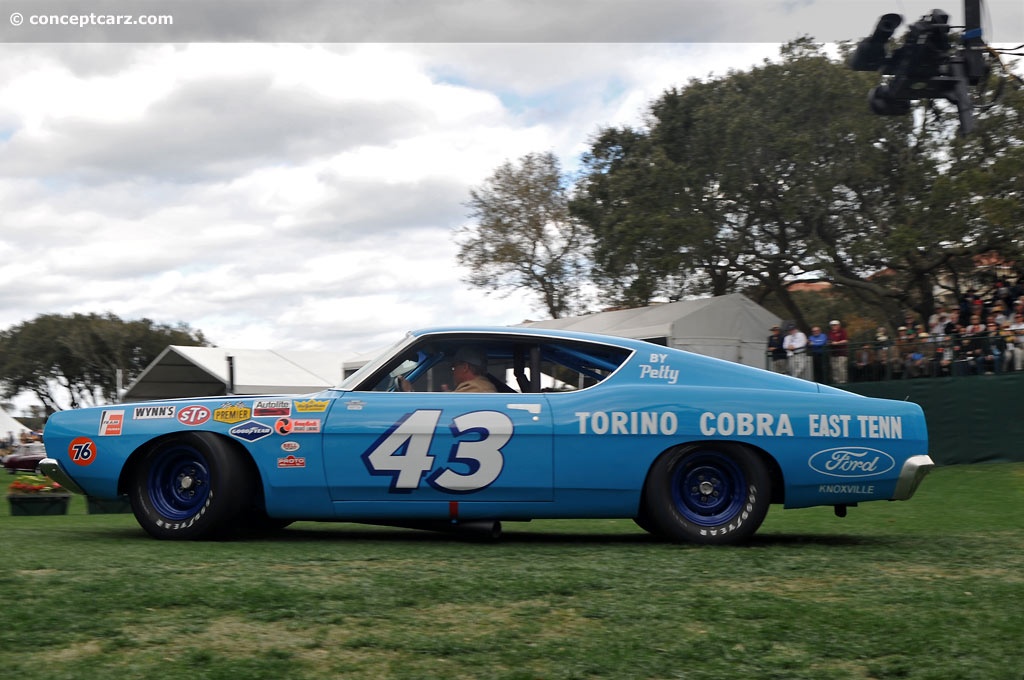
GT Cobra FastBack Coupe
View info and history
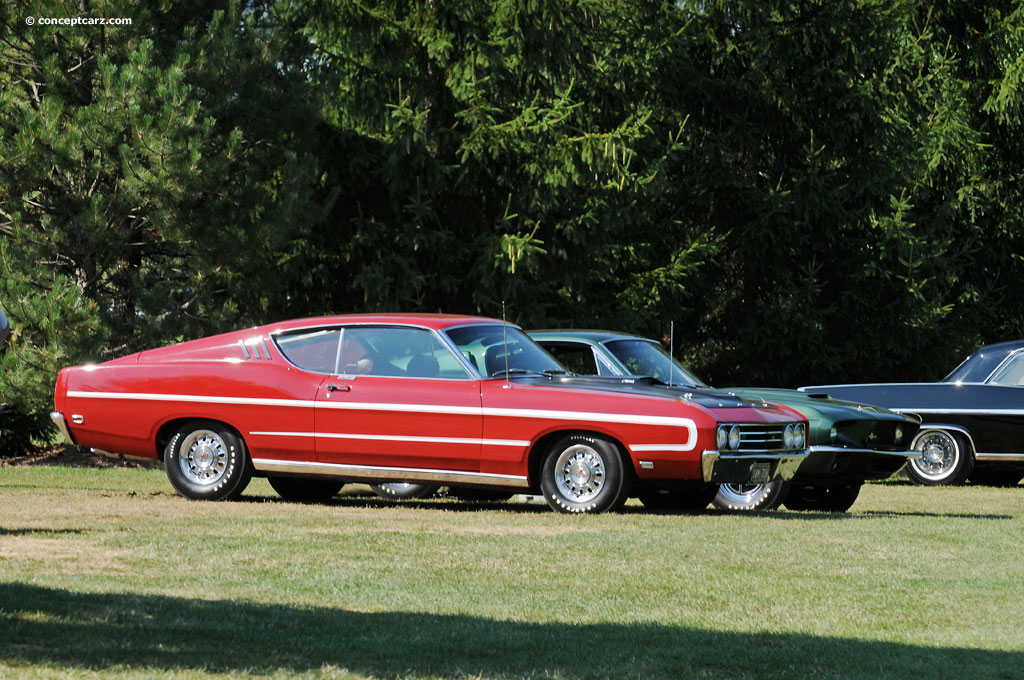
Talladega Coupe
View info and history
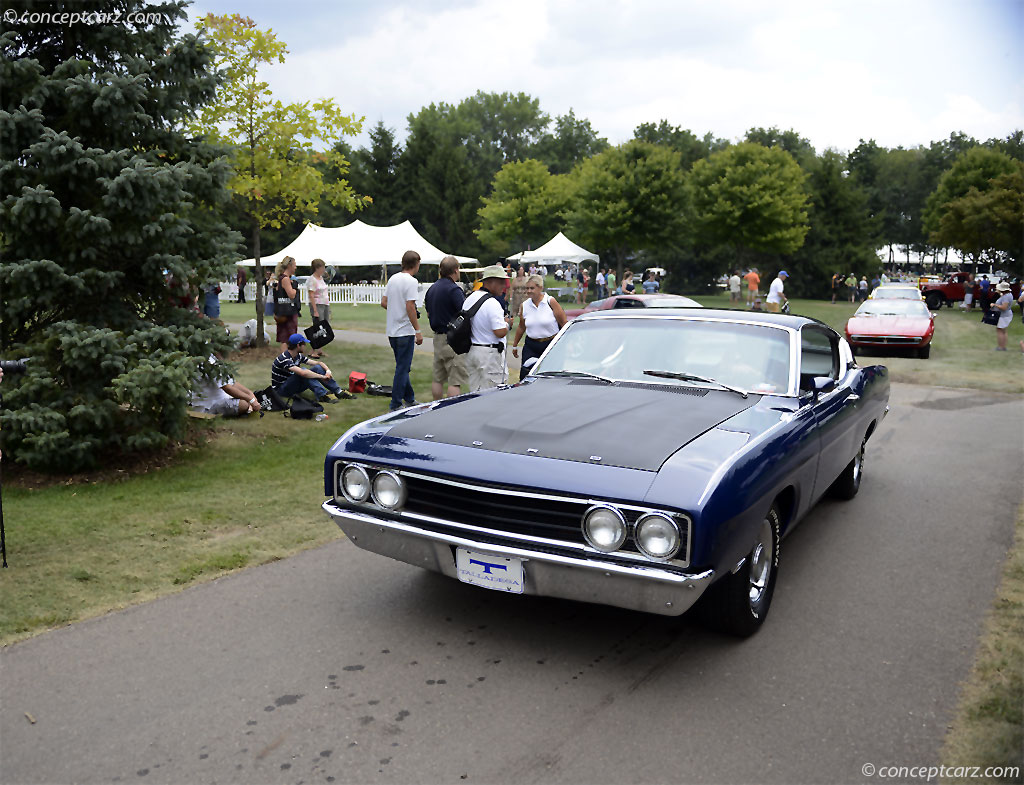
Talladega Coupe
View info and history
The Torino was the top trim level for the Fairlane in 1969 and came with either six- or eight-cylinder power, a 116-inch wheelbase, polished aluminum rocker panel molding, and a Torino crest on the 'C' pillars on the two-door hardtop and four-door sedan versions. Body styles on the base six and eight-cylinder Torinos included a sedan, Formal Hardtop Coupe, and squire station wagon. The Torino GT was offered as a Formal Hardtop coupe, Fastback Coupe, and Convertible with prices that ranged from $2,820 to $3,070. The Torino GT Cobra was either a $3,180 fastback coupe or a $3,200 hardtop coupe. The base overhead valve 250 cubic-inch six-cylinder engine used a Motorcraft one-barrel carburetor, seven main bearings, and delivered 155 horsepower at 4,000 RPM. Eight-cylinder options included the Windsor 302 and 351, and the FE 390 and 427. The 302 CID was standard on GTs, and the new-for-1969 351 CID Windsor produced 250 horsepower (the four-barrel version had 290 horsepower). The 428 CJ was offered with or without the Ram Air Induction package, however, cars equipped with the Ram Air had the same advertised power rating as those without the Ram Air. The 428 Super Cobra Jet (SCJ) engine was designed specifically for drag racing and came with the 'Drag Pack' option package that included an engine oil cooler, cast pistons, 427 (LeMans) capscrew connecting rods, an engine oil cooler, a nodular controlled cast-iron crankshaft casting 1UA or 1UA B with an external weight on the snout behind the balancer, and 4.30:1 gears with a Detroit Locker or a 9-inch rear axle with 3.91:1 gears and a Traction-Lock limited slip. The total Ford Torino production for 1969 was 129,054 units. Most of the Torinos were the Torino GT which accounted for 81,822 units produced.
by Daniel Vaughan | Dec 2020
Related Reading : Ford Torino History
In 1968 Ford introduced the mid-sized vehicle, the Torino, which stayed in production until 1976. The Torino replaced the Fairlane, although the name persisted on the base level models but was given different trim than the Torino versions. The Torino was available as a two-door fastback or convertible, four-door sedan or station wagon, hardtop, and as a pickup, similar to the El Camino. The Torino....
Continue Reading >>
Continue Reading >>
Similar Vehicles
Similarly Sized Vehicles
from 1969


1969 Ford Fairlane Torino Vehicle Profiles


Recent Vehicle Additions


Performance and Specification Comparison
Price Comparison
$2,194
$2,230
$2,470 - $3,210
$2,615 - $3,120
$3,075 - $3,180
$4,805 - $5,025
Torino (First Generation) Specification Comparison by Year
Year
Production
Wheelbase
Engine
Prices
172,083
113.00 in., 116.00 in.
6 cyl., 170.00 CID., 100.00hp
6 cyl., 200.00 CID., 115.00hp
8 cyl., 302.00 CID., 210.00hp
8 cyl., 302.00 CID., 230.00hp
6 cyl., 200.00 CID., 115.00hp
8 cyl., 302.00 CID., 210.00hp
8 cyl., 302.00 CID., 230.00hp
$2,685 - $3,120
129,054
113.00 in., 116.00 in.
6 cyl., 200.00 CID., 115.00hp
8 cyl., 302.00 CID., 220.00hp
8 cyl., 351.00 CID., 290.00hp
8 cyl., 302.00 CID., 220.00hp
8 cyl., 351.00 CID., 290.00hp
$2,715 - $3,210
Related Automotive News

Ray Evernham's Race Cars and More Head to Mecum's Indy Spring Classic
Estimated 3,000 Collector Vehicles Expected to Cross the Auction Block May 13-21
Following Mecum Auctions record-setting sales totaling nearly %24300 million from the companys first three auctions of 2022, the auction house is now prepping for...

BID IT LIKE BECKHAM…
Ford F-150 bought new by David Beckham to star at exclusive Barons auction
All-Ford sale to take place at The International Ford Show, Sandown Park, Surrey, on April 30
Rare convertibles, Mk 1 Cortina De Tomaso, right-hand drive Mustang and Talla...

15 Exciting Collector Automobiles to Watch During This January's Scottsdale, Arizona Car Week Auctions
Scottsdale, Arizona (January 13th, 2016) – Astute Collectors of the worlds most sought after and most valuable automobiles know that Scottsdale, Arizona in January is where the market values for collector cars are established each year. As such, they...
GREG BIFFLE GIVES FORD MOTOR COMPANY 1,000TH NASCAR VICTORY AFTER WINNING AT MICHIGAN INTERNATIONAL SPEEDWAY
Ford Motor Company has won 1,000 NASCAR races in the Sprint Cup, Nationwide and Camping World Truck Series combined.
Jim Roper won the very first NASCAR-sanctioned stock car race in a Lincoln when he was deemed the winner at Charlotte on June 19, 1...

TOPLINE COLLECTORS PLACE SPOTLIGHT on SPEED'S BARRETT-JACKSON BROADCAST FROM SCOTTSDALE
TOPLINE COLLECTORS PLACE SPOTLIGHT on SPEEDS BARRETT-JACKSON BROADCAST FROM SCOTTSDALE
LOST SHELBY DUAL PROTOTYPE, HAGERTY GIVEAWAY %26 SALON COLLECTION HIGHLIGHT 39 HOURS OF LIVE COVERAGE
The 42nd annual Barrett-Jackson Scottsdale (Ar...