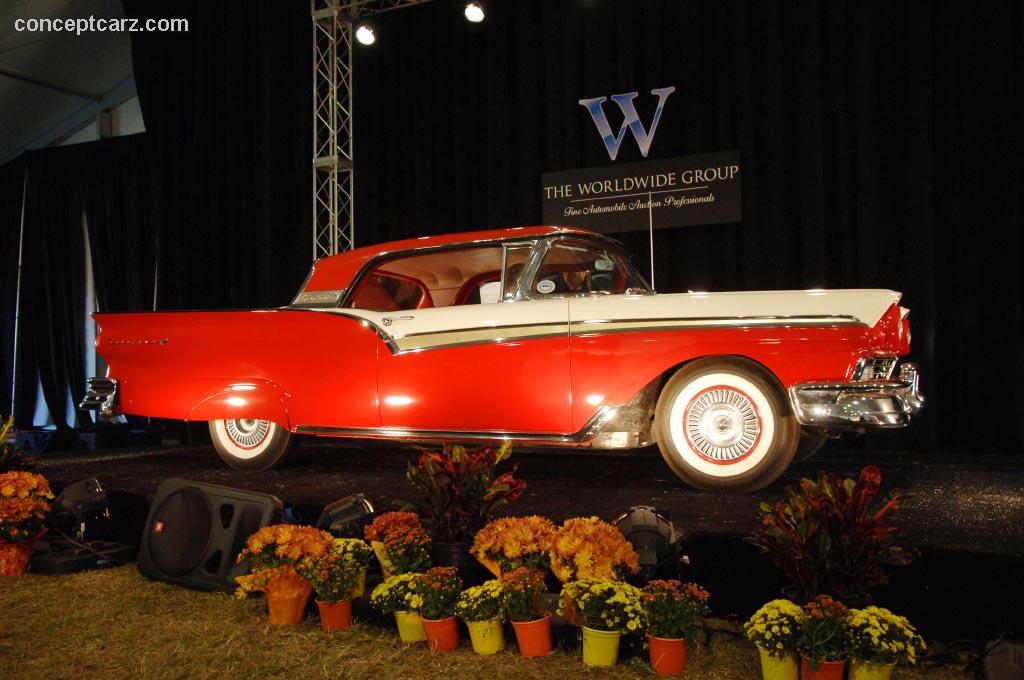
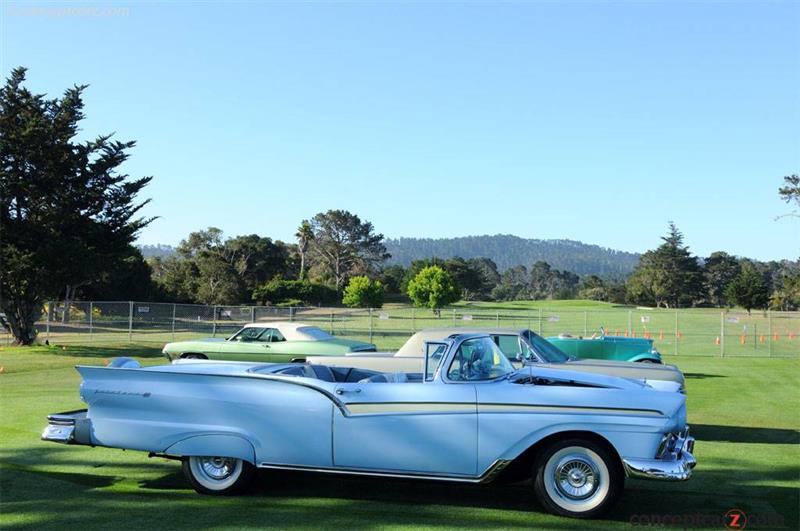
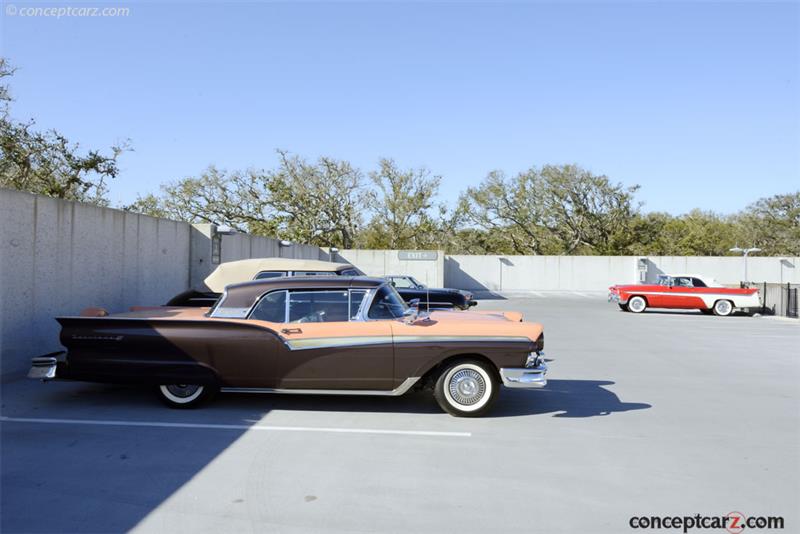
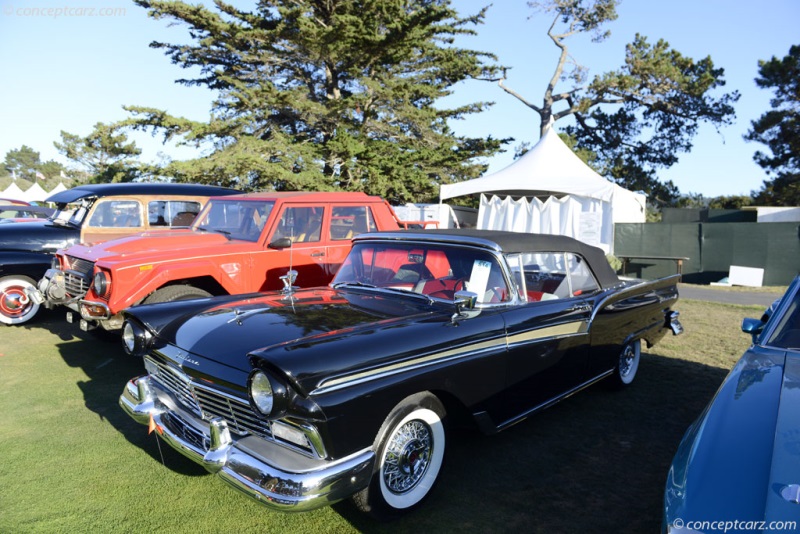
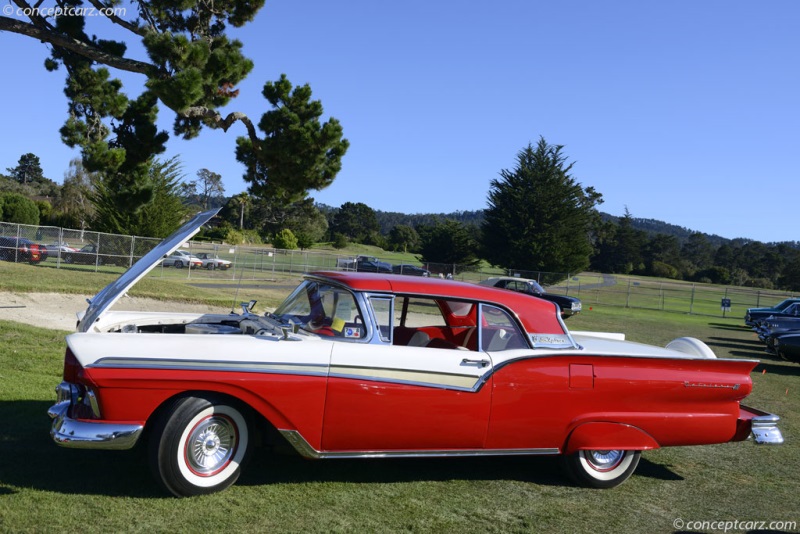
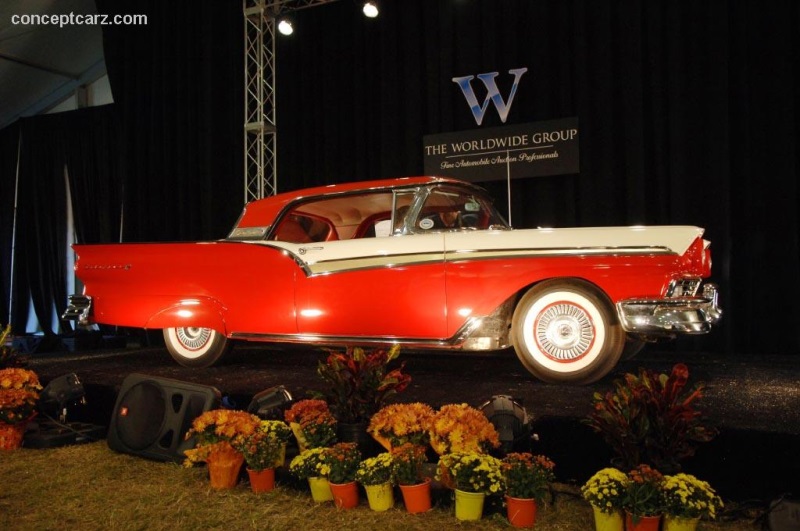
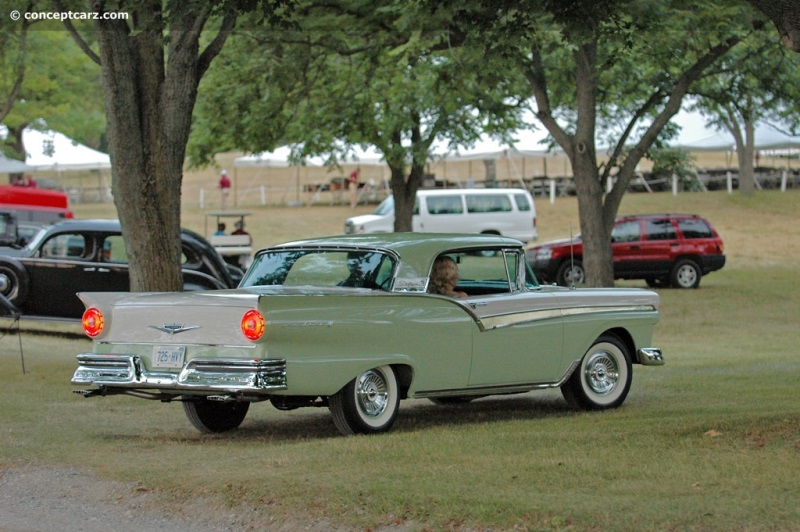
Ford, along with its Chief of Styling, George W. Walker, created and applied a series of innovative design principles to the 1957 Fords, resulting in boosting the company's reputation as a leader in manufacturing. There were subtle bits of chrome trim decoration around the body, a blunt front-end incorporating a clean, and full-width rectangular grille. 
500 V8 Skyliner Convertible
Chassis #: D7RW214783
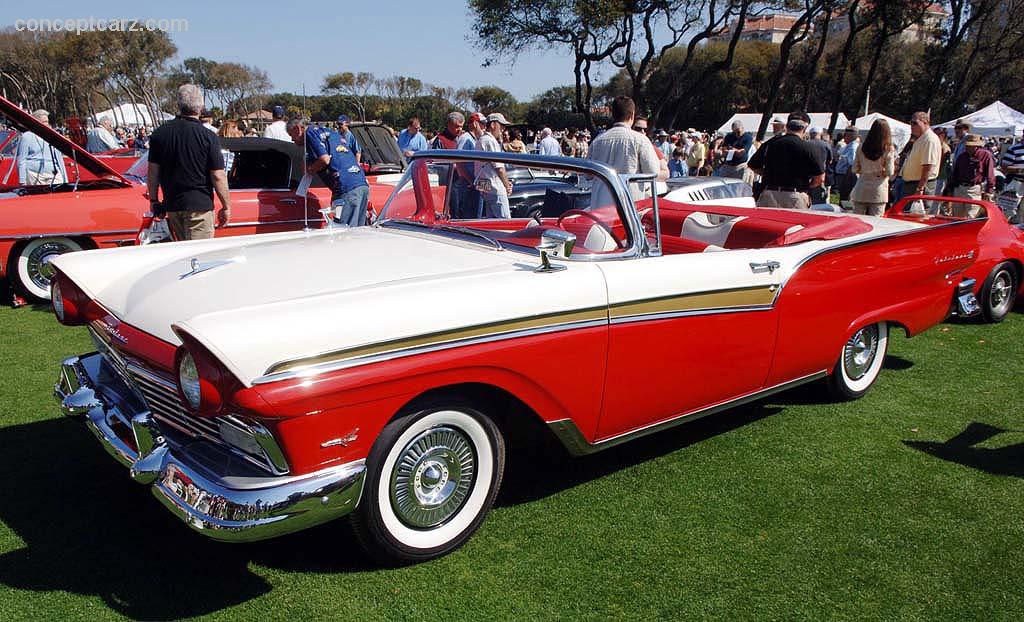
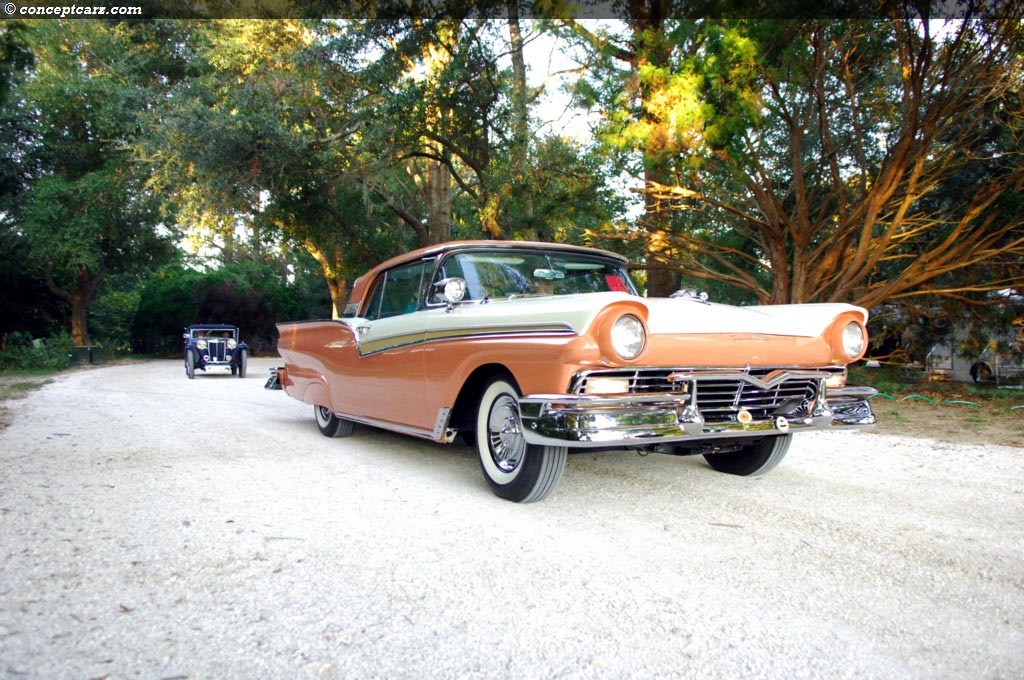
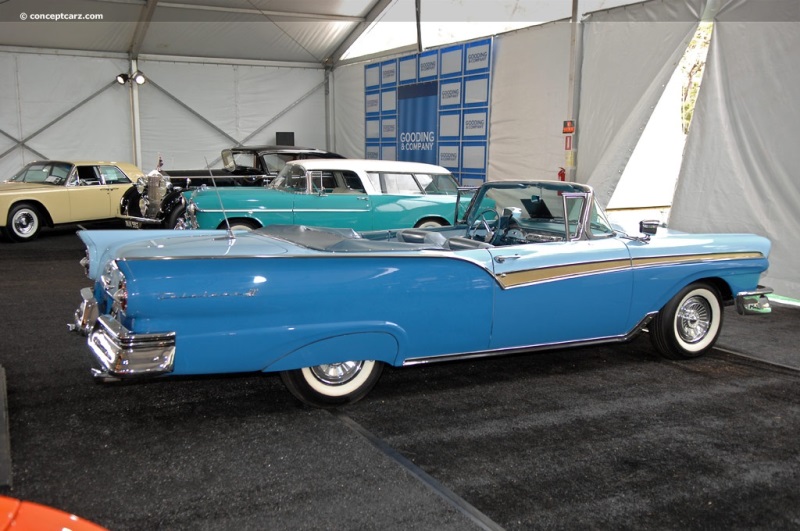
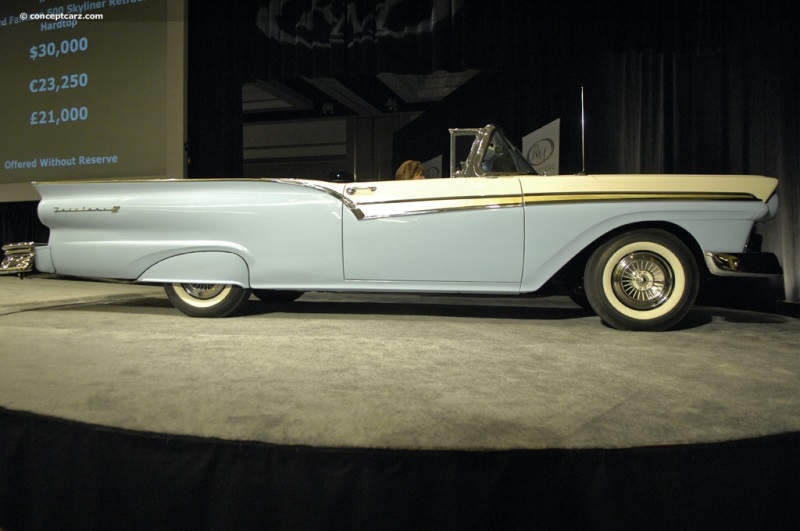
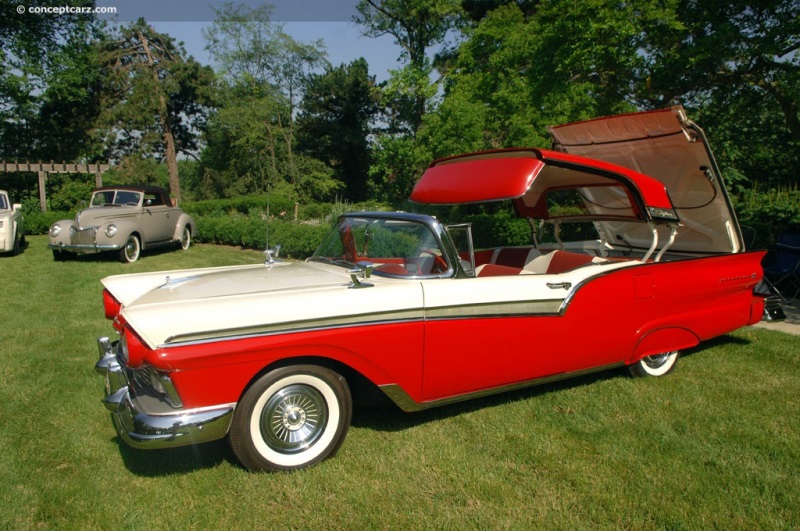
View info and historyThe Fairlane was a remarkable vehicle with its two and four-door 'thin pillar' body styles, while the convertible Sunliner and retractable roof Skyliner were considered the pinnacle of the series. There were 37 different fabric color combinations and a selection of either standard nylon or optional vinyl upholstery.Ford pushed the engineering and styling envelope even further with the first mass-produced retractable hardtop, the Fairlane 500 Skyliner. After pressing a button, the Skyliners hardtop would unscrew itself from the windshield frame and then fold neatly and tucked under a long, flat trunk lid that lifted on its own to make way for the top. In about 25 seconds, the Skyliner driver could literally transform his coupe into a true convertible. Ford offered the unique retractable hardtop option for only three years, from 1957 to 1959. The Fairlane 500 Skyliner was premiered at the December 1956 New York Auto Show. The inspiration is thought to have come from the Vista Dome railroad observation cars of the era. It was a fixed panel instead of the modern movable concept and was also seen on the Mercury Sun Valley. This principle was applied again as an option for the 1955 and 1956 Ford Crown Victoria and was also called a Skyliner in 1956.
500 V8 Skyliner Convertible
View info and historyIn 1957, the Dearborn assembly plant made available for all models a limited number of F-Code 312 cubic inch Thunderbird V-8 engines fitted with a four-barrel carburetor and a McCullochPaxton centrifugal supercharger a special cylinder head was fitted to these engines to keep the compression ratio at 8.51 so that they could drive on regular pump gas. The F-Code engine could be ordered with either a manual or a Ford-O-Matic transmission. Less than 14 Skyliners are believed to have been produced in 1957 with the F-Code engine. Ford's supercharger program was a stopgap measure to respond to Chevrolet's refined small-block V-8 on the nation's racetracks, which in 1957 had grown to 283-CID and 283-hp with fuel injection. Ford had dominated the V-8 market since 1932, so when Chevrolet started to win races in 1955 and 1956 with their new V8, initially a 265, Ford instituted a game plan to regain superiority. To be considered for the track they had to be homologated with 50 built for production, and it is reported that Ford responded by building 211 supercharged units that would end up in Thunderbirds, two-door sedans and in a few rare cases, the Skyliner.The public agreed with the changes Ford implemented on its 1957 vehicles and made them the best-selling cars of the year, even outselling Chevrolet for the first time since 1935.The Ford Fairlane
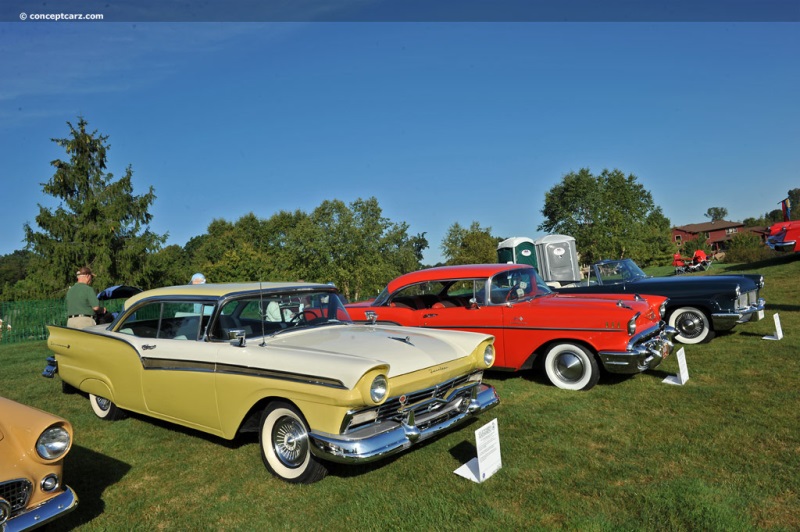
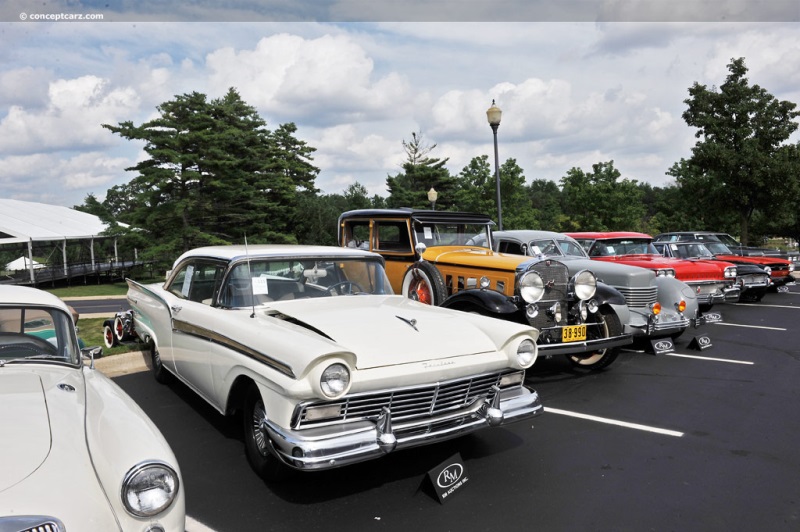
The 1957 Ford Fairlane had generous proportions, a variety of body styles, and several engine options. It had the largest wheelbase of any 1957 Ford automobile, measuring 118 inches(The Custom measured 116 inches and the Thunderbird at 102 inches). The standard engine was athe 223 cubic-inch 'Mileage Maker' inline-6 with overhead valves, 8.6:1 compression, four main bearings, a Holley one-barrel carburetor, and 144 bhp at 4,200 RPM. Body styles on the 'base' Fairlane (New for 1957 was the top-level trim, the Fairlane 500) included a two-door club sedan and Club Victoria, and four-door town sedan and Town Victoria.
500 V8 Skyliner Convertible
View info and historyAll new styling was bestowed upon the 1957 Fairlane, making it longer, lower, wider, and sleeker than the previous year's design. A large, V-shaped Fairlane crest was placed on the trunk lid, and was flanked on either side by low tailfins. The Fairlane nameplate was placed ont he side of the front fenders and above the grille. The single round headlights at the front would be replaced by quad headlights in 1958, and the grille would be updated with one that had a similar design to the 1958 Thunderbird. The styling introduced on the 1957 Fairlane, its second major restyling since its introduction in 1955, would continue through 1959. Ford Fairlane Body Styles, Pricing, and Production
The two-door club sedan was priced at $2,235, the two-door Club Victoria at $2,290, the four-door town sedan at $2,290, and the Town Victoria at $2,360. These figures were with the standard six-cylinder engine installed; the optional base V8 boosted the price by approximately $100.
500 V8 Skyliner Convertible
View info and historyThe town sedan was the most popular with 52,060 examples built, followed by 44,127 of the Club Victoria, 39,843 of the club sedan, and 12,695 of the Town Victoria.The Ford Fairlane 500
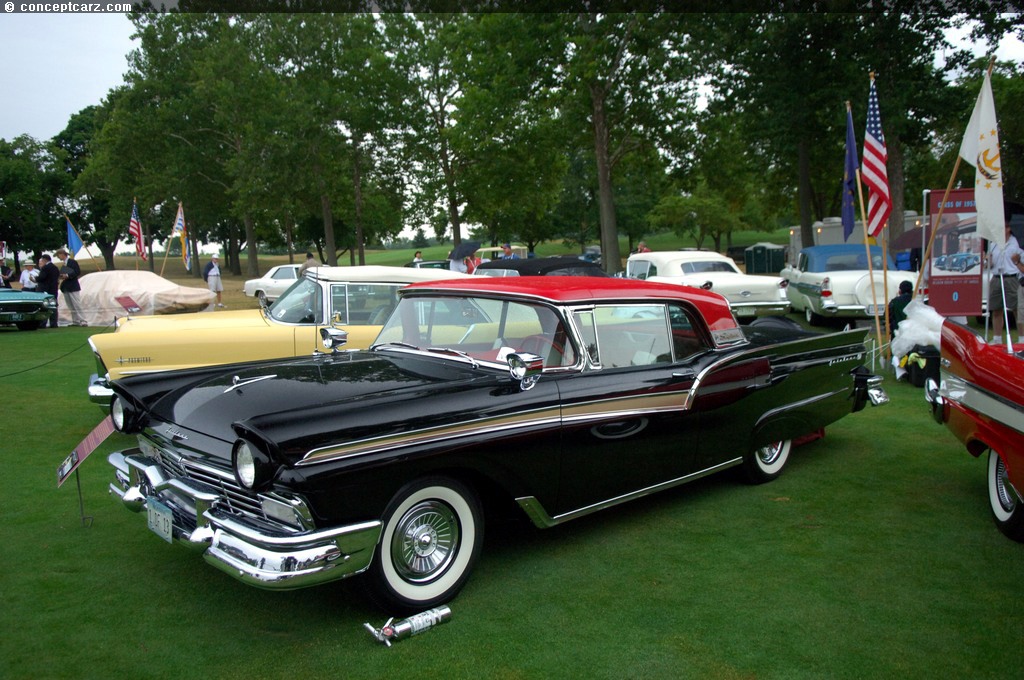
The 'Fairlane 500' had more trim and amenities than the 'base' Fairlane. They had more chrome on the 'C' pillars and unique body side trim with a gold anodized insert between the two chrome strips.Ford Fairlane 500 Body Styles, Pricing, and Production
The club sedan was priced at $2,280 (approximately $50 higher than the 'base' Fairlane), the Club Victoria at $2,340, the town sedan at $2,330, and the Town Victoria at $2,400. Replacing the standard six-cylinder engine with the 'base' V8 boosted the base price by approximately $100.
500 V8 Skyliner Convertible
View info and historyThe Sunliner Convertible was priced at $2,500 for the six-cylinder version and $2,600 with the 'base' V8. The Skyliner Convertible was only available with the V8 engine and had a base price of $2,940.The town sedan was very popular with 193,162 examples sold, followed by 183,202 of the Club Victoria and 93,753 of the club sedan. 77,728 examples were Sunliner Convertibles, and 68,550 were Town Victorias. The top-of-the-line Skyliner COnvertible found 20,766 willing buyers. Ford Fairlane Engines
The standard engine was the 223 CID (3.7-liter) 'Mileage Maker' inline-6. Optional V8 engines included the 292 CID and 312 CID Thunderbird V8s. Both of these V8 engines had overhead valves, a cast iron block, and five main bearings. The 292 cubic-inch Thunderbird V8 with a Holley four-barrel carburetor produced 212 bhp at 4,500 RPM. The 312 cubic-inch 'Thunderbird Special' with two Holley four-barrel carburetors and 9.7:1 compression produced 245 bhp at 4,500 RPM. The 8-valve 312 CID 'Thunderbird Special' with two Holley four-barrel carburetors and 9.7:1 compression produced 270 bhp at 4,800 RPM. With the 'Racing Kit' 10.0:1 compression, output rose to 285 bhp at 5,000 RPM. The 270 HP version of the 312 had the same cam as the other Ford V8s but had vibration dampers on the valve springs. Ford Fairlane Mechanical Specification
The 1957 Ford Fairlane had body-on-frame construction, a 118-inch wheelbase, a length of 207.7 inches (the Fairlane 500 Skyliner measured 210.8 inches), and rode on 7.50 x 14 four-ply tubeless tires. A three-speed manual transmission with semi-centrifugal-type clutch, helical gears, and synchronizers for second and third gears were standard. A three-speed with automatic overdrive was optional, as was the three-speed Ford-O-Matic automatic. The latter was a torque converter transmission with automatic planetary geartrain and a single-stage, three-element hydraulic torque converter. It had hydro-mechanical automatic controls and was devoid of vacuum or electric connections. Power flowed through fluid members.
500 V8 Skyliner Convertible
View info and historyWith the six-cylinder engine and manual transmission installed, a 3.89:1 gear ratio was used. A 3.22:1 gear ratio was used for the Ford-O-Matic and a 4.11:1 for the automatic overdrive. With the V8 engine installed, the standard gear ratio with the manual transmission was 3.56:1. The Ford-O-Matic had a 3.10:1 gear ratio, and the automatic overdrive had a 3.70:1 ratio.
500 V8 Skyliner Convertible
Chassis #: D7RW214783
View info and history
500 V8 Skyliner Convertible
View info and history
The 1957 Ford Fairlane had generous proportions, a variety of body styles, and several engine options. It had the largest wheelbase of any 1957 Ford automobile, measuring 118 inches(The Custom measured 116 inches and the Thunderbird at 102 inches). The standard engine was athe 223 cubic-inch 'Mileage Maker' inline-6 with overhead valves, 8.6:1 compression, four main bearings, a Holley one-barrel carburetor, and 144 bhp at 4,200 RPM. Body styles on the 'base' Fairlane (New for 1957 was the top-level trim, the Fairlane 500) included a two-door club sedan and Club Victoria, and four-door town sedan and Town Victoria.
500 V8 Skyliner Convertible
View info and history
The two-door club sedan was priced at $2,235, the two-door Club Victoria at $2,290, the four-door town sedan at $2,290, and the Town Victoria at $2,360. These figures were with the standard six-cylinder engine installed; the optional base V8 boosted the price by approximately $100.
500 V8 Skyliner Convertible
View info and history
The 'Fairlane 500' had more trim and amenities than the 'base' Fairlane. They had more chrome on the 'C' pillars and unique body side trim with a gold anodized insert between the two chrome strips.Ford Fairlane 500 Body Styles, Pricing, and Production
The club sedan was priced at $2,280 (approximately $50 higher than the 'base' Fairlane), the Club Victoria at $2,340, the town sedan at $2,330, and the Town Victoria at $2,400. Replacing the standard six-cylinder engine with the 'base' V8 boosted the base price by approximately $100.
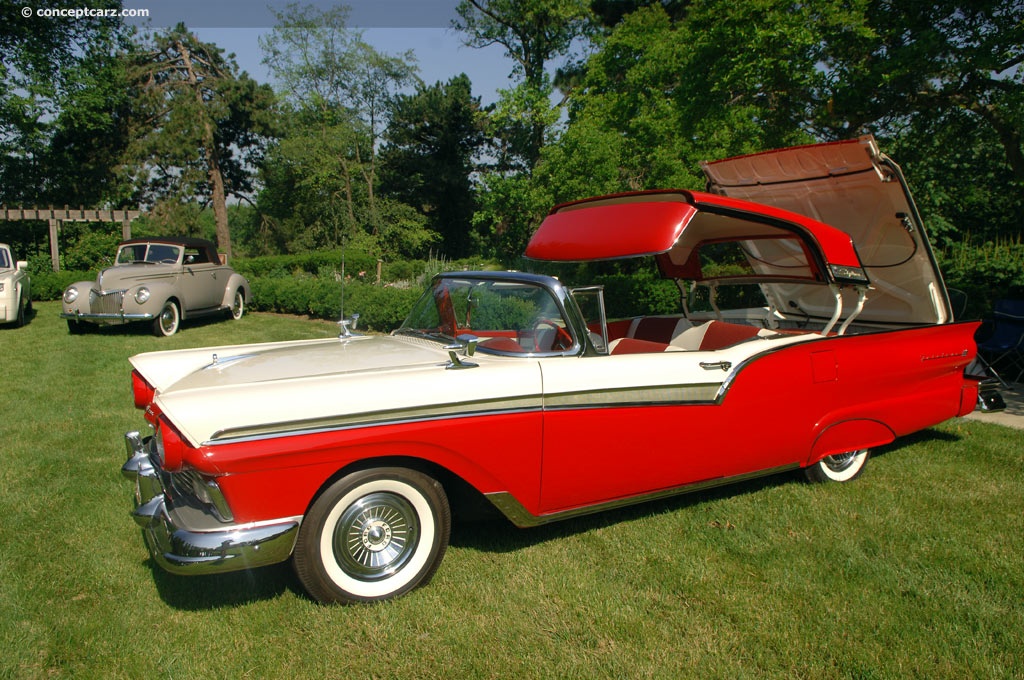
500 V8 Skyliner Convertible
View info and history
The standard engine was the 223 CID (3.7-liter) 'Mileage Maker' inline-6. Optional V8 engines included the 292 CID and 312 CID Thunderbird V8s. Both of these V8 engines had overhead valves, a cast iron block, and five main bearings. The 292 cubic-inch Thunderbird V8 with a Holley four-barrel carburetor produced 212 bhp at 4,500 RPM. The 312 cubic-inch 'Thunderbird Special' with two Holley four-barrel carburetors and 9.7:1 compression produced 245 bhp at 4,500 RPM. The 8-valve 312 CID 'Thunderbird Special' with two Holley four-barrel carburetors and 9.7:1 compression produced 270 bhp at 4,800 RPM. With the 'Racing Kit' 10.0:1 compression, output rose to 285 bhp at 5,000 RPM. The 270 HP version of the 312 had the same cam as the other Ford V8s but had vibration dampers on the valve springs. Ford Fairlane Mechanical Specification
The 1957 Ford Fairlane had body-on-frame construction, a 118-inch wheelbase, a length of 207.7 inches (the Fairlane 500 Skyliner measured 210.8 inches), and rode on 7.50 x 14 four-ply tubeless tires. A three-speed manual transmission with semi-centrifugal-type clutch, helical gears, and synchronizers for second and third gears were standard. A three-speed with automatic overdrive was optional, as was the three-speed Ford-O-Matic automatic. The latter was a torque converter transmission with automatic planetary geartrain and a single-stage, three-element hydraulic torque converter. It had hydro-mechanical automatic controls and was devoid of vacuum or electric connections. Power flowed through fluid members.
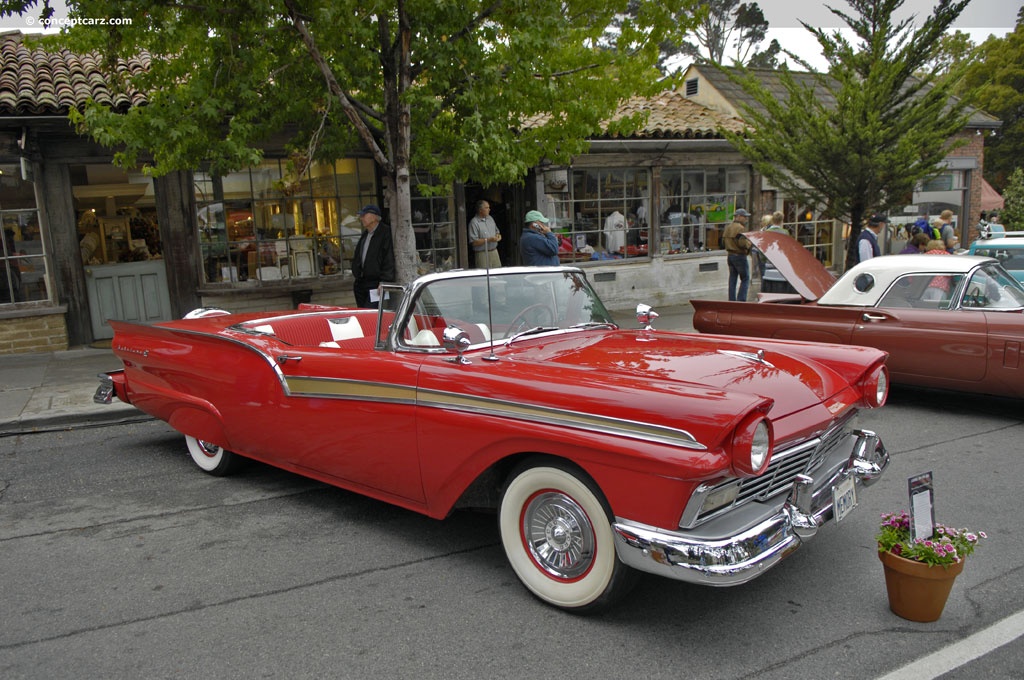
500 V8 Skyliner Convertible
View info and history
Related Reading : Ford Fairlane History
The name Fairlane came from Henry Fords Fair Lane mansion location in Dearborn, Michigan. The Ford Fairlane was introduced in 1955 as Fords full-size model and was available in six different body styles. The vehicle could be assembled as a 2 door club sedan, a 4 door town sedan, a Victoria 2 door hardtop, a Sunliner convertible, a Crown Victoria, or a Crown Victoria with a plastic top. There....
Continue Reading >>
Continue Reading >>
Similar Vehicles
Similarly Sized Vehicles
from 1957
Similarly Priced Vehicles


1957 Ford Fairlane Vehicle Profiles












Recent Vehicle Additions


Performance and Specification Comparison
Price Comparison
$1,420 - $2,080
$1,890 - $2,040
$1,990
$2,300 - $2,685
$3,406
Fairlane Specification Comparison by Year
Year
Production
Wheelbase
Engine
Prices
785,886
118.00 in.
6 cyl., 223.00 CID., 144.00hp
8 cyl., 272.00 CID., 190.00hp
8 cyl., 312.00 CID., 225.00hp
8 cyl., 312.00 CID., 270.00hp
8 cyl., 312.00 CID., 285.00hp
8 cyl., 312.00 CID., 300.00hp
8 cyl., 312.00 CID., 340.00hp
8 cyl., 272.00 CID., 190.00hp
8 cyl., 312.00 CID., 225.00hp
8 cyl., 312.00 CID., 270.00hp
8 cyl., 312.00 CID., 285.00hp
8 cyl., 312.00 CID., 300.00hp
8 cyl., 312.00 CID., 340.00hp
$2,230 - $2,945
306,429
118.00 in.
6 cyl., 223.00 CID., 145.00hp
8 cyl., 292.00 CID., 205.00hp
8 cyl., 332.00 CID., 240.00hp
8 cyl., 332.00 CID., 265.00hp
8 cyl., 352.00 CID., 300.00hp
8 cyl., 292.00 CID., 205.00hp
8 cyl., 332.00 CID., 240.00hp
8 cyl., 332.00 CID., 265.00hp
8 cyl., 352.00 CID., 300.00hp
$2,475 - $3,140
178,800
118.00 in.
6 cyl., 223.00 CID., 145.00hp
8 cyl., 292.00 CID., 225.00hp
8 cyl., 352.00 CID., 300.00hp
8 cyl., 292.00 CID., 225.00hp
8 cyl., 352.00 CID., 300.00hp
$2,360 - $2,600
Related Automotive News

Award-Winning Car Collections Head To Atlanta Concours As Show Enters 3Rd Year Of Impressive Growth
Renowned Collections Range from Brass Era to Modern Day
ATLANTA, GA., July 24, 2018 – The third year is indeed the charm for the Atlanta Concours dElegance, with distinguished collections to suit every enthusiast – from the romanticism...

2019 Hyundai Kona Electric Recalibrates The Eco CUV Formula With An Impressive 250 Miles Of Estimated Range
Generous 250 Mile Estimated Range Meets More Varied Lifestyle Needs
New Electric CUV offers Youthful Design, Sporty Driving Character, Leading Safety Technology and Advanced Infotainment Features in an Affordable, Compact Footprint
Abundant Suite...

THE JAGUAR F-TYPE R COUPE TO MAKE ITS CANADIAN DEBUT AT THE 2014 TORONTO AUTO SHOW
(MISSISSAUGA, ON) February 13, 2014 - Jaguar will showcase its 2014 model year line up at the 2014 Canadian Auto Show held February 14 to 23, 2014. The 2015 F-TYPE R Coupe will be making its Canadian debut and the C-X17 Sport Crossover concept...

VOLKSWAGEN E-GOLF TO MAKE NORTH AMERICAN DEBUT AT THE LOS ANGELES AUTO SHOW
The first fully electric Volkswagen for the U.S. market promises everyday usability and versatility with zero tailpipe emissions and low ownership costs
Drivetrain consists of 24.2 kWh lithium-ion battery and 115 horsepower electric motor 7.2 kW o...

Land Rover Celebrates 65 Years Of Technology And Innovation
SIXTY-FIVE YEARS OF LAND ROVER
From our earliest days, the desire to create a vehicle that will tackle any terrain has made Land Rover famous around the world. Over the past 65 years, the Land Rover family has grown into the highly respected...