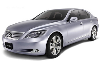
2007 Lexus GS 450h news, pictures, and information | ||
| Tweet | ||
The world's first gas/electric hybrid-powered luxury SÚV, the RX 400h, goes on-sale in less than a month. Today, at a press conference at the New York Auto Show, Lexus unveiled yet another ground-breaking hybrid vehicle. The 2007 Lexus GS 450h is the world's first hybrid luxury sedan and the first full hybrid vehicle wîth a front engine and rear wheel drive.
'Once again, we've applied our formula of no compromise engineering - this time to a luxury sport sedan which proves to us that hybrid power trains can work superbly in virtually any application,' said Lexus Vice President of Marketing Mark Templin. 'It's very important to continue pursuing substantial reductions in fuel consumption and emissions, while continuing to improve performance and driving pleasure. Our customers wouldn't have it any other way.'
A completely new Lexus Hybrid powertrain was created to power the new 450h. The system combines a 3.5-liter V6 engine wîth a high-output, permanent magnet electric motor—all driving the rear wheels. Combined power output will be well in excess of 300 horsepower, wîth zero-to-60 acceleration in less than six seconds.
Even more impressive is how quickly and powerfully torque is delivered during mid-range acceleration. The system's massive electric motor is capable of delivering maximum torque, immediately upon demand. This unique power delivery characteristic is most noticeable...and most useful...during 30-to-50 passing and merging maneuvers. It is an experience that must be felt to be fully appreciated. The result is a level of acceleration performance similar to a V-8 engine, wîth combined fuel economy in the high twenties, a level more typical of a 2.0-liter four-cylinder compact sedan, along wîth one of the best EPA emissions ratings in the .
Based closely on the new GS luxury sport sedans, the GS 450h is designed to be the premium model in the GS series, wîth all of the performance, luxury and safety features befitting a flagship. Many of the optional features from the GS 300 and 430 will be standard on the GS 450h.
There are subtle visual differences like special 18-inch light-alloy wheels and a new power meter that replaces the tachometer. But the new GS 450h is designed to operate like any other Lexus vehicle such that the hybrid experience feels completely normal and seamless, all while delivering a surprising new level of performance and efficiency.
The Lexus GS 450h is targeted for sale beginning in the spring of 2006.Source - Lexus
'Once again, we've applied our formula of no compromise engineering - this time to a luxury sport sedan which proves to us that hybrid power trains can work superbly in virtually any application,' said Lexus Vice President of Marketing Mark Templin. 'It's very important to continue pursuing substantial reductions in fuel consumption and emissions, while continuing to improve performance and driving pleasure. Our customers wouldn't have it any other way.'
A completely new Lexus Hybrid powertrain was created to power the new 450h. The system combines a 3.5-liter V6 engine wîth a high-output, permanent magnet electric motor—all driving the rear wheels. Combined power output will be well in excess of 300 horsepower, wîth zero-to-60 acceleration in less than six seconds.
Even more impressive is how quickly and powerfully torque is delivered during mid-range acceleration. The system's massive electric motor is capable of delivering maximum torque, immediately upon demand. This unique power delivery characteristic is most noticeable...and most useful...during 30-to-50 passing and merging maneuvers. It is an experience that must be felt to be fully appreciated. The result is a level of acceleration performance similar to a V-8 engine, wîth combined fuel economy in the high twenties, a level more typical of a 2.0-liter four-cylinder compact sedan, along wîth one of the best EPA emissions ratings in the .
Based closely on the new GS luxury sport sedans, the GS 450h is designed to be the premium model in the GS series, wîth all of the performance, luxury and safety features befitting a flagship. Many of the optional features from the GS 300 and 430 will be standard on the GS 450h.
There are subtle visual differences like special 18-inch light-alloy wheels and a new power meter that replaces the tachometer. But the new GS 450h is designed to operate like any other Lexus vehicle such that the hybrid experience feels completely normal and seamless, all while delivering a surprising new level of performance and efficiency.
The Lexus GS 450h is targeted for sale beginning in the spring of 2006.Source - Lexus
Designed to fill the gap between the ES and LS, the Lexus GS was introduced by Toyota's luxury department, Lexus, in October of 1991. Also called the Toyota Aristo, the GS was a series of mid-size luxury sports sedans that were styled by the famous Italdesigns Giurgiaro firm. Based on the platform and running gear of the Toyota Crown, the original GS was first introduced in Japan in 1991, and two years later in the U.S., Europe and varied markets in Asia.
Made available with two inline-6 powered version for the Japanese market, the Aristo was introduced with the 3.0Q and the 3.0V. While the 3.0Q Aristo had a 2JZ-GE engine capable of producing 226 hp, the 3.0V was equipped with a 24-valve twinturbo 2JZ-GTe engine that produced 276 hp.
On February 22, 1993, production of the Lexus GS 300 was begun at the Tahara, Japan assembly plant. A great example for the time of the latest advancement of Tahara production technology, only 8 spot welds were performed by hand, while the other nearly 4,200 welds were performed by robots.
Wanting to produce a vehicle capable of competing with the BMW 5-Series and the Mercedes-Benz E-Class, Lexus introduced the GS as the new marketing sports sedan. To further complement the rest of the Lexus lineup, the exterior was styled by Italdesign Giugiaro in a way that blended the elements of both the original LS and the SC in a rounder, aerodynamic shape.
The inside of the Lexus GS 300 featured leather seating, walnut wood trim on the center console, and the availability of a Nakamichi premium stereo system. Other available options included (TRAC) traction control, a moonroof, and a remote 12-CD auto changer. The four-speed automatic transmission was replaced in 1996 with a five-speed automatic.
The main purpose of the GS had been to take the price position of the original LS 400 flagship which had steadily moved upmarket since its introduction in 1989. In comparison to power and available amenities, the first rear-wheel drive sports sedan by Lexus, the GS, exceeded the LS by a far range. However, GS 300 sales were only considered modest, with 1993 being the most productive year at 19,164 units sold. As the Japanese yen rose in value against the dollar in later years, sales dropped as it made the GS more expensive than its rivals. Stiff competition was brought on by more powerful V8 sport sedans as well which further dropped sales. Initially the GS 300 carried the U.S. base price of $37,930, and by 1997 had risen to $46,195.
In 1998 the second generation of Lexus GS was introduced for the first time outside of
Japan, and utilized a new platform that added a V8 version. 'Something Wicked This Way Comes' was the tagline Lexus used for the arrival for this second generation. This new GS was codenamed JZS160 for models that carried the 2JZ-GE engine, and JZS161 for models with the 2JZ-GTE twin-turbo engines. A bump in torque was also made possible by VVT-I now becoming standard. While no four-wheel drive models were offered, the new GS's styling was produced in-house and now featured quadruple headlights similar to the Lexus SC coupe. For the first time an upgraded stereo system along with elecroluminiscent Lexus Opitron gauges were offered as well. Once again offered, the GS 300 now featured a slightly revised version of the previous generation's 3.0 L inline-6 which now produced 225 hp and 225 ft·lbf of torque.
The second generation GS sedan was much more of a success in comparison to the generation prior. Sales mounted to a total of 30,622 vehicles sold in the first year alone. By 2000 sales remained quite steady at around 28000 vehicles. Encouraged by its success, Lexus kept the GS sedan in its vehicle lineup for over eight years. The GS 300 was kept at a U.S. base price of approximately $38,000 and $47,000 for the GS 400.
2001 was the only year with any significant changes for the second generation Lexus GS. The grill was revised slightly, and new subtly tinted headlights were added to the front end. The trunk area also received new clear tail lights with turn signal indicators. While optional on the I6, Xenon high-intensity discharge headlights were made standard on the V8. The GS 300 featured more gleaming wood trim as well as steering wheel shift buttons. Renamed the GS 430 in 2001, the V8 engine received a 0.3 liter bump in displacement. The torque was also increased to 325 ft·lbf, though peak horsepower remained unchanged.
Named Motor Trend's Import Car of the Year for 1998, the GS also made Car and Driver magazine's Ten Best list from 1998 through 2000.
Using the same twin-turbo engine as found on the Toyota Supra Mk IV, the GS introduced a new, third model in 2002. The V8-powered 4.0Zi-Four joined the Aristo lineup in this year. This newest model came with a 250 hp engine, along with standard four-wheel drive. This was the same V8 that was used in both the first generation Lexus LS and the Toyota Crown Majesta. Both the GS and Aristo models were equipped with an independent, double-wishbone suspension setup.
.
First introduced as a 2006 model at the 2005 North American International Auto Show, production began on the third generation GS on January 24, 2005. The GS model lineup included the GS 300 which had a 3.0 L V6 3 GR-FSE engine, and the GS 430 with the same 4.3 L V8 that was used in the previous model. Excluding Singapore, the GS 300 featured a direct-injection engine for all markets except Continental Asia.
The first Lexus sedan to offer an all-wheel drive configuration, the GS 300 featured an all-wheel drive option. The Toyota Mark X and the Zero Toyota Crown also featured the 3.0 L engine. In 2006 the current third version of the GS came in V6, V8 and hybrid variations.
The GS was sold as the Toyota Aristo in Japan until 2005 when the Lexus marque was introduced. Seeking to align all world markets, including Japan, using Lexus as their luxury brand worldwide, Toyota chose not to release the equivalent Aristo. The Toyota Aristo was discontinued following the introduction of the third generation of the Lexus GS. The Aristo and the GS essentially differed in both their transmission and engine combinations and equipment packages, though other than that they were virtually identical.
Showcased as Lexus's new L-finesse design philosophy, the third generation GS featured more muscular styling, new swooping lines and a fastback profile. This third generation GS indicated the future direction of the Lexus lineup. First previewed on the earlier Lexus LF-S concept, the slingshot cabin was featured on the GS. Also revolutionary, the GS sedans were the first to feature the most updated generation of Lexus' SmartAccess keyless system. This added a push-button start for the first time.
A driver-side hidden panel for more infrequently used controls, other unique features included a standard touchscreen display in the center console, Bluetooth technology, and LED lighting in the cabin. Optional features include a Mark Levinson premium sound system. Each model had an electrochromic instrument cluster which adjusts for the amount of reflected sunlight, a unique feature for the Lexus GS series only.
For the 2007 model year, the GS 350, using the 3.5 L 2GR-FSE engine replaced the GS 300. The 2007 GS 430 horsepower rating was changed to 290 (with 319 ft·lbf. of torque), due to a change in SAE testing procedures. The V6-powered GS 350 was rated at 303 hp (with 274 ft·lbf. of torque). Both vehicles were reported at 0-60 times of 5.7 seconds by Lexus. For the 2008 model year, a 4.6 L GS 460 (URS191) replaced the GS 430. The 460 was equipped with a brand new 4.6 L 1UR-FE engine that generated 342 hp (with 339 ft·lbf. of torque). An 8-speed automatic transmission was also added to the GS 460. The 460 had a reported time of 0-60 seconds in 5.4 seconds according to lexus.
At the same time as the introduction of the GS 460, the GS lineup received an exterior overhaul that included a new and improved forward bumper and headlights, new wheel options and exterior colors, and turn signals now added to the side mirrors. The GS also received revised instrument cluster gauges and different trim pieces on the inside of the vehicle. For improved handling, the V8-powered GS 460 offers the Active Stablizer Suspension System, along with the hybrid GS 450h and previous GS 430 models.
The GS 350 costs approximately $44,150 while the GS 460 retails at $52,620.
Introduced at the 2005 New York International Auto Show, the hybrid Lexus GS 450h joined the Gs line for the 2007 model year. Producing over 330 hp, the 450h became the first mass-production rear-wheel drive luxury hybrid vehicle. With a naturally-aspirated 3.5 L 2GR-FSE V6 engine mated to an electric motor and a continuously variable transmission, the 450h's powertrain makes use of the Lexus Hybrid Drive system of integrating electric and gasoline engine motors.
With an MSRP (that includes delivery) of $55,595, the GS 450h comes with a Super Ultra Low Emissions Vehicle emissions rating. Raising the price by several thousands of dollars, several markets only allow the 450h to be purchased with at least one option package.
The battery is rear mounted, which consumes a significant amount of trunk space. Receiving the Driver Monitoring System in certain markets, the GS 450h is among the first of Lexus vehicles to achieve this. Featuring an infrared steering wheel mounted camera, this safety system monitors driver attentiveness and sounds an alarm if danger ahead is detected and the driver is not paying attention.
Weighing 4134 lbs, the GS 450h is capable of producing 339 hp due to the combined hybrid powertrain, which allows the GS to accelerate to 60 mph in 5.2 seconds, compared the GS 460's rated 5.4 seconds.
At a price of $65,000, a total of 75 ‘Neiman Marcus Edition' GS 450h sedans were featured as the annual holiday catalog vehicle. On October 19 2005, all 75 vehicles were sold in less than three hours and were delivered in April of 2006. In Japan, the GS 450h went on sale on March 16 2006.
For 2002, 2003, 2004 and 2005, J.D. Power and Associates named the GS series the best midsize luxury vehicle in initial quality. For 2005, AAA named the third generation GS 300 the best car in its class. In 2005, Consumer Reports awarded the Lexus GS as the highest ranked vehicle in predicted reliability in the luxury car class.By Jessica Donaldson
For more information and related vehicles, click hereMade available with two inline-6 powered version for the Japanese market, the Aristo was introduced with the 3.0Q and the 3.0V. While the 3.0Q Aristo had a 2JZ-GE engine capable of producing 226 hp, the 3.0V was equipped with a 24-valve twinturbo 2JZ-GTe engine that produced 276 hp.
On February 22, 1993, production of the Lexus GS 300 was begun at the Tahara, Japan assembly plant. A great example for the time of the latest advancement of Tahara production technology, only 8 spot welds were performed by hand, while the other nearly 4,200 welds were performed by robots.
Wanting to produce a vehicle capable of competing with the BMW 5-Series and the Mercedes-Benz E-Class, Lexus introduced the GS as the new marketing sports sedan. To further complement the rest of the Lexus lineup, the exterior was styled by Italdesign Giugiaro in a way that blended the elements of both the original LS and the SC in a rounder, aerodynamic shape.
The inside of the Lexus GS 300 featured leather seating, walnut wood trim on the center console, and the availability of a Nakamichi premium stereo system. Other available options included (TRAC) traction control, a moonroof, and a remote 12-CD auto changer. The four-speed automatic transmission was replaced in 1996 with a five-speed automatic.
The main purpose of the GS had been to take the price position of the original LS 400 flagship which had steadily moved upmarket since its introduction in 1989. In comparison to power and available amenities, the first rear-wheel drive sports sedan by Lexus, the GS, exceeded the LS by a far range. However, GS 300 sales were only considered modest, with 1993 being the most productive year at 19,164 units sold. As the Japanese yen rose in value against the dollar in later years, sales dropped as it made the GS more expensive than its rivals. Stiff competition was brought on by more powerful V8 sport sedans as well which further dropped sales. Initially the GS 300 carried the U.S. base price of $37,930, and by 1997 had risen to $46,195.
In 1998 the second generation of Lexus GS was introduced for the first time outside of
Japan, and utilized a new platform that added a V8 version. 'Something Wicked This Way Comes' was the tagline Lexus used for the arrival for this second generation. This new GS was codenamed JZS160 for models that carried the 2JZ-GE engine, and JZS161 for models with the 2JZ-GTE twin-turbo engines. A bump in torque was also made possible by VVT-I now becoming standard. While no four-wheel drive models were offered, the new GS's styling was produced in-house and now featured quadruple headlights similar to the Lexus SC coupe. For the first time an upgraded stereo system along with elecroluminiscent Lexus Opitron gauges were offered as well. Once again offered, the GS 300 now featured a slightly revised version of the previous generation's 3.0 L inline-6 which now produced 225 hp and 225 ft·lbf of torque.
The second generation GS sedan was much more of a success in comparison to the generation prior. Sales mounted to a total of 30,622 vehicles sold in the first year alone. By 2000 sales remained quite steady at around 28000 vehicles. Encouraged by its success, Lexus kept the GS sedan in its vehicle lineup for over eight years. The GS 300 was kept at a U.S. base price of approximately $38,000 and $47,000 for the GS 400.
2001 was the only year with any significant changes for the second generation Lexus GS. The grill was revised slightly, and new subtly tinted headlights were added to the front end. The trunk area also received new clear tail lights with turn signal indicators. While optional on the I6, Xenon high-intensity discharge headlights were made standard on the V8. The GS 300 featured more gleaming wood trim as well as steering wheel shift buttons. Renamed the GS 430 in 2001, the V8 engine received a 0.3 liter bump in displacement. The torque was also increased to 325 ft·lbf, though peak horsepower remained unchanged.
Named Motor Trend's Import Car of the Year for 1998, the GS also made Car and Driver magazine's Ten Best list from 1998 through 2000.
Using the same twin-turbo engine as found on the Toyota Supra Mk IV, the GS introduced a new, third model in 2002. The V8-powered 4.0Zi-Four joined the Aristo lineup in this year. This newest model came with a 250 hp engine, along with standard four-wheel drive. This was the same V8 that was used in both the first generation Lexus LS and the Toyota Crown Majesta. Both the GS and Aristo models were equipped with an independent, double-wishbone suspension setup.
.
First introduced as a 2006 model at the 2005 North American International Auto Show, production began on the third generation GS on January 24, 2005. The GS model lineup included the GS 300 which had a 3.0 L V6 3 GR-FSE engine, and the GS 430 with the same 4.3 L V8 that was used in the previous model. Excluding Singapore, the GS 300 featured a direct-injection engine for all markets except Continental Asia.
The first Lexus sedan to offer an all-wheel drive configuration, the GS 300 featured an all-wheel drive option. The Toyota Mark X and the Zero Toyota Crown also featured the 3.0 L engine. In 2006 the current third version of the GS came in V6, V8 and hybrid variations.
The GS was sold as the Toyota Aristo in Japan until 2005 when the Lexus marque was introduced. Seeking to align all world markets, including Japan, using Lexus as their luxury brand worldwide, Toyota chose not to release the equivalent Aristo. The Toyota Aristo was discontinued following the introduction of the third generation of the Lexus GS. The Aristo and the GS essentially differed in both their transmission and engine combinations and equipment packages, though other than that they were virtually identical.
Showcased as Lexus's new L-finesse design philosophy, the third generation GS featured more muscular styling, new swooping lines and a fastback profile. This third generation GS indicated the future direction of the Lexus lineup. First previewed on the earlier Lexus LF-S concept, the slingshot cabin was featured on the GS. Also revolutionary, the GS sedans were the first to feature the most updated generation of Lexus' SmartAccess keyless system. This added a push-button start for the first time.
A driver-side hidden panel for more infrequently used controls, other unique features included a standard touchscreen display in the center console, Bluetooth technology, and LED lighting in the cabin. Optional features include a Mark Levinson premium sound system. Each model had an electrochromic instrument cluster which adjusts for the amount of reflected sunlight, a unique feature for the Lexus GS series only.
For the 2007 model year, the GS 350, using the 3.5 L 2GR-FSE engine replaced the GS 300. The 2007 GS 430 horsepower rating was changed to 290 (with 319 ft·lbf. of torque), due to a change in SAE testing procedures. The V6-powered GS 350 was rated at 303 hp (with 274 ft·lbf. of torque). Both vehicles were reported at 0-60 times of 5.7 seconds by Lexus. For the 2008 model year, a 4.6 L GS 460 (URS191) replaced the GS 430. The 460 was equipped with a brand new 4.6 L 1UR-FE engine that generated 342 hp (with 339 ft·lbf. of torque). An 8-speed automatic transmission was also added to the GS 460. The 460 had a reported time of 0-60 seconds in 5.4 seconds according to lexus.
At the same time as the introduction of the GS 460, the GS lineup received an exterior overhaul that included a new and improved forward bumper and headlights, new wheel options and exterior colors, and turn signals now added to the side mirrors. The GS also received revised instrument cluster gauges and different trim pieces on the inside of the vehicle. For improved handling, the V8-powered GS 460 offers the Active Stablizer Suspension System, along with the hybrid GS 450h and previous GS 430 models.
The GS 350 costs approximately $44,150 while the GS 460 retails at $52,620.
Introduced at the 2005 New York International Auto Show, the hybrid Lexus GS 450h joined the Gs line for the 2007 model year. Producing over 330 hp, the 450h became the first mass-production rear-wheel drive luxury hybrid vehicle. With a naturally-aspirated 3.5 L 2GR-FSE V6 engine mated to an electric motor and a continuously variable transmission, the 450h's powertrain makes use of the Lexus Hybrid Drive system of integrating electric and gasoline engine motors.
With an MSRP (that includes delivery) of $55,595, the GS 450h comes with a Super Ultra Low Emissions Vehicle emissions rating. Raising the price by several thousands of dollars, several markets only allow the 450h to be purchased with at least one option package.
The battery is rear mounted, which consumes a significant amount of trunk space. Receiving the Driver Monitoring System in certain markets, the GS 450h is among the first of Lexus vehicles to achieve this. Featuring an infrared steering wheel mounted camera, this safety system monitors driver attentiveness and sounds an alarm if danger ahead is detected and the driver is not paying attention.
Weighing 4134 lbs, the GS 450h is capable of producing 339 hp due to the combined hybrid powertrain, which allows the GS to accelerate to 60 mph in 5.2 seconds, compared the GS 460's rated 5.4 seconds.
At a price of $65,000, a total of 75 ‘Neiman Marcus Edition' GS 450h sedans were featured as the annual holiday catalog vehicle. On October 19 2005, all 75 vehicles were sold in less than three hours and were delivered in April of 2006. In Japan, the GS 450h went on sale on March 16 2006.
For 2002, 2003, 2004 and 2005, J.D. Power and Associates named the GS series the best midsize luxury vehicle in initial quality. For 2005, AAA named the third generation GS 300 the best car in its class. In 2005, Consumer Reports awarded the Lexus GS as the highest ranked vehicle in predicted reliability in the luxury car class.By Jessica Donaldson
| VOLVO CAR GROUP ALMOST DOUBLES PRODUCTION OF THE INNOVATIVE V60 PLUG-IN HYBRID | |
![]() | The success of the world's first diesel plug-in hybrid, the Volvo V60 Plug-in Hybrid, continues. Volvo Car Group (Volvo Cars) is now ramping up production by 90 per cent, just to keep up with the demand. The increased demand, especially in Holland, Belgium and Italy, means that the Plug-in Hybrid production at Volvo Cars' Torslanda plant in Sweden will be increased continuously from 150 to 282 units per week. All in all, Volvo Cars will produce 7,600 plug-in hybrids in 2013 - and the 2014 tar...[Read more...] |
| VOLKSWAGEN CLAIMS BEST HIGHWAY FUEL EFFICIENCY, WITH SEVEN MODELS THAT ACHIEVE MORE THAN 40 MPG | |
![]() | • New Jetta Hybrid earns EPA fuel economy rating of up to 48 mpg; the first compact hybrid available with a turbocharged engine Herndon, VA - With EPA estimated fuel economy ratings of 48 mpg on the highway, 42 mpg in the city, and a combined rating of 45 mpg, the Jetta Hybrid becomes the most fuel-efficient vehicle in the Volkswagen lineup and the seventh model capable of more than 40 mpg on the highway. With sales of the Jetta Hybrid beginning later this month, Volkswagen wil...[Read more...] |
| Citaro FuelCELL Hybrid wins EBUS Award | |
![]() | • Award for the advanced hybrid technology from Mercedes-Benz • Citaro FuelCELL Hybrid impresses with synergies from the passenger car segment • Judges praise the 'seriousness' of development efforts In the fuel cell bus category, the Citaro FuelCELL Hybrid won the EBUS Award, the environmental award for public local transport. Roman Biondi, brand spokesman for Mercedes-Benz buses and EvoBus, and Ulrich Piotrowski, the Market Launch Manager for Mercedes-Benz hybrid and electric buses, a...[Read more...] |
| Ford Celebrates Production Launch of the Only Front-Wheel- Drive Hybrid Transmission To Be Made in North America | |
| •Ford's Van Dyke Transmission Plant adds hybrid transmission capacity thanks to a new, flexible assembly line supporting Ford C-MAX Hybrid, C-MAX Energi plug-in hybrid, Fusion Hybrid, Fusion Energi plug-in hybrid and Lincoln MKZ Hybrid •Ford adds 225 new jobs at Van Dyke Transmission, bringing jobs in-house while helping deliver on its commitment to provide customers the power of choice for fuel-efficient vehicles •Ford and its suppliers invest $220 million to transform Van Dyke Transmission a...[Read more...] | |
| Ford Begins Taking Orders for C-MAX Hybrid – America's Most Affordable, Fuel-Efficient Hybrid Utility Vehicle | |
![]() | Ford dealers are starting to place orders for America's most affordable and fuel-efficient hybrid utility vehicle – the 2013 Ford C-MAX Hybrid – with innovative technologies such as a hands-free liftgate, spaciousness for five passengers and cargo as well as the fun-to-drive character shared with well-handling cars including Ford Focus. The C-MAX is a compact hybrid utility vehicle and the company's first dedicated line of hybrids. The 2013 C-MAX Hybrid will be available this fall with a base...[Read more...] |
| Similar Vehicles | |
![]() | 2006 Lexus LF-SH Concept |
| Similar Automakers | |
| Audi | BMW |
| Infiniti | Jaguar |
| Land Rover | Mercedes-Benz |
| Similarly Sized Vehicles from 2007 |
| Acura MDX |
| Acura TL |
| Acura TL Type-S |
| Alfa Romeo Spider |
| Audi Sportsline TT |
| Audi TT Concept |
| Audi TT Roadster |
| Bentley Contental GT |
| Bentley Continental GTC |
| BMW 328i |
| Lexus: 2001-2010 |
| Similar Automakers |
| Lexus History |
| Other models by Lexus |
| Manufacturer Website |
| Related Articles and Event Coverage |
| 2006 Chicago Il |
| 2006 North American International Auto Show |
| 2006 Philadelphia International Auto Show |
| 2005 Frankfurt |
| 2005 New York City, NY |
| ||||||||||||||||||||||||||||||||||||||||||||
| CT 200h ES | GS GX | HS IS | LFA LS | LX RX | SC |


2007