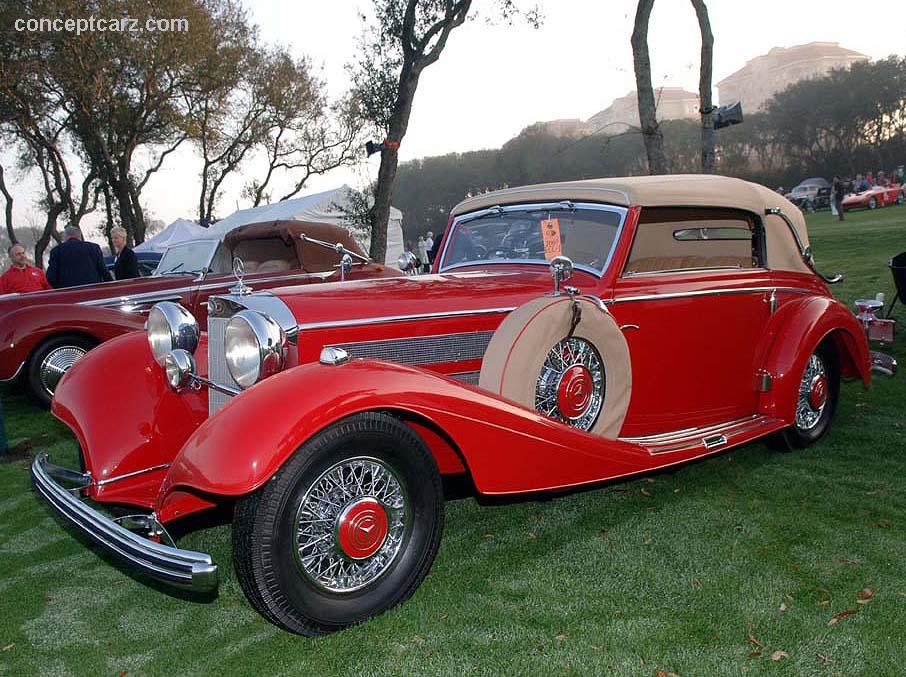
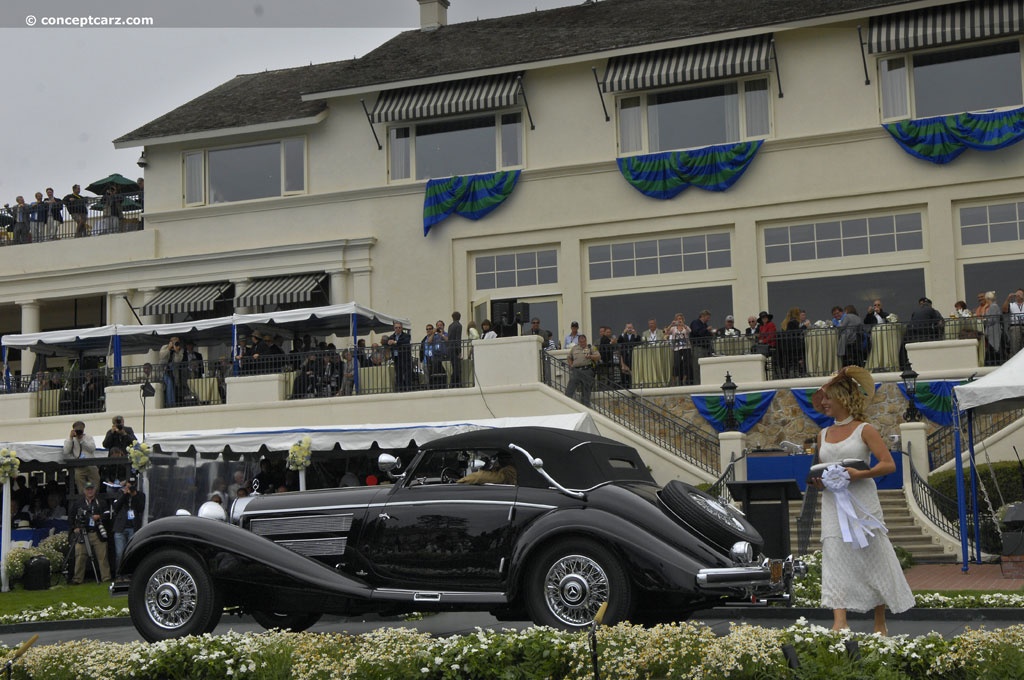
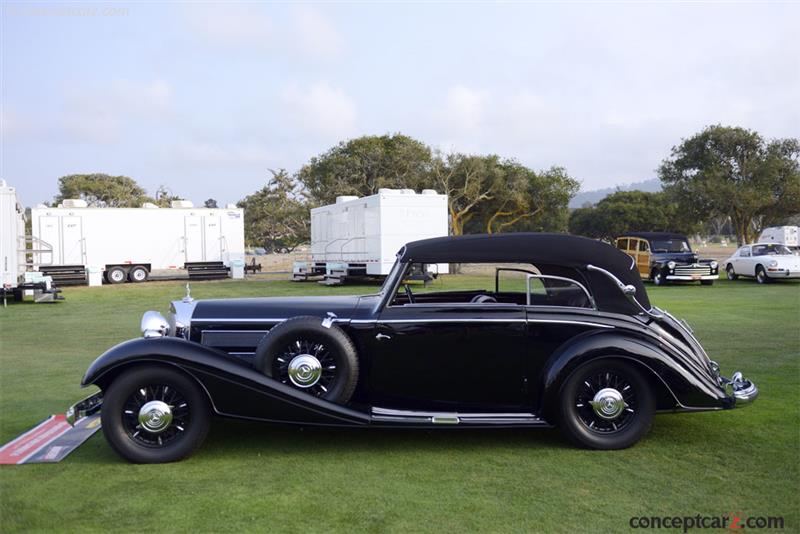
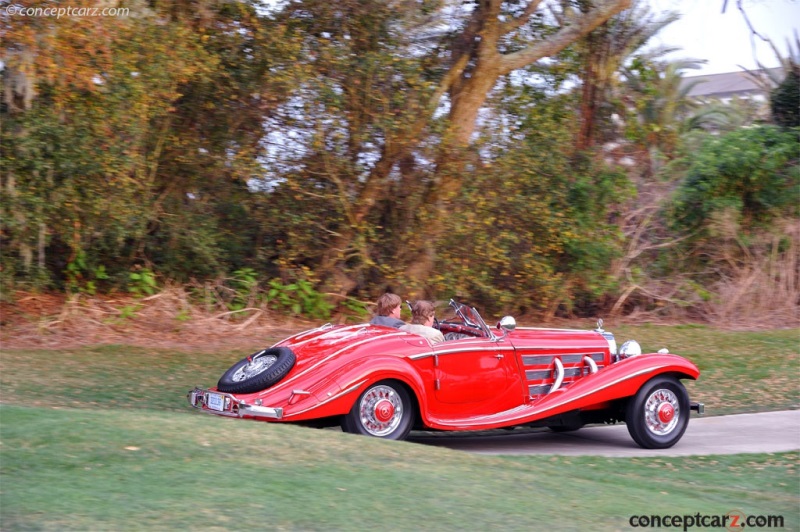
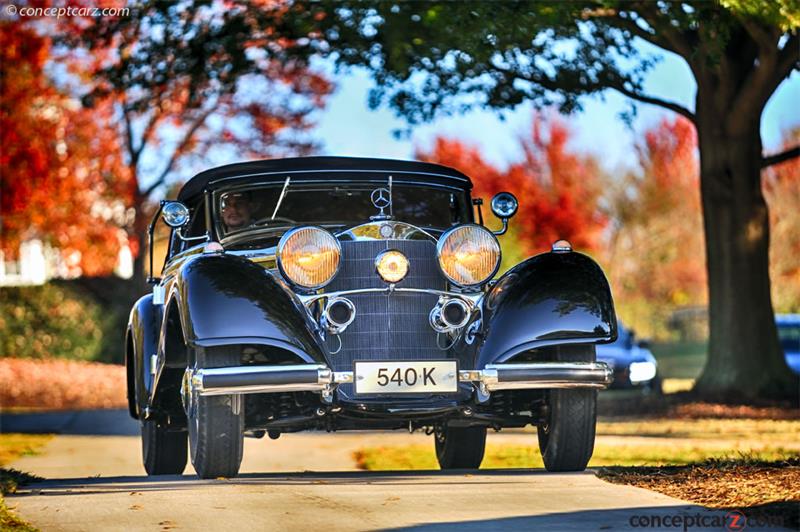
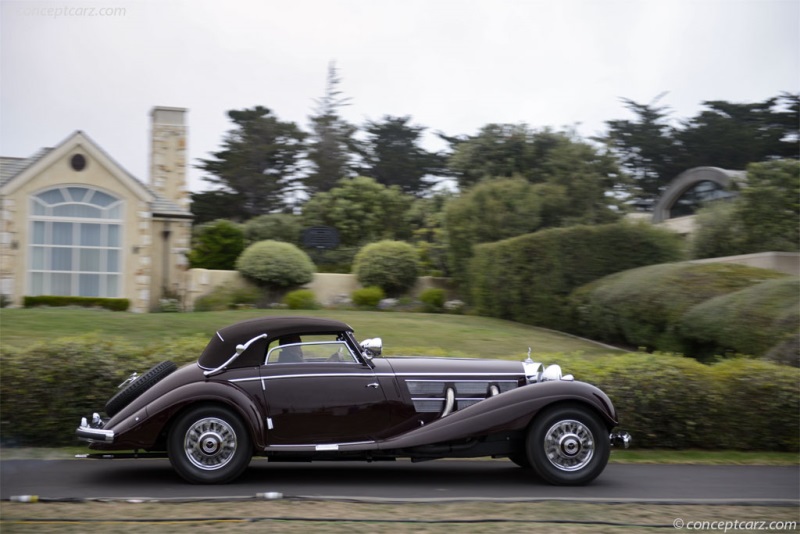
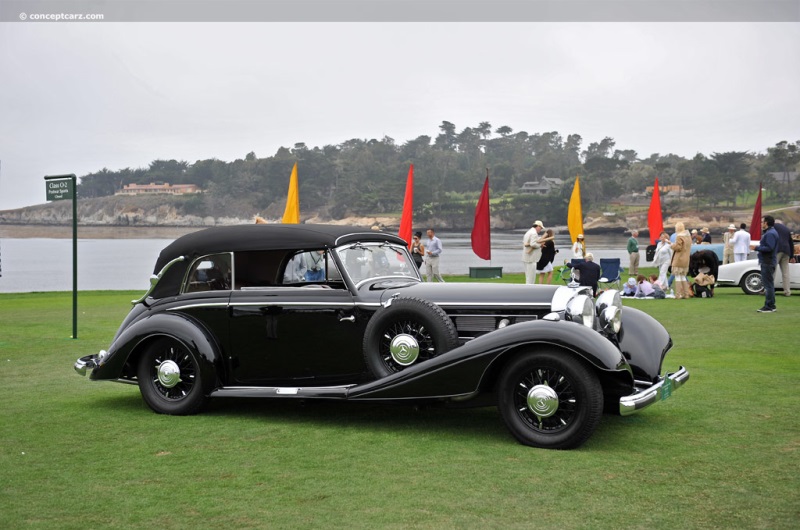
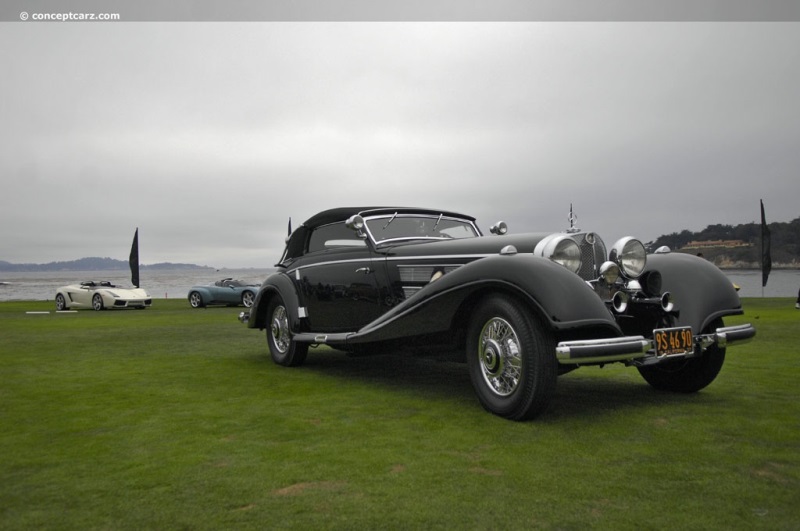
1936 540K | 1936 500K | 1938 540K ![]() |
|
|
|
|
|
|
|
|
|
|
|
|
|
|
|
|
|
|
|
|
|
|
|
|
|
|
1937 Mercedes-Benz 540K news, pictures, and information |
![]() | Roadster |
This was the fastest production automobile of its era.
![]() | ![]() | View more photos Cabriolet C |
![]() | ![]() | View more photos Sport Cabriolet |
![]() | ![]() | View more photos Roadster |
The 'Blue Goose'
On May 4, 1945, The US Army, C Company, 326th Engineers, 101st Airborne Division 'Screaming Eagles' liberated and took possession of this armored 1937 Mercedes Benz 540 K Spezial Roadster at Berchtesgaden in the Bavarian alps. The car had been custom made for Hermann Goring, Reichsmarschall of the Greater German Reich, President of the German Parliament, Commander of the German Air Force and President of the Preussian Council of State. Goring was also a WWI fighter pilot as commander of the Red Baron Squadron.Major General Maxwell Taylor used this Mercedes as his command car in Germany until it was commissioned by the US Treasury Dept, in Washington DC to be displayed on a Victory war bond fund-raising tour across the USA. The bond tour was very successful. Some ten years later the car was auctioned away by the army in Maryland in 1956. It has been stowed away in a private collection since 1958.
This Mercedes Benz 540 K Spezial Roadster has been carefully preserved, with emphasis on keeping as much as possible original. There has been no body off. The engine and transmission have not been opened. The two bullet-marks from a 101'st soldiers rifle shots are still seen on this Trophy of War, shown as of its moment of liberation.
![]() | ![]() | View more photos Cabriolet A Coachwork: Sindelfingen Chassis Num: 232198 Engine Num: 154081 |
![]() | ![]() | Roadster Mayfair Coachwork: Mayfair Carriage Company Ltd. Chassis Num: 154080 |
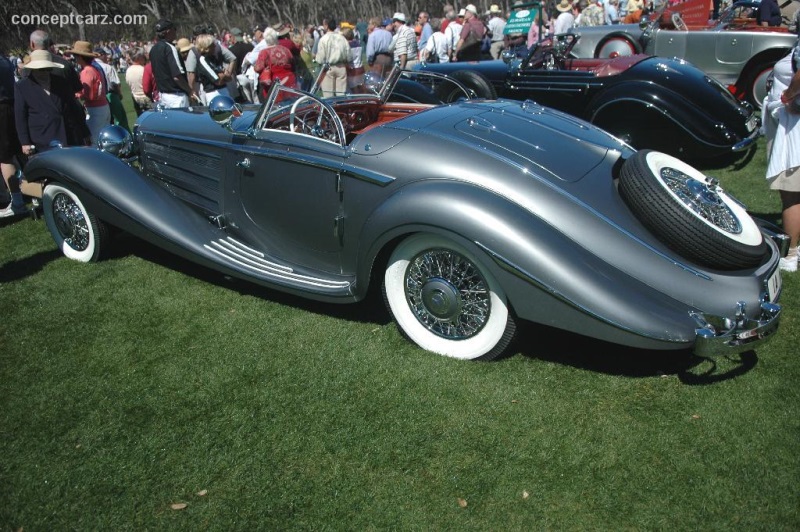
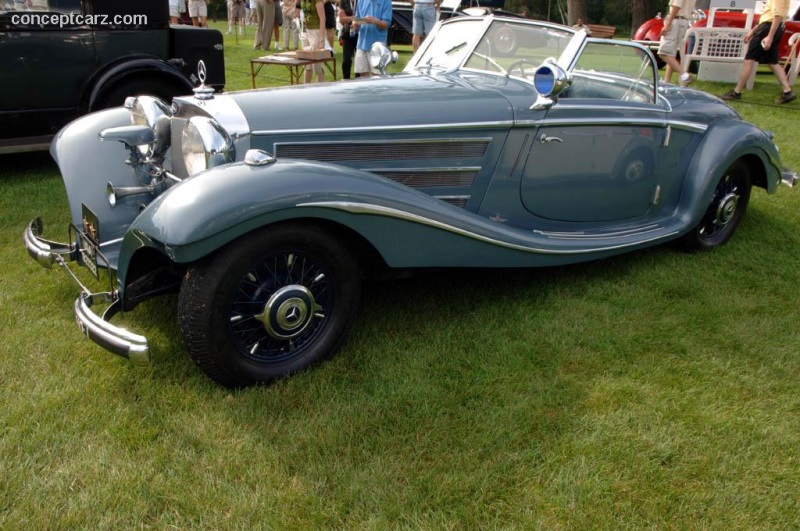
This sporty vehicle has a folding windshield, skirted rear fenders, and extensive use of louvers. It is fitted with an eight-cylinder engine with driver activated and gear driven Rootes type supercharger with twin updraft pressurized carburetors. The result is 180 horsepower which is sent to the rear wheels through a four-speed gearbox with synchromesh on the third and a dog clutch on the fourth gear. Four-wheel servo-assisted hydraulic drum brakes provide the stopping power.
It was shipped from the factory on October 7th of 1936 to the factory store in Paris, France. Paris was an unusual place for a right-hand drive chassis, especially one that would later be fitted with an English body. Some theory's for this unusual situation was that it may have been ordered by a British individual living in Paris who took possession of the chassis then had it sent to the UK for completion. In any case, the early history of the vehicle has been lost to time and the mystery of its early travel to Paris adds to the allure of the vehicle.
The car was brought to North America by a Canadian serviceman. This part of the vehicle's history is also unknown. But by the late 1950s, the car was still in Canada. It was involved in a garage fire but received very little damage. In the early 1960s it was purchased by publisher and collector Richard C. Mertz who had the car brought to America and commissioned a restoration.
In 1984, the restoration was in the process, and Mr. Mertz passed away. The ownership passed to his son, Stephen Mertz, of Royal Oak, Mi.
In 1995 the car was nearing completion but some of the work was over two decades old. The car was sold and purchased by Ralph Englestad of Las Vegas, Nevada. Under his care the restoration was completed, with the work done the vehicle amounting to a second restoration. The color was changed from black over silver to red. Mr. Englestad passed away in 2002 and the car entered the collection of a well-known California enthusiast.
This 540K Special Roadster was brought to the 2007 Monterey Sports & Classic Car Auction presented by RM Auctions, where it had an estimated value of $2,500,000 - $3,000,000. It was one of the highlights of the show and one of the high sales of the day, as the lot was sold for $2,530,000 including buyer's premium.
![]() | ![]() | View more photos Cabriolet A Coachwork: Sindelfingen |
The bodies of the nicest of the Mercedes 540Ks were built by Mercedes in its Sindelfingen plant in Germany. Launched at the Paris Salon in 1936, these supercharged 5.4-liter, 8-cylinder cars were built in many different styles from closed coupes to seven-seat sedans. There were also six different cabriolet designs.
This particular cabriolet was delivered to the Mercedes dealer, Carlo Saporiti, in Milan. It remained there until the mid-fifties. The car changed hands three times before it fell into the hands of racing school owner Skip Barber, in 2001. The current owner purchased the car in 2006 and had the vehicle completely restored.
It is one of 97 examples built at Sindelfingen and one of a very few with left-hand drive. In its day, the 540K Cabriolet A sold for 28,000 Reichsmarks. Sadly Mercedes ceased production of the 540K in 1942.
A total of 406 540s were produced on this chassis from 1936 through 1940. The original price was $7,500 when the average American car of the era sold for $750.
![]() | ![]() | View more photos Roadster |
This car is believed to have been originally delivered to Adolph Eichmann when he resided in Argentina. Later the car was in the United States, Australia, Germany and finally to the present owner in the United States.
The car is powered by a 5.4-liter supercharged, in-line, eight-cylinder engine developing 180 horsepower coupled to an unsynchronized four-speed manual transmission. It has a top speed of 105 MPH and is capable of 0-60 MPH in 16.4 seconds.
The Mercedes-Benz 500K was introduced in 1934 with the 'K' representing a Kompressor which is German for supercharger. In non-aspirated form, the engine produced 100 horsepower. With the adoption of the Kompressor the horsepower jumped to an impressive 160 making them one of the fastest grand touring cars of their time. The vehicles rode on a 116 inch wheelbase.
In 1936 the 540K was introduced which increased power even further. The base version produced 115 horsepower while the supercharged increased horsepower to 180. The engine bay was lengthened and the wheelbase was extended by twelve inches which allowed for more stately and elegant vehicles. Chrome accents were used throughout added to the visual appeal. The vehicles were elegant, powerful, and produced in limited numbers. Production continued until 1940 with only 419 examples being produced.
The Mercedes-Benz were among the most desirable and elegant vehicles of their day. They were constructed of the finest materials available. The craftsmanship is legendary and undeniable excellent. Most of the chassis received coachwork by the Mercedes-Benz in-house coachworks facility named the Sindelfingen Body Works. The others were sent to coachbuilders such as Erdmann & Rossi.
When completed, the vehicles carried a price tag that only few could afford. During World War II many were hidden and protected along with other priceless works-of-art.
Though the 540K models were all built to the same mechanical and chassis configurations, they varied based on their coachwork designs making many unique creations. Configurations varied such as four-seat cabriolets, long-tail roadsters, and high-door luxury styles. The vehicles were tailored to the buyer's requirements and requests.
With production low and craftsmanship at their peak, these vehicles are well sought after in modern times. They continue to win 'Best in Show' and class awards at various concourses throughout the country.
In 1936 the 540K was introduced which increased power even further. The base version produced 115 horsepower while the supercharged increased horsepower to 180. The engine bay was lengthened and the wheelbase was extended by twelve inches which allowed for more stately and elegant vehicles. Chrome accents were used throughout added to the visual appeal. The vehicles were elegant, powerful, and produced in limited numbers. Production continued until 1940 with only 419 examples being produced.
The Mercedes-Benz were among the most desirable and elegant vehicles of their day. They were constructed of the finest materials available. The craftsmanship is legendary and undeniable excellent. Most of the chassis received coachwork by the Mercedes-Benz in-house coachworks facility named the Sindelfingen Body Works. The others were sent to coachbuilders such as Erdmann & Rossi.
When completed, the vehicles carried a price tag that only few could afford. During World War II many were hidden and protected along with other priceless works-of-art.
Though the 540K models were all built to the same mechanical and chassis configurations, they varied based on their coachwork designs making many unique creations. Configurations varied such as four-seat cabriolets, long-tail roadsters, and high-door luxury styles. The vehicles were tailored to the buyer's requirements and requests.
With production low and craftsmanship at their peak, these vehicles are well sought after in modern times. They continue to win 'Best in Show' and class awards at various concourses throughout the country.
Two new – and very different – Mercedes models were displayed at the Berlin Motor Show in March 1934. One was the 130, Mercedes-Benz's first production car with a rear-mounted four-cylinder engine which developed 26 hp from a displacement of 1.3 liters. The other was the 500 K, an imposing, elegant sports car with supercharged eight-cylinder engine; with the supercharger engaged, it developed 160 hp from a displacement of 5,018 cc.
The 500 K was the successor to the 380 presented only one year earlier, and a descendant of the tremendously powerful, supercharged S, SS, SSK and SSKL sports cars – genuine muscle cars, as we would call them today, and virtually invincible in motor sport.
The first 500 K – 'K' for Kompressor = supercharger, to distinguish it from the 500 sedan without supercharger – had been designed as an elegant two- or four-seater sports car with roadster and cabriolet bodies tailored at the Daimler-Benz plant in Sindelfingen. With this model, the company bid farewell to the Roaring Twenties and the Big Four mentioned earlier. The latter had still had extremely firm chassis with rigid axles and leaf springs, i.e. hardly any damping at all, and their bodies were plain and above all functional, not to say uncomfortable.
The new supercharged Mercedes sports car appealed to well-heeled buyers because it was not only powerful but also more elegant, more comfortable and easier to handle than its predecessors – features welcomed in particular by the growing number of lady drivers.
Daimler-Benz had laid the foundations for this type of car as early as 1933 by introducing the 380, the first Mercedes-Benz sports car with swing axle. It was the first car that pampered its occupants with independent wheel suspension; the latter featured a sensational world first, a double-wishbone front axle that combined with the double-joint swing axle introduced in the 170 as early as 1931.
In this ground-breaking design, wheel location, springing and damping were for the first time separated from each other, creating a new level of precision in straightline stability. In its essence, this front axle, fitted like the rear axle with coil springs, has remained the design model for generations of automobiles throughout the world to this day, and it also featured in the 500 K, of course.
It was the customers' craving for power, however, that prompted the replacement of the 380, not exactly a lame duck with its supercharged 140 hp, by the 500 K only one year later. The newcomer's engine generated 160 hp with the supercharger engaged; even without the supercharger in action, it still had an impressive output of 100 hp at 3400 rpm. Depending on fuel quality, which varied greatly in those days, the compression ratio was between 1:5.5 and 1:6.5. The fuel was apportioned to the cylinders by a Mercedes-Benz double updraught carburetor. The driver engaged the double-vane Roots supercharger by depressing the accelerator pedal beyond a pressure point.
With the exception of first gear, both the standard four-speed and the optional five-speed transmissions were synchronized. A single-plate dry clutch linked the engine with the powertrain which transmitted engine power to the rear wheels. The car rolled along on wire-spoke wheels which were as elegant as they were robust.
All these features combined to permit a top speed of 160 kilometers per hour – a dream for sports cars in that day and age. The penalty was paid in the form of fuel consumption: between 27 and 30 liters were blown through the carburetor on 100 kilometers. The 110-liter tank in the rear gave the car a decent radius of action.
To meet the individual wishes of the demanding customers, three chassis variants were available for the 500 K: two long versions with a 3,290 millimeter wheelbase, differing in terms of powertrain and bodywork layout, and a short version with 2,980 millimeters.
The long variant, the so-called normal chassis with the radiator directly above the front axle, served as the backbone for the four-seater cabriolets 'B' (with four side windows) and 'C' (with two side windows) and, at a later stage, also for touring cars and sedans.
The roadsters, the two-seater cabriolet 'A' (with two side windows) and the ultra-modern, streamlined Motorway Courier, the first car with curved side windows and classified by the manufacturer as a sports sedan, were set up on a chassis on which radiator, engine, cockpit and all rearward modules were moved 185 millimeters back from the front axle. This configuration was a concession to the zeitgeist, a small trick that created the visual impression of a particularly long front-end and, therefore, the desired sporting appeal.
The most ravishing model of this species was the two-seater 500 K special roadster launched in 1936, a masterpiece in terms of its styling, with inimitably powerful and elegant lines. It has been filling onlookers with enthusiasm to this day, reflecting, as it does, the spirit of its day and age as well as the design perfection of the 500 K models. Its price tag – 28,000 Reichsmark – was 6,000 marks above the average price of 'simpler' models. People were able to buy a generously furnished house for that money.
The short-wheelbase chassis was used only for a few two-seaters with special bodies. On these models, the radiator was back right above the front axle, and the models carried the designations 500 K sports roadster, sports cabriolet and sports coupe.
The 500 K's chassis complete with helical-spindle steering had been adopted – though in further refined form – from the preceding 380: the new double-wishbone axle with coil springs at the front and the double-joint swing axle - complemented by double coil springs and additional transverse balancing spring – at the rear. The vacuum-boosted service brake acted hydraulically on all four wheels, the mechanical parking brake on the rear wheels. The chassis weighed as much as 1,700 kilograms; the complete car tipped the scales at 2,300 kilograms and the permissible gross weight was around 2,700 kilograms.
No matter what version of the 500 K you look at, the elegance of its body sends people into raptures even today: every single one had been given its own, unparalleled personality by the ingenious coachbuilders in Sindelfingen. Only few customers opted for bodywork tailored by independent bodybuilders to their own wishes (the price lists quoted the chassis as individual items), especially since the Sindelfingers rose above themselves in accommodating the customers' special wishes, for instance for individual fender versions, rear-end designs or interior appointments. Within two years, 342 units of the 500 K were produced.
In response to the virtually insatiable craving for performance on the part of well-heeled customers all over the world, the 500 K was replaced in 1936 by the 540 K with supercharged 180 hp engine. This model was sold to 319 motoring enthusiasts.
The history of supercharged Mercedes-Benz cars goes back to World War II and has its roots in aeroengine production. Daimler-Motoren-Gesellschaft had introduced mechanical air compressors which supercharged the engines and thereby compensated for the power loss of aeroengines at higher altitudes, ensuring their stable performance.
The first Mercedes models with supercharged engines were displayed at the Berlin Motor Show in 1921 – between bicycles with auxiliary engines and mini-cars. They caused quite a stir among automotive experts. With the supercharger, an engine booster had been introduced which, from 1926, catapulted Mercedes passenger, sports and racing cars into a new dimension of performance.Source - Mercedes-Benz
For more information and related vehicles, click here© 1998-2010. All rights reserved. The material may not be published, broadcast, rewritten, or redistributed.
The 500 K was the successor to the 380 presented only one year earlier, and a descendant of the tremendously powerful, supercharged S, SS, SSK and SSKL sports cars – genuine muscle cars, as we would call them today, and virtually invincible in motor sport.
The first 500 K – 'K' for Kompressor = supercharger, to distinguish it from the 500 sedan without supercharger – had been designed as an elegant two- or four-seater sports car with roadster and cabriolet bodies tailored at the Daimler-Benz plant in Sindelfingen. With this model, the company bid farewell to the Roaring Twenties and the Big Four mentioned earlier. The latter had still had extremely firm chassis with rigid axles and leaf springs, i.e. hardly any damping at all, and their bodies were plain and above all functional, not to say uncomfortable.
The new supercharged Mercedes sports car appealed to well-heeled buyers because it was not only powerful but also more elegant, more comfortable and easier to handle than its predecessors – features welcomed in particular by the growing number of lady drivers.
Daimler-Benz had laid the foundations for this type of car as early as 1933 by introducing the 380, the first Mercedes-Benz sports car with swing axle. It was the first car that pampered its occupants with independent wheel suspension; the latter featured a sensational world first, a double-wishbone front axle that combined with the double-joint swing axle introduced in the 170 as early as 1931.
In this ground-breaking design, wheel location, springing and damping were for the first time separated from each other, creating a new level of precision in straightline stability. In its essence, this front axle, fitted like the rear axle with coil springs, has remained the design model for generations of automobiles throughout the world to this day, and it also featured in the 500 K, of course.
It was the customers' craving for power, however, that prompted the replacement of the 380, not exactly a lame duck with its supercharged 140 hp, by the 500 K only one year later. The newcomer's engine generated 160 hp with the supercharger engaged; even without the supercharger in action, it still had an impressive output of 100 hp at 3400 rpm. Depending on fuel quality, which varied greatly in those days, the compression ratio was between 1:5.5 and 1:6.5. The fuel was apportioned to the cylinders by a Mercedes-Benz double updraught carburetor. The driver engaged the double-vane Roots supercharger by depressing the accelerator pedal beyond a pressure point.
With the exception of first gear, both the standard four-speed and the optional five-speed transmissions were synchronized. A single-plate dry clutch linked the engine with the powertrain which transmitted engine power to the rear wheels. The car rolled along on wire-spoke wheels which were as elegant as they were robust.
All these features combined to permit a top speed of 160 kilometers per hour – a dream for sports cars in that day and age. The penalty was paid in the form of fuel consumption: between 27 and 30 liters were blown through the carburetor on 100 kilometers. The 110-liter tank in the rear gave the car a decent radius of action.
To meet the individual wishes of the demanding customers, three chassis variants were available for the 500 K: two long versions with a 3,290 millimeter wheelbase, differing in terms of powertrain and bodywork layout, and a short version with 2,980 millimeters.
The long variant, the so-called normal chassis with the radiator directly above the front axle, served as the backbone for the four-seater cabriolets 'B' (with four side windows) and 'C' (with two side windows) and, at a later stage, also for touring cars and sedans.
The roadsters, the two-seater cabriolet 'A' (with two side windows) and the ultra-modern, streamlined Motorway Courier, the first car with curved side windows and classified by the manufacturer as a sports sedan, were set up on a chassis on which radiator, engine, cockpit and all rearward modules were moved 185 millimeters back from the front axle. This configuration was a concession to the zeitgeist, a small trick that created the visual impression of a particularly long front-end and, therefore, the desired sporting appeal.
The most ravishing model of this species was the two-seater 500 K special roadster launched in 1936, a masterpiece in terms of its styling, with inimitably powerful and elegant lines. It has been filling onlookers with enthusiasm to this day, reflecting, as it does, the spirit of its day and age as well as the design perfection of the 500 K models. Its price tag – 28,000 Reichsmark – was 6,000 marks above the average price of 'simpler' models. People were able to buy a generously furnished house for that money.
The short-wheelbase chassis was used only for a few two-seaters with special bodies. On these models, the radiator was back right above the front axle, and the models carried the designations 500 K sports roadster, sports cabriolet and sports coupe.
The 500 K's chassis complete with helical-spindle steering had been adopted – though in further refined form – from the preceding 380: the new double-wishbone axle with coil springs at the front and the double-joint swing axle - complemented by double coil springs and additional transverse balancing spring – at the rear. The vacuum-boosted service brake acted hydraulically on all four wheels, the mechanical parking brake on the rear wheels. The chassis weighed as much as 1,700 kilograms; the complete car tipped the scales at 2,300 kilograms and the permissible gross weight was around 2,700 kilograms.
No matter what version of the 500 K you look at, the elegance of its body sends people into raptures even today: every single one had been given its own, unparalleled personality by the ingenious coachbuilders in Sindelfingen. Only few customers opted for bodywork tailored by independent bodybuilders to their own wishes (the price lists quoted the chassis as individual items), especially since the Sindelfingers rose above themselves in accommodating the customers' special wishes, for instance for individual fender versions, rear-end designs or interior appointments. Within two years, 342 units of the 500 K were produced.
In response to the virtually insatiable craving for performance on the part of well-heeled customers all over the world, the 500 K was replaced in 1936 by the 540 K with supercharged 180 hp engine. This model was sold to 319 motoring enthusiasts.
The history of supercharged Mercedes-Benz cars goes back to World War II and has its roots in aeroengine production. Daimler-Motoren-Gesellschaft had introduced mechanical air compressors which supercharged the engines and thereby compensated for the power loss of aeroengines at higher altitudes, ensuring their stable performance.
The first Mercedes models with supercharged engines were displayed at the Berlin Motor Show in 1921 – between bicycles with auxiliary engines and mini-cars. They caused quite a stir among automotive experts. With the supercharger, an engine booster had been introduced which, from 1926, catapulted Mercedes passenger, sports and racing cars into a new dimension of performance.Source - Mercedes-Benz
| Vehicle Spotlight |
![]() | ![]() | ![]() | ![]() | ![]() | ![]() |
![]() | ![]() | ![]() | ![]() | ![]() | ![]() |
![]() | ![]() | ![]() | ![]() | ![]() | ![]() |
![]() | ![]() | ![]() | ![]() | ![]() | ![]() |
![]() |
1937
Mercedes-Benz
models |
| Mercedes-Benz 290 L |
| Mercedes-Benz Type 320 |
| Mercedes-Benz: 1931-1940 |
| Similar Automakers |
| Other models by Mercedes-Benz |
| Manufacturer Website |
| Similar Automakers | |
| Audi | |
| BMW | |
| Infiniti | |
| Jaguar | |
| Land Rover | |
| Lexus | |
| Similarly Sized Vehicles from 1937 |
| Rolls-Royce Phantom III |
| Similarly Priced Vehicles from 1937 |
| Cadillac Series 90 V16 ($7,355-$7,955) |
| ||||||||||||||||||||||||||||||||||||||||||||


1936 540K


1937