History
H.F.S. Morgan created a three-wheeled runabout with seating for one in 1909. Morgan created the vehicle for his own personal use and to meet his needs. Interest in the little vehicle soon spread and requests were made to produce more examples. After patenting his designs, production commenced. The early examples were mostly powered by a single-cylinder engine; a twin-cylinder version soon followed.
Morgan's first three-wheeler was powered by a 7 horsepower Peugeot engine which was more than adequate to carry the lightweight vehicle. It was built atop a rigid frame and given an independent front suspension.
Two examples were shown at the 1911 Olympia Motor Show. One example was powered by a single-cylinder engine which created about 4 horsepower. The second example had a twin-cylinder J.A.P. engine which doubled the horsepower of the single-cylinder unit. The cars were alluring and attracted much attention, but it soon became obvious that a two-seater would be more marketable.
The following year, the two-seater examples were on display and generated more work than Morgan could handle. To meet the demand, Morgan purchased the necessary machining tools and built larger facilities.
The cars endured much success in races and hill-climbs. After witnessing the success the nimble vehicles achieved, racing enthusiasts were eager to get one for their own. Around 1913, Morgan produced special derivations of his Morgan cycle cars for racing, which were longer and had the seat set lower into the chassis. After McMinnies was victorious at the Cyclecar Grand Prix at Amiens with the specially prepared cyclecar, the vehicle was given the designation 'Grand Prix'.
The next iteration of the Morgan cyclecar was a four-seater version, which Morgan had created for his family's use. Once again, the idea seemed appropriate and soon versions were being made for sale and would continue until 1937.
For many years, the Morgans featured two speeds and a two-chain drive. The engines were from motorcycles, placed in the front, and were either air-cooled or liquid-cooled. Little improvements were needed or made to the vehicle for most of its lifespan. Modern amenities such as starters and electric lamps found their way onto the vehicles, but in terms of the chassis, little changed. During the turn of the 1930s, a three-speed version with one chain drive was introduced.
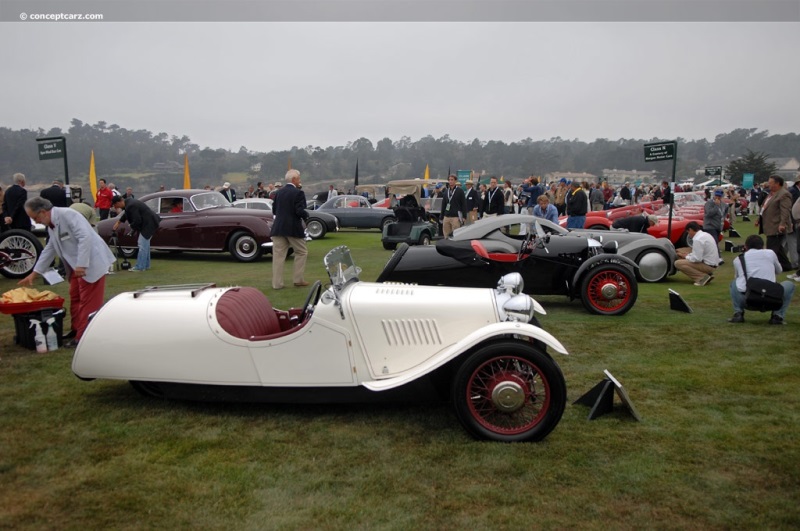
The F-Series was introduced in 1932 and would stay in production until 1952. These versions had four-cylinder engines courtesy of Ford and a press-steel chassis. Other variations of this design were created during this time, including the F-2 and F-Super.
By Daniel Vaughan | Sep 2007
Morgan's first three-wheeler was powered by a 7 horsepower Peugeot engine which was more than adequate to carry the lightweight vehicle. It was built atop a rigid frame and given an independent front suspension.
Two examples were shown at the 1911 Olympia Motor Show. One example was powered by a single-cylinder engine which created about 4 horsepower. The second example had a twin-cylinder J.A.P. engine which doubled the horsepower of the single-cylinder unit. The cars were alluring and attracted much attention, but it soon became obvious that a two-seater would be more marketable.
The following year, the two-seater examples were on display and generated more work than Morgan could handle. To meet the demand, Morgan purchased the necessary machining tools and built larger facilities.
The cars endured much success in races and hill-climbs. After witnessing the success the nimble vehicles achieved, racing enthusiasts were eager to get one for their own. Around 1913, Morgan produced special derivations of his Morgan cycle cars for racing, which were longer and had the seat set lower into the chassis. After McMinnies was victorious at the Cyclecar Grand Prix at Amiens with the specially prepared cyclecar, the vehicle was given the designation 'Grand Prix'.
The next iteration of the Morgan cyclecar was a four-seater version, which Morgan had created for his family's use. Once again, the idea seemed appropriate and soon versions were being made for sale and would continue until 1937.
For many years, the Morgans featured two speeds and a two-chain drive. The engines were from motorcycles, placed in the front, and were either air-cooled or liquid-cooled. Little improvements were needed or made to the vehicle for most of its lifespan. Modern amenities such as starters and electric lamps found their way onto the vehicles, but in terms of the chassis, little changed. During the turn of the 1930s, a three-speed version with one chain drive was introduced.
The F-Series was introduced in 1932 and would stay in production until 1952. These versions had four-cylinder engines courtesy of Ford and a press-steel chassis. Other variations of this design were created during this time, including the F-2 and F-Super.
By Daniel Vaughan | Sep 2007
Similar Automakers
Similarly Sized Vehicles
from 1947


1947 Morgan F-Super Vehicle Profiles

Recent Vehicle Additions


Performance and Specification Comparison
F-Series Specification Comparison by Year
Year
Production
Wheelbase
Engine
Prices
Related Automotive News

THIRD-GENERATION HYUNDAI TUCSON DELIVERS SPORTY LOOKS AND HIGH REFINEMENT
FOUNTAIN VALLEY, Calif., July 13, 2015 – The all-new 2016 Hyundai Tucson arrives in dealerships this month offering an edgy exterior design, a pair of fuel efficient drivetrains and a stylish interior that is roomier than its predecessor. A host...

FORD RACING INTRODUCES KING COBRA PARTS PACKAGE FOR 2015 FORD MUSTANG GT
New King Cobra parts package 2015 Mustang GT concept unveiled at SEMA Show.
King Cobra package can be replicated by any Mustang owner with the help of Ford Racings extensive parts catalog.
Highlights Ford Racings first performance packages ava...

2015 K900 OVERVIEW
Modern and Elegant, the K900 Signals a New Era for Kia and Advances the Brand to New Levels of Sophistication
Highly intuitive and advanced technology combine with superb craftsmanship and materials to boldly announce Kias entry into the rea...

DUTCH SUPERCAR MAKER VENCER TO REVEAL STUNNING ‘SARTHE' AT SALON PRIVÉ 2013
Salon Privé 2013 from Wednesday to Friday the 4th to 6th September
Syon Park, London, 10 June 2013 – Salon Privé confirms Dutch super car manufacturer Vencer will reveal the Sarthe to the UK for the first time in the stunning grounds o...
2013 KIA SOUL WINS ACTIVE LIFESTYLE VEHICLE OF THE YEAR AWARD IN URBAN CATEGORY
Hip Hatchback Earns Praise for Its Roomy Interior and Cargo Space
With 19 cubic feet of cargo space, 14 storage zones and fold down seats, the Soul can accommodate mountain bikes, snowboarding gear and other outdoor necessities
The Souls fun-to...