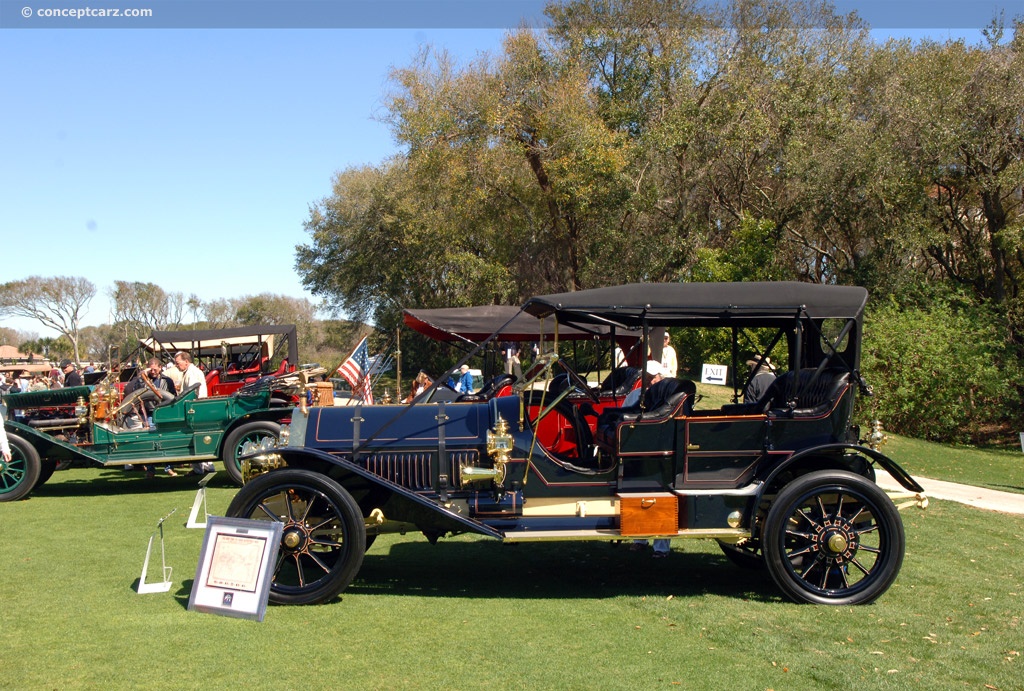
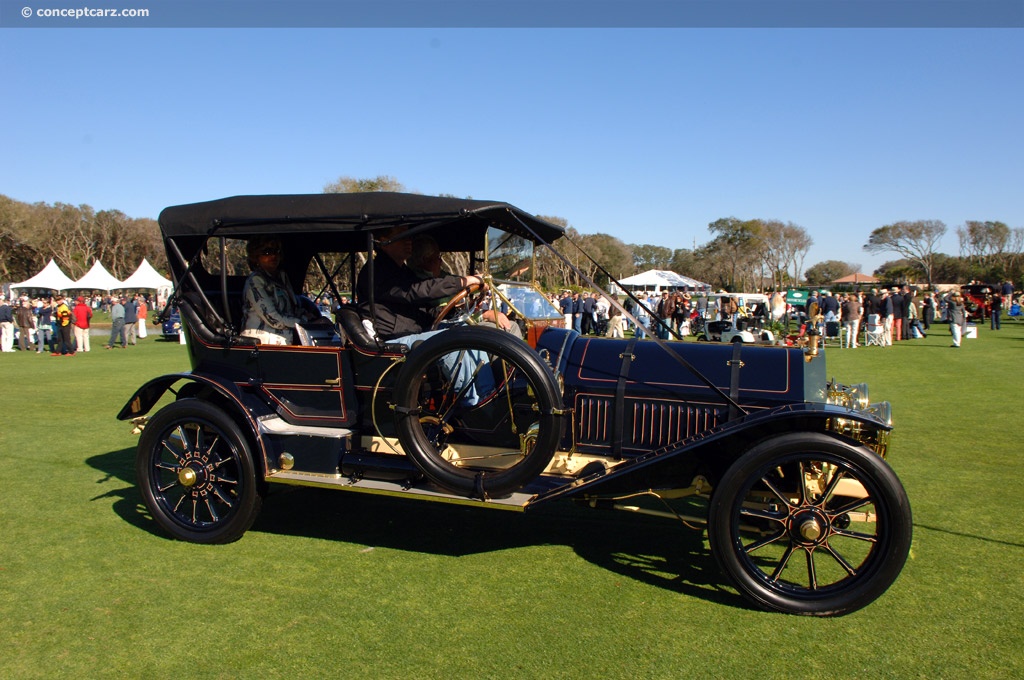
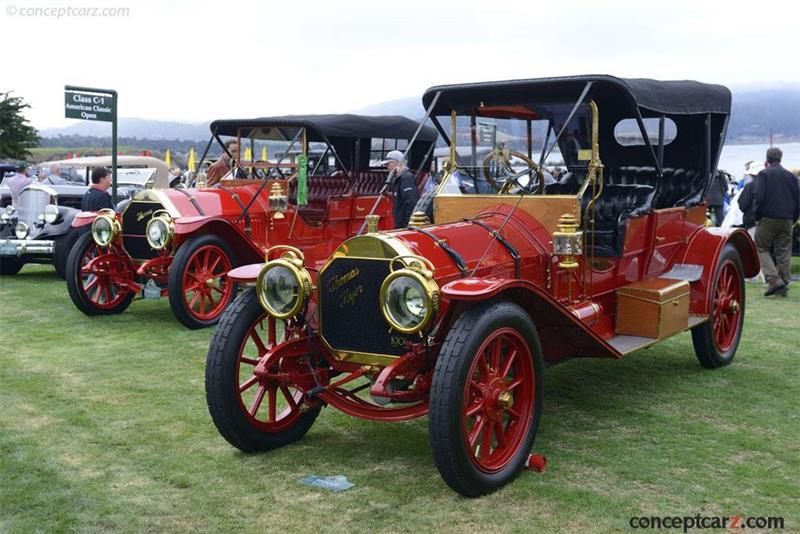
The Thomas, named after the firm's founder Edwin Ross Thomas, actually began as the Buffalo Automobile in 1902. It received a name change the following year once E.R. Thomas was sure the cars merited carrying his name.
Touring
View info and historyLike so many of his pioneering contemporaries, Mr. Thomas was in the bicycle business prior to manufacturing automobiles. During the 1890s, he was the managing director for H. A. Lozier & Co., which produced the famous Cleveland bicycle. He later left Lozier to take over the Buffalo Automobile and Auto-Bi Company, which was known for its production of bicycles and motorcycle engines. In 1900 E. R. changed the company name to Thomas Auto-Bi, and by 1901 Thomas claimed to build more air-cooled motors than anyone else. In 1903, the first Thomas automobiles were introduced. They were small runabouts described in the catalog as the happy medium between the cheaper and more expensive cars. By 1905 the Thomas Company was building bigger four-cylinder cars dubbed 'Thomas Flyers.' His cars were often finished in bright colors and loaded with many ornate brass accessories. The 1907 sales catalogue boasted, 'You can't go by a Thomas Flyer, so go buy one!' In 1908, a stock Thomas Flyer gained worldwide acclaim for winning the famed 'New York to Paris Race' when it circled the globe in 171 days. Car sales, which had always been good among the wealthy, increased greatly until E.R. Thomas sold the firm in 1911.
Touring
View info and historyNotably, it was said that Thomas died without ever learning to drive!The Great Race, sponsored by Le Matin, went from New York in the dead of winter, across the United States, to San Francisco. Travels continued aboard a ship to Alaska, and across the Bering Strait, either by ship or by ice to Siberia. To be certain that the Yukon and the Bering Strait would be covered in ice, the race purposely began in the winter. Many of the dirt-covered trails had never been traveled by a motorcar. The decision for a Thomas automobile to contest the race was a last-minute decision. It was made three days prior to the start. A stock 1907 model was selected from the factory lot. 13,341 miles and 171 days later, the victorious Thomas rolled into Paris and forever cemented its place in history.
Touring
View info and historyAs the 1910s were coming to a close, Thomas moved into the six-cylinder territory. Thomas simply extended their existing four with two extra cylinders. The large 5.5-inch bore resulted in a 12.9-liter displacement and produced more than 70 horsepower. At this point in history, this was by far the largest engine available and remains one of the largest engines ever to be fitted to an American production automobile. The new 'six' was given the designation Model K or 6-70, and Thomas priced it at $6,000 in Touring form, with options of Seven Passenger Touring, 'Tourabout' or 'Flyabout.' The Flyabout was by far the most sporting and effectively a Thomas branding for a 'Toy Tonneau.'
by Daniel Vaughan | Aug 2019
Touring
View info and history
Touring
View info and history

Touring
View info and history
by Daniel Vaughan | Aug 2019
Related Reading : Thomas 6-70 History
The Erwin Ross (E.R.) Thomas Motor Company produced automobiles from 1902 through 1919 in Buffalo, New York. The first cars produced by the company appeared in 1903 and were mostly small runabouts with seating for two. The company had begun like so many other automobile manufacturing firms at the time - through a bicycle business. Thomas had been building bicycles for several companies before making....
Continue Reading >>
Continue Reading >>


1909 Thomas Flyer K6-70 Vehicle Profiles


Recent Vehicle Additions


Performance and Specification Comparison
Price Comparison
6-70 Specification Comparison by Year
Year
Production
Wheelbase
Engine
Prices
Related Automotive News

Hidden For Four Decades - BMW 507 Sells For $2.3 Million At Bonhams Audrain Concours Auction
A rare example of BMWs glamorous Fifties flagship sportscar, a 1957 BMW 507 Series II Roadster, which had been hidden in a Philadelphia garage for more than four decades, stole the limelight in the Bonhams Audrain Concours Auction on Friday (September...

Remarkable Classic Car Collection from the Dean Edmonds Estate Consigned to Amelia Island Auction
Rare and exquisite Bugatti Type 55 leads impressive collection Final consignments being accepted for March sale
Bonhams is delighted to announce a major collection for this years Amelia Island Auction – a dozen cars from the Estate of Dean...

Renowned Don C. Boulton Collection Of Brass Era Automobiles Heads To Amelia Island
Bonhams is very pleased to announce the sale of the Don C. Boulton Collection of two dozen Pioneer, Veteran and Brass Era automobiles and automobilia at the Amelia Island Auction on March 7th.
The late Don Boulton of Oklahoma City was renowned for...

Fascinating Early and Classic Era American Collections Set for RM Sotheby's Hershey Sale
RM Sothebys brings two private collections rich in automotive history to its annual Hershey sale, October 8-9 in Pennsylvania
Auction headlined by the Richard Roy Estate Collection, 25 automobiles with strong New Jersey and Pennsylvania ties
E...

PEBBLE BEACH AWARD-WINNING COACHBUILT FERRARI LEADS IMPRESSIVE STABLE OF PRANCING HORSES CONSIGNED FOR BONHAMS QUAIL LODGE AUCTION
Select consignments are now being accepted to join the confirmed roster of top-tier entries
Bonhams renowned mid-August auction at Quail Lodge in Carmel, California, just added another star to its constellation of consignments a 1951 Ferrari...