1936 Delahaye Type 135
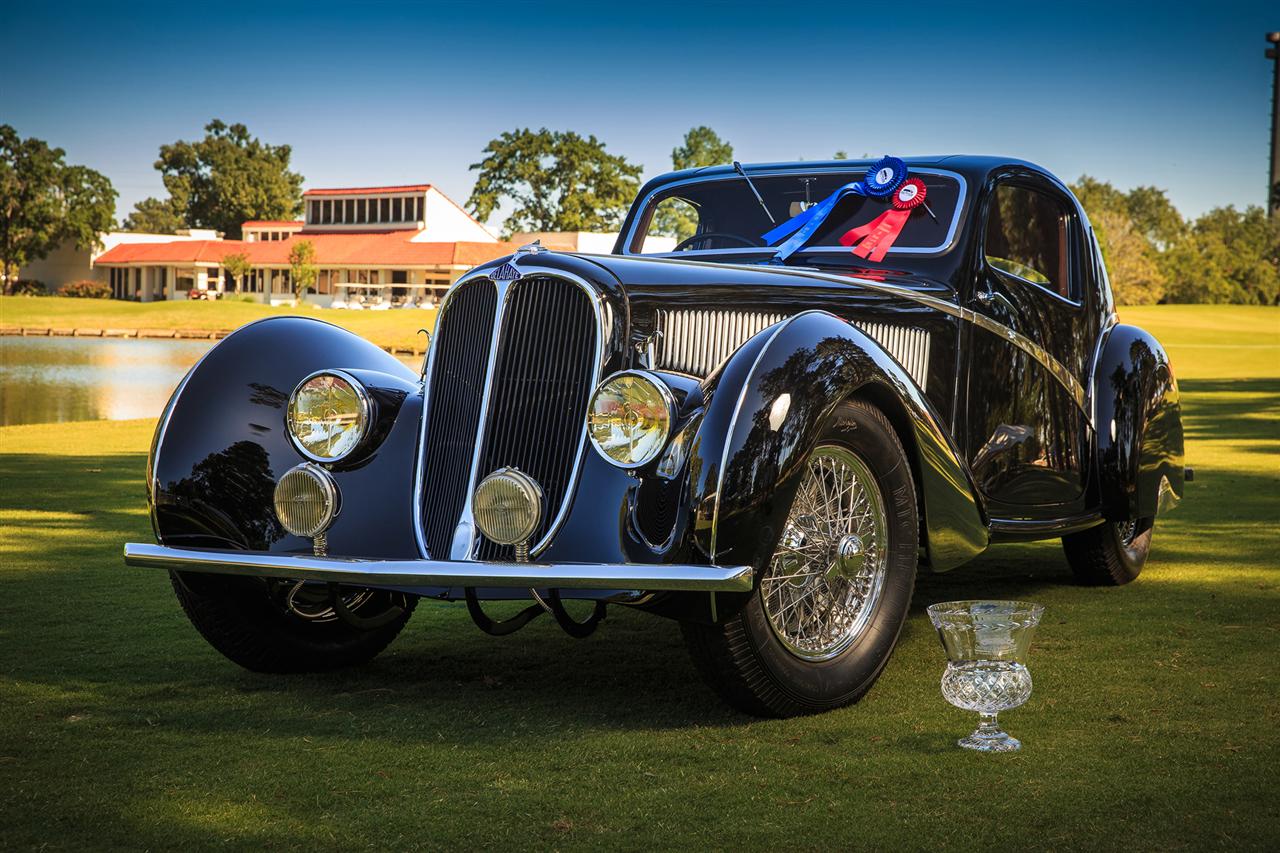
1936 Delahaye Type 135 Navigation
Emile Delahaye was one of the select few to exhibit in 1894 at the Paris Motor Show. Two years later, he entered the Paris-Marseille-Paris race and finished the 1,710km event in tenth place overall. Patronage from the Duchess d'Uzes brought further notoriety to Automobiles Delahaye, and in 1898, with financial backing from customer Georges Morane and his brother-in-law Leon Desmarais, the company was relocated to Paris. Also in 1898, Charles Weiffenbach was appointed Factory Director, and Amedee Varlet became Chief Engineer.
In 1901, Emile Delahaye retired from the automobile business, and the following year, the marque ceased its road racing activities. They continued their powerboat racing which was powered by the Amedee Varlet-designed double overhead camshaft marine powerplant which captured the Walter Speed Record. Other ingenious designs would follow, including the engine found in the Delahaye Type 44, which was produced from 1911 through 1914. It had a patent-protected narrow-angle V6 engine mated to a four-speed manual transmission.
The Delahaye vehicles during the 1920s were positioned as mid-priced vehicles as Charles Weiffenbach worked to establish the company as France's premiere commercial vehicle manufacturer. The Great Depression of the 1930s brought a decline in private sales. Some manufacturers turned their attention to municipal contracts which added competition for Delahaye. In response, Delahaye chose to go after the luxury car and sports sectors.
Engineer Jean Francois was tasked by Monsieur Charles (Charles Weiffenbach) to create a new Delahaye. The result of his work was displayed in October of 1933 at the Paris Salon. They were the Types 134 and 138 powered by an 18CV (3.2-litre) six-cylinder engine. One example, a Type 138 18CV Speciale with coachwork by Joseph Figoni, would capture four world and eleven international class records at Montlhery in 1934. The following year, a Type 138 driven by Michel Paris and Marcel Mongin claimed fifth place overall (2nd-in-class) at the Le Mans 24-hours.
At the 1935 Paris Salon, Delahaye introduced the Type 135. In comparison to its predecessors, it was lower-slung with box-section side rails and two cross members. It had a steel transmission tunnel, welded-in floor panels, independent front suspension comprised of a lower transverse leaf spring, and upper wishbones allied to longitudinal torque arms. The rear setup was a live axle supported by semi-elliptic leaf springs mounted outside the main chassis rails. There was a high-geared worm and sector steering and large cable-operated drum brakes with Bendix self-wrapping shoes. The Type 135 evolved further with the 96-horsepower Sport, 110-horsepower Coupe des Alpes, and 120-horsepower Competition models constructed on several wheelbase sizes. The shortest platform measured 2.70m while the longest was 3.15m.
The Type 135 Special was the recipient of the Competition Court short chassis with a reworked version of the Competition's 20CV, 3.6-liter engine. Eighteen examples were built between late 1935 and 1937, and it is believed that around thirteen remain in existence. As was customary at the time, Delahaye initially only provided the bare chassis. Thus, no two bodies were identical.
The Type 135 Special claimed numerous victories and racing successes during its competition career. It finished in 2nd through 5th place at the 1936 Grand Prix de 'lA.C.F., along with 7th, 11th, and 12th place. It was 2nd and 3rd at Spa 24-Hours and 1st at both the Coupe d'Automne and Mount Ventoux. The following year, it was third at the Grand Prix de Pau and at the Mille Miglia. At the LeMans 24 Hour race, it finished 2nd and 3rd, followed by a 1st at Donnington 12-hours. It was fifth at the RAC Tourist Trophy, and a 1st and 2nd place finish at the Coupe d'Automne.
For the 1938 season, it finished 1st, 2nd, and 4th at LeMans, and 2nd and 3rd at Paris 12 Hours. It earned 1st in class at the Grand Prix des Frontieres and 1st overall at the Cote Lapize.
Part of the success of the Delahaye is attributed to the merger with Delage, which occurred just after the introduction of the Type 135. With this union, Delahaye inherited many of the marque's wealthy clients who were seeking an elegant and sporty automobile. The Type 135 was a suitable solution, with its agile chassis, 120 horsepower six-cylinder engine fitted with triple-Solex downdraft carburetors, and four-speed manual transmission.
by Daniel Vaughan | Sep 2019
In 1901, Emile Delahaye retired from the automobile business, and the following year, the marque ceased its road racing activities. They continued their powerboat racing which was powered by the Amedee Varlet-designed double overhead camshaft marine powerplant which captured the Walter Speed Record. Other ingenious designs would follow, including the engine found in the Delahaye Type 44, which was produced from 1911 through 1914. It had a patent-protected narrow-angle V6 engine mated to a four-speed manual transmission.
The Delahaye vehicles during the 1920s were positioned as mid-priced vehicles as Charles Weiffenbach worked to establish the company as France's premiere commercial vehicle manufacturer. The Great Depression of the 1930s brought a decline in private sales. Some manufacturers turned their attention to municipal contracts which added competition for Delahaye. In response, Delahaye chose to go after the luxury car and sports sectors.
Engineer Jean Francois was tasked by Monsieur Charles (Charles Weiffenbach) to create a new Delahaye. The result of his work was displayed in October of 1933 at the Paris Salon. They were the Types 134 and 138 powered by an 18CV (3.2-litre) six-cylinder engine. One example, a Type 138 18CV Speciale with coachwork by Joseph Figoni, would capture four world and eleven international class records at Montlhery in 1934. The following year, a Type 138 driven by Michel Paris and Marcel Mongin claimed fifth place overall (2nd-in-class) at the Le Mans 24-hours.
At the 1935 Paris Salon, Delahaye introduced the Type 135. In comparison to its predecessors, it was lower-slung with box-section side rails and two cross members. It had a steel transmission tunnel, welded-in floor panels, independent front suspension comprised of a lower transverse leaf spring, and upper wishbones allied to longitudinal torque arms. The rear setup was a live axle supported by semi-elliptic leaf springs mounted outside the main chassis rails. There was a high-geared worm and sector steering and large cable-operated drum brakes with Bendix self-wrapping shoes. The Type 135 evolved further with the 96-horsepower Sport, 110-horsepower Coupe des Alpes, and 120-horsepower Competition models constructed on several wheelbase sizes. The shortest platform measured 2.70m while the longest was 3.15m.
The Type 135 Special was the recipient of the Competition Court short chassis with a reworked version of the Competition's 20CV, 3.6-liter engine. Eighteen examples were built between late 1935 and 1937, and it is believed that around thirteen remain in existence. As was customary at the time, Delahaye initially only provided the bare chassis. Thus, no two bodies were identical.
The Type 135 Special claimed numerous victories and racing successes during its competition career. It finished in 2nd through 5th place at the 1936 Grand Prix de 'lA.C.F., along with 7th, 11th, and 12th place. It was 2nd and 3rd at Spa 24-Hours and 1st at both the Coupe d'Automne and Mount Ventoux. The following year, it was third at the Grand Prix de Pau and at the Mille Miglia. At the LeMans 24 Hour race, it finished 2nd and 3rd, followed by a 1st at Donnington 12-hours. It was fifth at the RAC Tourist Trophy, and a 1st and 2nd place finish at the Coupe d'Automne.
For the 1938 season, it finished 1st, 2nd, and 4th at LeMans, and 2nd and 3rd at Paris 12 Hours. It earned 1st in class at the Grand Prix des Frontieres and 1st overall at the Cote Lapize.
Part of the success of the Delahaye is attributed to the merger with Delage, which occurred just after the introduction of the Type 135. With this union, Delahaye inherited many of the marque's wealthy clients who were seeking an elegant and sporty automobile. The Type 135 was a suitable solution, with its agile chassis, 120 horsepower six-cylinder engine fitted with triple-Solex downdraft carburetors, and four-speed manual transmission.
by Daniel Vaughan | Sep 2019
Related Reading : Delahaye Type 135 History
was born in Tours, France in 1843. He studied engineering in Angers, France. In 1869 he began work with his engineering degree in applied arts and crafts. Emile Delahaye began business in Tours, France in the middle of the 19th century for the purpose of constructing engines for the ceramic industry. The company branched out and began constructing mechanical appliances such as pumps and engines.....
Continue Reading >>
Continue Reading >>
- 1936 Delahaye Type 135 Menu
- Article
- Image gallery
- Valuation
- Specifications
- Profiles
- Production figures
Delahaye
Similar Vehicles

Similar Automakers
Similarly Sized Vehicles
from 1936


1936 Delahaye Type 135 Vehicle Profiles



Recent Vehicle Additions


Performance and Specification Comparison
Type 135 Specification Comparison by Year
Year
Production
Wheelbase
Engine
Prices
Related Automotive News

Spectacular 1936 Delahaye Type 135 Competition Court Coupe and 1969 Ford GT40 MKI take Best in Show at the Concours d'Elegance of Texas
Houston, Texas. May 17, 2013. Last weekend, the award winning La Torretta Lake Resort %26 Spa in Montgomery, Texas, played host to the biggest celebration of vintage motoring in Texas, welcoming thousands of visitors through its doors for The Houston...

A Comparison of 1997 Best of Show and 2022 Best of Show Nominee at the Pebble Beach Concours d'Elegance
Left 1997 Best of Show Right 2022 Best of Show Nominee
The combined efforts of Talbot-Lago and Figoni %26 Falaschi resulted in many wondrous automotive creations, including the T150C model with goutte deau, literally a drop...

Past Best of Show Winners at The Pebble Beach Concours d'Elegance
overview1
The 70th anniversary of the Pebble Beach Concours dElegance was celebrated with a spectacular display of previous Best of Show winners. Thirty-seven examples graced the showfield and many were still with the same owners who raised the trophy...

The Narval Design by Figoni et Falaschi
One of their most flamboyant and artistic Figoni et Falaschi designs was the Narval or Narwhal, based upon the Delahaye 135M chassis and introduced at the 1946 Salon de Paris. It was named Narval for its prominent front treatment, like a Narwhal...

Concours d'Elegance of America : Best of Show
image0
The 38th Concours dElegance of America displayed over 300 of the worlds most spectacular contributions to automotive history. This year, the event paid tribute to many special features inclduing Ford GT-40s, Body by Dietrich, Rally Cars,...

CHUBB INSURANCE CONCOURS D'ELÉGANCE AT SALON PRIVÉ CONFIRMS WORLD-LEADING COLLECTION OF CARS FOR 2015 EVENT
Outstanding line-up of cars will be paraded at new home of Blenheim Palace as Salon Privé celebrates 10th year anniversary
1937 Delahaye known as Star of India set to be one of the stars of the show, as well as Ferrari 250 GT Berlinetta Tour de...