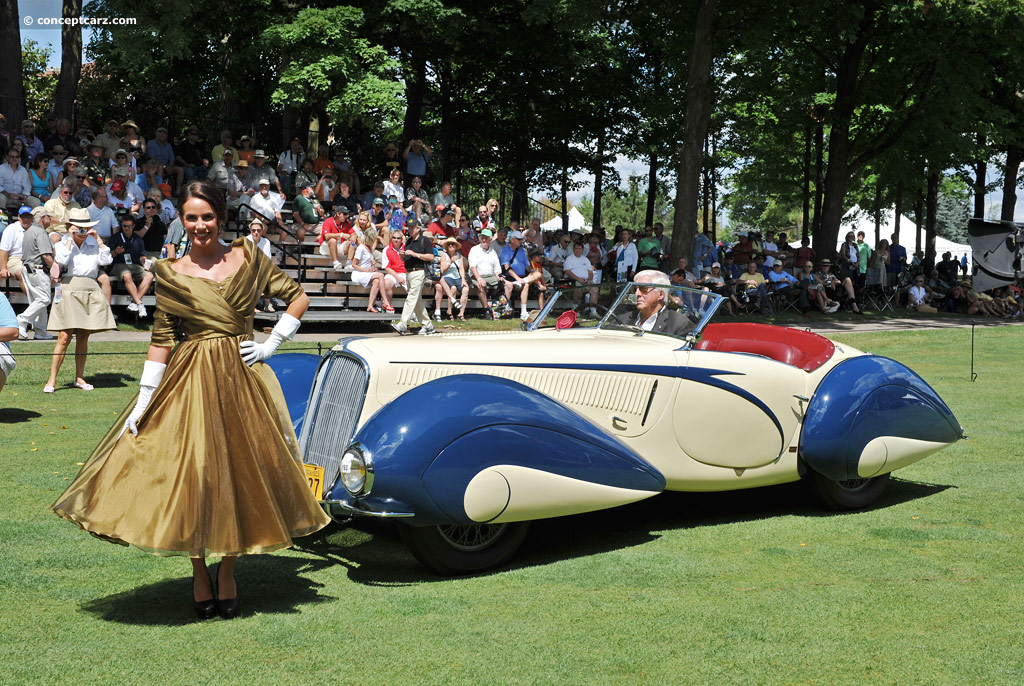
1939 Delahaye Type 135 M
1939 Delahaye Type 135 M Navigation
History
I]Emile Delahaye was born in Tours, France in 1843. He studied engineering in Angers, France. In 1869 he began work with his engineering degree in applied arts and crafts.
Emile Delahaye began business in Tours, France in the middle of the 19th century for the purpose of constructing engines for the ceramic industry. The company branched out and began constructing mechanical appliances such as pumps and engines. In 1888, Delahaye designed an internal combustion engine for the shipping industry. It was not until 1896 that Automobile production began for Delahaye. His first automobiles produced were powered by belt-driven single and twin-cylinder engines.
Emile used motor racing to promote his vehicles. In 1896, Emile Delahaye entered the Paris-Marseilles race. Not only did he enter a vehicle his company had created, but he entered as the driver. The results were astounding, which truly speaks highly of the caliber and quality of the automobile. The demand for the vehicles began pouring in and a second factory was opened.
Due to failing health, Delahaye was forced into retirement in 1901. This was a year after the second factory was opened in Paris. Since Delahaye had no heirs, management control was passed onto a young engineer named Charles Weiffenbach. Weiffenbach oversaw operations until 1954.
In 1905, due to failing health, Emile Delahaye passed away.
Automotive racing was paramount during this period in history. This is why many of the vehicles built during this era were built to be raced and to be used as the daily driver. The sales of the vehicles were stimulated by the way the vehicle performed on the race track. Weiffenbach, however, had a different philosophy. His main focus and priority were to build dependable vehicles. Many of the early vehicles were equipped with four-cylinder engines capable of producing between 9-12 horsepower. Near the beginning of the First World War, a 6-cylinder, 2565cc engine was used.
In addition to automobiles, the Delahaye company produced trucks, lorries, parcel carriers for the post office, motor plows, fire engines, and other commercial and military vehicles. Many of the vehicles were used during the First World War
From 1927 to 1933, productions of medium-class cars were low, but the vehicles that were produced carried with them a reputation for being reliable and robust.
In the early thirties, Weiffenbach, also known as 'Monsieur Charles' by his peers, was in his early 60's. The decision was made to boldly move into the sports car arena. This was in response to the market trends and a way to re-establish a competitive edge in the automotive technology spectrum. For an automotive company that had never created a car that could achieve a top speed faster than 110 km/h, this would be a major undertaking.
Jean Francois, a 29-year-old engineer, was commissioned to construct a series of sporty cars using as many spare parts as possible. Talbot's new independent suspension was used along with a new chassis with box-section side members. The engine was borrowed from one of their trucks. The engine featured a 65mm crankshaft with internal lubrication. In 1933, the vehicles were introduced at the Paris Car Salon. They were the 4-cylinder 12CV and the 6-cylinder 18CV. At the show, Lucy O'Reilly Schell approached Weiffenbach with a request to have a vehicle built that could be entered in rally events.
Lucy O'Reilly, a wealthy American of Irish origin, had a passion for racing. So fueled by Delahaye's desire to produce sports cars and Reilly's financial backing and quest to win motorsport events, the company re-entered the racing scene.
The Delahaye Type 135
The Type 135 was created with variants such as the 135 Competition Speciale (135 CS), designed specifically for racing. The 135 Sport and the 135 Coupe both featured a 3.2-liter engine. The Sport produced 96 horsepower while the Coupe had 110 horsepower. 120 horsepower was produced by the 3.6-liter engine that rested in the Type 135 Competition model. The engine in the 135 CS was a simple pushrod-operated engine borrowed from the 1927 Type 103 truck engine. It gave up horsepower for great acceleration and torque.
The Type 135 is considered one of the most famous and prestigious vehicles produced by Delahaye. In both design and racing competition, it was very successful. Designed in 1934 it was quickly entered into races such as the 24 Heures du Mans, the Monte-Carlo Rally, and the Paris-Saint-Raphael motor race, where it had great success at being a competitive and reliable automobile.
The Type 135 Competition Speciale Sports Car (CS) had a chassis 25 cm shorter than the 135 touring car. This shortened version had better weight distribution which greatly improved the handling and performance. The engine and 4-speed Wilson epicyclic gearbox were placed lower in the chassis, thus contributing to the benefits of a better-balanced vehicle. The 135 CS came equipped with an 80-liter or a 100-liter fuel tank, this option was left up to the buyer's discretion.
The 135 CS was debuted in the 1936 Monte Carlo Rally where it finished 2nd in a field of fierce competition. In 1936 it was the winner of the Marsailles Gran Prix. At the French Grand Prix is placed second, third, fourth and fifth.
Well-known coachbuilders, such as Franay, Letourner & Marchard, Chapron, and Guillore, were tasked with outfitting the 135's. This may have been influenced by Delage, an automotive company that Delahaye merged with in 1935. As a result, the 135 won numerous awards for styling and design.
The Type 135's is truly a prestigious masterpiece with strong racing history and a heritage that was formed on stability, robustness, and stamina.
By Daniel Vaughan | Feb 2007
Emile Delahaye began business in Tours, France in the middle of the 19th century for the purpose of constructing engines for the ceramic industry. The company branched out and began constructing mechanical appliances such as pumps and engines. In 1888, Delahaye designed an internal combustion engine for the shipping industry. It was not until 1896 that Automobile production began for Delahaye. His first automobiles produced were powered by belt-driven single and twin-cylinder engines.
Emile used motor racing to promote his vehicles. In 1896, Emile Delahaye entered the Paris-Marseilles race. Not only did he enter a vehicle his company had created, but he entered as the driver. The results were astounding, which truly speaks highly of the caliber and quality of the automobile. The demand for the vehicles began pouring in and a second factory was opened.
Due to failing health, Delahaye was forced into retirement in 1901. This was a year after the second factory was opened in Paris. Since Delahaye had no heirs, management control was passed onto a young engineer named Charles Weiffenbach. Weiffenbach oversaw operations until 1954.
In 1905, due to failing health, Emile Delahaye passed away.
Automotive racing was paramount during this period in history. This is why many of the vehicles built during this era were built to be raced and to be used as the daily driver. The sales of the vehicles were stimulated by the way the vehicle performed on the race track. Weiffenbach, however, had a different philosophy. His main focus and priority were to build dependable vehicles. Many of the early vehicles were equipped with four-cylinder engines capable of producing between 9-12 horsepower. Near the beginning of the First World War, a 6-cylinder, 2565cc engine was used.
In addition to automobiles, the Delahaye company produced trucks, lorries, parcel carriers for the post office, motor plows, fire engines, and other commercial and military vehicles. Many of the vehicles were used during the First World War
From 1927 to 1933, productions of medium-class cars were low, but the vehicles that were produced carried with them a reputation for being reliable and robust.
In the early thirties, Weiffenbach, also known as 'Monsieur Charles' by his peers, was in his early 60's. The decision was made to boldly move into the sports car arena. This was in response to the market trends and a way to re-establish a competitive edge in the automotive technology spectrum. For an automotive company that had never created a car that could achieve a top speed faster than 110 km/h, this would be a major undertaking.
Jean Francois, a 29-year-old engineer, was commissioned to construct a series of sporty cars using as many spare parts as possible. Talbot's new independent suspension was used along with a new chassis with box-section side members. The engine was borrowed from one of their trucks. The engine featured a 65mm crankshaft with internal lubrication. In 1933, the vehicles were introduced at the Paris Car Salon. They were the 4-cylinder 12CV and the 6-cylinder 18CV. At the show, Lucy O'Reilly Schell approached Weiffenbach with a request to have a vehicle built that could be entered in rally events.
Lucy O'Reilly, a wealthy American of Irish origin, had a passion for racing. So fueled by Delahaye's desire to produce sports cars and Reilly's financial backing and quest to win motorsport events, the company re-entered the racing scene.
The Delahaye Type 135
The Type 135 was created with variants such as the 135 Competition Speciale (135 CS), designed specifically for racing. The 135 Sport and the 135 Coupe both featured a 3.2-liter engine. The Sport produced 96 horsepower while the Coupe had 110 horsepower. 120 horsepower was produced by the 3.6-liter engine that rested in the Type 135 Competition model. The engine in the 135 CS was a simple pushrod-operated engine borrowed from the 1927 Type 103 truck engine. It gave up horsepower for great acceleration and torque.
The Type 135 is considered one of the most famous and prestigious vehicles produced by Delahaye. In both design and racing competition, it was very successful. Designed in 1934 it was quickly entered into races such as the 24 Heures du Mans, the Monte-Carlo Rally, and the Paris-Saint-Raphael motor race, where it had great success at being a competitive and reliable automobile.
The Type 135 Competition Speciale Sports Car (CS) had a chassis 25 cm shorter than the 135 touring car. This shortened version had better weight distribution which greatly improved the handling and performance. The engine and 4-speed Wilson epicyclic gearbox were placed lower in the chassis, thus contributing to the benefits of a better-balanced vehicle. The 135 CS came equipped with an 80-liter or a 100-liter fuel tank, this option was left up to the buyer's discretion.
The 135 CS was debuted in the 1936 Monte Carlo Rally where it finished 2nd in a field of fierce competition. In 1936 it was the winner of the Marsailles Gran Prix. At the French Grand Prix is placed second, third, fourth and fifth.
Well-known coachbuilders, such as Franay, Letourner & Marchard, Chapron, and Guillore, were tasked with outfitting the 135's. This may have been influenced by Delage, an automotive company that Delahaye merged with in 1935. As a result, the 135 won numerous awards for styling and design.
The Type 135's is truly a prestigious masterpiece with strong racing history and a heritage that was formed on stability, robustness, and stamina.
By Daniel Vaughan | Feb 2007
- 1939 Delahaye Type 135 M Menu
- Article
- Image gallery
- Valuation
- Specifications
- Profiles
Delahaye
Similar Vehicles

Similar Automakers


1939 Delahaye Type 135 M Vehicle Profiles



Recent Vehicle Additions


Performance and Specification Comparison
Type 135 Specification Comparison by Year
Year
Production
Wheelbase
Engine
Prices
Related Automotive News

1937 Delahaye 135 Competition Court Torpedo Roadster by Figoni et Falaschi
Even by the 1930s, the performance capabilities of the automobile had progressed to such an extent that many manufacturers would shy away from offering chassis that tested those limits for fear their customers would not be able to handle what was available...

Esteemed Pray Collection To Headline RM's 16Th Annual Amelia Island Sale
RM Auctions announces exceptional estate collection of Malcolm S. Pray Jr. for its 16th annual Amelia Island sale, March 8
Renowned businessman and philanthropists collection features no less than 17 automobiles, headlined by a 1937 Delahaye 135...

The Mullin Automotive Museum To Showcase Seven Iconic Examples Of Automotive Design And Motorsport History Throughout Monterey Car Week
Led by iconic auto builders Delage, Delahaye, Talbot and Voisin, the Mullin will be represented at the Rolex Monterey Motorsports Reunion, The Quail, A Motorsports Gathering and Pebble Beach Concours dElegance
The Mullin Automotive Museum announced...

The Elegance at Hershey
Modeled after the finest concours in Europe and America, The Elegance is a genteel garden party featuring the worlds finest collector cars, arrayed around the classically manicured gardens of The Hotel Hershey. Approximately 75 carefully curated...

RM Auctions Amelia Island Preview - 2014
0
RM Auctions, the worlds largest auction house for investment-quality automobiles, will hold its Amelia Island, Florida, sale on March 8th at the Ritz-Carlton.
As the official auction house of the Amelia Island Concours dElegance, RMs...
1937 Delahaye 135 Competition Court Torpedo Roadster by Figoni et Falaschi
Even by the 1930s, the performance capabilities of the automobile had progressed to such an extent that many manufacturers would shy away from offering chassis that tested those limits for fear their customers would not be able to handle what was available...

63rd Pebble Beach Concours d'Elegance Names 1934 Packard 'Best of Show'
The competition showcased 248 cars, including 48 from abroad
PEBBLE BEACH, Calif. (August 18, 2013) -- A 1934 Packard 1108 Twelve Dietrich Convertible Victoria owned by Joseph and Margie Cassini III of West Orange, New Jersey, was named Best...