Work began in 1937 on the upcoming Mercury cars, first introduced in New York in November of 1938 at the auto show, available in body styles that included a convertible coupe, sedan coupe, two-door sedan, and a four-door. This new company was the brainchild of Edsel Ford and the design was courtesy of E.T. 'Bob' Gregorie. The appearance was similar to its Ford counterparts, and in many respects was a larger and better-equipped version of the Ford. The mechanical components were equally similar to the Fords with a four-inch longer wheelbase and ten extra horsepower.
1942 was the third year of Mercury production but it ended short due to the bombing of Pearl Harbor on December 7th of 1941.
The 1945 through 1948 period in American automobile history was a struggle for Automakers to keep pace with pent-up demand for new cars while battling material shortages and fending off labor disputes. The bread-and-butter models were mildly updated versions of the 1942 models, however, a few new prestige models joined the lineup including a bevy of wood-bodied sedans, wagons, and convertibles.
All-new styling on the Mercury line was introduced in 1949, designed in Ford's in-house studio by E.T. 'Bob' Gregorie. It was initially intended to be the entry-level Ford model of a trio, the senior members of which were Mercury and Lincoln. Prior to plans being finalized, a competing Ford proposal from George Walker was chosen by management, so Gregorie's design was 'promoted' to Mercury. His other two designs became Lincoln and the Lincoln Cosmopolitan, respectively.
A smaller version of the Mercury entered production at Ford France as the Vedette.
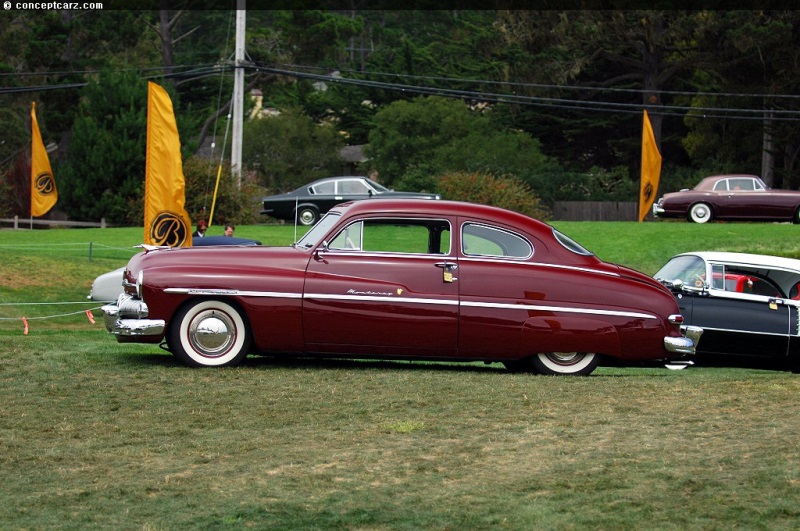
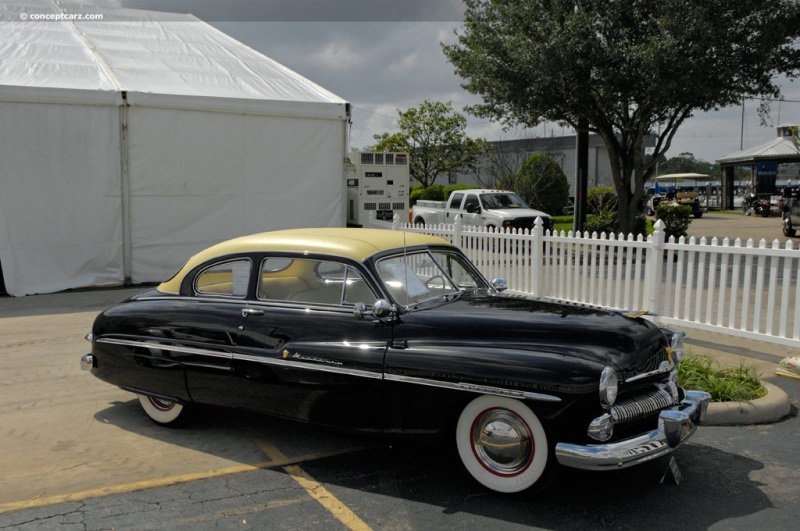
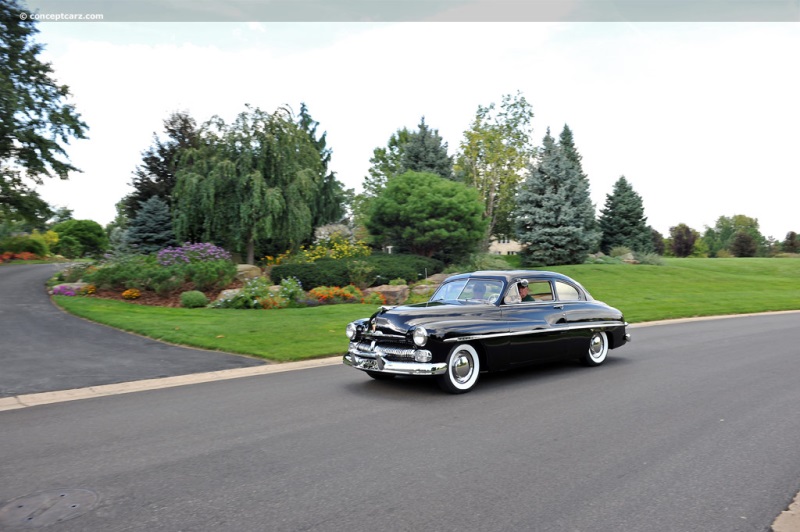
The 1949 Mercury appeared much larger than the Ford, although it shared the same 118-inch wheelbase. Design elements included a stepped sculpture line that traversed from the front fenders, across the doors, back along the rear quarter, and dipped down to the bumper. The basic rear of the body was similar to the Ford models. Mercurys received several upmarket features, like an all-leather interior, while the Fords were fitted with genuine leather only on the seat cushions. Mercurys had twin Blue Dot tail lights and directional signals. Both the Ford and the Mercury shared Ford's new independent front suspension and open driveline. Power was from its own larger 255 cubic-inch version of the venerable flathead V-8.
Just like in the past, there was a single series of Mercurys. They were introduced in April of 1948 and were well received, with model year sales expanding six-fold from 1948, aided in part by a longer model year. Total production exceeded 300,000 units, with wood-bodied station wagons accounting for 2.6 percent.
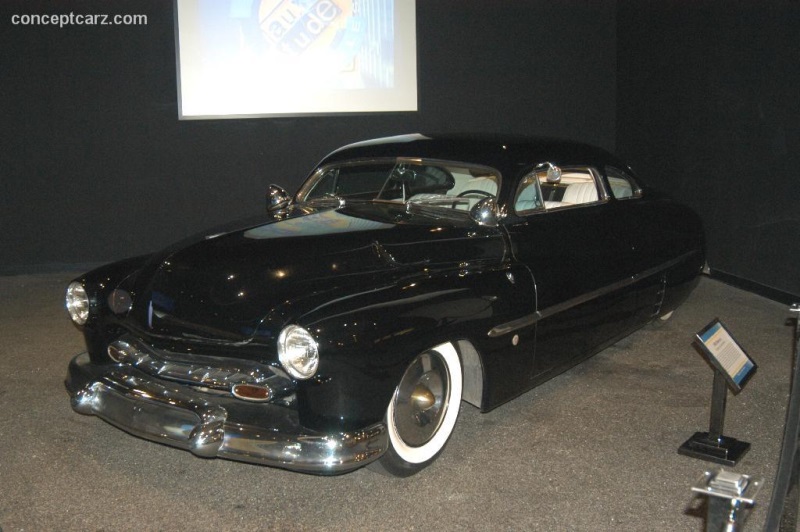
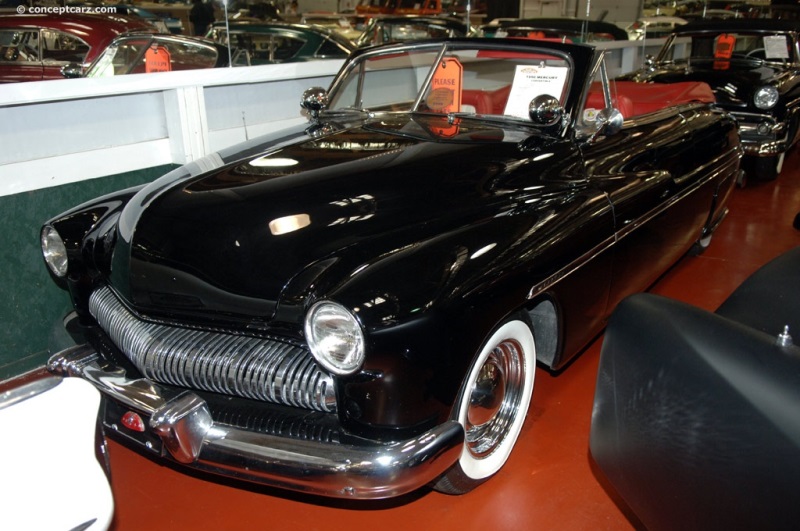
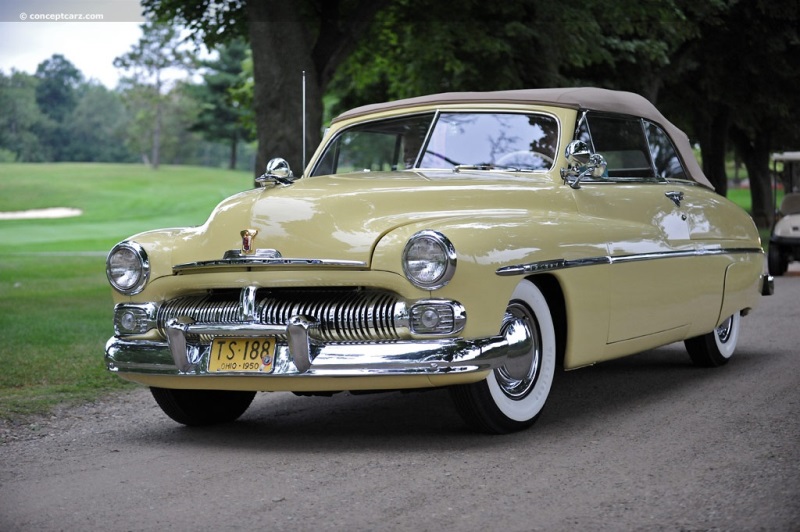
Since the 1949 Mercurys wore all-new styling, and sales had been strong, the 1950 Mercurys received only minor updating. Among the more distinguishable changes were the letters of the word 'Mercury' placed in chrome on the front of the hood. The trunk chrome and the tip of the spear were slightly altered, and the signal lights were now encased in chrome.
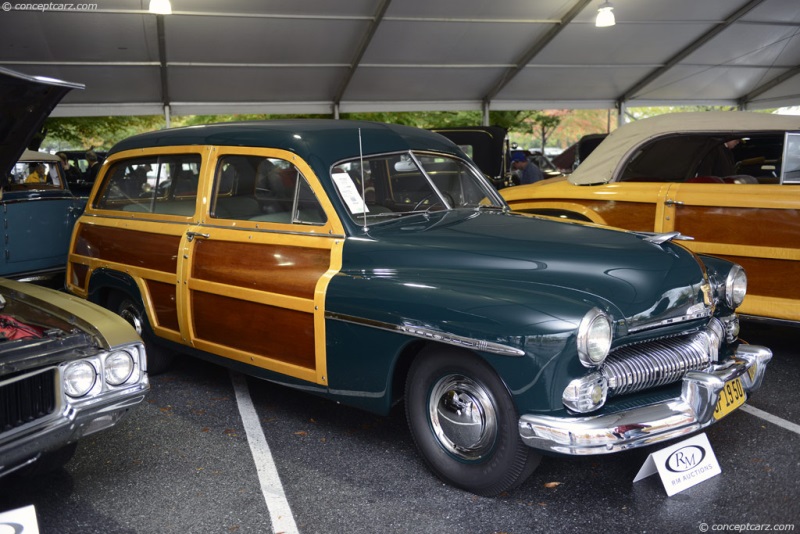
The interior changes, however, were more dramatic, with a completely restyled dashboard. Mechanical changes were also more elaborate with updates to the steering, parking brake, and carburetor. A new Monterey Coupe joined the body style list, complete with a vinyl top or padded canvas, and a custom leather interior. It was priced at $2,150 which made it slightly more expensive than the four-door Sport Sedan, priced at $2,030. The coupe listed for $1,875 and the club coupe had a base price of $1,980. The convertible was the most expensive in the lineup, listed at $3,412. The eight-passenger station wagon, of which 1,746 examples were built, listed for $2,560. The total production of 1950 Mercury Coupes reached 151,489 units, and 132,082 of the Sport Sedan were built.
Powering the 1950 Mercury was a 255.4 cubic-inch, L-head V8 engine with a Holley two-barrel carburetor, three main bearings, and delivering 110 horsepower at 3,600 RPM. It was backed by a three-speed manual transmission or an optional Touch-O-Matic overdrive. Additional optional items included a radio, two-tone paint, whitewall tires, an Oil bath air cleaner, power seats, and power windows. The power windows were standard in the convertible.
1950 was a milestone year for Mercury, as it constructed its one-millionth vehicle, won two NASCAR Grand National races, and was the official pace car at the 1950 Indianapolis 500.
by Daniel Vaughan | Oct 2020
1942 was the third year of Mercury production but it ended short due to the bombing of Pearl Harbor on December 7th of 1941.
The 1945 through 1948 period in American automobile history was a struggle for Automakers to keep pace with pent-up demand for new cars while battling material shortages and fending off labor disputes. The bread-and-butter models were mildly updated versions of the 1942 models, however, a few new prestige models joined the lineup including a bevy of wood-bodied sedans, wagons, and convertibles.
All-new styling on the Mercury line was introduced in 1949, designed in Ford's in-house studio by E.T. 'Bob' Gregorie. It was initially intended to be the entry-level Ford model of a trio, the senior members of which were Mercury and Lincoln. Prior to plans being finalized, a competing Ford proposal from George Walker was chosen by management, so Gregorie's design was 'promoted' to Mercury. His other two designs became Lincoln and the Lincoln Cosmopolitan, respectively.
A smaller version of the Mercury entered production at Ford France as the Vedette.
The 1949 Mercury appeared much larger than the Ford, although it shared the same 118-inch wheelbase. Design elements included a stepped sculpture line that traversed from the front fenders, across the doors, back along the rear quarter, and dipped down to the bumper. The basic rear of the body was similar to the Ford models. Mercurys received several upmarket features, like an all-leather interior, while the Fords were fitted with genuine leather only on the seat cushions. Mercurys had twin Blue Dot tail lights and directional signals. Both the Ford and the Mercury shared Ford's new independent front suspension and open driveline. Power was from its own larger 255 cubic-inch version of the venerable flathead V-8.
Just like in the past, there was a single series of Mercurys. They were introduced in April of 1948 and were well received, with model year sales expanding six-fold from 1948, aided in part by a longer model year. Total production exceeded 300,000 units, with wood-bodied station wagons accounting for 2.6 percent.
Since the 1949 Mercurys wore all-new styling, and sales had been strong, the 1950 Mercurys received only minor updating. Among the more distinguishable changes were the letters of the word 'Mercury' placed in chrome on the front of the hood. The trunk chrome and the tip of the spear were slightly altered, and the signal lights were now encased in chrome.
The interior changes, however, were more dramatic, with a completely restyled dashboard. Mechanical changes were also more elaborate with updates to the steering, parking brake, and carburetor. A new Monterey Coupe joined the body style list, complete with a vinyl top or padded canvas, and a custom leather interior. It was priced at $2,150 which made it slightly more expensive than the four-door Sport Sedan, priced at $2,030. The coupe listed for $1,875 and the club coupe had a base price of $1,980. The convertible was the most expensive in the lineup, listed at $3,412. The eight-passenger station wagon, of which 1,746 examples were built, listed for $2,560. The total production of 1950 Mercury Coupes reached 151,489 units, and 132,082 of the Sport Sedan were built.
Powering the 1950 Mercury was a 255.4 cubic-inch, L-head V8 engine with a Holley two-barrel carburetor, three main bearings, and delivering 110 horsepower at 3,600 RPM. It was backed by a three-speed manual transmission or an optional Touch-O-Matic overdrive. Additional optional items included a radio, two-tone paint, whitewall tires, an Oil bath air cleaner, power seats, and power windows. The power windows were standard in the convertible.
1950 was a milestone year for Mercury, as it constructed its one-millionth vehicle, won two NASCAR Grand National races, and was the official pace car at the 1950 Indianapolis 500.
by Daniel Vaughan | Oct 2020
Related Reading : Mercury Monterey History
An automobile marque of the Ford Motor Company, Mercury was founded in 1939 with the purpose to market entry-level-luxury vehicles that were slotted in between Ford-branded regular models and Lincoln-branded luxury vehicles. All Mercury models are today based on Ford platforms. The Mercury name is derived from messenger of the gods of Roman mythology. In the beginning years, Mercury was known for....
Continue Reading >>
Continue Reading >>
Similar Vehicles
Similarly Sized Vehicles
from 1950
Similarly Priced Vehicles


1950 Mercury Series 0CM Vehicle Profiles

Recent Vehicle Additions


Performance and Specification Comparison
Price Comparison
Monterey Specification Comparison by Year
Year
Production
Wheelbase
Engine
Prices
118.00 in.
156,339
118.00 in.
8 cyl., 255.40 CID., 125.00hp
8 cyl., 256.00 CID., 162.00hp
8 cyl., 256.00 CID., 162.00hp
$2,130 - $2,590
Related Automotive News

The Brumos Collection
The Brumos Collection, located at 5159 San Pablo Road South, recently opened its doors to the public, with viewings on Thursdays and Fridays from 10 a.m. to 3p.m (and one Saturday a month). Although they rarely use the word museum, the mission...

DRAW FOR THIS WEEKEND'S RACE OF CHAMPIONS GETS MOTOR SPORT'S GREATS READY TO ROC MIAMI
The draw for this weekends Race Of Champions inside Miamis Marlins Park has thrown up some intriguing head-to-head encounters between some of the worlds greatest drivers
Saturdays individual race will see NASCAR champion Kyle Busch take on Form...

ROC FACTOR WINNERS RZADZINSKI AND GLUSMAN TO COMPETE IN MIAMI'S ROC NATIONS CUP
Two relatively unknown drivers have won the opportunity to compete at this months Race Of Champions inside Miamis Marlins Park following a unique ROC Factor contest based on a social media vote
Canadas Stefan Rzadzinski will team up with IndyCar...

OFFENHAUSER HEROES AND MERCHANTS OF SPEED SEMINARS OFFER FANS A BACKSTAGE PASS TO AMERICAN MOTORSPORT
A pair ofthe Amelia Island Concours dElegances popular seminars will offer backstage passes to the history and the business of American motorsport.
On Friday March 7, 2014 the celebration of Offenhauser-powered vehicles will begin in the Talbot...

Limited-Edition Ford Racing History Artwork Unveiled at SEMA; Limited-Edition Print Sales to Benefit JDRF
Special limited-edition Ford Racing history artwork is unveiled at the annual SEMA show as part of the Ford press conference
Famed automotive artist Sam Bass created the artwork at the request of Edsel B. Ford II, with proceeds from sales of limit...