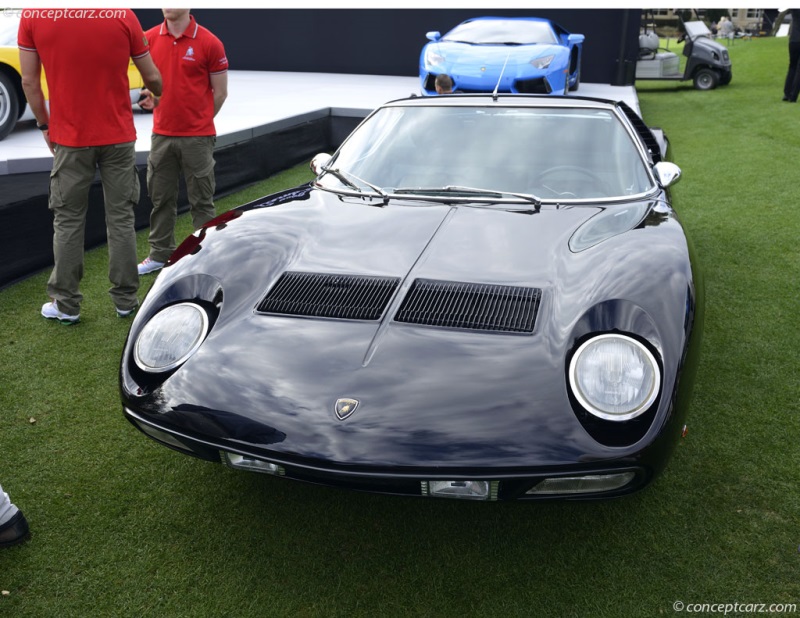
The Lamborghini Miura is widely considered the first production 'supercar,' combining race-inspired technical innovation, massive speed, and a futuristic design at an equally jaw-dropping price. Named for an infamous fighting bull, the Miura was introduced in March 1966 at the Geneva Salon. It was the creation of seven young engineers, including Gian Paolo Dallara, along with a design penned by Marcello Gandini at Bertone (some name Bertone's Giorgetto Giugiaro as the vehicle's designer). The sophisticated Miura had a top speed of nearly 180 mph thanks to its lightweight frame, four-wheel disc brakes, all-independent suspension, and an exotic DOHC V12 engine with Weber carburetors. Constant development resulted in the 'S' (spinto or tuned) version in 1968, followed by the ultimate 385 bhp SV ('S' for spinto, 'V' for veloce or speed) that debuted at Geneva in 1971. The SV came with ventilated disc brakes, nine-inch Campagnolo wheels, wide Pirelli tires, aggressively purposeful body modifications and a leather-trimmed interior. An optional limited-slip ZF differential became available in the autumn of 1971, and dry-sump lubrication appeared.Origins
The existence of the Lamborghini Miura began in the minds of engineers Giampaolo Dallara, Paolo Stanzani, and Bob Wallace, who envisioned an entirely new type of sports car. High-performance GT cars existed during this time, however, the Miura represented a new chapter in the evolution of automotive design. Perhaps not a 'new chapter,' as it rewrote the rule book and brought about an all-new type of road-going vehicle - the supercar. The project began in the off-hours, and after significant progress had been made, it was unveiled to company founder Ferruccio Lamborghini, who backed the project, believing that if nothing more, it could be a valuable marketing tool.
Coupe
Chassis #: 5012
Engine #: 30708
View info and history
Auction entries : 1Lamborghini unveiled the Miura in 1965 at the Turin Salon as a bare chassis fitted with a mid-mounted, transverse V-12 engine built in-unit with a five-speed transaxle. It had a fully independent suspension and four-wheel disc brakes. Carrozzeria Bertone was commissioned to create a suitable body for the advanced chassis that would faithfully capture the youthfulness and spirit of Lamborghini's newest creation. What was penned was thoroughly modern, exotic, and impossibly low, with clamshell panels, articulating headlamps, and many functional vents. The interior housed large circular instruments, a tall central console, and reclining bucket seats. Bertone completed the body for hte prototype just days before the start of the Geneva Motor Show in 1966. Unable to fit the engine bay with an engine by the start of the show, the hood was kept locked throughout the show. Known initially as the P400, production commenced the following year bearing the name 'Miura' and wearing a newly created company badge. Dimensions
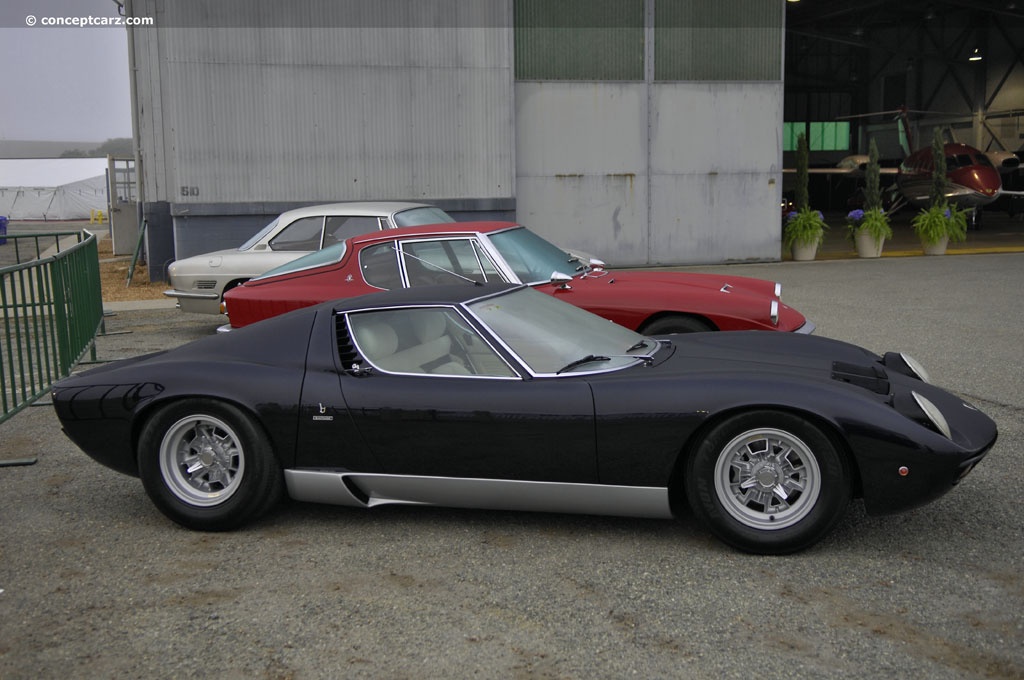
The Lamborghini Miura rested on a 98.4 inch wheelbase and had an overall length of 171.7 inches, a width of 69.3 inches, and stood 41.5 inches tall. Engine
The transversely-mounted mid-placed engine had an 82mm bore, a stroke of 62mm, and a total displacement size of 3,929cc. The 60-degree four-stroke naturally aspirated engine had two valves per cylinder and four IDL40 3C 3-barrel downdraft Weber carburetors. With 9.5:1 compression, the engine delivered 345 horsepower at 7,000 RPM and 262 lb-ft of torque at 5,000 RPM.
Coupe
Chassis #: 5080
View info and historyThe P400S had 10.7:1 compression and produced 365 horsepower at 7,700 RPM and 286 lb-ft of torque at 5,500 RPM.The P400SV also had 10.7:1 compression but produced 380 horsepower at 7,850 RPM and 295 lb-ft of torque at 5,750 RPM. This engine received different cam timing and altered 4x3-barrel Weber carbs, resulting in an increase in power. The final 96 examples of the SV built had a split sump. Lamborghini P400 (Posteriore 4 litri)
The P400 was built from 1966 to 1969, with 275 examples constructed. It was powered by the 3.9-liter Lamborghini V12 engine used in the 400GT at the time, and the car rode on Pirelli Cinturato 205VR15 tires.Lamborghini P400S (Miura S)
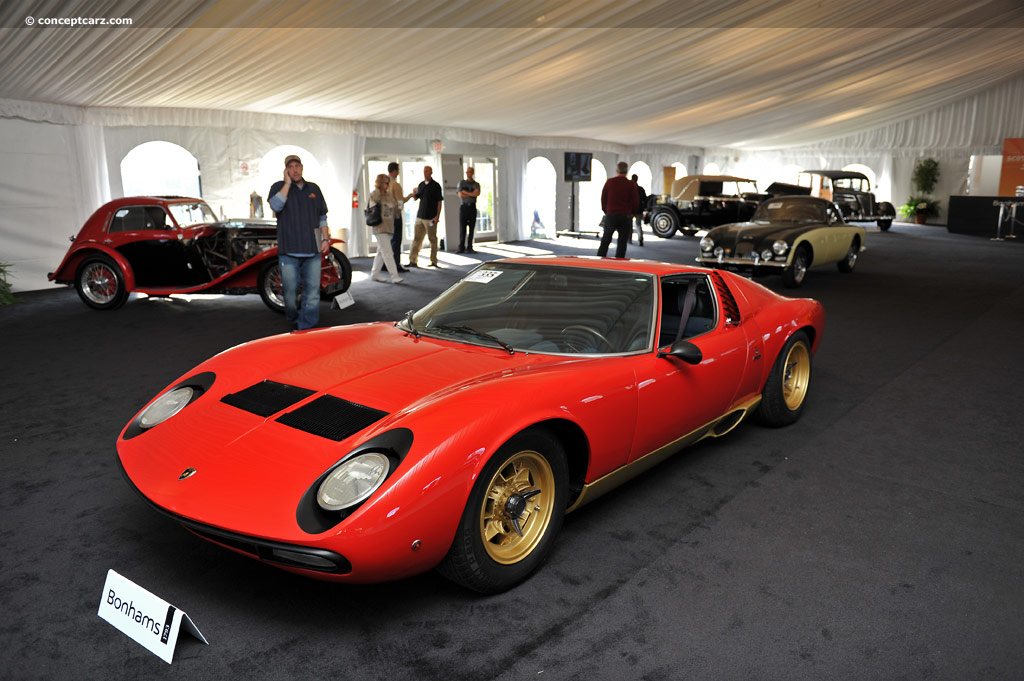
The Miura P400S, also known as the Miura S, was introduced in November 1968 at the Turin Motor Show. Production began in December 1968 and continued through March 1971, with around 338 examples created.
Coupe
Chassis #: 5080
View info and historyRiding on 215/70VR15 Pirelli Cinturato CN12 tires at the front and 225/70VR15 CN12 at the rear, the Miura S came with power windows, bright chrome trim around the headlights and external windows, and notched trunk end panels, resulting in slightly more luggage space. The engine manifolds were enlarged by 2mm and it used different camshaft profiles, resulting in an additional 20 horsepower. The interior gained a locking glovebox lid and a reversed position of the cigarette lighter and windshield wiper switch. Lamborghini P400SV (Miura SV)
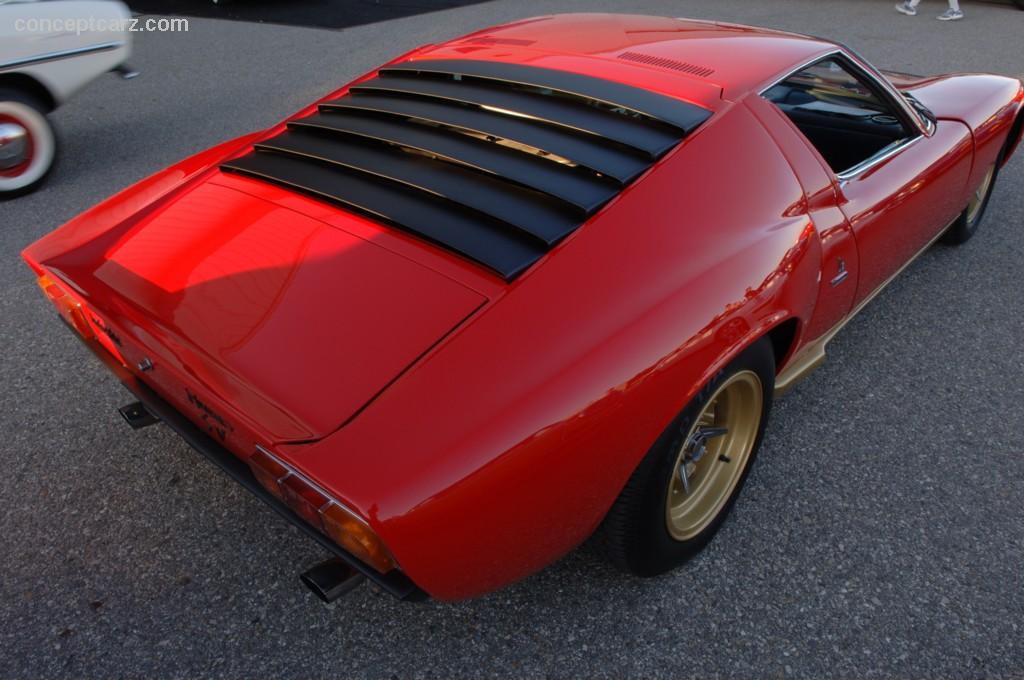
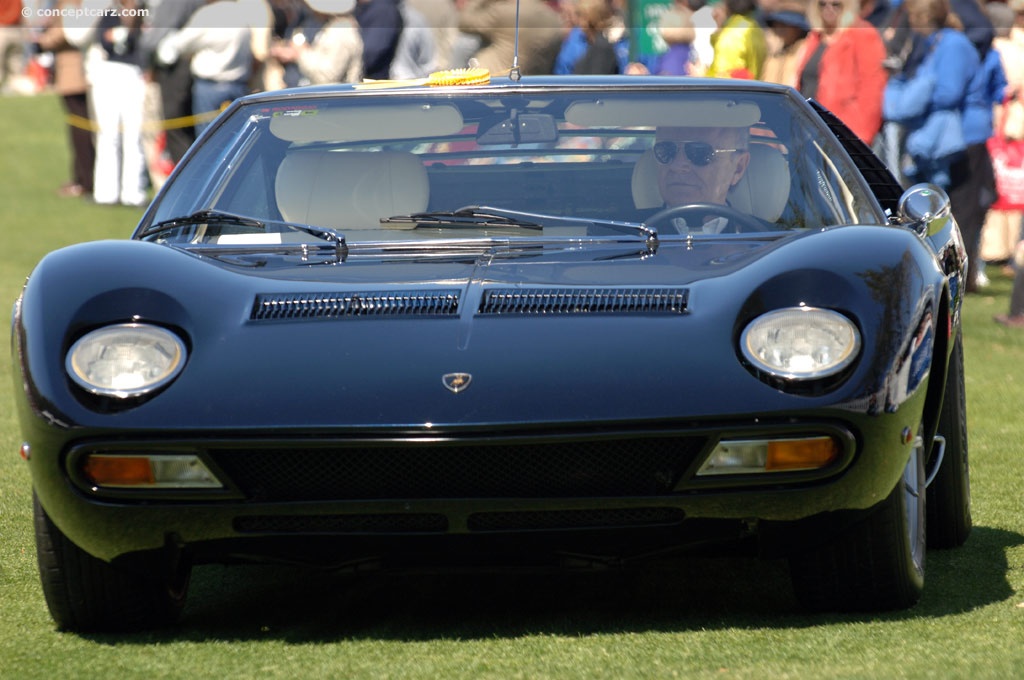
The Lamborghini Miura P400SV, for Spinto Veloce, was built from 1971 to 1973 with approximately 150 examples built. This was the final and highest specification of the Miura with 380 horsepower being produced by the V12 engine. It had altered 4x3-barrel Weber carburetors and different cam timing, and the lubrication system for the gearbox was now separate from the engine.
Coupe
Chassis #: 5012
Engine #: 30708
View info and history
Auction entries : 1Distinguishable features of the Miura SV compared to its predecessors were the lack of 'eyelashes' around the headlamps, different taillights, and wider fenders to contain the 9-inch wide rear wheels and Pirelli Cinturato tires 215/70R15 CN12 & 255/60R15 CN12.Revised suspension helped to resolve the 'front-end lightness' of the earlier cars.Zero-to-sixty mph took 5.8 seconds and the top speed was quoted at 180 mph.
Coupe
Chassis #: 5012
Engine #: 30708
View info and history
Auction entries : 1The Lamborghini Miura was succeeded by the Countach in 1974, remaining in production through 1990. The Countach was another ground-breaking automobile for the Italian marque, with its sharply angled 'Italian Wedge' shape and scissor doors.
by Daniel Vaughan | Dec 2023
The existence of the Lamborghini Miura began in the minds of engineers Giampaolo Dallara, Paolo Stanzani, and Bob Wallace, who envisioned an entirely new type of sports car. High-performance GT cars existed during this time, however, the Miura represented a new chapter in the evolution of automotive design. Perhaps not a 'new chapter,' as it rewrote the rule book and brought about an all-new type of road-going vehicle - the supercar. The project began in the off-hours, and after significant progress had been made, it was unveiled to company founder Ferruccio Lamborghini, who backed the project, believing that if nothing more, it could be a valuable marketing tool.
Coupe
Chassis #: 5012
Engine #: 30708
View info and history
Auction entries : 1
The Lamborghini Miura rested on a 98.4 inch wheelbase and had an overall length of 171.7 inches, a width of 69.3 inches, and stood 41.5 inches tall. Engine
The transversely-mounted mid-placed engine had an 82mm bore, a stroke of 62mm, and a total displacement size of 3,929cc. The 60-degree four-stroke naturally aspirated engine had two valves per cylinder and four IDL40 3C 3-barrel downdraft Weber carburetors. With 9.5:1 compression, the engine delivered 345 horsepower at 7,000 RPM and 262 lb-ft of torque at 5,000 RPM.
Coupe
Chassis #: 5080
View info and history
The P400 was built from 1966 to 1969, with 275 examples constructed. It was powered by the 3.9-liter Lamborghini V12 engine used in the 400GT at the time, and the car rode on Pirelli Cinturato 205VR15 tires.Lamborghini P400S (Miura S)
The Miura P400S, also known as the Miura S, was introduced in November 1968 at the Turin Motor Show. Production began in December 1968 and continued through March 1971, with around 338 examples created.
Coupe
Chassis #: 5080
View info and history
The Lamborghini Miura P400SV, for Spinto Veloce, was built from 1971 to 1973 with approximately 150 examples built. This was the final and highest specification of the Miura with 380 horsepower being produced by the V12 engine. It had altered 4x3-barrel Weber carburetors and different cam timing, and the lubrication system for the gearbox was now separate from the engine.

Coupe
Chassis #: 5012
Engine #: 30708
View info and history
Auction entries : 1
Coupe
Chassis #: 5012
Engine #: 30708
View info and history
Auction entries : 1
by Daniel Vaughan | Dec 2023
Related Reading : Lamborghini Miura P400 SV History
The Miura was first show to the public at the November 1965 Turin Auto Show. At the time, it did not have a body. It was just a rolling-chassis. The design was mid-engined, very revolutionary at the time. Bertone was chosen to body the vehicle. Nuccio Bertone gave the project to Marcello Gandini. In early 1966 the Bertone body and the chassis designed by Giampaolo Dallara were assembled into one unit.....
Continue Reading >>
Continue Reading >>
Related Reading : Lamborghini Miura History
The Miura was first shown to the public at the November 1965 Turin Auto Show. At the time, it did not have a body. It was just a rolling-chassis. The design was mid-engined, very revolutionary at the time. Bertone was chosen to body the vehicle. Nuccio Bertone gave the project to Marcello Gandini. In early 1966 the Bertone body and the chassis designed by Giampaolo Dallara were assembled into one....
Continue Reading >>
Continue Reading >>
Similar Automakers
Similarly Sized Vehicles
from 1972
Similarly Priced Vehicles
Maserati Ghibli ($19,280-$19,910)
Rolls-Royce Silver Shadow ($19,750-$19,750)
Average Auction Sale: $1,834,337
Rolls-Royce Silver Shadow ($19,750-$19,750)
Average Auction Sale: $1,834,337


1972 Lamborghini Miura Vehicle Profiles




Recent Vehicle Additions


Performance and Specification Comparison
Price Comparison
$23,505
Miura P400 SV Specification Comparison by Year
Year
Production
Wheelbase
Engine
Prices
Related Automotive News

Lamborghini Polo Storico At Rétromobile Paris To Unveil The Latest Restoration: The Miura SV Owned By Jean Todt
SantAgata BologneseParis, 6 February 2019 – From 6 to 10 February, Lamborghini Polo Storico will be at Rétromobile, the Paris show devoted to classic cars, with a special red Miura SV. This important car underwent a complete restoration by Polo...

Lamborghini Polostorico At 2017 Techno Classica, Essen: Announcing Lamborghini And Design, Concorso D'Eleganza
SantAgata BologneseEssen, 5 April 2017 – Lamborghini PoloStorico, the heritage and restoration department of Automobili Lamborghini, is at Techno Classica, Essen from 5 to 9 April 2017. Two vehicles are shown on its stand a Miura P400 SV, the...

Lamborghini Miura SV turns 50 in 2021
The Lamborghini Miura SV, the last evolution of the highly successful P400 project, was officially unveiled in March 1971, on the Lamborghini stand at the Geneva Motor Show. On the same occasion, on its stand, Carrozzeria Bertone presented the Countach...

Lamborghini Celebrates The 50Th Anniversary Of The Jarama GT
This year marks the 50th Anniversary of the Lamborghini Jarama GT, presented for the first time at the Geneva Motor Show in March 1970.
The Jarama, whose name derives from an area north of Madrid famous for breeding fighting bulls, was the latest evolution...

The Best Of Lamborghini At London Concours 2020
The London Concours has announced its Great Marques Lamborghini display, celebrating the very best from SantAgata
Line-up includes icons early pioneers like the 400GT and iconic Miura, through to the Diablo SV, Murcielago and Aventador SVJ
Les...

Lamborghini Miura Celebrated In A Dedicated Class At The 59Th Pebble Beach Concours d'Elegance
SantAgata Bolognese, 12 August 2019 – The Pebble Beach Concours dElegance, established in 1950, is the one of the most renowned classic car shows in the world, and every year the selection of cars for display is very severe, because only the...

LAMBORGHINI MIURA 50th ANNIVERSARY AT 2016 AMELIA ISLAND CONCOURS d'ELEGANCE
The 21st annual Amelia Island Concours dElegance will celebrate the 50th anniversary of the legendary Lamborghini Miura the car that changed the exotic car universe forever.
The landmark Miura was introduced as a rolling chassis at the 1965 Turin...