1965 Shelby Cobra Daytona pictures and wallpaper 1965 Shelby Cobra Daytona pictures and wallpaper 1965 Shelby Cobra Daytona pictures and wallpaper 1965 Shelby Cobra Daytona pictures and wallpaper 1965 Shelby Cobra Daytona pictures and wallpaper
1965 Shelby Cobra Daytona pictures and wallpaper 1965 Shelby Cobra Daytona pictures and wallpaper 1965 Shelby Cobra Daytona pictures and wallpaper


View more photos
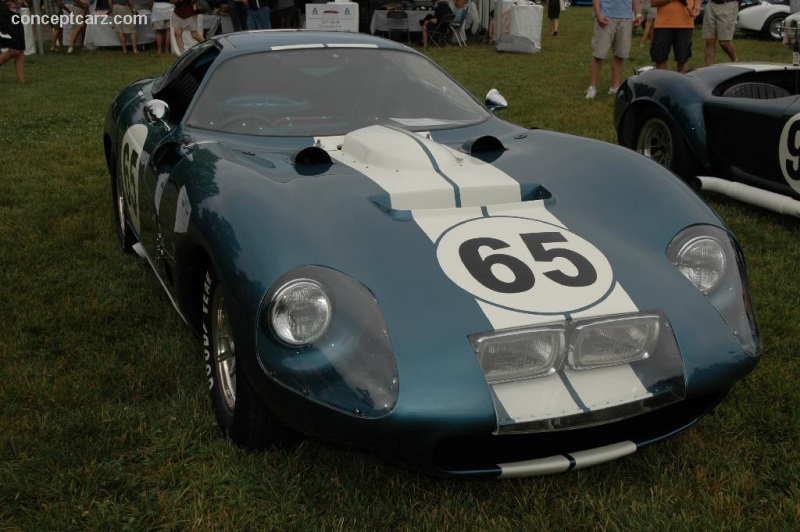
Chassis Num: CSB 3054
 
This car is a result of a secret project undertaken by Pete Brock, the Shelby American director of special projects. After designing the 289 Cobra Daytona Coupe, Mr Brock then designed this car as a coupe version of the 427 Competition Cobra. It was designated the Type 65 Coupe and came to be known as the 427 Daytona Super Coupe or, in short, the Super Coupe.

Originally started only as a 427 chassis and completed on 3/13/65, it was shipped to Slough, England for construction of a coupe body by Radford Coachbuilders. This project was canceled before fully completed. It was shipped back to Shelby American in late 1965 and stored at the Shelby facility in unfinished condition.

The car was sold by Shelby American and after several owners, Craig Sutherland had Mike Dopudja of Englewood, Colorado complete it in 1980 with consultation by Pete Brock. During this time the car was test driven by a number of people including Dick Smith, Bob Bondurant, Brian Redman, Mike Dopudja and Bob Hindson.

The completed Super Coupe was unveiled at the Riverside vintage races in April of 1981. It was then vintage raced for a number of years with Dick Smith as the primary driver.

After being sold again in 1987 the Super Coupe then underwent a major group up mechanical and cosmetic restoration over a period of years.

The Super Coupe is the only 427 Competition Cobra Coupe. Aimed at international endurance racing, it would have been a formidable competitor at Daytona and Le Mans.
View more photos
Super Coupe
Chassis Num: CSX 2286
 
Even though 2286 is the lowest chassis number of the six Daytona Coupes built, it was the last Coupe completed.

It was originally intended to place a 390 cubic-inch alloy V8 in 2286, so during construction at Carrozzeria Gransport in Modena, Italy, the body and frame were stretched to accommodate the big-block motor. These modifications caused a delay in the completion of this coupe.

2286 was ready for the 1964 LeMans race, but was badly damaged when the truck transporting it from Italy to LeMans was involved in a crash.

During the winter of 1964-1965, Shelby's organization began to focus on the GT40 program and started to experiment with a 427 cubic-inch V8 in the mid-engine GT40. It soon became obvious that a big-block front-engined Cobra Coupe was not the way to go, so 2286 was converted back to standard frame and body lengths and a 289 cubic-inch motor was installed for the 1965 season. In this form, 2286 was raced only once by Shelby-American.

2286 was raced at the 1965 LeMans 24 Hours driven by Dan Gurney and Jerry Grant. During the 15th hour, running as high as 3rd overall and having set a GT lap record, the car experienced clutch failure and left the race prematurely.

After the 1965 season, 2286 was used in the 'Cobra Caravan' which traveled across the country to publicize Ford's racing successes.
View more photos
Super Coupe
Chassis Num: CSX 2287
 
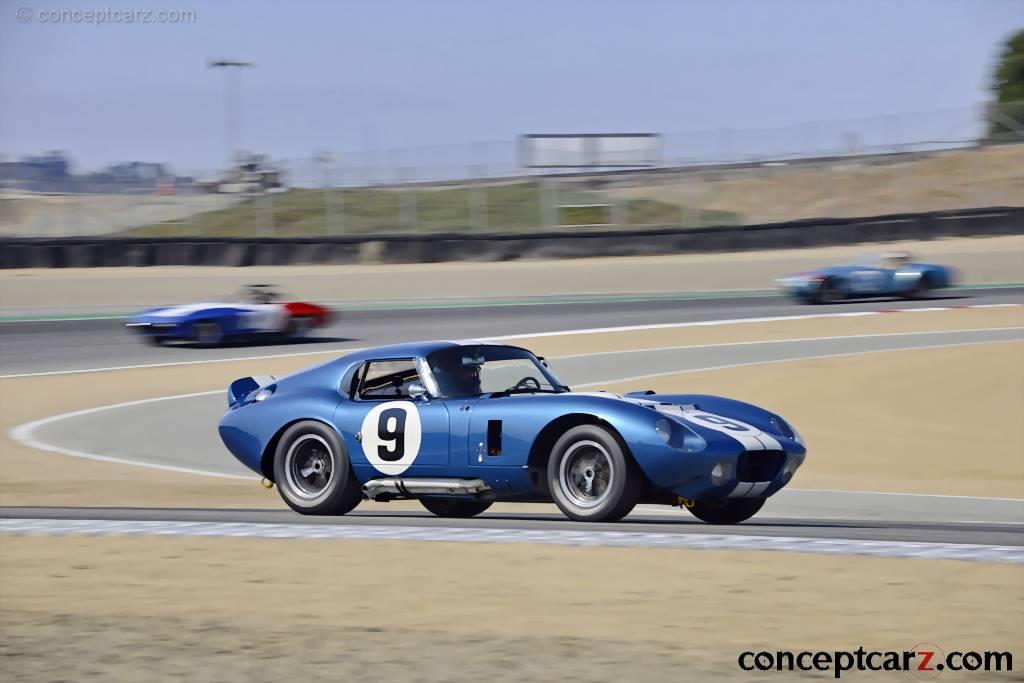
There were only six of these iconic race cars ever created. They achieved many important victories thanks, in part, to their streamlined design, power, and reliability. They beat the legendary Ferrari GTOs to win the 1964 and 1965 World Championship of Makes. At Bonneville, this car set numerous speed records.

This Shelby Cobra Daytona Coupe has chassis number CSX 2287. It set records at Bonneville on November 4th of 1965. It traveled 1931 miles in 12 hours and did-so at 150 miles per hour. It set a total of 23 World Stock Car Speed and Endurance Records. It even broke records that had been set in 1936 by the Bugatti Type 57G 'Tank'.
View more photos
Super Coupe
Chassis Num: CSX 2601
 
In 1963, Carroll Shelby's new Cobra had established its supremacy on the short road courses of America, but Shelby and Ford shared a more ambitious goal: to beat Ferrari on the world stage and became the first American team to win the coveted F.I.A. (Federation Internationale de Automobile) World Manufacturers Championship for GT cars.

An experimental coupe body, designed by Peter Brock, was built on an existing Cobra chassis, immediately increasing the top speed by 25 mph. The new car won the GT class at its first race, the Daytona Continental, Team Shelby narrowly missed winning the 1964 Championship. By 1965, they were not to be denied and, on July 4th, 1965, Bob Bondurant drove this Shelby Cobra Daytona Coupe, CSX2601, across the finish line at the 12 Heures du Reims in France to secure the F.I.A. Championship.
Caroll Shelby scored a victory for Aston Martin at the grueling 24 Hours of LeMans in 1959. Soon after he was struck by heart problems and forced to retire from the driver's seat. This freed up time to pursue his other passion, building the world's fastest sports car. That dream would be realized years later, adapting a powerful Ford engine into a nimble, British sports car. The car was named the Cobra.

John Tojeiro had designed and produced a small sports-car which he sold under the name of AC Ace. The cars had a tubular chassis and powered by Bristol 2-liter six-cylinder engines. With its lightweight body and good handling characteristics it was an ideal vehicle for racing. Many of the owners entered the Ace in competition and enjoyed moderate success.

When Bristol announced they would no longer offer the engine, Tojeiro was left without a power-plant to propel his cars. As a result, the end of AC Ace production was announced. When Shelby found out about this, he contacted Tojeiro and convinced him to continue production by outfitting the cars with Ford Fairlane engines. Shelby traveled to the UK to supervise the construction of the prototype chassis. The main problem with the engine was the high amounts of torque that it produced. The engine produced almost twice as much power as the engine it was replacing and yet it weighed less. The rear end was modified to handle this increase in power. After thorough testing and fine-tuning, 100 examples were ordered.

Right around the same time, General Motors was getting ready to introduce the Chevrolet Corvette Sting Ray. In 1962 the Shelby Cobra and the Stingray made their debut at the Riverside 3-Hour race. During qualifying, Shelby Cobra himself drove one of the newly created Cobra's, beating the Stingray's best time by over four seconds. During the race, Bill Krause was leading the competition by more than 30 seconds when he was forced to retire due to mechanical difficulties. The Sting Ray went on to win the race.

For the following season, Shelby took part in the first US manufactures' championship which he easily dominated. His Shelby Cobra's went on to secure 111 points by winning six out of the seven races. Ferrari had accumulated 28 points and Chevrolet amassed only 19. The Cobra had proven it was a very capable machine. Shelby turned his sights to international competition.

Ferrari was the ruling force for GT cars in the FIA World Championship Series. Their powerful engines and carefully crafted vehicles were suitable for the high speed tracks where most of the races were held. The Shelby Cobra, too, was a fast car but was at a disadvantage on these types of tracks due to the design of the body. As a result, the Shelby Cobra Daytona Coupe was born.

The Shelby Cobra Daytona Coupe was created by Pete Brock who was given permission by Shelby to re-body a 289 Cobra in a closed-cockpit configuration. It was hand fabricated out of aluminum over wooden cross-section templates. In the back of the vehicle featured a chopped off Kamm-back tail and void of any spoiler. The main purpose for this endeavor was to improve aerodynamics. A test run in October of 1963 proved that the Daytona Coupe had a lower center of gravity, less drag, and a higher top speed by about 20 mph. Its racing debut was at Daytona and thus, the derivative of its name. For the first half of the race the Daytona dominated but fire in the pits forced the team to retire prematurely. A visit to the 12 Hours of Sebring gave the Cobra Daytona its first racing victory where it finished first in the GT class and third overall. Up to this point, only one car had been created, CSX 2287. By the Le Mans race, two examples had been created, CSX 2287 and CSX 2299. Eventually, a total of six examples would be constructed. Dan Gurney and Bob Bondurant drove the Daytona Coupe to a GT class win at LeMans and finished fourth overall.

Ferrari went on to capture the manufacturer's title, though only by the slightest of margins. The Shelby team missed the World Manufacturers Championship by just a few points. The Daytona Coupe probably would have won the title if the Italian Monza race had not been canceled. By this point, four Daytona Coupes were ready for competition. Throughout the season, the Daytona Coupes had lead the Ferrari's in most of the races. Mechanical difficulties were often the only factor that allowed the Ferrari's to beat the Daytona Coupes. By fielding four racers, the success of the Daytona Coupe was almost certainly guaranteed had the race not been canceled. In 1965 Ferrari did not compete in the GT World Championship. They were unable to field a legal replacement for the 250 GTO.

For the 1965 season, the Daytona Coupes won eight of the eleven races. They repeated their victory's in the 24 Hours of Le Mans in 1965. Rule changes at the end of the season made the Cobra Daytona Coupes obsolete. The Lola based Ford GT40 program was progressing with much success. The decision was made to shift resources over to the Ford GT40 program. At the close of the season, the Coupes were left with Alan Mann in England but tax fines forced the cars to be shipped back to Shelby in the United States. It took years to sell the racers but eventually they were sold. Two of them reside in the Shelby American Collection museum in Boulder, Colorado. In modern times, their demanding price for one of these rare vehicles is estimated to be in the millions.
View more GT vehicles

For more information and related vehicles, click here

© 1998-2009. All rights reserved. This material may not be published, broadcast, rewritten, or redistributed.

Vehicle Spotlight
Gemballa Tornado 750 GTSInnotech Corvette C62010 Chevrolet Equinox2010 BMW X5 M2010 Toyota PriusLotus Carlton
1967 Ferrari 350 Can-AmBertone Mantide ConceptMatech GT1BMW 760Li2010 MAZDASPEED32010 Mazda CX-9
2010 Volkswagen GTIBentley BrooklandsBMW 1 Series2009 Saturn Sky2010 Lincoln MKZ2010 Saab 9-3X
2010 Audi A52010 Mercedes-Benz E-ClassChevrolet Corvette2010 Chevrolet CamaroAston Martin One-772010 Ford Mustang
 
Shelby: 1961-1970
Similar Automakers
Add Review
Other models by Shelby

AddThis Social Bookmark Button   

Related Articles and Event Coverage
Amelia Island Concours d'Elegance
Simeone Foundation Museum
Monterey Historic Automobile Races at Laguna Seca
2005 Cincinnati Concours d'Elegance in Ault Park

Similar Vehicles
Superformance Shelby Daytona Cobra Coupe2009 Superformance Shelby Daytona Cobra Coupe

1965 Shelby models
Shelby Cobra 289
Shelby Cobra 289 Stage I
Shelby Cobra 427
Shelby Mustang GT 350 R Competition
 
1965 Shelby Concepts
Shelby Cobra 427 Competition Prototype CSX 3002