The Road to the Ferrari 365
The World Sportscar Championship was sanctioned in 1953 by the FIA (Fédération Internationale de l'Automobile) for sports car racing and quickly became as important and popular as Grand Prix competition. Initially, the major races were contested by road-going sports cars, but by the close of the 1950s, podiums were filled with dedicated competition cars. In 1962, the FIA replaced the World Championship for Sports Cars with the International Championship for GT Manufacturers, with sports cars temporarily being displaced by GT cars. Each racing class now had its own championship rather than a single overall title. Ferrari won the 2.0-liter GT class award in 1963 with its 250 GT Berlinetta SWB and 250 GTO.
Coupe
Chassis #: 12467
Engine #: 251
View info and history
Auction entries : 4The Ferrari 250 GTO grand tourer was produced from 1962 to 1964 and was homologated for FIA's Group 3 Grand Touring Car category. When the 250 GTO's successor, the 250 LM, was denied homologation for GT-class racing, Ferrari developed an updated 250 GTO (known as the Series II or GT064) and a competition version of the 275 GTB. Three distinct series of the 275 GTB-based competition cars were built between 1964 and 1966, and these purpose-built cars were known as the 275 GTB Competizione Speciale (or 275 GTB/C Speciale). Designed under the supervision of Mauro Forghieri, the 275 GTB/C Speciale was equipped with Tipo 213 engines tuned to 250 LM specification, offering upwards of 305 horsepower. Four cars of this type were built, each wearing streamlined coachwork designed by Pininfarina and built from extra-thing gauge alloy by Scaglietti. Since they were hand-built, each of the four cars had slightly differing bodywork. At first, the FIA refused to homologate the model for the GT class, but when Enzo Ferrari threatened to cease competing in the GT class, the FIA reversed its decision. Only one 275 GTB/C Speciale competed during the 1965 season, with notable finishes including a 3rd overall in the 1965 24 Hours of Le Mans (piloted by Willy Mairesse and Jean Blaton) and winning the Nassau Tourist Trophy.
Coupe
Chassis #: 12467
Engine #: 251
View info and history
Auction entries : 4Less extreme versions of the 275 GTB/C Speciale were built for privateers, and these were known as 275 GTB Competizione Clienti models. Similar to the production 275 GTB, they were powered by a Tipo 213 engine breathing through six carburetors. They differed via the alloy coachwork, larger fuel tanks, additional exterior fuel fillers, and more venting. Twelve lightweight 275 GTB/C racing cars were built for the 1966 season, with substantial modifications to the mechanical components and the body panels. Several independent racing teams competed with the 275 GTB/C during the 1966 season, including Ecurie Francorchamps, Maranello Concessionaires, Scuderia Filipinetti, and NART. Roy Pike and Piers Courage drove the Maranello Concessionaires-entered 275 GTB/C at the 24 Hours of Le Mans and finished 8th overall and 1st in class. Claude Dubois and Pierre Noblet driving for Ecurie Francorchamps finished 10th overall and 2nd in class. Other accolades included a 1st in class at the 1967 Targa Florio by Tullio Sergio Marchesi, and Marchesi won the 1966 and 1967 Italian GT Championship with a 275 GTB/C (chassis number 09007). The 365 GTB/4 'Daytona'
The replacement for the 275 GTB emerged during the winter of 1967 in prototype form. Beneath its bonnet was a three-valve per cylinder four-liter V12 engine that would not be used on the production version. Instead, a Tipo 251 power unit was used with a 4.4-liter (4390cc) displacement size, hemispherical combustion chambers in its twin-cam heads, and single-plug ignition. With a lengthened block, the bore and stroke grew to 81mm and 71mm, respectively, identical to the Tipo 245 engine, which already powered the 365 GT 2-plus-2, GTC, and GTS models.
Coupe
Chassis #: 12467
Engine #: 251
View info and history
Auction entries : 4The 4.4-liter engine had a dry-sump system with a 14-liter separate tank, 8.8:1 compression, and six Weber 40DCN carburetors. In this configuration, the engine offered 352 horsepower at 7,500 RPM and 318 lb-ft of torque at 5,500 RPM. A five-speed manual transmission was mounted at the rear of the engine for optimal weight distribution in a chassis that had a 94.5-inch wheelbase. The engine, torque tube, and five-speed transaxle were attached to the tub chassis at four points (two on the transaxle and two on the engine). The suspension was independent all round with wishbones and coil springs.Body styles included a Berlinetta and Spider. The styling was courtesy of Pininfarina designer Leonardo Fioravanti, with a sharp-edge aerodynamic appearance and fixed headlights resting behind an acrylic glass cover. Only the prototype body was actually built by Pininfarina, and as with the preceding Berlinettas, it was Scaglietti who actually made the bodies in steel.
Coupe
Chassis #: 12467
Engine #: 251
View info and history
Auction entries : 4In honor of the Ferrari factory team's 1-2-3 victory in the 1967 Daytona 24-Hour race, the new model was nicknamed the 'Daytona.' At the time, the new Ferrari was the fastest production car in the world, capable of achieving 172 mph in standard guise. Ferrari 365 GTB production reached 500 units by the end of August 1971, satisfying FIA homologation in the International Group 4 Special Grand Touring car racing category. Initially, Ferrari had no plans to race the 365 GTB, but following several valued clients' demands for a competition version, production of Competizione versions for customer use commenced at the Assistenza Clienti department of the factory in Modena.Early Competition Examples
The first 'Competizione' version, Daytona number 12547, was sold in 1969 to Luigi Chinetti at N.A.R.T. to participate in the 1969 Le Mans 24 Hours. Its exterior was painted red with a black stripe down the side. Although it wore lightweight aluminum coachwork, it did have glass windows, a standard rear exhaust, and air conditioning. Due to being damaged during testing, it never raced at Le Mans, but it did compete in 1970 at the Daytona 24 Hours.
Coupe
Chassis #: 12467
Engine #: 251
View info and history
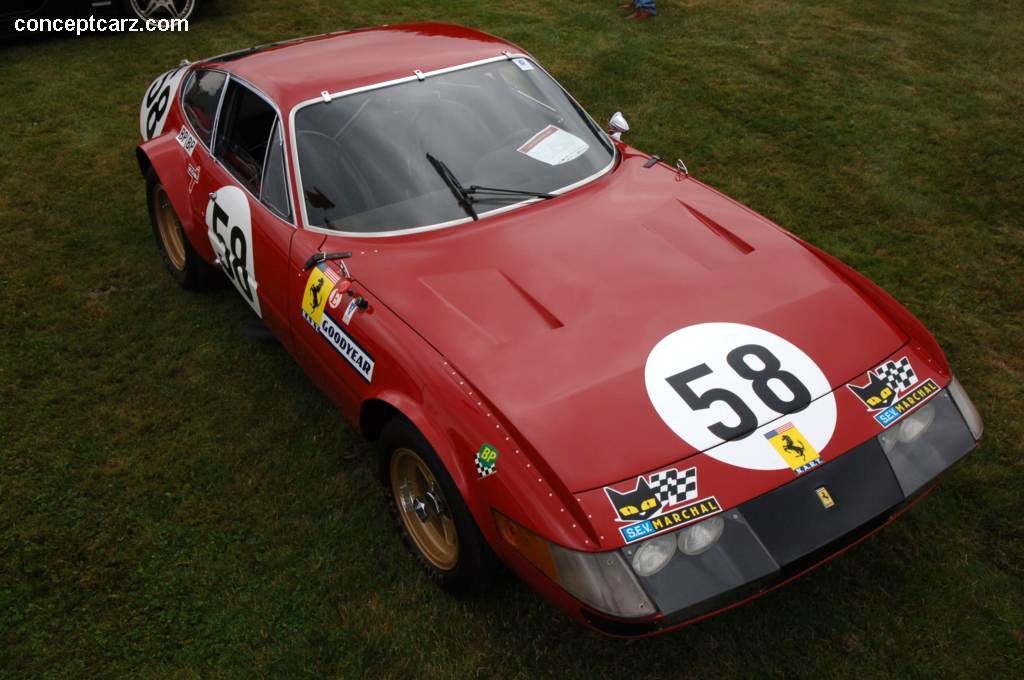
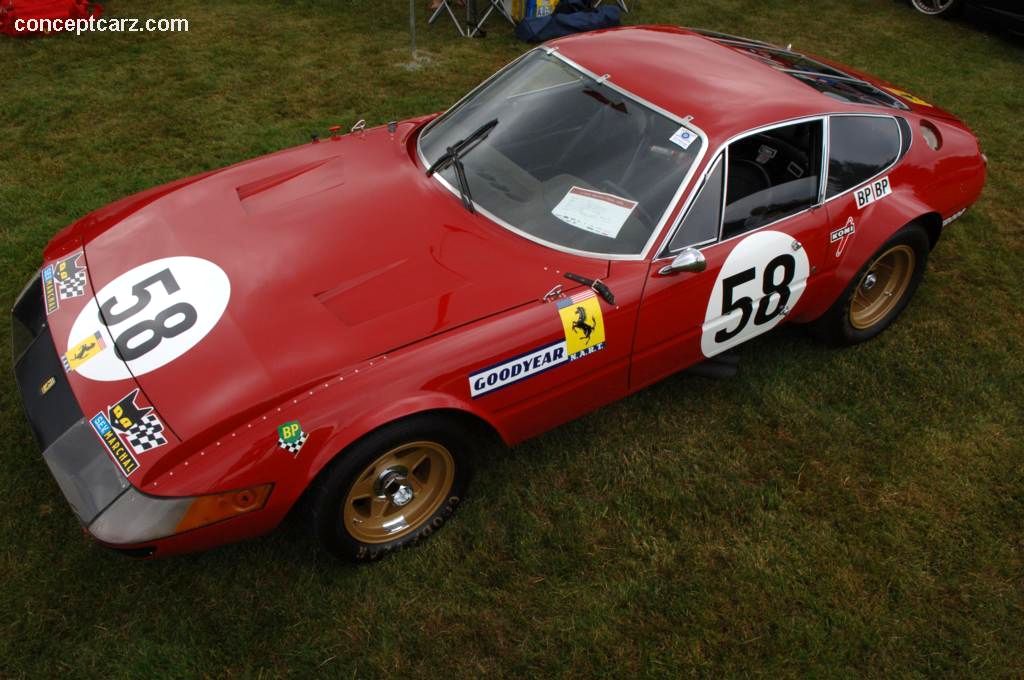
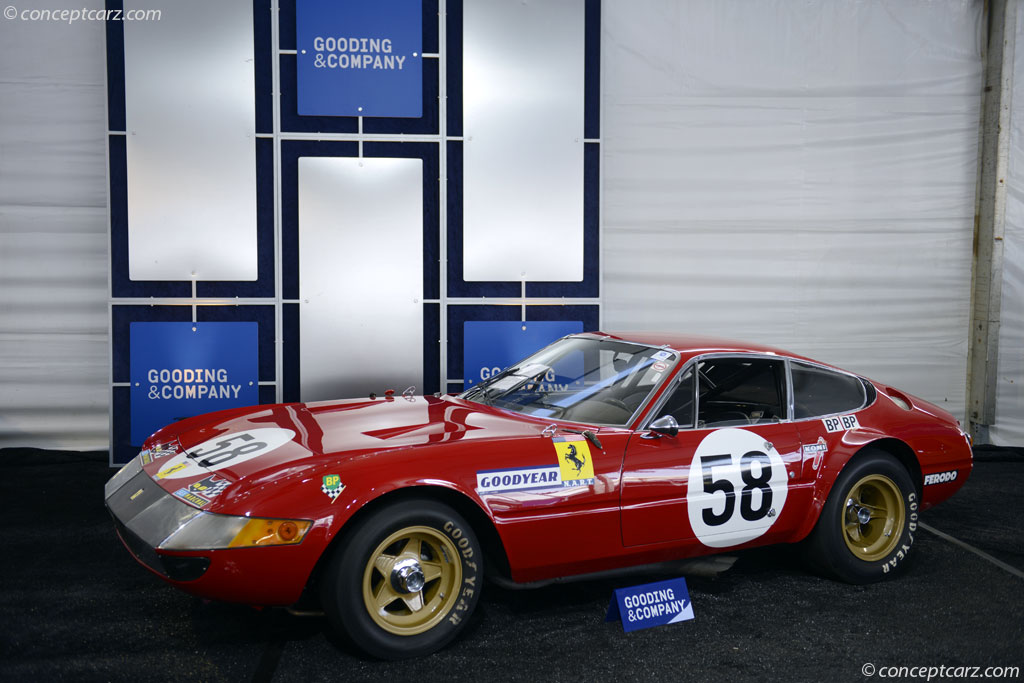
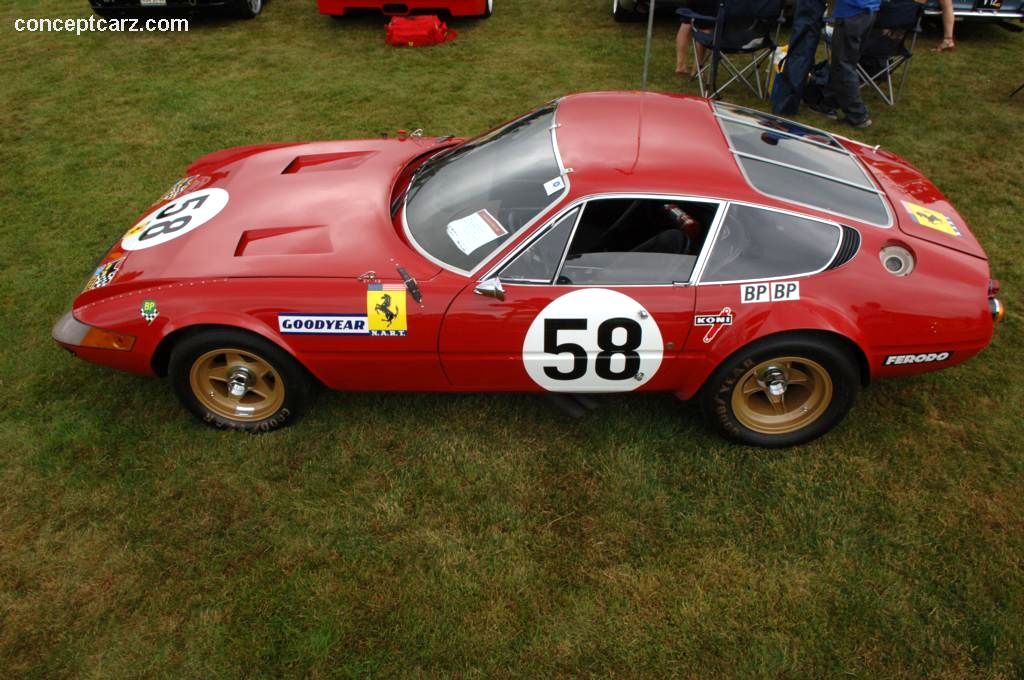
Auction entries : 4The second 365 GTB/4 Group 4 prototype, chassis number 12467, was purchased by Chinetti on June 10th, 1971. The factory delivered it directly to the Le Mans circuit by Ferrari. With assistance from Carrozzeria Sports Cars, the car was fully prepared to Group 4 specification, with a battery cut-out, an FIA-compliant roll-bar, an adjustment to prevent the use of reverse gear, and various other minor details. It had a steel body, a side exhaust, and the windows (except for the windscreen) were plexiglass. Larger headlights rested behind vertical plexiglass, with switches on the roof and the front right-hand wing. The fuel cap was set in the center of the rear boot lid, and small spoilers were added to the front. With 120 liters of fuel, the car weighed 1,514kg despite having an air-conditioning system. At Le Mans, chassis number 12467 was driven by 'Coco' Chinetti (Luigi's son) and Bob Grossman. The test session revealed that the ATE brakes were inadequate, so they were replaced with soft Abex pads.During the race, chassis 12467 was in 25th position after three hours, 15th place after 12 hours, and 5th place by the 19th hour. At the conclusion of the race, chassis 12467 was in 5th place overall and won the Energy Index with an average consumption of 40 litres per 100 kms for the 4.218,752 km covered. After the race, the car was sold to Clive Baker, who raced it under the Baker Motor Co. team banner at the 1972 Daytona Six Hours, driven by Grossman and Reynolds to a 15th-place finish. At the Sebring 12 Hours, Grossman and Reynolds finished 19th; at Watkins Glen, Reynolds and De Lorenzo finished 11th. The final racing outing for chassis 12467 was at the 1973 Sebring 12 Hours, but a mechanical problem prevented it from taking the start.Ferrari's Assistenza Clienti division
Development of factory competition Daytonas by Ferrari's Assistenza Clienti division began in the summer of 1971. Fifteen examples were built between 1971 and 1973 in three batches of five cars. The Series III specification was the final and most evolved of the three batches.
Coupe
Chassis #: 12467
Engine #: 251
View info and history
Auction entries : 4The engines of the first batch of competition cars (the first five cars built) had the same engines as the road cars. The latter two batches had their engines tuned; the Series II cars produced approximately 400 horsepower, and the Series III developed around 450 horsepower. The latter had high-compression pistons, 9.9:1 high-compression cylinder heads, re-choked carburetors, and reprofiled cams. It retained practicable, easily serviced features such as standard connecting rods and standard-sized valves. These competition versions of the 365 GTB/4 Daytona were raced by privateers and not by the official Scuderia Ferrari team. Among the accolades achieved were class victories at the 24 Hours of Le Mans in 1972, 1973, and 1974. They took the top five places in the GT class at the 1972 Le Mans. In 1979, a 1973 car placed 2nd overall in the 24 Hours of Daytona and first in class. Pioneered by NART and other privateers of the early 1970s, the Ferrari 365 GTB/4 Competizione added to the legacy of the Maranello-built GT racing car. Even though it was built by the client assistance department and not in the competition department, it secured several impressive class victories, including at Le Mans. Late in 1973, the first of the replacement rear-engined 365 GT4/Boxer Berlinetta cars were delivered, ushering in a new era of Ferrari GT competition cars. Like its predecessor, the 365 GT4 BB was never officially raced by Scuderia Ferrari. Modified street versions were raced by NART with some factory support. Purpose-built competition versions of the BB 512 arrived in 1978, known as the 512 BB LM (a.k.a. 512 BB/LM or 512 BBLM).
by Daniel Vaughan | Jul 2023
The World Sportscar Championship was sanctioned in 1953 by the FIA (Fédération Internationale de l'Automobile) for sports car racing and quickly became as important and popular as Grand Prix competition. Initially, the major races were contested by road-going sports cars, but by the close of the 1950s, podiums were filled with dedicated competition cars. In 1962, the FIA replaced the World Championship for Sports Cars with the International Championship for GT Manufacturers, with sports cars temporarily being displaced by GT cars. Each racing class now had its own championship rather than a single overall title. Ferrari won the 2.0-liter GT class award in 1963 with its 250 GT Berlinetta SWB and 250 GTO.

Coupe
Chassis #: 12467
Engine #: 251
View info and history
Auction entries : 4
Coupe
Chassis #: 12467
Engine #: 251
View info and history
Auction entries : 4
The replacement for the 275 GTB emerged during the winter of 1967 in prototype form. Beneath its bonnet was a three-valve per cylinder four-liter V12 engine that would not be used on the production version. Instead, a Tipo 251 power unit was used with a 4.4-liter (4390cc) displacement size, hemispherical combustion chambers in its twin-cam heads, and single-plug ignition. With a lengthened block, the bore and stroke grew to 81mm and 71mm, respectively, identical to the Tipo 245 engine, which already powered the 365 GT 2-plus-2, GTC, and GTS models.
Coupe
Chassis #: 12467
Engine #: 251
View info and history
Auction entries : 4
Coupe
Chassis #: 12467
Engine #: 251
View info and history
Auction entries : 4
The first 'Competizione' version, Daytona number 12547, was sold in 1969 to Luigi Chinetti at N.A.R.T. to participate in the 1969 Le Mans 24 Hours. Its exterior was painted red with a black stripe down the side. Although it wore lightweight aluminum coachwork, it did have glass windows, a standard rear exhaust, and air conditioning. Due to being damaged during testing, it never raced at Le Mans, but it did compete in 1970 at the Daytona 24 Hours.

Coupe
Chassis #: 12467
Engine #: 251
View info and history
Auction entries : 4
Development of factory competition Daytonas by Ferrari's Assistenza Clienti division began in the summer of 1971. Fifteen examples were built between 1971 and 1973 in three batches of five cars. The Series III specification was the final and most evolved of the three batches.
Coupe
Chassis #: 12467
Engine #: 251
View info and history
Auction entries : 4
by Daniel Vaughan | Jul 2023
Related Reading : Ferrari 365 GBT4 Competition History
. The first series of five cars were equipped with unmodified engines from the road-going cars. The second batch of five cars was tuned to produce 400 horsepower, and the third batch of five had 450 horsepower engines. The Ferrari 365 GTB4 Competition models were not campaigned by the factory team rather, they were raced by privateers. Among the accolades achieved was a 5th overall in 1971....
Continue Reading >>
Continue Reading >>
Similar Automakers
Similarly Sized Vehicles
from 1969


1969 Ferrari 365 GTB/4C Competition Vehicle Profiles

Recent Vehicle Additions


Related Automotive News

Artcurial : 1969 Ferrari 365 GTB/4 Daytona Competizione Groupe 4
Headed to Auction 1969 Ferrari 365 GTB4 Daytona Competizione Groupe 4
Chassis number 12467 is expected to cross Artcurials auction block during their Le Mans Classic sale. It has a pre-auction estimated value of %246.5 - %247.5 million. It was 5th...

1969 24 Hours of Le Mans: A Traditional Statement Provides a Memorable Race
What if a statement ended up costing one of the biggest victories of ones career Would it be worth it Jacky Ickx would come close to finding out as he approached the checkered flag on the afternoon of the 15th of June in 1969.
Ford had determined...

New Vantage GT3 aiming for glory on debut in IMSA's world-famous 12 Hours of Sebring
New Vantage GT3 to challenge for class podium on first visit to Sebring
Heart of Racing out to build on strong IMSA debut for Vantage at Daytona
Sebring 12 Hours class winner Magnus Racing returns to the fray with its new Vantage GT3
Rebel Rock...

Aston Martin targets Daytona glory as Vantage kicks-off global programme of GT racing in 2023
Aston Martin begins 110th anniversary year aiming for victory in North Americas most famous endurance race – the Rolex 24 at Daytona
Four Vantage GT3s in contention for Rolex 24 GTD class supremacy
Heart of Racing begins IMSA GTD title defence,...

The Amelia's Ferrari 275 GTB Special Class
The Ferrari 275 GTBS that won the GT class in the 1965 24 Hours of Le Mans was featured in the special class saluting the Ferrari 275 GTB at the 26th annual Amelia Island Concours dElegance.
The legend of the 275 GTBC -- Competizione...

LE MANS WINNER HEADLINES THE AMELIA'S FERRARI 275 GTB SPECIAL CLASS
Jacksonville, FL – The Ferrari 275 GTBS that won the GT class in the 1965 24 Hours of Le Mans will be featured in the special class saluting the Ferrari 275 GTB at the 26th annual Amelia Island Concours dElegance.
The legend of the 275 GTBC...

Spectacular Racers Lead Stellar Entry For Salon Privé Concours D'Élegance
Rare Ferraris include legendary Le Mans-winning 166MM First production Jaguar D-type will join them at Blenheim Palace Grand Touring era represented by beautiful Aston Martin DB4 GT McLaren F1 GTR to be ho...