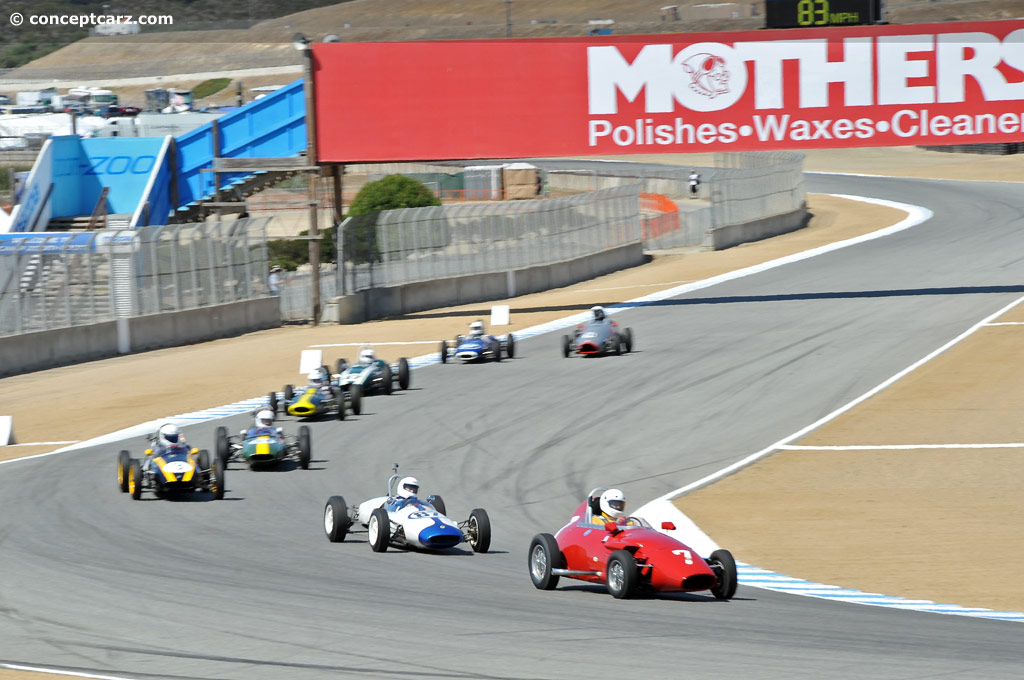
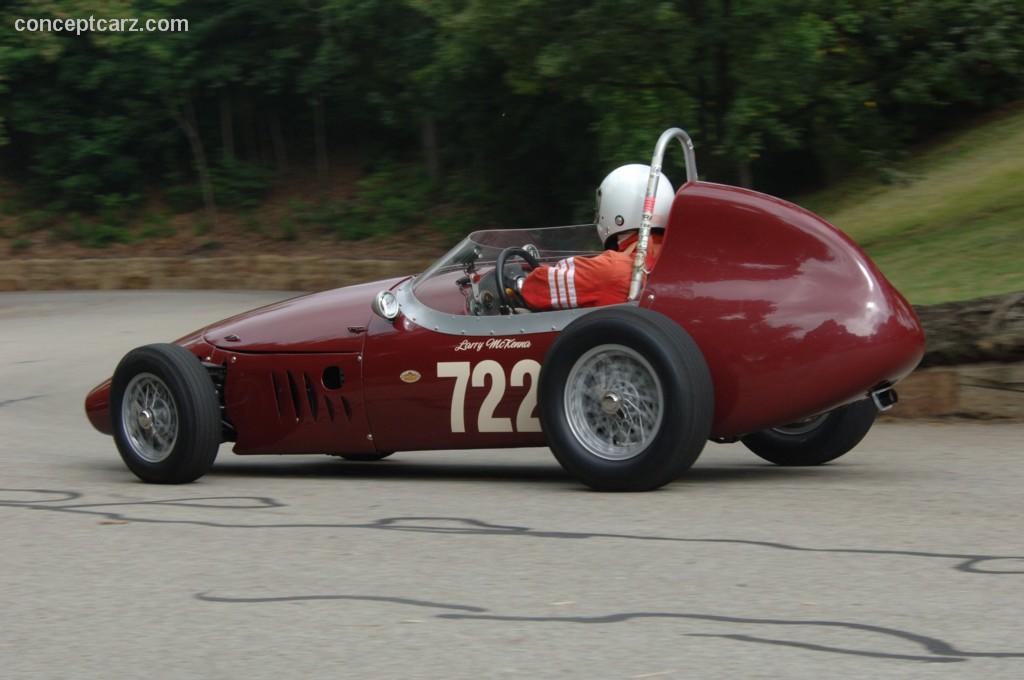
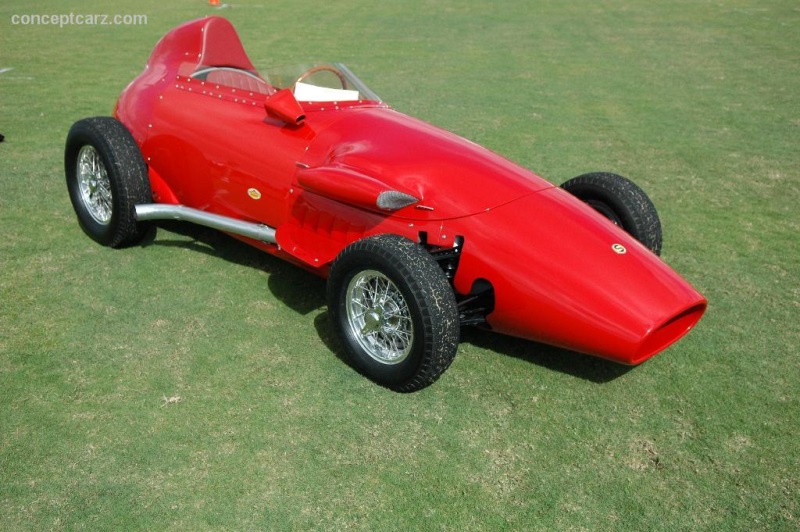
1959 Stanguellini Motoposto Formula Junior pictures and wallpaper 1959 Stanguellini Motoposto Formula Junior pictures and wallpaper 1959 Stanguellini Motoposto Formula Junior pictures and wallpaper 1959 Stanguellini Motoposto Formula Junior pictures and wallpaper

View more photos
Chassis Num: 137
 
This monoposta racecar is serial #137, and was manufactured in Modena, Italy, in June of 1959 by Vittorio Stanguellini, also known as the "Magician of Modena." The all aluminum body was produced by Vaccari & Baccrini-Carrozzeria Gransport. The engine is a modified Fiat 1100 cc with Weber twin-choke carburetors and can produce 78 hp at 6500 rpm.

The car was first sold to Peter Carpenter and he raced it extensively throughout Europe during the 1959 series of Formula Junior, placing 5th place at Monza and 2nd at Di Salerno. The Formula Junior cars were designed to provide an international class of single seat racing cars. It would train and develop a new breed of designers and drivers. Specifications were intended to limit the components to production units.

This car was partially restored in 1970s and spent approximately 20 years in a private museum of an Italian car collector in Miami, Florida.

The current owner purchased the car in 1994 and has spent the last 8 years restoring it to the original racing condition.
Automobili Stanguellini, an Italian sports car builder, is remembered for their sports cars and for competing in races such as the 24 Hours of LeMans, Monza, and other International competition. The single seat racing cars were given aluminum bodies and had modified Fiat 1100 cc engine that produced nearly 80 horsepower, thanks in part to the Weber twin-choke carburetors. Vittorio Stanguellini was known as the 'Magician of Modena' and his vehicles provided many podium finishes for the drivers.
Racer
Chassis Num: 00132
 
The 1959 Stanguellini Motoposto finished in red and bearing the number Zero (0) was offered for sale at the 2006 Russo & Steele Auction held in Monterey, Ca. It is #00132. It was originally owned by Raphaele Cammorata of Milan who campaigned it in the Grand Prix di Napoli, Coppa Junior at Monza and more. He became the national Italian Champion in 1959.

It was then purchased by Don Wasserman who raced it at Sears Point where the vehicle was involved in an accident. The car was flipped and incurred damage. It was sent to Nino Epifani for a six-year body-off restoration. Terry Burke was the vehicles next owner.

The Motoposto racer was campaigned in the 2006 Sears Point Wine Classic race.

On auction day the vehicle was sold for $121,000.
View more photos
Racer
Chassis Num: CS00159
 
This 1959 Stanguellini Formula Junior racer has a build date of December 5th of 1959. '159' was exported to the United States, arriving in early 1960. As Cooper's rear engined Type 52 had been introduced before 159 was built, 159 was obsolete before its arrival in The States. 159 bounced around the Northeast and Midwest through the 1960's and early 1970's, at one time selling for $250.

159 was rescued by noted vintage racer Peter Giddings in 1977. Dennis Burkey of Virginia ran 159 in the Mid-Atlantic area into the late 1980's. Pam Clapp Lyford brought 159 to the Northwest in the early 1990's.

It is currently owned by Bill Weed, who purchased the race car from Mrs. Lyford in 2005.

The car is powered by a four-cylinder engine capable of producing 85 horsepower. There is a Fiat gearbox, Borrani wire wheels, and Dunlop tires. The front suspension is independent, while the rear is a live axle setup.
Vittorio Stanguellini was a good businessman and an excellent builder of racing cars. He was born on March 24th of 1910. 23 years later he was creating racers and building a reputation. The Second World War slowed his progress but shortly after the treaty he had regained momentum. His 1100 twin cam Fiat-based engines were in high demand. War torn Europe was eager to get back to racing and these were excellent, durable, competitive, and affordable racers. By 1950 he was producing, what would become legendary, a dual overhead camshaft 750 engine which would be used successfully in single seater and sports cars racing.

Much like other specialty-equipment producers such as Abarth, Stanguellini often modified and enhanced pre-existing equipment. He operated Modena's larger Fiat dealership and was renowned for his metal work and truck-body fabrication business. His legacy though, was with his racers. Part of that success was due to his Sporting Director Adolfo Bedoni who aided Stanguellini in the creation of some of the world's best F1 feeder series racers.

Count Giovanni Lurani envisioned a racing series that would be inexpensive and could help drivers prepare for the next level of racing, such as Formula 2 or Grand Prix. The series would be called the Formula Junior and it took some convincing to get it approved by the Italian Automobile Club. Stanguellini saw an opportunity and by 1958 had created some racers that would qualify for this new series. More importantly he created machinery and had gathered components to construct more racers. By the time the series was granted full international status in 1959, Stanguellini had a front-engined racer that was competitive, tested, and proven. Over its racing career in the Formula Junior series the Stanguellini cars would capture over forty national and international victories and several championships.

For the 1958 season the rules stated that any engines of Italian origin could be used. This rule was relaxed in 1959 to include any production car classified in the FIA's Appendix J GT category. The other major components were the gearbox and brakes which also had to come from FIA homologated cars in their International Touring Class. Other rules for 1958 stated that the front suspension was to come from the vehicle that had housed the engine. The minimum weight allowed was 400kg.

For 1958 the Stanguellini was created from a tubular steel ladder type frame and reinforced with integral stiffening tubes. The front suspension was an independent suspension with parallel wishbones, coil springs, and an anti-roll bar. The coil springs were tilted at a steep angle pointed inwards. In the rear was a live axle located by parallel trailing arms with coil springs pointed at a vertical angle. There were angled telescopic shock absorbers similar to the ones used on the Stanguellini 750 cc Formula Corse. Al-Fin drum brakes were placed on all four corners and provided adequate stopping power for the 12-inch Borrani wire wheels. The driver sat low in the seat and located to the right was the shifter. Regulations stated that the gearbox had to be similar to production cars so Stanguellini selected a unit from the Fiat 1100. Minor modifications by Stanguellini included a special gear ratio and a single dry plate clutch.

There were strict requirements for the engine such as overhead cams were not permitted. The Fiat 1100 Millecento motor meet most of the requirements and was chosen for the Stanguellini racer. Located in the front the 1.1 liter Fiat four-cylinder engine had a 68 mm stroke and a 75 mm bore resulting in a 1089 cc of displacement. With some special tuning, the engine was modified to produce 78 horsepower; an increase of 42 horsepower over the standard unit. The engine kept cool by the front-mounted radiator and a unique duct that was located atop of the engine cover. Louvres located above the front wheel aided in the circulation of cool air.

The body work was courtesy of the coachbuilder Gransport of Modena. The body was similar to the Grand Prix racers of its day, but smaller. The body was aluminum due to its lightweight features and rigidity. The resulting 420kg racer could race from zero-to-sixty in just 6.6 seconds and reaching top speed at 135 mph.

In 1957 Stanguellini created a prototype bearing chassis number 04087 which was based on their prio 750 formula Corse single seater cars. The prototype was powered by a Fiat 1100 engine which received modifications to include a two-port head and two downdraught Weber carburetors. After time, these were replaced with two Dell'Ortos. The legendary Juan Fangio was given the honor of performing test runs at the Modena Autodrome. With additional tweaking and testing, the prototype proved to be a potent competitor. By the following year there were 15 Stanguellini Formula Junior's created, each with production-specification Fiat front suspension. Driven by Roberto Lippi and sponsored by Bardahl, a Stanguellini racer captured the first Italian FJ Championship in 1958 after winning an astonishing four races during the season. The popularity of the proven racer skyrocketed and for 1959, around seventy examples were produced. Thirty more were created in the following year.

There were around 30 examples created in 1959 that were given an independent rear suspension setup.

In 1959 the Stanguellini captured the International Championship in 1958 and in 1959. They also captured the International Series Championship in 1959. The racers dominated until 1960 when competitors such as Colin Chapman and his mid-engined Lotus 30's and the mid-engined Cooper's proved too nimble and powerful for the Stanguellini.
Formula Junior

In October of 1958, the Controller of International Motorsport (CSI), now FIA, adopted the formula racing class 'Formula Junior'. Formula Junior is a single-seater racing class started by Count Giovganni 'Johnny' Lurani and intentioned for young and inexperienced drivers. It was a way for gaining experience in the racing environment while using inexpensive components from ordinary automobiles.
Even though the class was short-lived, ending in 1964, it was responsible for revolutionizing technology and car design and ultimately helping bring about Grand Prix competition. The sport became a victim of its own success. Due to the popularity, the technology in the cars was being enhanced in ever area possible. This included more horsepower from the engines and lighter vehicle designs that were more aerodynamic. For many, the costs associated with being competitive became too expensive.

The original rules for Formula Junior stated the vehicles were to be powered by a production-based 1000cc engine for a car weighing less than 792 pounds. If the car weighed 880 pounds, an 1100 cc engine could be used. Components such as the cylinders, head, block, brakes, and transmission had to come from a production vehicle. Safety was paramount and roll-bars were required. Single or twin overhead camshafts and limited-slip differentials were not allowed.

There were few production based engines that could accommodate the strict rules. Many Italians favored the 1100 cc Fiat engine.

There were no rules to where the engine was to be mounted. Some favored the front while other favored the rear of the vehicle. Much of the decision was based on optimal weight distribution achieving the best performance possible.

During the first year of competition, the Stanguellini's dominated the racing circuit. The Swiss driver Michael May won the first International Championship for Formula Juniors in 1959 driving a Stanguellini. Other competitive vehicles consisted of the German based Mitter and Hartmann vehicles powered by the DKW engines. France had the Ferry and DB vehicles, both powered using Renault engines. In Britain, the Elva 100 series sports cars produced by Frank Nichols were a popular favorite. In April of 1959 The Elva 100 was the first Formula Junior vehicle to start a British race. It was also the first mass-produced Formula Junior vehicle from Britain. Later, other names such as Gemini (Moorland), Lotus and Lola, to name a few, would enter the racing scene.

Things were different in the 1950's and 1960's than they are today. Cosworth Engineering was not a name-plate; rather they were broke engineering's looking for a 'nitch' in the automotive industry. Their big-brake came from a pair of 1959 Ford Anglia engines which they used to power their vehicles. From their, their racing success skyrocketed and their line of vehicles became legendary.

Cooper used the chassis from their Formula One cars for the Formula Junior class. A BMC A-series engine provided the power. Lotus entered the scene with their Lotus 18 featuring an 1100 cc. Ford Anglia engine. Later, the Lotus 20 and 22 were entered for competition. They featured tube-frame construction. In 1963, Lotus revolutionized the sport with their Lotus 27 which was built using monocoque construction.

The sport continued to gain support and the list of manufacturers worldwide continued to grow. By the close of 1963, more than 500 manufacturers were producing vehicles to race in Formula Junior. Most were using rear-engine designs since the front-engine vehicles proved to be less competitive.

The demise of the sport began when the cost of being competitive began to escalate. There were increasing costs associated with producing light-weight and sturdy chassis compounded with tapping into every available horsepower possible from the 1100cc engines. The sport was eventually taken over by Formula 3 which also had a short life span. Ultimately it would be Formula Vee and Formula Ford that would take the place of the single-seater, inexpensive racing sport and bringing it to a whole new level.

Today, Formula Junior is still being raced in vintage race classes. Since there were so many manufacturers producing the cars, many still exist. Most are rear-engine vehicles, with the front-engine vehicles being the most sought-after due being more rare. Some of the designs suffered from under-steer, others were better at drifting through corners, but all provided a level of satisfaction, competitiveness, and fun that is hard to match.

Photos grouped by event

Pittsburgh Vintage Grand Prix

Monterey Historic Automobile Races at Laguna Seca

Pittsburgh Vintage Grand Prix

Russo and Steele Auction in Monterey

2006 Pittsburgh Vintage Grand Prix

Monterey Historic Automobile Races

2006 Meadow Brook Concours d'Elegance

2006 Palm Beach International Concours d'Elegance

2005 Pittsburgh Vintage Grand Prix

2005 Amelia Island Concours d'Elegance


Similar Automakers
Add Review
Other models by Stanguellini
AddThis Social Bookmark Button

Related Articles and Event Coverage
Pittsburgh Vintage Grand Prix
Monterey Historic Automobile Races at Laguna Seca
Pittsburgh Vintage Grand Prix
Russo and Steele Auction in Monterey
2006 Pittsburgh Vintage Grand Prix
Monterey Historic Automobile Races
2006 Meadow Brook Concours d'Elegance
2006 Palm Beach International Concours d'Elegance
2005 Pittsburgh Vintage Grand Prix
2005 Amelia Island Concours d'Elegance


Vehicle Spotlight
2010 Lexus RX 3502010 Lexus RX 450h2010 Kia Soul
2010 Ford Fusion HybridNissan 370ZSpyker C8 Laviolette LM85
Infiniti G37 ConvertibleAston Martin V8 Vantage GT4Brabus tuned Tesla Roadster
Anteros XTRHyundai Genesis RHYS Millen RacingHyundai HKS Genesis
Hyundai Genesis Street ConceptsDodge Mopar Drift ChallengerToyota Tacoma X-Runner Concept
Subaru Forester XTI ConceptVolkswagen CC Eco Performance ConceptHamann Volcano
Pontiac G8 ST ConceptPontiac Solstice GXP Coupe ConceptChevrolet Camaro LS7 Concept
Chevrolet Camaro Black ConceptLamborghini Gallardo LP560-4 Super TrofeoLamborghini Estoque Concept