1997 Mercedes-Benz F300 Life Jet
1997 Mercedes-Benz F300 Life Jet Navigation
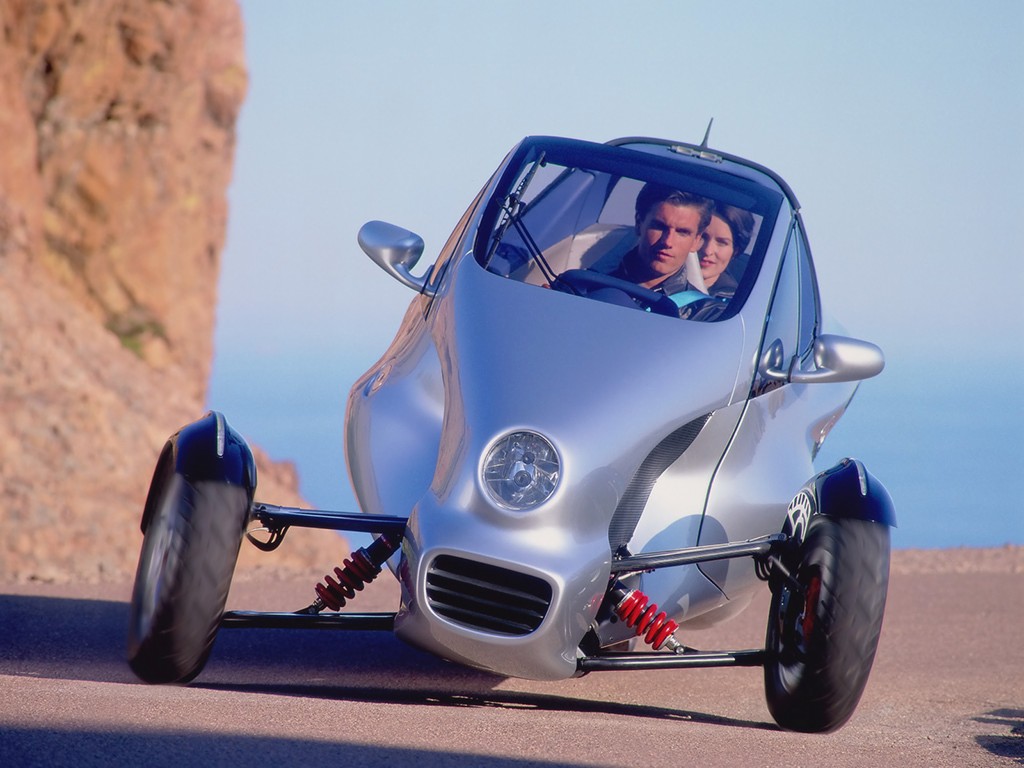
The idea behind the F 300 Life Jet, presented at the 1997 Frankfurt Motor Show, was to combine the benefits of a motorbike with those of a car. Being able to lean into corners, to feel the power of the engine, and be closer to the elements: these are the trademark motorbike characteristics of the F 300 Life Jet. Its car-like properties include greater stability thanks to its three wheels, a roof, seat belts and air conditioning. In addition, it requires neither a helmet nor protective clothing.
The most striking feature of this research vehicle was its unique Active Tilt Control, which was developed specially for the F 300 Life Jet and allows it lean into corners. It also featured specially developed tyres that allowed for such a large tilt angle. The chassis of the F 300 Life Jet was made of aluminium and weighed just 89 kilograms. The bodyshell was inspired by aeroplane design, as were the vertically opening front-hinged doors. In fine weather, the two roof sections could be removed and stowed in the boot, turning the F 300 Life Jet into a cabriolet.
The headlamps' electronics were linked to the computer for the Active Tilt Control system and could thus switch on a special cornering light. The idea of headlamps that follow the line of the road can now be found in the Active Light System available on Mercedes-Benz cars such as the E-Class.

The F 300 Life Jet was the first research vehicle to be designed completed by computer. As such, it also served to test a new design tool.Source - Mercedes-Benz
The most striking feature of this research vehicle was its unique Active Tilt Control, which was developed specially for the F 300 Life Jet and allows it lean into corners. It also featured specially developed tyres that allowed for such a large tilt angle. The chassis of the F 300 Life Jet was made of aluminium and weighed just 89 kilograms. The bodyshell was inspired by aeroplane design, as were the vertically opening front-hinged doors. In fine weather, the two roof sections could be removed and stowed in the boot, turning the F 300 Life Jet into a cabriolet.
The headlamps' electronics were linked to the computer for the Active Tilt Control system and could thus switch on a special cornering light. The idea of headlamps that follow the line of the road can now be found in the Active Light System available on Mercedes-Benz cars such as the E-Class.

The F 300 Life Jet was the first research vehicle to be designed completed by computer. As such, it also served to test a new design tool.Source - Mercedes-Benz
Dynamic driving pleasure on three wheels
Cornering dynamics of a motorcycle, safety of a passenger carBody and front wheels tilt when negotiating bendsThree wheels, two seats and a jet-design body – these are the visual characteristics of a research vehicle with which DaimlerChrysler surprised the public at the Frankfurt Motor Show in autumn 1997. The F 300 Life-Jet is aimed at a market segment which does not even exist yet, namely the niche between passenger cars and motorcycles. A new species of vehicle could establish itself here which combines everything the modern motorist requires for the perfect driving experience: the fresh-air fun of a convertible, the individuality of a roadster, the performance of a sports car, the comfort of a compact car and – not least – the safety of a Mercedes-Benz.
The F 300 Life-Jet offers all these attributes, and combines them with a further special feature which car drivers have previously lacked: the driving experience and cornering dynamics of a motorcycle. Accordingly this research vehicle reconciles seemingly contradictory characteristics: it is as safe and comfortable as a four-wheeled vehicle but as dynamic as a two-wheeler. Active Tilt Control (ATC) lies at the heart of the F 300 technology. This system is based on the lightning-fast interaction between electronics, hydraulics and mechanics: sensors register the current driving situation and continuously feed the onboard computer with data indicating the yawing and linear speed of the vehicle, the acceleration, the current steering angle and the position of the hydraulic cylinder which steers the front axle. On the basis of this information the computer calculates the necessary angle of body tilt and sends the relevant control signals to the hydraulic system. As a result, the F 300 Life-Jet adopts a precisely calculated angle of tilt when negotiating bends, which reflects the current driving situation and therefore offers the best possible resistance to overturning. At maximum speed, for example, the ATC computer allows only a very small amount of body roll and provides additional stability, but quickly allows the active control system to select a maximum angle of tilt of 30 degrees at non-motorway road speeds.Cornering speed of a motorcycle
By means of this active tilt on bends, the F 300 developers are able to compensate a large proportion of the lateral forces which act on the vehicle and affect its resistance to overturning. The centre of gravity is shifted to the inside of the bend, substantially compensating the tendency to overturn and making high cornering speeds possible. The maximum lateral acceleration of the F 300 Life-Jet is 0.9 g – a level normally only reached by experienced motorcyclists. The loads acting on the occupants remain low, however. Owing to the tilting effect on bends, they only need to resist the centrifugal forces to a very small extent – an advantage that decisively improves ride comfort. The engine and transmission of the three-wheeled study are in a space-saving position between the interior and the rear wheel. The 1.6-litre power unit adopted from the A-Class has an output of 75 kW/102 hp and accelerates the F 300 Life-Jet from standstill to 100 km/h in just 7.7 seconds. The maximum speed is 211 km/h. This innovative three-wheeler therefore achieves the performance levels of much more powerful sports cars and roadsters.Aluminium chassis with removable roof sections
The chassis of the two-seater is made from aluminium and weighs only 89 kilograms. Special features of the body include an upward pivoting door on the driver's side, a rearward pivoting door on the passenger side and a fixed roof of aluminium and transparent plastic which makes the F 300 Life-Jet a genuine all-season vehicle. The two roof sections can be easily removed and stowed in a compartment above the rear wheel, converting the three-wheeled study into an open-top roadster.
F 300 Life-Jet Resarch Car
F 300 Life-Jet: the three-wheeled driving machine• New concept for sport-utility vehicles of the day after tomorrow• The cornering dynamics of a motor cycle, the safety of a saloon car• Body and front wheels lean into the corner• Sensors and computer calculate tilt angle• Consumption with A 160 engine just 5.3 litres• Computer-controlled headlamp with special cornering light With the research project F 300 Life-Jet on show at the 57th Frankfurt Interna-tional Motor Show (IAA), Daimler-Benz is airing some new ideas on vehicle concepts of the future for the young and young at heart. The three-wheeler research study, equipped with intelligent technology, blends the special thrill and cornering dynamics of a motor cycle with the safety and comfort of a saloon car - a combination which offers unrivalled driving enjoyment.
Thanks to a new active tilt control system, the front wheels and body of the twoseater lean into the bend when cornering. This means the F 300 Life-Jet combines cornering speeds comparable with those of a motor cycle with maximum standards of active safety. The tilt control also increases the ride comfort for the passengers, who hardly need to brace themselves against centrifugal forces when cornering. A sophisticated electronic system uses the vehicle speed, acceleration, steering angle and yaw to calculate the exact angle of tilt required in any particu-lar situation.The electronic commands are passed on to a hydraulic cylinder on the front axle which, with reference to the steering angle, pushes one of the two spring struts outwards to produce the desired degree of lean. The maximum tilt angle is 30 degrees.Engine and transmission taken from the A-class
The three-wheeler's engine and transmission are space-savingly accommodated between the interior compartment and the rear wheel. The Daimler-Benz researchers decided to use the 1.6 litre 75 kW/102 hp engine from the new Mercedes-Benz A-class. The four-cylinder unit accelerates the F 300 Life-Jet from 0 to 100 km/h in just 7.7 seconds. With a top speed of 211 km/h, the innovative three-wheeler boasts the performance of more powerful sports cars or roadsters.
The two-seater research car has an aluminium chassis which weighs only 89 kilograms. Points of interest on the body include an upward-swivelling door for the driver, a rear-swivelling passenger's door and a hardtop of aluminium and trans-parent plastic, which makes the F 300 Life-Jet an uncompromising all-weather, all-year-round contender. The roof is split into two halves. To turn the three-wheeler into an open roadster, these can be quickly and easily removed and stowed away in a compartment over the rear wheel. Headlamp with automatic cornering control
A new-design front headlamp with three reflector zones and two bulbs offers maximum illumination when cornering. The headlamp is equipped with an electronic control system which is linked to the active tilt control. It adjusts the headlamp position in response to the tilting of the body and if necessary activates an additional cornering light. This increases the width of the dipped beam by more than 80 per cent.The direction indicators, brake lights and side marker lights of the research vehicle feature a new, space-saving neon lighting technology. The low beam is automatically switched on by a sensor at nightfall or when entering a tunnel. The F 300 Life-Jet in dialogue with show visitors
Daimler-Benz will take the unveiling of the F 300 Life-Jet at the Frankfurt International Motor Show as an opportunity to engage in dialogue about the new concept with visitors attending the Show. The company will look closely at the public's reactions, which will influence its decision whether or not to build a novel, activelifestyle vehicle of this kind in a production version.
F 300 Life-Jet Resarch Car Driving dynamics
On a roll• Active tilt control with sensors• High lateral acceleration, maximum safety• Computer-controlled hydraulic system to regulate tilt Fun, excitement, sport, leisure, pleasure, emotion. As modern lifestyles change, so do the expectations facing the car. Active-lifestyle models are on the advance - vehicles that in addition to their transport role are also active partners in the pursuit of leisure interests. The F 300 Life-Jet also offers another aspect, teamwork between ‘man and machine' - between the occupants and the technology, which scales new dimensions in driving dynamics.
The heart of this technology is ATC (Active Tilt Control), a system in which electronic, hydraulic and mechanical systems communicate at lightning speed. Sensors assess the driving situation at any particular moment and supply data about the yaw and longitudinal speed of the vehicle, the acceleration, the steering wheel angle and the position of the hydraulic cylinder controlling the front axle. The computer then uses this information to calculate the appropriate body tilt angle and sends the necessary commands to the hydraulic system. As a result, the F 300 Life-Jet corners at an angle which will ensure optimum safety. At top speed for example, ATC permits only a small degree of tilt, which helps to stabilise the body, while at more moderate speeds it reacts very quickly to produce a tilt angle of up to 30 degrees. The ATC system is also quickly able to identify different driving styles - the various sensors on the F 300 Life-Jet create a direct dialogue between man and machine. The system can distinguish whether a driver has a more sporty style or a smoother, less hectic style and it refers to these preferences when controlling the front axle.Cornering speeds similar to a motor cycle
With active cornering control, it is possible to counteract a large portion of the transverse forces which act on the vehicle and affect its tilt characteristics. The centre of gravity is shifted more towards the inside of the corner, largely eliminating the tilting moment and permitting high cornering speeds. The F 300 Life-Jet can cope with a maximum transverse acceleration of 0.9 g, a level normally only encountered by seasoned motorcyclists. Even under these conditions, the stress on the occupants is insignificant. Lttle bracing effort is required, and this makes for a much more comfortable ride.
To come back to the engineering: all the ATC systems are provided in triplicate, in the interests of active safety and reliable functioning. As soon as the first module has processed the data from the sensors and calculated an optimal tilt angle, a second microcomputer comes into play and checks the tilt angle. It uses the information from its redundant sensor system, computes a tolerance range of possible tilt angles and compares these values with the actual situation.Should the actual tilt angle be outside the tolerance range, the second module switches off the ATC system and activates a third emergency system. The F 300 Life-Jet is still fully operational. If such an error occurs, the hydraulic system still has sufficient pressure to continue reducing body tilt during cornering and öane changes. New-design tyres with high resistance to lateral forces
The tyres play a prominent part in the impeccable handling of the F 300 Life-Jet. Though they look like conventional motor cycle tyres they actually incorporate an innovative construction principle for operation under enhanced camber and side-slip conditions. The front axle is fitted with size 150/80 ZR 16 tyres with a special tread designed for low friction and low side-slip resistance. The characteristics of the rear wheel (190/50 ZR 17) are quite different, with a high-friction tread and reinforced belt which is extremely resistant to side-slip forces. This intelligent tyre configuration ensures good-natured handling characteristics with a tendency towards understeer, which keeps the rear wheel firmly on track.The magnesium rims of the F 300 have only about 75 per cent the weight of a conventional motorcycle aluminium rim. Hydraulic cylinder between the front wheels
The hydraulic system in the F 300 Life-Jet consists basically of a pump, two pressure reservoirs and a servo cylinder with valve placed cross-wise between the front wheels. The pump is flanged to the engine. As soon as the engine is started, it delivers the hydraulic fluid to the two reservoirs at a constant pressure of approximately 180 bar. Via a valve the ATC computer creates the flow required to set the axle components to the desired tilt angle. The hydraulic cylinder is connected on the left and right to a jointed lever shaft. When the cylinder is actuated, the joints actuate the upper anchorage points of one of the two spring struts. The axle control arms and track rods follow this movement and as a result the wheel and body adopt the desired tilt angle. Simultaneously, the linkage between the lever shafts ensures that the opposite spring strut too follows this movement, moving out of its original position to support the body.
The sophisticated dual-wishbone front axle uses an up-and-coming new material which is particularly light and strong - carbon fibre reinforced plastic (CFRP). The CFRP components are aerodynamically streamlined but they also have enough room inside to accommodate the brake lines and cables leading to the front wheels. Admittedly, steel cannot be dispensed with altogether. It is combined with CFRP on the upper and lower front axle guide tubes, reinforcing the control arms and ensuring an optimal connection between these, the integral sub-frame and the axle bearings. The motorcycle-type suspension unit at the rear of the research car forms part of a sophisticated power transmission system. It is made of die-cast aluminium and is connected to the chassis via lateral arms. The drive is supplied via a toothed belt and a shaft with eccentric disc inside the suspension unit.Developed in the computer, tested in the simulator
The F 300 Life-Jet already has thousands of test kilometres under its belt - on the computer. The simulation program „CASCaDE' (Computer Aided Simulation of Car, Driver and Environment) developed by Daimler-Benz was an important tool in devising this new vehicle concept. A virtual prototype simulated by this program fed back information on the handling of the F 300 Life-Jet right from the early design phase and allowed the new driving dynamics systems to be honed with reference to realistic conditions. „CASCaDE' simulates typical steering commands and allows the handling behaviour to be precisely analysed right through to the critical limits. The vehicle's environment is also simulated so that the behaviour of the vehicle can be studied in situations such as cornering, moving off from stand-still, accelerating, braking or exposure to side winds.The CASCaDE testing was followed by tests in the Daimler-Benz Berlin driving simulator. Here the engineers looked at how car drivers coped with the ATC and how it should be refined. Two dozen test persons took an F 300 Life-Jet model out on a simulated journey and gave the researchers valuable tips for achieving a remarkable standard of man/machine teamwork.Eventually a real test vehicle was constructed, which was put through its paces on racing tracks and test tracks. The quaint-looking test vehicle contained all the technical components of a F 300 Life-Jet and provided an opportunity to compare simulation with reality.Source - DaimlerChrysler
- 1997 Mercedes-Benz F300 Life Jet Menu
- Article
- Image gallery
- Specifications
Mercedes-Benz
Similar Automakers
Recent Vehicle Additions


Performance and Specification Comparison
Related Automotive News

Public Debut For Three Models At Home Motor Show: Hyundai Motor At The 2017 Iaa
Hyundai Motor showcases its young, Europe-focused range with the All-New i30 N, i30 Fastback, KONA and its new-generation Smart Stream powertrain line-up at the 2017 Frankfurt Motor Show (IAA)
IAA is Hyundais home motor show in Europe, with Desi...

Vauxhall At The 2017 Frankfurt Motor Show
All new quartet debut Grandland X, Insignia GSi, Country Tourer and Vivaro Tourer
Exclusive allows customers to take personalisation of their Vauxhall to the next level
VAUXHALL REVEALS ALL-NEW GRANDLAND X SUV
New SUV with a sporty design...

Public Debut For Three Models At Home Motor Show: Hyundai Motor At The 2017 Iaa
Hyundai Motor showcases its young, Europe-focused range with the All-New i30 N, i30 Fastback, KONA and its new-generation Smart Stream powertrain line-up at the 2017 Frankfurt Motor Show (IAA)
IAA is Hyundais home motor show in Europe, with Desi...

1976-2016: FORD FIESTA CELEBRATES 40 YEARS OF PRODUCTION
Ford celebrates 40 years since the first Ford Fiesta rolled off the production line in Valencia, Spain
Fiesta is the UKs best-selling car of all time with sales of over four million
In celebrating, Ford gathered 40 Fiestas from the last four deca...

NEW AVENSIS: PRESTIGE, COMFORT AND EFFICIENCY
New exterior styling and all-new cabin
New 1.6 and 2.0 D-4D engines
Toyota Safety Sense featured on all models in the range
New grade structure with improved equipment specifications
All Avensis models built by Toyota in the UK
The new Toyota A...