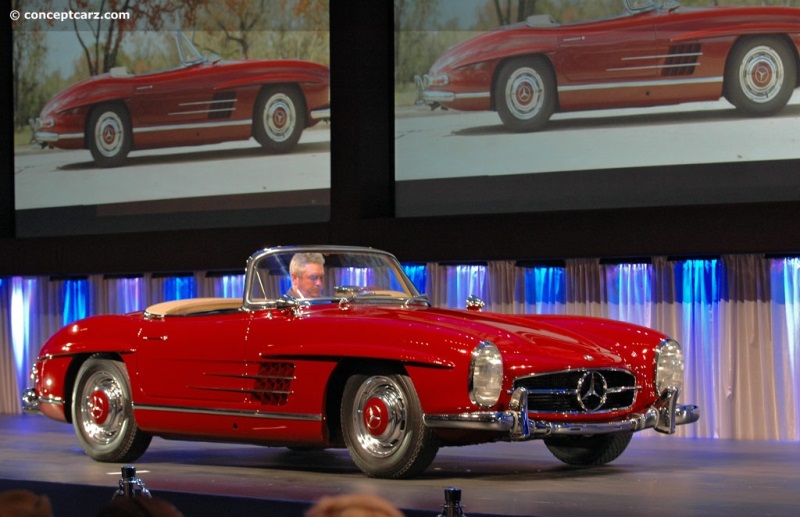
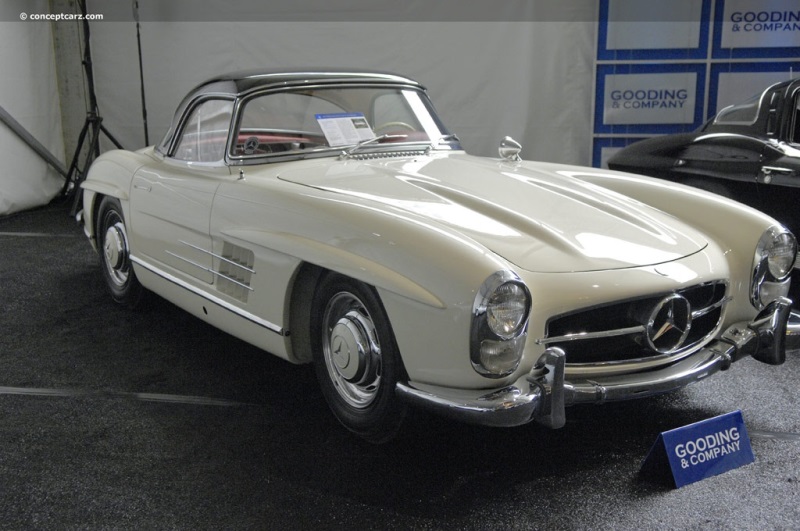
1961 Mercedes-Benz 300 SL
1961 Mercedes-Benz 300 SL Navigation
History
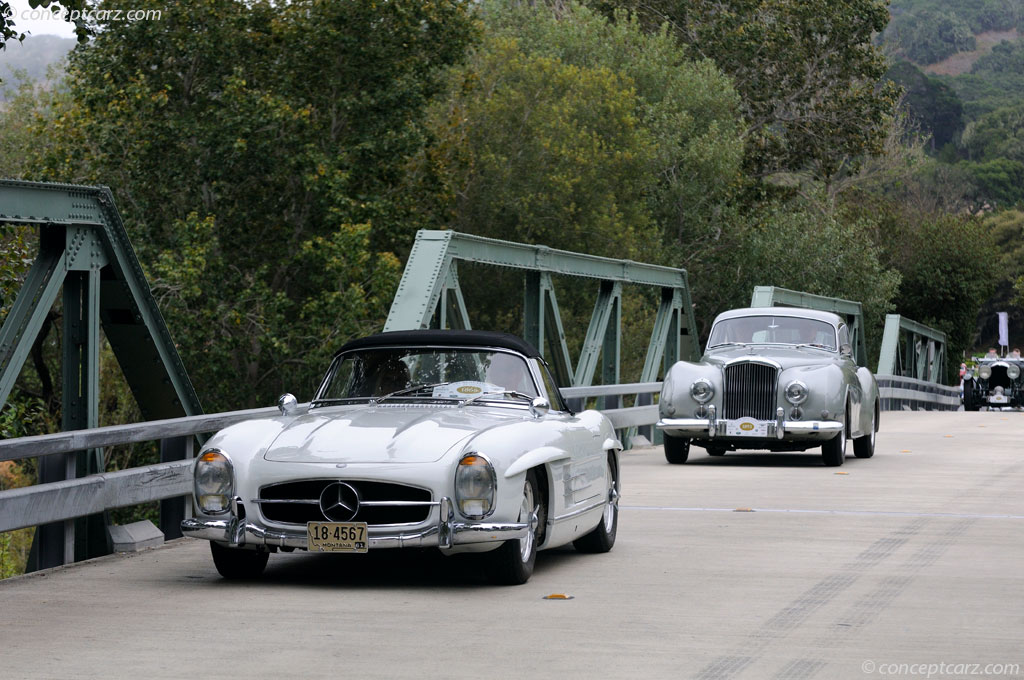
With a top speed of 130-155 mph, depending on the axle ratio, the 300SL was one of the fastest vehicles of the 1950's. Its performance, design, reputation, and futuristic Gullwing door's were all responsible for the success of the vehicle. The 'SL' represented 'Sport Leicht' or 'Sport Light'.
An American Max Hoffman is partly responsible for the mass-production of the 300SL. He had urged Mercedes-Benz to create the vehicle for the American market. In 1954, the vehicle was officially presented to the world at the New York Auto Show. This was not its first appearance. It had been raced in several international events that included Mexico's Carrera Panamerican road race, Berne, Nurburgring, and the Mille Miglia. Prototypes had been entered in the 1952 24-hours of Le Mans where they were victorious. These successes on the race track, including endurance runs, guaranteed a reliable, fast, performance machine.
In 1955, the famous Stirling Moss drove a 300 SLR to victory in the 1955 Mille Miglia where he averaged a speed of 157.6 km/h for 1,600 km. (97.9 mph for 994 miles). A 300 SLR was leading the 24 Hours of Le Mans when it was withdrawn from the race. A horrible accident had occurred where a car had killed 82 spectators during the race.
The 300 SL was powered by a fuel-injected, overhead-cam, six-cylinder engine and produced around 215 horsepower at 6200 RPM. It was the first vehicle to ever use fuel-injection with a gasoline-powered engine. The large drum brakes, independent suspension, and four-speed manual transmission helped give this vehicle super-car status. The silver color was by far the most popular. Other color options available were dark blue and black. The leather interior was optional with cloth upholstery being standard equipment.
The Gullwing or butterfly-wing doors were well received by owners and spectators. They added a distinctive quality that could not be found in any other vehicle at the time. The Mercedes 300SL was first a race car. It was built using a tubular space-frame chassis and conceived by DBAG's chief developing engineer Rudolf Uhlenhaut. In an effort to keep the vehicle as light as possible and to retain the necessary strength, Gullwing doors were used. The doors were not without their problems though. Getting into and out of the vehicle was rather difficult. Due to the doors, the vehicle was prone to leaking and difficult to repair. As a result, after 1,400 examples had been produced, the Gullwing doors were replaced by the 1957 roadster. The roadster with its conventional doors, updated suspension, and convertible roof proved to be more popular than the previous design. More than 1,800 roadsters were sold.
Disc brakes were added in 1961 as was the alloy block.
Throughout the seven-year production of the 300SL, the car endured major changes both mechanically and aesthetically. Throughout it all, it retained its race-breed heritage and supercar status.
By Daniel Vaughan | Aug 2010
An American Max Hoffman is partly responsible for the mass-production of the 300SL. He had urged Mercedes-Benz to create the vehicle for the American market. In 1954, the vehicle was officially presented to the world at the New York Auto Show. This was not its first appearance. It had been raced in several international events that included Mexico's Carrera Panamerican road race, Berne, Nurburgring, and the Mille Miglia. Prototypes had been entered in the 1952 24-hours of Le Mans where they were victorious. These successes on the race track, including endurance runs, guaranteed a reliable, fast, performance machine.
In 1955, the famous Stirling Moss drove a 300 SLR to victory in the 1955 Mille Miglia where he averaged a speed of 157.6 km/h for 1,600 km. (97.9 mph for 994 miles). A 300 SLR was leading the 24 Hours of Le Mans when it was withdrawn from the race. A horrible accident had occurred where a car had killed 82 spectators during the race.
The 300 SL was powered by a fuel-injected, overhead-cam, six-cylinder engine and produced around 215 horsepower at 6200 RPM. It was the first vehicle to ever use fuel-injection with a gasoline-powered engine. The large drum brakes, independent suspension, and four-speed manual transmission helped give this vehicle super-car status. The silver color was by far the most popular. Other color options available were dark blue and black. The leather interior was optional with cloth upholstery being standard equipment.
The Gullwing or butterfly-wing doors were well received by owners and spectators. They added a distinctive quality that could not be found in any other vehicle at the time. The Mercedes 300SL was first a race car. It was built using a tubular space-frame chassis and conceived by DBAG's chief developing engineer Rudolf Uhlenhaut. In an effort to keep the vehicle as light as possible and to retain the necessary strength, Gullwing doors were used. The doors were not without their problems though. Getting into and out of the vehicle was rather difficult. Due to the doors, the vehicle was prone to leaking and difficult to repair. As a result, after 1,400 examples had been produced, the Gullwing doors were replaced by the 1957 roadster. The roadster with its conventional doors, updated suspension, and convertible roof proved to be more popular than the previous design. More than 1,800 roadsters were sold.
Disc brakes were added in 1961 as was the alloy block.
Throughout the seven-year production of the 300SL, the car endured major changes both mechanically and aesthetically. Throughout it all, it retained its race-breed heritage and supercar status.
By Daniel Vaughan | Aug 2010
The Mercedes-Benz 300 was produced from 1951 through 1958 and is one of the most graceful and classic creations of the post-World War II era. The style was both classic and modern and built to high standards. They were constructed from fine materials using the latest in technology and achieving minimal weight with a high degree of strength.
The 300 was built on a traditional body-on-frame construction as many other marque's, including most of the Mercedes-Benz line, had switched to unit-body construction. The body-on-frame construction was ideal for maintaining a high level of quality for vehicles produced in limited quantities. The front end was suspended in place through the use of an independent suspension with A-arms and coil springs. The rear was the tried-and-true swing axle with coil springs.
Under the bonnet was a 2996-cc six-cylinder engine with Bosch mechanical fuel injection that produced 175 horsepower. Considering the modest wheelbase size and the overall low weight of the vehicle, the 175 horsepower was more than enough to carry these custom-built vehicles at highway speeds with little effort. The car was fast, luxurious, safe, and comfortable.
From November of 1951 through March of 1962, there were 11,430 examples of the Mercedes 300 constructed. Most were built atop of a 120-inch wheelbase and with a four-door configuration. Just over 700 were convertible sedans.
The 300 had been introduced at the Frankfurt Auto Show. Mercedes-Benz selected the Paris Auto Show to introduce the next iteration of the 300-Series, the 300S. This was a much sportier version that rode on a shortened, 114.2-inch wheelbase, and built in a 2-door open and closed configuration. The engine was a multi-carbureted unit that produced just over 160 SAE horsepower.
The Mercedes-Benz 300S was a very fast automobile that still retained luxury, comfort, and style. Built in very limited quantities, it was an exclusive automobile.
Production of the 300S lasted from 1952 through April of 1958 with a total of 760 examples being constructed.
The final iteration of the 300-Series was the 300SC, which made its appearance at the 1955 Paris Auto Show. It was given a detuned version of the 300SL's Bosch mechanical fuel-injected engine and a new 'low-pivot' swing axle rear suspension.
By Daniel Vaughan | Feb 2007
The 300 was built on a traditional body-on-frame construction as many other marque's, including most of the Mercedes-Benz line, had switched to unit-body construction. The body-on-frame construction was ideal for maintaining a high level of quality for vehicles produced in limited quantities. The front end was suspended in place through the use of an independent suspension with A-arms and coil springs. The rear was the tried-and-true swing axle with coil springs.
Under the bonnet was a 2996-cc six-cylinder engine with Bosch mechanical fuel injection that produced 175 horsepower. Considering the modest wheelbase size and the overall low weight of the vehicle, the 175 horsepower was more than enough to carry these custom-built vehicles at highway speeds with little effort. The car was fast, luxurious, safe, and comfortable.
From November of 1951 through March of 1962, there were 11,430 examples of the Mercedes 300 constructed. Most were built atop of a 120-inch wheelbase and with a four-door configuration. Just over 700 were convertible sedans.
The 300 had been introduced at the Frankfurt Auto Show. Mercedes-Benz selected the Paris Auto Show to introduce the next iteration of the 300-Series, the 300S. This was a much sportier version that rode on a shortened, 114.2-inch wheelbase, and built in a 2-door open and closed configuration. The engine was a multi-carbureted unit that produced just over 160 SAE horsepower.
The Mercedes-Benz 300S was a very fast automobile that still retained luxury, comfort, and style. Built in very limited quantities, it was an exclusive automobile.
Production of the 300S lasted from 1952 through April of 1958 with a total of 760 examples being constructed.
The final iteration of the 300-Series was the 300SC, which made its appearance at the 1955 Paris Auto Show. It was given a detuned version of the 300SL's Bosch mechanical fuel-injected engine and a new 'low-pivot' swing axle rear suspension.
By Daniel Vaughan | Feb 2007
Eternal youth is a miracle bestowed on only a small number of cars, and the Mercedes-Benz 300 SL coupe is one of this elite group. The Stuttgart-based brand unveiled its new sports car in February 1954 at the International Motor Sports Show in New York, and in so doing lit the fuse for an icon of the automotive world. With its flat, graceful body, the 300 SL had lost nothing of its freshness even as the millennium drew to a close and was voted 'Sports car of the Century' in 1999. 'Gullwing' doors provided that essential touch of inspiration, opening up towards the sky to reveal a tightly sculptured interior. The history of the 300 SL is inextricably linked with the life of an influential admirer. American importer Maximilian E. Hoffman it was who urged Mercedes-Benz to build a road car in the image of its racing coupe, the start of production in 1954 providing a sweet fruit for his endeavors. The assembly lines may have waved goodbye to the last of the only 1,400 units of the 300 SL coupe ever made in 1957, but the spirit of this extraordinary car most certainly lives on.
From the race-track to the road
The Mercedes-Benz 300 SL was conceived initially as a purpose-built racing sports car (W 194). In 1952, the coupe notched up an impressive record of success in the year's major races. At the Grand Prix in Bern the 300 SL sealed a clean sweep of the podium places, an awesome performance backed up by a one-two finish ahead of a stunned field in the 24 Hours of Le Mans. The Nürburgring duly yielded another one-two-three, and the new Mercedes racing sports car also claimed victory in the Carrera Panamericana in Mexico. It all added up to a majestic return to motor sport for Mercedes-Benz, picking up where the brand had left off during a highly successful period before the Second World War.
Although there were initially no plans to send the 300 SL into series production, the Daimler-Benz Board had been left with the words of Maximilian ('Maxi') Hoffman ringing in their ears. The official importer of Mercedes-Benz cars into America campaigned tirelessly for a sports car to offer his well-heeled clientele, and the 300 SL racer fitted the bill perfectly. After lengthy deliberations, the green light was given for series production of the road-trim 300 SL (W 198), as well as a smaller, open-top sports car, the 190 SL (W 121).
The two models were due to celebrate their premieres less than six months after the Board had granted the project their approval. The occasion was the International Motor Sports Show taking place in New York from February 6 –14, 1954 and at the time America's most important auto show. The engineers rose to the challenge of their race against the clock, and the 300 SL and its smaller brother, the 190 SL, were ready to receive the acclaim of the admiring crowds. Series production began in Sindelfingen in August 1954 and the price was fixed at 29,000 Marks – a quite enormous sum at the time, especially when you compared the new model alongside the Mercedes-Benz 170 Vb – on sale at 7,900 Marks.
The body
The body of the 300 SL was developed with the primary aim of cutting aerodynamic drag to a minimum. The result was a streamlined form with few adornments, a car which adhered faithfully to its design brief and which has retained its freshness and allure to the present day. Wonderfully proportioned and extremely dynamic, it was as if the 300 SL – surging forward on its wheels – had been cut form a single mold.
The new sports car was a real crowd-puller, thanks in no small measure to its wonderfully charismatic 'gullwing' doors. Rather than serving merely as a stylistic gimmick, they represented the central element of the 300 SL design, the ultimate example of necessity as the mother of invention. The car's aluminum skin was stretched over a tubular frame, which – in the interests of stability – rose much further than usual up the sides of the vehicle, making it impossible to fit conventional doors. The response of the engineers was to devise an upwards-opening door concept. The elegance of the car's side view remained undisturbed by a door handle, with a discreet pull-out bar disengaging the lock. The door then opened upwards with the help of a telescopic spring.
The tubular frame for the 300 SL, designed by Rudolf Uhlenhaut, reduced weight to a minimum but provided maximum strength. A series of extremely thin tubes were welded together into triangles to produce a frame which boasted impressive torsional stiffness and was only subjected to compression and tensile forces. In the standard SL the frame tipped the scales at only 82 kilograms, whilst the complete car in ready-to-drive condition and including the spare wheel, tools and fuel weighed in at 1,295 kilograms.
The body of the 300 SL was constructed largely out of high-grade sheet steel, although aluminum was used for the engine hood, trunk lid and the skin panels for the door sills and doors. For a relatively small extra charge, customers could choose to have the whole body made from light alloy, which cut 80 kilograms off the car's total weight. However, only 29 SL customers took up this option and today their cars are highly sought-after rarities.
The technology
The technical make-up of the 300 SL owes much to the Mercedes-Benz 300 (W 186 II) sedan, the vehicle of choice for many statesmen and industrialists and also known as the 'Adenauer Mercedes'. The six-cylinder engine featured a number of modifications, one of which saw the carburetor replaced by a direct injection system – a technical advance that was years ahead of its time. This new technology boosted output to 158 kW (215 hp) and the car's maximum speed up as far as 260 km/h, depending on the rear axle ratio. Customers could order their SL with a choice of five different ratios. The standard 1:3.64 variant was set up primarily to deliver rapid acceleration and capable of 235 km/h. The 1:3.89 and 1:4.11 ratios were good for even faster acceleration, whilst the 1:3.42 option offered a higher top speed. This figure rose still further – to 260 km/h – when the ratio was set at 1:3.25. However, this 'resulted in greatly reduced acceleration, making the car less enjoyable to drive in downtown city traffic,' as the sales information pointed out. The 300 SL hit 100 km/h in just 10 seconds, with car testers at the time measuring fuel consumption at an average of 15 liters per 100 km. A 100-liter fuel tank was positioned at the rear of the car and could be enlarged to 130 liters at an extra charge.
The engine had to be tilted 45 degrees to the left in order to squeeze under the hood of what was an extremely flat car, thus reducing the amount of space in the passenger-side footwell. The SL's center of gravity was almost exactly in the middle of the car, laying the perfect foundations for fast and precise cornering. The chassis was essentially the same as the 300a sedan's, but with sportier tuning, and the drum brakes were adapted in response to the increased performance of the muscle-bound sports car. Only later, in the 1961 roadster variant, were these replaced by disc brakes all round.
The interior
The interior of the 300 SL was more solid than spectacular. The standard fabric seat upholstery was available in a choice of three checked patterns, but most customers opted for leather instead. The body paintwork came in silver metallic as standard, although red, dark blue, and black also proved popular.
A shortage of space made getting into the 300 SL something of a challenge – this was, after all, a sports car. Fortunately, the steering wheel could be folded down, allowing the driver to twist his or her legs in the direction of the pedals. Once seated, the driver enjoyed an ergonomically impressively refined cockpit design. The steering wheel was just the right distance for the arms to reach and the driver's feet moved intuitively onto the pedals: the 300 SL was very much a driver's car. In addition, the instrument panel was extremely tidy and clearly laid-out, with the rev counter and speedometer in the center of the driver's field of vision, as you would expect.
The handling characteristics
Out on the road, you quickly realized why the 300 SL had been christened with those particular letters – the car was certainly Sporty and Light. With an engine delivering 215 hp and a total weight of only around 1,300 kilograms, acceleration was suitably impressive – especially with the right choice of rear axle ratio. Exceptional torque ensured good pulling power at any speed. The steering was direct and the suspension made sure that the car hugged the road nicely. There's no doubt that the 300 SL was a sports car of the finest pedigree. That said, it was far from impractical, as many owners were quick to appreciate. For them, this was a high-speed touring car that offered precise driving characteristics but which avoided sapping the energy of the driver unduly. The trunk was sufficiently large, complemented as it was by the extra room behind the seats for additional baggage. Plus, customers could order a made-to-measure luggage set designed to make the most of the space available.
How the press saw the 300 SL
The press at the time were falling over themselves to lavish praise on the 300 SL. 'Autosport' reported that: 'The exterior form of the 300 SL is quite wonderful and its performance almost unbelievable. The construction of the car and its production quality are first class and the whole concept represents an uncompromising realization of all the new ideas.' After its initial test, 'Road & Track' wrote: 'We are looking at a car where a comfortable interior is complemented by remarkably impressive handling characteristics, quite incredible roadholding, light and precise steering, and performance levels which are up there with – and even an improvement on – the best cars the automotive industry has to offer. There is only one thing left to say: the sports car of the future has become a reality.' And 'auto, motor und sport' noted: 'The Mercedes 300 SL is the most refined and at the same time the most inspirational sports car of our era – an automotive dream.'
Maxi Hoffman keeps up the pressure
The first units of the 300 SL were sold in Europe in 1954, whilst Maxi Hoffman received his first customer car in March 1955. A total of 1,400 Gullwings rolled off the production line, the lion's share of which – some 1,100 units – found their way to the USA. Hoffman had thus assessed the response of the market to the car extremely well and had every right to be satisfied with his work. However, he had also succeeded in stoking the expectations of his discerning customers, who now wanted a touch more comfort in their cars, a larger trunk and, in many cases, a cabriolet version. Hoffman passed the message on to Stuttgart and once again his request bore fruit – this time in the form of the 300 SL roadster (W 198 II) unveiled in 1957.
Success on racetracks and rally courses
The racing genes of the 300 SL tempted renowned racing drivers and privateers from all over the world to enter sports car races and rallies. The 300 SL made its first appearances in the popular racing events of the time in 1955 – and didn't have to wait long before tasting success. The Mercedes-Benz 300 SL attained legendary status well before the assembly lines ground to a halt, thanks in part to its success in race competition but most of all to the captivating allure of its stunning design. The 300 SL has been counted among the world's most sought-after and highly rated cars for 50 years now, and its status as one of the most revered classic automobiles on the market is set to remain intact for quite some time to come.Source - Mercedes-Benz
From the race-track to the road
The Mercedes-Benz 300 SL was conceived initially as a purpose-built racing sports car (W 194). In 1952, the coupe notched up an impressive record of success in the year's major races. At the Grand Prix in Bern the 300 SL sealed a clean sweep of the podium places, an awesome performance backed up by a one-two finish ahead of a stunned field in the 24 Hours of Le Mans. The Nürburgring duly yielded another one-two-three, and the new Mercedes racing sports car also claimed victory in the Carrera Panamericana in Mexico. It all added up to a majestic return to motor sport for Mercedes-Benz, picking up where the brand had left off during a highly successful period before the Second World War.
Although there were initially no plans to send the 300 SL into series production, the Daimler-Benz Board had been left with the words of Maximilian ('Maxi') Hoffman ringing in their ears. The official importer of Mercedes-Benz cars into America campaigned tirelessly for a sports car to offer his well-heeled clientele, and the 300 SL racer fitted the bill perfectly. After lengthy deliberations, the green light was given for series production of the road-trim 300 SL (W 198), as well as a smaller, open-top sports car, the 190 SL (W 121).
The two models were due to celebrate their premieres less than six months after the Board had granted the project their approval. The occasion was the International Motor Sports Show taking place in New York from February 6 –14, 1954 and at the time America's most important auto show. The engineers rose to the challenge of their race against the clock, and the 300 SL and its smaller brother, the 190 SL, were ready to receive the acclaim of the admiring crowds. Series production began in Sindelfingen in August 1954 and the price was fixed at 29,000 Marks – a quite enormous sum at the time, especially when you compared the new model alongside the Mercedes-Benz 170 Vb – on sale at 7,900 Marks.
The body
The body of the 300 SL was developed with the primary aim of cutting aerodynamic drag to a minimum. The result was a streamlined form with few adornments, a car which adhered faithfully to its design brief and which has retained its freshness and allure to the present day. Wonderfully proportioned and extremely dynamic, it was as if the 300 SL – surging forward on its wheels – had been cut form a single mold.
The new sports car was a real crowd-puller, thanks in no small measure to its wonderfully charismatic 'gullwing' doors. Rather than serving merely as a stylistic gimmick, they represented the central element of the 300 SL design, the ultimate example of necessity as the mother of invention. The car's aluminum skin was stretched over a tubular frame, which – in the interests of stability – rose much further than usual up the sides of the vehicle, making it impossible to fit conventional doors. The response of the engineers was to devise an upwards-opening door concept. The elegance of the car's side view remained undisturbed by a door handle, with a discreet pull-out bar disengaging the lock. The door then opened upwards with the help of a telescopic spring.
The tubular frame for the 300 SL, designed by Rudolf Uhlenhaut, reduced weight to a minimum but provided maximum strength. A series of extremely thin tubes were welded together into triangles to produce a frame which boasted impressive torsional stiffness and was only subjected to compression and tensile forces. In the standard SL the frame tipped the scales at only 82 kilograms, whilst the complete car in ready-to-drive condition and including the spare wheel, tools and fuel weighed in at 1,295 kilograms.
The body of the 300 SL was constructed largely out of high-grade sheet steel, although aluminum was used for the engine hood, trunk lid and the skin panels for the door sills and doors. For a relatively small extra charge, customers could choose to have the whole body made from light alloy, which cut 80 kilograms off the car's total weight. However, only 29 SL customers took up this option and today their cars are highly sought-after rarities.
The technology
The technical make-up of the 300 SL owes much to the Mercedes-Benz 300 (W 186 II) sedan, the vehicle of choice for many statesmen and industrialists and also known as the 'Adenauer Mercedes'. The six-cylinder engine featured a number of modifications, one of which saw the carburetor replaced by a direct injection system – a technical advance that was years ahead of its time. This new technology boosted output to 158 kW (215 hp) and the car's maximum speed up as far as 260 km/h, depending on the rear axle ratio. Customers could order their SL with a choice of five different ratios. The standard 1:3.64 variant was set up primarily to deliver rapid acceleration and capable of 235 km/h. The 1:3.89 and 1:4.11 ratios were good for even faster acceleration, whilst the 1:3.42 option offered a higher top speed. This figure rose still further – to 260 km/h – when the ratio was set at 1:3.25. However, this 'resulted in greatly reduced acceleration, making the car less enjoyable to drive in downtown city traffic,' as the sales information pointed out. The 300 SL hit 100 km/h in just 10 seconds, with car testers at the time measuring fuel consumption at an average of 15 liters per 100 km. A 100-liter fuel tank was positioned at the rear of the car and could be enlarged to 130 liters at an extra charge.
The engine had to be tilted 45 degrees to the left in order to squeeze under the hood of what was an extremely flat car, thus reducing the amount of space in the passenger-side footwell. The SL's center of gravity was almost exactly in the middle of the car, laying the perfect foundations for fast and precise cornering. The chassis was essentially the same as the 300a sedan's, but with sportier tuning, and the drum brakes were adapted in response to the increased performance of the muscle-bound sports car. Only later, in the 1961 roadster variant, were these replaced by disc brakes all round.
The interior
The interior of the 300 SL was more solid than spectacular. The standard fabric seat upholstery was available in a choice of three checked patterns, but most customers opted for leather instead. The body paintwork came in silver metallic as standard, although red, dark blue, and black also proved popular.
A shortage of space made getting into the 300 SL something of a challenge – this was, after all, a sports car. Fortunately, the steering wheel could be folded down, allowing the driver to twist his or her legs in the direction of the pedals. Once seated, the driver enjoyed an ergonomically impressively refined cockpit design. The steering wheel was just the right distance for the arms to reach and the driver's feet moved intuitively onto the pedals: the 300 SL was very much a driver's car. In addition, the instrument panel was extremely tidy and clearly laid-out, with the rev counter and speedometer in the center of the driver's field of vision, as you would expect.
The handling characteristics
Out on the road, you quickly realized why the 300 SL had been christened with those particular letters – the car was certainly Sporty and Light. With an engine delivering 215 hp and a total weight of only around 1,300 kilograms, acceleration was suitably impressive – especially with the right choice of rear axle ratio. Exceptional torque ensured good pulling power at any speed. The steering was direct and the suspension made sure that the car hugged the road nicely. There's no doubt that the 300 SL was a sports car of the finest pedigree. That said, it was far from impractical, as many owners were quick to appreciate. For them, this was a high-speed touring car that offered precise driving characteristics but which avoided sapping the energy of the driver unduly. The trunk was sufficiently large, complemented as it was by the extra room behind the seats for additional baggage. Plus, customers could order a made-to-measure luggage set designed to make the most of the space available.
How the press saw the 300 SL
The press at the time were falling over themselves to lavish praise on the 300 SL. 'Autosport' reported that: 'The exterior form of the 300 SL is quite wonderful and its performance almost unbelievable. The construction of the car and its production quality are first class and the whole concept represents an uncompromising realization of all the new ideas.' After its initial test, 'Road & Track' wrote: 'We are looking at a car where a comfortable interior is complemented by remarkably impressive handling characteristics, quite incredible roadholding, light and precise steering, and performance levels which are up there with – and even an improvement on – the best cars the automotive industry has to offer. There is only one thing left to say: the sports car of the future has become a reality.' And 'auto, motor und sport' noted: 'The Mercedes 300 SL is the most refined and at the same time the most inspirational sports car of our era – an automotive dream.'
Maxi Hoffman keeps up the pressure
The first units of the 300 SL were sold in Europe in 1954, whilst Maxi Hoffman received his first customer car in March 1955. A total of 1,400 Gullwings rolled off the production line, the lion's share of which – some 1,100 units – found their way to the USA. Hoffman had thus assessed the response of the market to the car extremely well and had every right to be satisfied with his work. However, he had also succeeded in stoking the expectations of his discerning customers, who now wanted a touch more comfort in their cars, a larger trunk and, in many cases, a cabriolet version. Hoffman passed the message on to Stuttgart and once again his request bore fruit – this time in the form of the 300 SL roadster (W 198 II) unveiled in 1957.
Success on racetracks and rally courses
The racing genes of the 300 SL tempted renowned racing drivers and privateers from all over the world to enter sports car races and rallies. The 300 SL made its first appearances in the popular racing events of the time in 1955 – and didn't have to wait long before tasting success. The Mercedes-Benz 300 SL attained legendary status well before the assembly lines ground to a halt, thanks in part to its success in race competition but most of all to the captivating allure of its stunning design. The 300 SL has been counted among the world's most sought-after and highly rated cars for 50 years now, and its status as one of the most revered classic automobiles on the market is set to remain intact for quite some time to come.Source - Mercedes-Benz
Large and luxurious, the Mercedes 300 series was built from 1951 until 1957 in its original form. The company's largest and most-prestigious models, the Mercedes-Benz Type 300 is considered a trademark of the era throughout the 1950s. With a 3 liter engine capacity, the name 300 said it all. Exclusive, expensive, elegant and full of power, the Type 300 vehicles were in an elite status all of its own. In a tribute to the Chancellor of Germany at the time, this series was often referred to as the Adenauer, after Konrad Adenauer. During his time as Chancellor, Adenauer used a total of six of these vehicles.
The main competition that the 300 Series faced during its production time was the less-expensive Ponton series. A large majority of the company's sales were directed in the area of this cheaper series. During the early 1960's, both the Ponton series and the Type 300 were eventually replaced by the 'Heckflosse' cars.
Available as either a sedan or cabriolet, the Type 300 was offered both with four doors, along with seating for six. With a more modern body, the 'W186' Type 300 was built on a pre-war chassis, yet it utilized a modern 3 L straight-6 engine. The most interesting feature was a rear load-levelling suspension that was operated by a switch on the dashboard. Many other luxury features were offered on this series, these included a VHF mobile telephone, a dictation machine and a Becker radio. The Chancellor's personal vehicle was equipped with a writing desk, sirens, a dividing partition, curtains, and many more features.
A special Type 300 Lang, Innenlenker model was a limousine version that rode on a 20 cm (7.9 in) longer wheelbase.
The Type 300 b was introduced with power brakes in 1954. In September of 1955, a larger rear window was featured on the Type 300 c. Also featuring a swing axle rear independent suspension, the Type 300 c was sold at $10,864 in the U.S. with the convertible available at an expensive $14,231.
In August of 1957, the B-pillar was updated for the hardtop look in the Type 300 d. With a total of 3,077 produced, the d was produced until March of 1963. Available with a compression ratio of 8.55:1 and Bosch fuel injection, the d produced 160 hp. The W112 300SE replaced the limousine version.
Mercedes-Benz's top-end vehicle in 1952 following its introduction, the 'W188' Type 300 S was available as a 2+2 coupe, cabriolet or roadster. Marketed as one of the top luxury vehicles in the world, the W188 was actually very similar mechanically to the more contemporary W186. The Type 300 Sc received the addition of fuel injection in 1955, along the same time that Mercedes-Benz's 'low-pivot' independent suspension was substituted. Dual chrome strips were placed on each side of the hood that denotes the 'Sc' model.
The 300 S line was an established Mercedes tradition, 2-door convertible and coupe versions of the limousine model. These models had a body built on a separate chassis, and were conventionally styled grand tourers. The SL, which stood for 'Sport Leicht', and can be broken down to lightweight sportscar, was introduced in the same year. Essentially a derivative of the ‘ordinary' Mercedes 300 series, there was really nothing ordinary about the 300 SL.
The vehicle that was responsible for re-establishing Mercedes-Benz as a formidable power in sports vehicle racing following World War 2, the 300 SL was introduced in 1952. Beginning as a thoroughbred road racing vehicle, the exotic 300 SL finished its career in 1963 as a very fast convertible for the wealthy.
Following such an impressive impact on car enthusiasts worldwide, there has continued to be an SL model in the Mercedes Range ever since. There has never been another SL model in the Mercedes range that has been able to live up to the prestige, engineering and styling of the original 300 SL.
Introduced at the 1953 Mille Miglia, where a total of 300 SL's took part in the event, the original 300 SL was first introduced as a contender for the famous road races of those days. One of the SL models took 2nd place, and another took 4th place, making a very impressive mark on viewers. This was only the beginning of many more racing successes soon after.By Jessica Donaldson
The main competition that the 300 Series faced during its production time was the less-expensive Ponton series. A large majority of the company's sales were directed in the area of this cheaper series. During the early 1960's, both the Ponton series and the Type 300 were eventually replaced by the 'Heckflosse' cars.
Available as either a sedan or cabriolet, the Type 300 was offered both with four doors, along with seating for six. With a more modern body, the 'W186' Type 300 was built on a pre-war chassis, yet it utilized a modern 3 L straight-6 engine. The most interesting feature was a rear load-levelling suspension that was operated by a switch on the dashboard. Many other luxury features were offered on this series, these included a VHF mobile telephone, a dictation machine and a Becker radio. The Chancellor's personal vehicle was equipped with a writing desk, sirens, a dividing partition, curtains, and many more features.
A special Type 300 Lang, Innenlenker model was a limousine version that rode on a 20 cm (7.9 in) longer wheelbase.
The Type 300 b was introduced with power brakes in 1954. In September of 1955, a larger rear window was featured on the Type 300 c. Also featuring a swing axle rear independent suspension, the Type 300 c was sold at $10,864 in the U.S. with the convertible available at an expensive $14,231.
In August of 1957, the B-pillar was updated for the hardtop look in the Type 300 d. With a total of 3,077 produced, the d was produced until March of 1963. Available with a compression ratio of 8.55:1 and Bosch fuel injection, the d produced 160 hp. The W112 300SE replaced the limousine version.
Mercedes-Benz's top-end vehicle in 1952 following its introduction, the 'W188' Type 300 S was available as a 2+2 coupe, cabriolet or roadster. Marketed as one of the top luxury vehicles in the world, the W188 was actually very similar mechanically to the more contemporary W186. The Type 300 Sc received the addition of fuel injection in 1955, along the same time that Mercedes-Benz's 'low-pivot' independent suspension was substituted. Dual chrome strips were placed on each side of the hood that denotes the 'Sc' model.
The 300 S line was an established Mercedes tradition, 2-door convertible and coupe versions of the limousine model. These models had a body built on a separate chassis, and were conventionally styled grand tourers. The SL, which stood for 'Sport Leicht', and can be broken down to lightweight sportscar, was introduced in the same year. Essentially a derivative of the ‘ordinary' Mercedes 300 series, there was really nothing ordinary about the 300 SL.
The vehicle that was responsible for re-establishing Mercedes-Benz as a formidable power in sports vehicle racing following World War 2, the 300 SL was introduced in 1952. Beginning as a thoroughbred road racing vehicle, the exotic 300 SL finished its career in 1963 as a very fast convertible for the wealthy.
Following such an impressive impact on car enthusiasts worldwide, there has continued to be an SL model in the Mercedes Range ever since. There has never been another SL model in the Mercedes range that has been able to live up to the prestige, engineering and styling of the original 300 SL.
Introduced at the 1953 Mille Miglia, where a total of 300 SL's took part in the event, the original 300 SL was first introduced as a contender for the famous road races of those days. One of the SL models took 2nd place, and another took 4th place, making a very impressive mark on viewers. This was only the beginning of many more racing successes soon after.By Jessica Donaldson
- 1961 Mercedes-Benz 300 SL Menu
- Article
- Image gallery
- Valuation
- Specifications
- Profiles
- Production figures
Mercedes-Benz
Similar Automakers
Similarly Sized Vehicles
from 1961


1961 Mercedes-Benz 300 SL Vehicle Profiles


Recent Vehicle Additions


Performance and Specification Comparison
Price Comparison
$3,440
$4,280 - $8,090
$5,030 - $5,245
$10,070 - $12,640
300 SL Specification Comparison by Year
Year
Production
Wheelbase
Engine
Prices
Related Automotive News

FROM SHELBYS TO SUPERCARS, RM SOTHEBY'S ARIZONA SALE OFFERS ICONIC COLLECTOR CARS OF EVERY ERA
Pure adrenaline 1965 Shelby 427 Competition Cobra, 1963 Shelby 289 Cobra Dragonsnake, and 1964 Shelby 289 Cobra lead recent entries for RM Sothebys Arizona Biltmore sale, January 28-29
Auction features more than 125 motor cars and offers incr...

COMING OUT THE GATE STRONG: AMERICAN MUSCLE LEADS EARLY ENTRIES FOR AUCTIONS AMERICA'S 2016 SEASON OPENER
Auctions Americas kicks off its 2016 calendar, April 1-3 in Fort Lauderdale, Florida
Regarded as South Floridas premier collector car auction, multi-day sale expected to feature diverse roster of nearly 500 automobiles
Early highlights led b...

Extremely Original 'Holy Grail' 1970 Oldsmobile 442 W-30 Convertible at Russo and Steele's 2016 Arizona Auction Event
Scottsdale, Arizona (November 24, 2015) – While Oldsmobile is believed to have created the first true American muscle car with the release of its 303 V-8 Rocket 88 in 1949, it was not until 1964 that it returned to the concept with the 442 option,...

Barrett-Jackson Flavors Its January Scottsdale Auction With NASCAR Treats
RACING HERITAGE, HIGH PERFORMANCE ARE RECIPES FOR CAR-COLLECTING FEAST
SPEED™ SET FOR 39 HOURS of LIVE COVERAGE STARTING JAN. 15
The great Henry Ford once said, Auto racing began five minutes after the second car was built.
...

TOPLINE COLLECTORS PLACE SPOTLIGHT on SPEED'S BARRETT-JACKSON BROADCAST FROM SCOTTSDALE
TOPLINE COLLECTORS PLACE SPOTLIGHT on SPEEDS BARRETT-JACKSON BROADCAST FROM SCOTTSDALE
LOST SHELBY DUAL PROTOTYPE, HAGERTY GIVEAWAY %26 SALON COLLECTION HIGHLIGHT 39 HOURS OF LIVE COVERAGE
The 42nd annual Barrett-Jackson Scottsdale (Ar...