From the very beginning, racing has played an important role in the development of Porsche automobiles. Ferdinand Porsche and his son, Ferry, both recognized that racing exposed any inherent weaknesses in a vehicle's design and allowed new technologies to be developed and tested. Porsche cars were entered in countless races, often with outstanding results, but it would not be until 1962 that Stuttgart's famous firm ventured into the competitive Formula 1 scene.
Monoposto
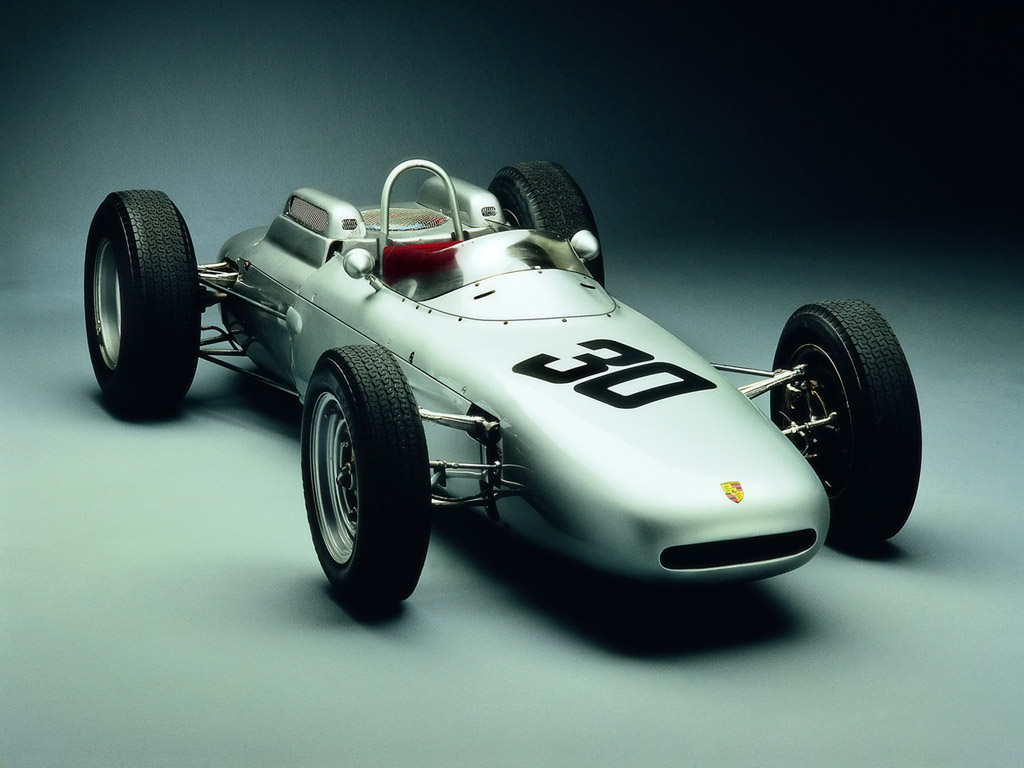
Chassis #: 2/1/804In 1958, Porsche entered Formula 2. With Jo Bonnier and Stirling Moss driving, Porsche was successful in its F2 endeavors. Beginning in 1961, F1 rules changed to resemble prior F2 regulations, and these rule changes enabled Porsche to conveniently pursue F1 racing. The 1961 F1 regulations called for a maximum engine displacement of 1,500cc. Porsche decided to develop an entirely new engine for its F1 debut and chose a flat-eight configuration. Designated Type 753, the 1,494cc engine was air-cooled in proper Porsche tradition. Its block was constructed of magnesium alloy. The mill used separate aluminum cylinders to better engine cooling, and each cylinder was topped by its own aluminum alloy head with two valves. The twin overhead camshafts operating the valves on either bank of cylinders were actuated by shafts instead of by a belt or chain. Type 753's horizontal cooling fan was mounted above the cylinder banks and surrounded left and right by the eight polished velocity stacks of four Weber carburetors. With the engine cover removed, this arrangement made for a dazzling display of air-cooled pride. Type 753's internals was designed to withstand 10,000rpm, which was essential as peak power of 180hp was not reached until 9,200rpm. The Type 753 engine transmitted power through a 6-speed gearbox with a limited-slip differential. It was mounted behind the cockpit of the Porsche 804, the car with which the Stuttgart miracle brand was to enter F1. All of the 804's mechanical bits were housed within a steel space frame clothed in sleek aluminum bodywork. The suspension was by double wishbones front and rear, using torsion bars and inboard shock absorbers. The front torsion bars were longitudinally-mounted, but the transverse rear unit served double duty as an anti-roll bar. Disc brakes and rack-and-pinion steering completed the capable package.
Monoposto
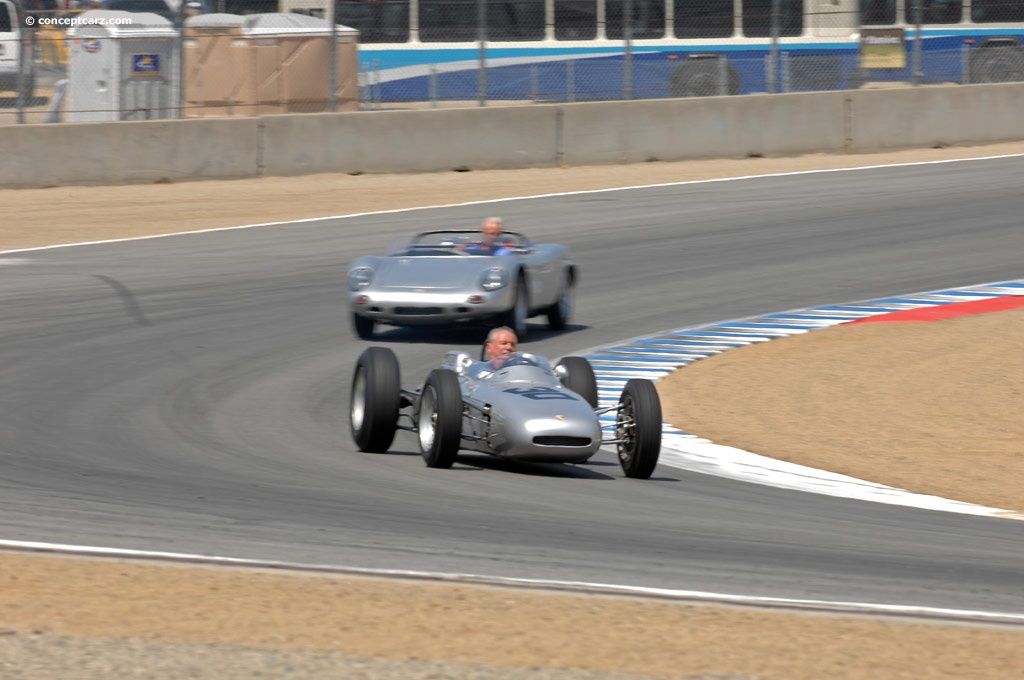
Chassis #: 2/1/804Racing success followed after Porsche debuted its 804 for the 1962 season. With Dan Gurney driving, a Porsche 804 emerged victorious from the French Grand Prix in Rouen. Just a week later, Gurney and an 804 again captured a first-place finish, this time at the Solitude racetrack in Porsche's hometown. There were 300,000 excited witnesses to this latter win. Porsche retired from Formula 1 just as abruptly as it entered, pulling out at the end of the 1962 season. The team had been successful, but Porsche could not justify the heavy expenditures necessary to the development of competitive F1 products. Porsche felt that little of its F1 technology could be translated to its streetcars, prompting the brand to shift its racing focus back to the grand touring and long-distance events that it considered essential to the development of advanced road cars.The 804 was a short but successful chapter in the rich history of Porsche. It may have been the only Porsche ever able to secure a Formula 1 win, but it at least proved that the brand could be successful even in racing styles to which it was not accustomed. Porsche constructed four examples of its 804, racing three of them. At least three are believed to survive.
Monoposto
Chassis #: 2/1/804
Sources:'1962 Porsche 804, Formula 1.' Porsche Web. 12 Jan 2010. http://www.porsche.com/usa/eventsandracing/motorsport/philosophy/history/racingcars/1962-804formel1/.'Porsche 804 F1.' F1technical.net Web. 12 Jan 2010. http://www.f1technical.net/f1db/cars/164.By Evan Acuña
Monoposto
Chassis #: 2/1/804

Monoposto
Chassis #: 2/1/804
Monoposto
Chassis #: 2/1/804
Sources:'1962 Porsche 804, Formula 1.' Porsche Web. 12 Jan 2010. http://www.porsche.com/usa/eventsandracing/motorsport/philosophy/history/racingcars/1962-804formel1/.'Porsche 804 F1.' F1technical.net Web. 12 Jan 2010. http://www.f1technical.net/f1db/cars/164.By Evan Acuña
When the engine capacity for Formula 1 cars was reduced to 1.5-litres in 1961, this change of regulations helped to motivate Porsche to enter the Grand Prix arena since these new rules scarcely differed from those of the previous Formula 2 class.
Monoposto
Chassis #: 2/1/804Porsche nearly achieved its first Formula 1 victory in 1961 with its modified Type 787 F2 chassis, with Dan Gurney finishing second at Reims in France, and at the Grand Prix of Italy and the USA. However, in 1962, Porsche developed an eight-cylinder Grand Prix racer intent on claiming that first outright win.In concept and chassis, the Type 804 was similar to contemporary mid-engined racers. It also used an interesting disc brake design and a horizontal cooling fan on top of its air-cooled eight-cylinder engine.Everything came together in July 1962. Following a promising Monaco, the American Gurney won the Grand Prix of France at Rouen with a lap lead over South African Tony Maggs in a Cooper. A week later, Gurney beat Jim Clark's Lotus to win again, this time in front of 300,000 enthusiastic spectators, at the the Solutide track in Stuttgart.
Monoposto
Chassis #: 2/1/804Towards the end of 1962, Porsche ceased its Formula 1 programme. Such technology, with only minimal carryover to production cars, required heavy financial outlays. Since motor racing was always the basis for new developments and improvements to production sports cars at Porsche, the company concentrated instead on GT cars and long-distance events once again.Source - Porsche
Monoposto
Chassis #: 2/1/804
Monoposto
Chassis #: 2/1/804
Similar Automakers
Similarly Sized Vehicles
from 1962
Related Drivers
 Joakim 'Jo' Bonnier
 Daniel Sexton Gurney Philip Toll Hill, Jr
Related Teams
 Porsche System Engineering
 | Related F1 Articles | |
|---|---|
| Joakim Bonnier: 1958 Formula One Season | |
| Joakim Bonnier: 1957 Formula One Season | |


1962 Porsche 804 Vehicle Profiles

Recent Vehicle Additions


Related Automotive News

THE McLAREN F1
FOR THE DRIVER VITALLY – AS IN ONE OF McLARENS WORLD CHAMPION RACING CARS – DRIVER AND VEHICLE BECOME ENTIRELY AS ONE
The primary design consideration for the McLaren F1 has been to make it without reserve a drivers car, an extremely high-performance...
Scuderia Ugolini: 1959 Formula One Season
While the name Ferrari is recognized the world-over, Ugolini, on the other hand, is only a name recognized by those very knowledgeable of motor racing and football. However, the name is nearly as vitally important to the world of motor sport. In 1959,...

Techno Classica 2014: more than 30 racing cars to celebrate 120 years of Mercedes-Benz motor racing history
Cars that were the heroes of magical moments put their stamp on this high-powered, most comprehensive show presentation
With more than 30 vehicles, Mercedes-Benz Classic presents motor racing history in all its unique breadth and depth
120 years o...

1961 Monaco Grand Prix: Outdueled by a Legend
Powering his way around Tabac, Richie Ginther would find that his time had run out. He had doggedly fought and wrestled his way around the tight, twisty streets of Monaco in pursuit of Moss. The British veteran had an answer for everything but it required...

1962 Monaco Grand Prix: McLaren Carries the Cooper Flag back to the Top
By the beginning of the 1962 Formula One season Jack Brabham had left Cooper to form his own racing team. It seemed the glories days of the double World Championship were well and truly behind them. However, left in Brabhams stead would be a man very...


