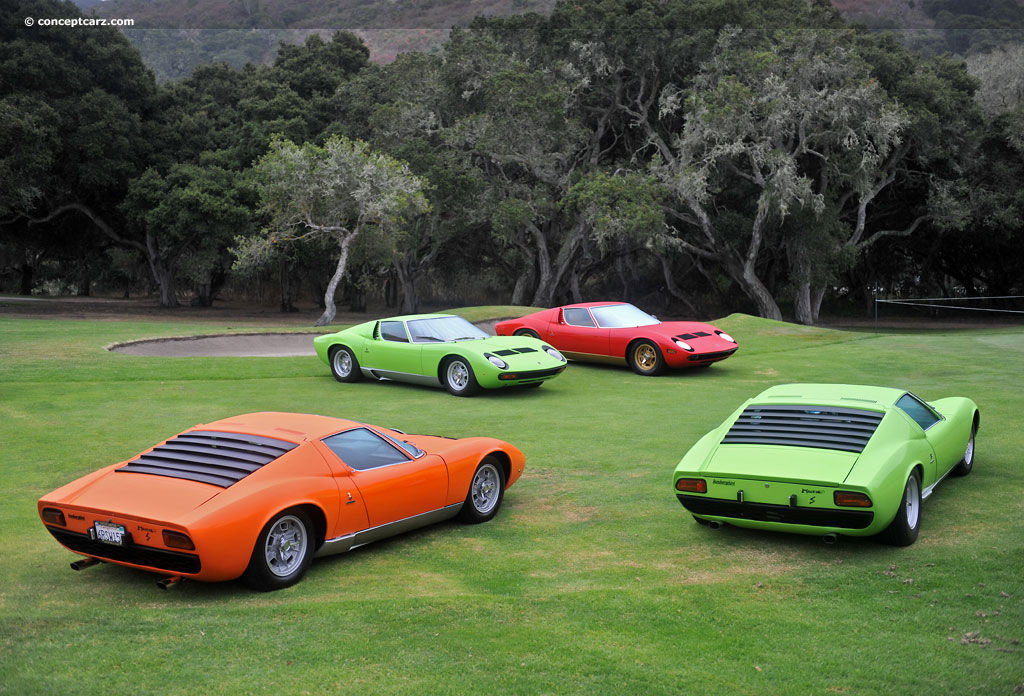
The Lamborghini Miura P400 prototype's introduction at the Geneva Salon in 1966 changed the automotive landscape forever, as it was unlike any previous production automobile, both in construction and appearance. Its design would influence a new breed of vehicles that has continued into modern times, and is regarded as the world's first supercar. It was revolutionary and exotic, with its transverse mid-engine architecture, Bizzarrini-designed 3.9-litre V-12 engine, and graceful yet athletic body designed by Marcello Gandini.
Coupe
Chassis #: 4578
Engine #: 30618
View info and history
Auction entries : 1Lamborghini 350 GT
Ferruccio Lamborghini founded Automobili Lamborghini S.p.A. in 1963 and their first production model was the 350 GT, a grand tourer built from 1964 through 1966. It was equipped with a quad-cam 3.5-liter Bizzarrini-designed V12 engine and clothed with an aluminum, two-door coupe body by Carrozzeria Touring. The V12 engine was essentially a race motor with the capability of developing upwards of 400 horsepower at 11,000 RPM. To make this engine more suitable for road-going purposes, engineer Gian Paolo Dallara and test driver Bob Wallace de-tuned the powerplant, reducing its compression from 11.0:1 to 9.4:1 and replacing the expensive 36 mm down-draft racing Weber carburetors with conventional, inexpensive side-draft 40 DCOE Webers. A wet sump replaced the dry-sump oiling system, and fewer exotic materials were used for the crankshaft and other components. In this guise, the engine offered 280 bhp at 6,500 RPM and 240 lb-ft of torque at 4,500 RPM. The all-aluminum alloy V12 engine was backed by a five-speed ZF manual gearbox, delivering power via a Salisbury limited-slip differential. Vacuum servo-assisted Girling disc brakes provided the stopping power. The 100.4-inch wheelbase was suspended by an independent suspension with unequal-length wishbones, anti-roll bars, and coil-over shock absorbers. The rear setup employed a coil-over assembly with asymmetrical wishbones.Lamborghini 400 GT
After 120 examples of the 350 GT were constructed, Lamborghini introduced the 400 GT in 1966 and it would remain in production through 1968, with a total of 247 units built. It was visually similar to its predecessor but powered by an enlarged 3,929cc V12 engine that now offered 320 horsepower.
Coupe
Chassis #: 4578
Engine #: 30618
View info and history
Auction entries : 1The first twenty-three examples were known as the 400 GT (or 400 GT Interim), including three that wore aluminum coachwork. These were followed by a second 400 GT, known as the 400 GT 2+2, which wore slight changes to its sheetmetal and a different roofline. Both the Interim and the 2+2 rested on a 100.4-inch wheelbase and had a length of 176 inches, but the re-worked bodywork of the 400 GT 2+2 allowed for the +2 seating in the rear. Lamborghini Miura
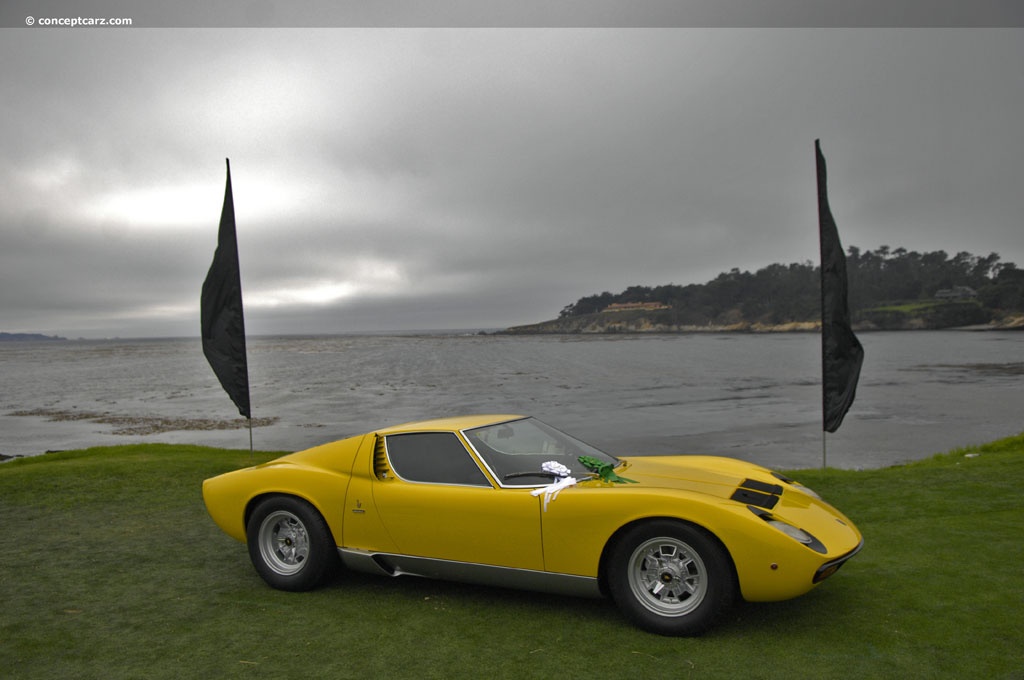
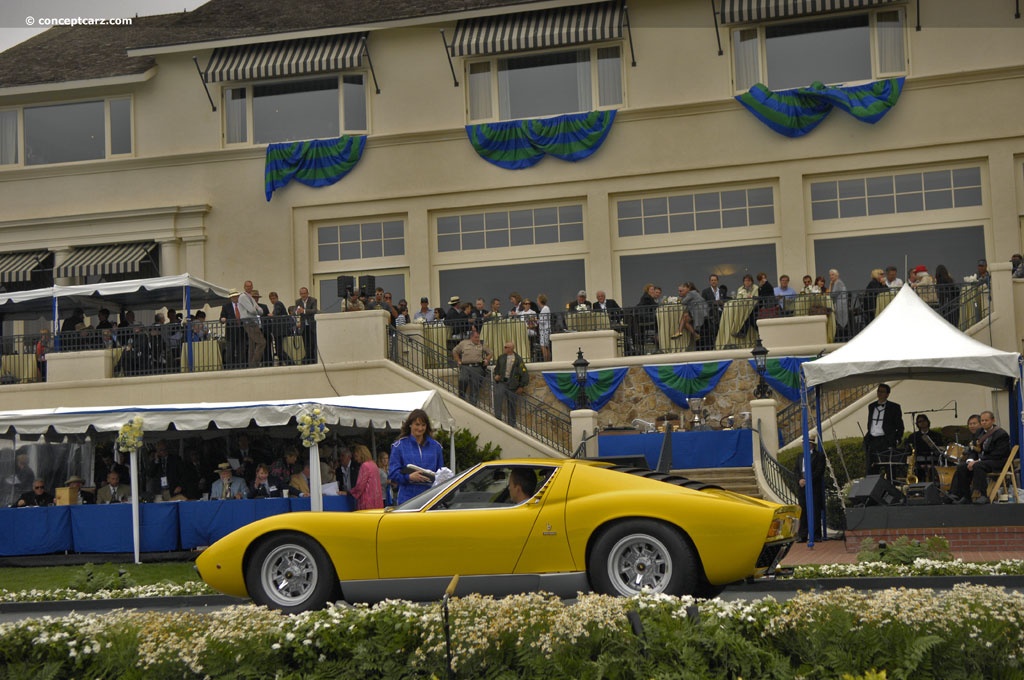
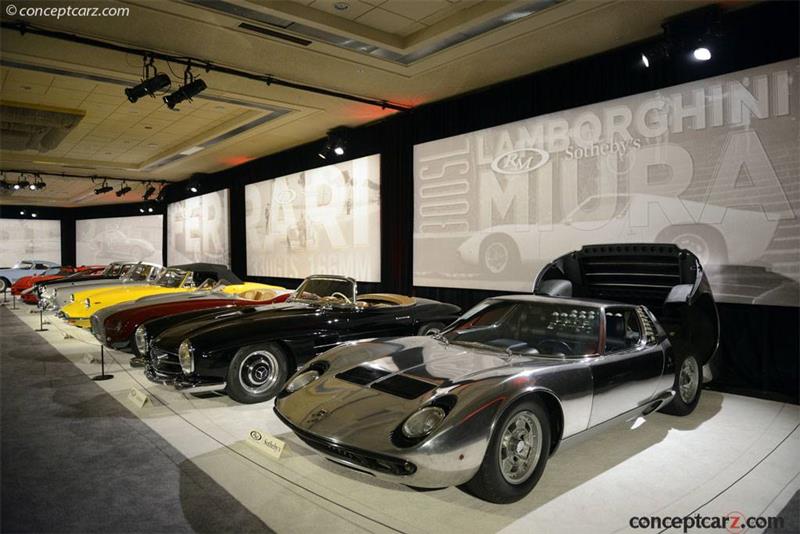
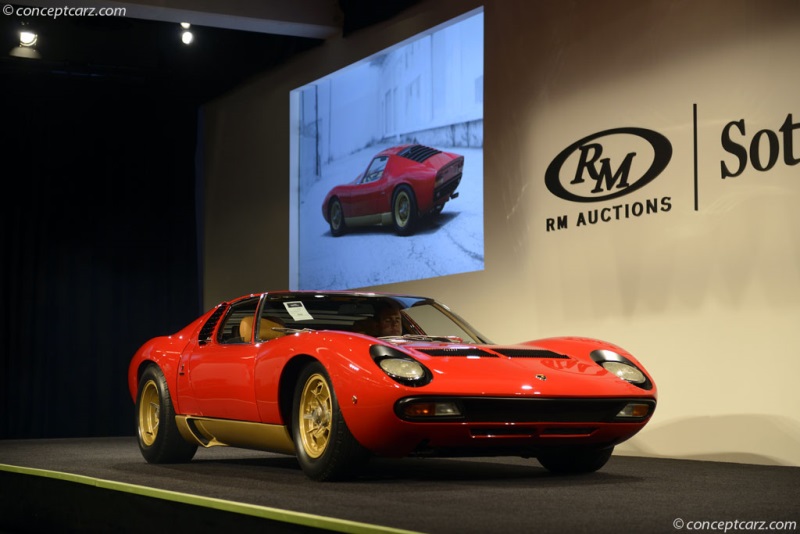
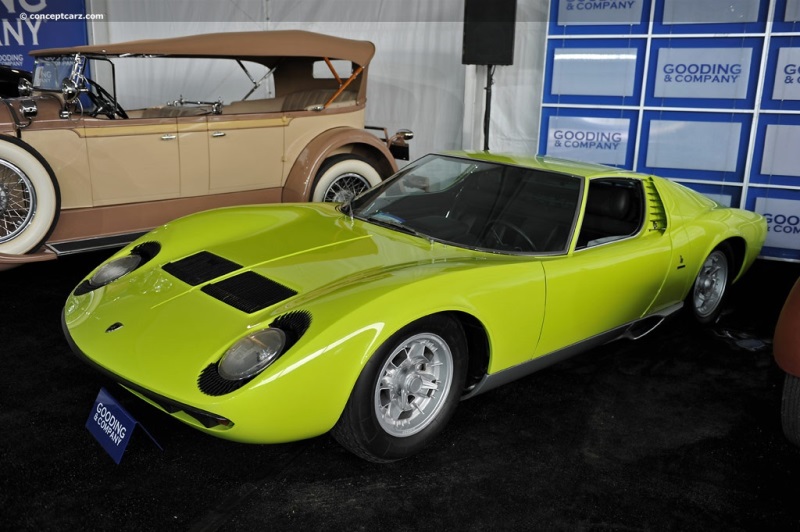
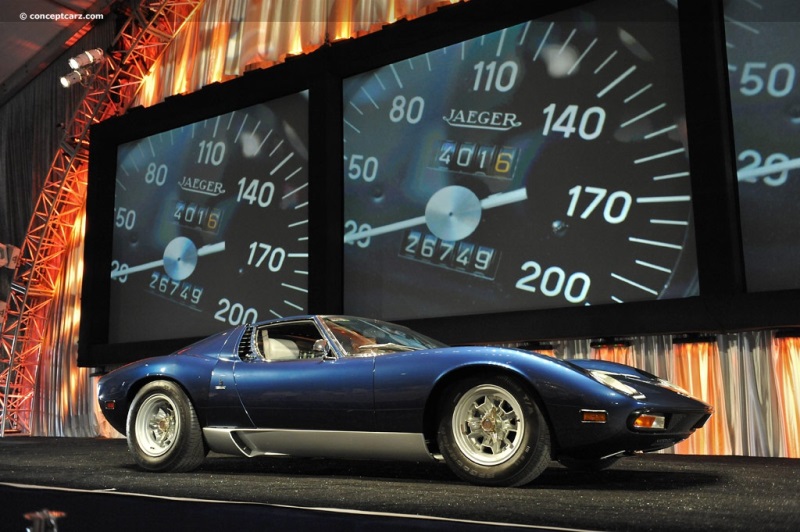
Ferruccio Lamborghini preferred grand touring cars delivering an abundance of power, comfort, and style. The Miura, however, did not conform to Ferruccio's vision and had been conceived by Lamborghini's engineering team in their spare time. A rolling chassis was displayed at the Turin Auto Show in 1965 and the prototype P400 followed a year later at the Geneva Motor Show. The reception it received from the motoring press and showgoers put to rest any doubts that Ferrucio may have had.The prototype car, known as the P400, was created by Gian Paolo Dallara, Paolo Stanzani and Bob Wallace. It had a transversely-mounted mid-engine layout, and its V12 engine was effectively merged with the transmission and differential. After its debut at Turin, Marcello Gandini of Carrozzeria Bertone was tasked with styling its exterior. The 25-year-old created a design that was equally radical as the underpinnings, with a shark-nosed front, dramatically swept-back windscreen, a low roofline that arched back over the V-12, and bulging air intakes for the rear brakes and weber carburetors. The interior had Jaeger instrumentation, Italian leather, an open gated gear leaver, and a large passenger grab handle.
Coupe
Chassis #: 4512
View info and history
Auction entries : 1The name Miura was chosen in homage to Eduardo Miura who raised bulls for bullfighting and whose ranch Ferrucio Lamborghini had visited in 1962.Lamborghini Miura P400
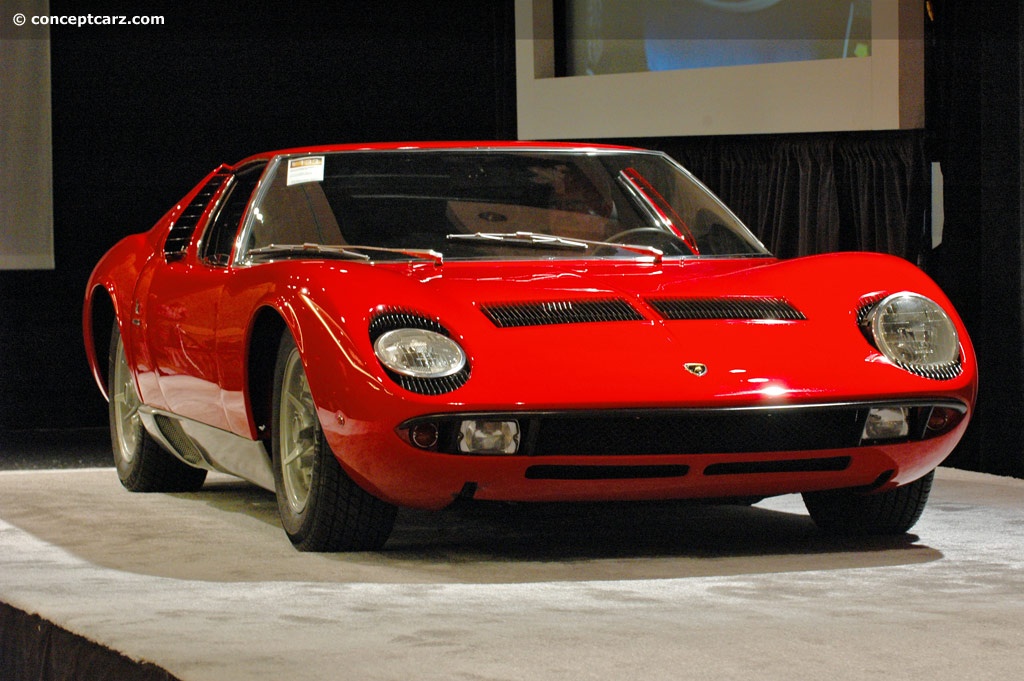
The P400 was the earliest model of the Miura and its name was in reference to Posteriore to its engine location and the '400' referencing the displacement of 4 litri. The V12 engine was the same powering the 400GT at the time and produced 345 horsepower. Between 1966 and 1969, Lamborghini produced 275 P400 models.Lamborghini Miura P400 S
Coupe
Chassis #: 4926
View info and history
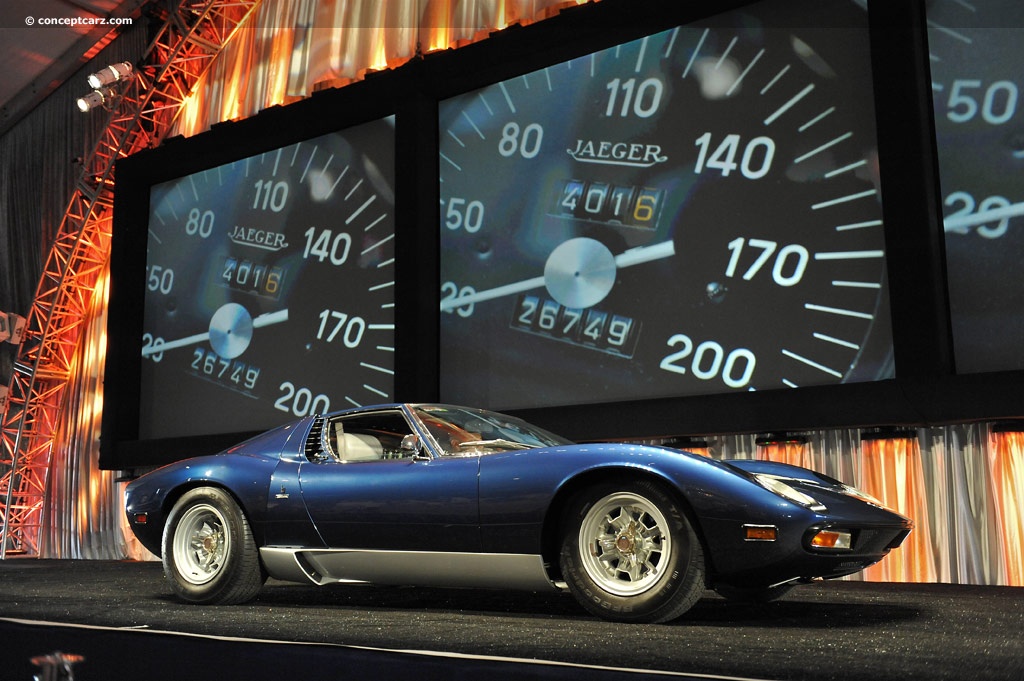
Auction entries : 2At the Turin Motor Show in November of 1968, Lamborghini introduced a slightly revised version of the P400 known as the P400S (a.k.a. the Miura S). The interior was given a new overhead inline console with new rocker switches, notched trunk end panels, a locking glovebox lid, a reversed position of the cigarette lighter and windshield wiper switch, and power windows. The exterior received additional bright chrome trim around the headlights and external windows. The engine gained 2mm larger engine intake manifolds and different camshaft profiles, boosting output by 20 hp. Air conditioning was now optional, adding an additional $800 (US) to the base price. Lamborghini produced approximately 338 examples of the P400S Miura between December 1968 and March 1971. Lamborghini Miura P400 SV
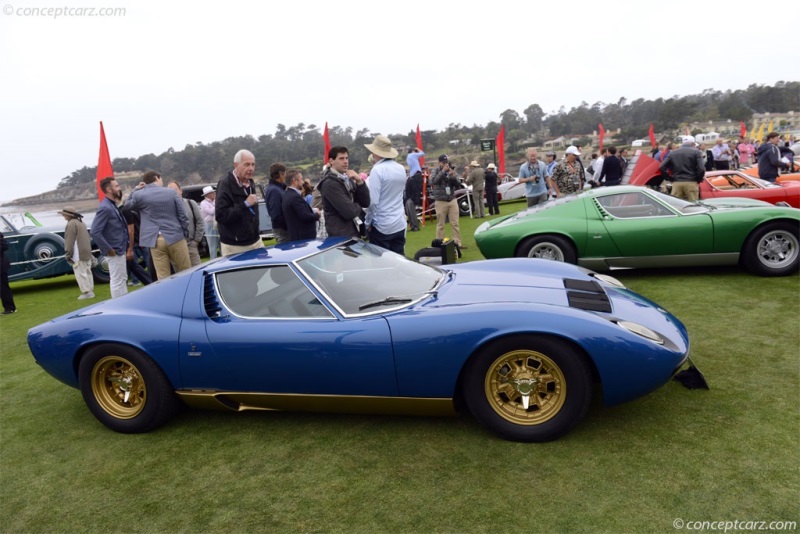
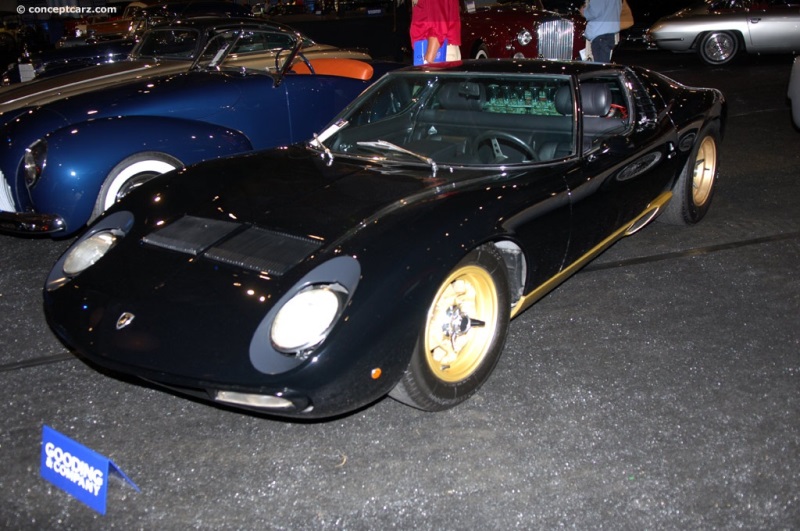
Continuous fettling and numerous upgrades culminated in the Miura 'Sprinto Veloce' or SV, of which 150 examples were built between 1971 and 1973. The SV models are instantly recognizable from the front for not having the headlight lashes of earlier cars and from the rear for their updated light clusters and flared arches, required to accommodate the new 9-inch-wide wheels. The rear suspension gained a regular lower A-arm taking the place of the inverted A-arm and trailing link arrangement, as well as substantial chassis stiffening. These modifications dramatically improved handling, especially on the limit. Under the rear louvres the V-12 was also fettled and outfitted with four Weber 40 IDL30 triple carburetors for the first time, boosting output to 385 bhp at 7,850 RPM, endowing the Miura with a zero-to-sixty mph time of 5.8 seconds and a top speed of 180 mph. The gearbox now had its lubrication system separate from the engine, which allowed the use of the appropriate types of oil for the gearbox and the engine.
CoupeOf the 150 Miura SV examples built, the final 96 received a split sump.
by Daniel Vaughan | Nov 2021
Coupe
Chassis #: 4578
Engine #: 30618
View info and history
Auction entries : 1
Ferruccio Lamborghini founded Automobili Lamborghini S.p.A. in 1963 and their first production model was the 350 GT, a grand tourer built from 1964 through 1966. It was equipped with a quad-cam 3.5-liter Bizzarrini-designed V12 engine and clothed with an aluminum, two-door coupe body by Carrozzeria Touring. The V12 engine was essentially a race motor with the capability of developing upwards of 400 horsepower at 11,000 RPM. To make this engine more suitable for road-going purposes, engineer Gian Paolo Dallara and test driver Bob Wallace de-tuned the powerplant, reducing its compression from 11.0:1 to 9.4:1 and replacing the expensive 36 mm down-draft racing Weber carburetors with conventional, inexpensive side-draft 40 DCOE Webers. A wet sump replaced the dry-sump oiling system, and fewer exotic materials were used for the crankshaft and other components. In this guise, the engine offered 280 bhp at 6,500 RPM and 240 lb-ft of torque at 4,500 RPM. The all-aluminum alloy V12 engine was backed by a five-speed ZF manual gearbox, delivering power via a Salisbury limited-slip differential. Vacuum servo-assisted Girling disc brakes provided the stopping power. The 100.4-inch wheelbase was suspended by an independent suspension with unequal-length wishbones, anti-roll bars, and coil-over shock absorbers. The rear setup employed a coil-over assembly with asymmetrical wishbones.Lamborghini 400 GT
After 120 examples of the 350 GT were constructed, Lamborghini introduced the 400 GT in 1966 and it would remain in production through 1968, with a total of 247 units built. It was visually similar to its predecessor but powered by an enlarged 3,929cc V12 engine that now offered 320 horsepower.
Coupe
Chassis #: 4578
Engine #: 30618
View info and history
Auction entries : 1
Ferruccio Lamborghini preferred grand touring cars delivering an abundance of power, comfort, and style. The Miura, however, did not conform to Ferruccio's vision and had been conceived by Lamborghini's engineering team in their spare time. A rolling chassis was displayed at the Turin Auto Show in 1965 and the prototype P400 followed a year later at the Geneva Motor Show. The reception it received from the motoring press and showgoers put to rest any doubts that Ferrucio may have had.The prototype car, known as the P400, was created by Gian Paolo Dallara, Paolo Stanzani and Bob Wallace. It had a transversely-mounted mid-engine layout, and its V12 engine was effectively merged with the transmission and differential. After its debut at Turin, Marcello Gandini of Carrozzeria Bertone was tasked with styling its exterior. The 25-year-old created a design that was equally radical as the underpinnings, with a shark-nosed front, dramatically swept-back windscreen, a low roofline that arched back over the V-12, and bulging air intakes for the rear brakes and weber carburetors. The interior had Jaeger instrumentation, Italian leather, an open gated gear leaver, and a large passenger grab handle.
Coupe
Chassis #: 4512
View info and history
Auction entries : 1
The P400 was the earliest model of the Miura and its name was in reference to Posteriore to its engine location and the '400' referencing the displacement of 4 litri. The V12 engine was the same powering the 400GT at the time and produced 345 horsepower. Between 1966 and 1969, Lamborghini produced 275 P400 models.Lamborghini Miura P400 S
Coupe
Chassis #: 4926
View info and history
Auction entries : 2
Continuous fettling and numerous upgrades culminated in the Miura 'Sprinto Veloce' or SV, of which 150 examples were built between 1971 and 1973. The SV models are instantly recognizable from the front for not having the headlight lashes of earlier cars and from the rear for their updated light clusters and flared arches, required to accommodate the new 9-inch-wide wheels. The rear suspension gained a regular lower A-arm taking the place of the inverted A-arm and trailing link arrangement, as well as substantial chassis stiffening. These modifications dramatically improved handling, especially on the limit. Under the rear louvres the V-12 was also fettled and outfitted with four Weber 40 IDL30 triple carburetors for the first time, boosting output to 385 bhp at 7,850 RPM, endowing the Miura with a zero-to-sixty mph time of 5.8 seconds and a top speed of 180 mph. The gearbox now had its lubrication system separate from the engine, which allowed the use of the appropriate types of oil for the gearbox and the engine.
Coupe
by Daniel Vaughan | Nov 2021
Related Reading : Lamborghini Miura P400 SV History
The Miura was first show to the public at the November 1965 Turin Auto Show. At the time, it did not have a body. It was just a rolling-chassis. The design was mid-engined, very revolutionary at the time. Bertone was chosen to body the vehicle. Nuccio Bertone gave the project to Marcello Gandini. In early 1966 the Bertone body and the chassis designed by Giampaolo Dallara were assembled into one unit.....
Continue Reading >>
Continue Reading >>
Related Reading : Lamborghini Miura History
The Miura was first shown to the public at the November 1965 Turin Auto Show. At the time, it did not have a body. It was just a rolling-chassis. The design was mid-engined, very revolutionary at the time. Bertone was chosen to body the vehicle. Nuccio Bertone gave the project to Marcello Gandini. In early 1966 the Bertone body and the chassis designed by Giampaolo Dallara were assembled into one....
Continue Reading >>
Continue Reading >>
Similar Vehicles
Similar Automakers


1971 Lamborghini Miura P400 Vehicle Profiles









Recent Vehicle Additions


Performance and Specification Comparison
Price Comparison
$19,520
Miura P400 SV Specification Comparison by Year
Year
Production
Wheelbase
Engine
Prices
Related Automotive News

LAMBORGHINI CELEBRATES THE MIURA 50TH ANNIVERSARY AT GOODWOOD FESTIVAL OF SPEED
SantAgata BologneseGoodwood, 27 June 2016 - A Miura SV restored by Lamborghini PoloStorico was awarded overall winner in the Cartier Style et Luxe Concours dElegance at Goodwood Festival of Speed 2016, in the year that Automobili Lamborghini...

LAMBORGHINI POLOSTORICO CELEBRATES MIURA 50 ANNIVERSARY AT AMELIA ISLAND WITH RESTORED MIURA SV 1971 GENEVA SHOW CAR
SantAgata Bolognese, 9 March 2016 – The original Lamborghini Miura SV shown at Geneva motor show in 1971 has been the subject of more than a years restoration by Lamborghini PoloStorico, and is presented as a finished project at the Amelia Island...

Historic 1955 Jaguar D-Type Joins Starting Grid at RM's Amelia Island Concours d'Elegance Sale
RM Auctions announces final entries for its Amelia Island, Florida sale, March 14
Representing RMs finest Amelia Island offering to date, recent highlights include a 1955 Jaguar D-Type, a 1971 Lamborghini Miura SV and a 1972 Ferrari 365 GTB4 Da...

Lamborghini Miura SV turns 50 in 2021
The Lamborghini Miura SV, the last evolution of the highly successful P400 project, was officially unveiled in March 1971, on the Lamborghini stand at the Geneva Motor Show. On the same occasion, on its stand, Carrozzeria Bertone presented the Countach...

Lamborghini Celebrates The 50Th Anniversary Of The Jarama GT
This year marks the 50th Anniversary of the Lamborghini Jarama GT, presented for the first time at the Geneva Motor Show in March 1970.
The Jarama, whose name derives from an area north of Madrid famous for breeding fighting bulls, was the latest evolution...

The Best Of Lamborghini At London Concours 2020
The London Concours has announced its Great Marques Lamborghini display, celebrating the very best from SantAgata
Line-up includes icons early pioneers like the 400GT and iconic Miura, through to the Diablo SV, Murcielago and Aventador SVJ
Les...

Lamborghini Miura Celebrated In A Dedicated Class At The 59Th Pebble Beach Concours d'Elegance
SantAgata Bolognese, 12 August 2019 – The Pebble Beach Concours dElegance, established in 1950, is the one of the most renowned classic car shows in the world, and every year the selection of cars for display is very severe, because only the...

AUTOMOBILI LAMBORGHINI AT PADUA'S 2016 CLASSIC CAR AND MOTORCYCLE SHOW 'AUTO E MOTO D'EPOCA'
SantAgata Bolognese, 20 October 2016 – Automobili Lamborghini is celebrating its glorious past and the 50th anniversary of the Miura with an official attendance at the 2016 Classic Car and Motorcycle Show in Padua. From 20 to 23 October a large...