With a history of innovative technology and styling in its bloodlines, the 2000 Eldorado moves into the new millennium with a series of technological and aesthetic improvements.Eldorado continues to be the best-selling prestige luxury coupe in the United States and has the highest owner loyalty of any coupe in its segment. While this Eldorado is the most advanced and responsive ever, it adheres to a philosophy that has been a hallmark of Eldorado from the beginning: Eldorado is for those who have accomplished on their own terms and those who proudly display their strong sense of individuality. Offering both 275- and 300-horsepower variants, the 4.6-liter aluminum 32-valve Northstar V8 remains the heart of the Eldorado lineup. The redesign of the engine focuses on significantly lowering emissions, quieter operation (without losing the 'pleasing' performance note that has long been a signature of the engine), and better fuel economy running on regular fuel. The engine features an all-new head design, new intake manifolds, coil-on-plug ignition and rolling cam runners to reduce friction. Additionally, virtually all other components were changed or updated, including the pistons, valves, connecting rods and cams.Further demonstrating a commitment to the legendary Eldorado brand and its customers, Cadillac introduced an Eldorado Touring Coupe in 1999 with monochromatic exterior ornamentation. This monochromatic ETC's exterior provides Eldorado with a fresh look more in line with its target consumers. Updates include new body color inserts on side and fascia moldings replacing chrome inserts; a new seven-spoke wheel with a Cadillac wreath and crest center cap; new P235/60HR 16-inch tires; and a new ETC decklid.For 2000, Eldorado offers a new version of OnStar. An integrated three-button system replaces the handset phone. This simplified approach allows for drivers to benefit from all of OnStar's safety, security and convenience features while keeping their eyes on the road and hands on the wheel.Exterior
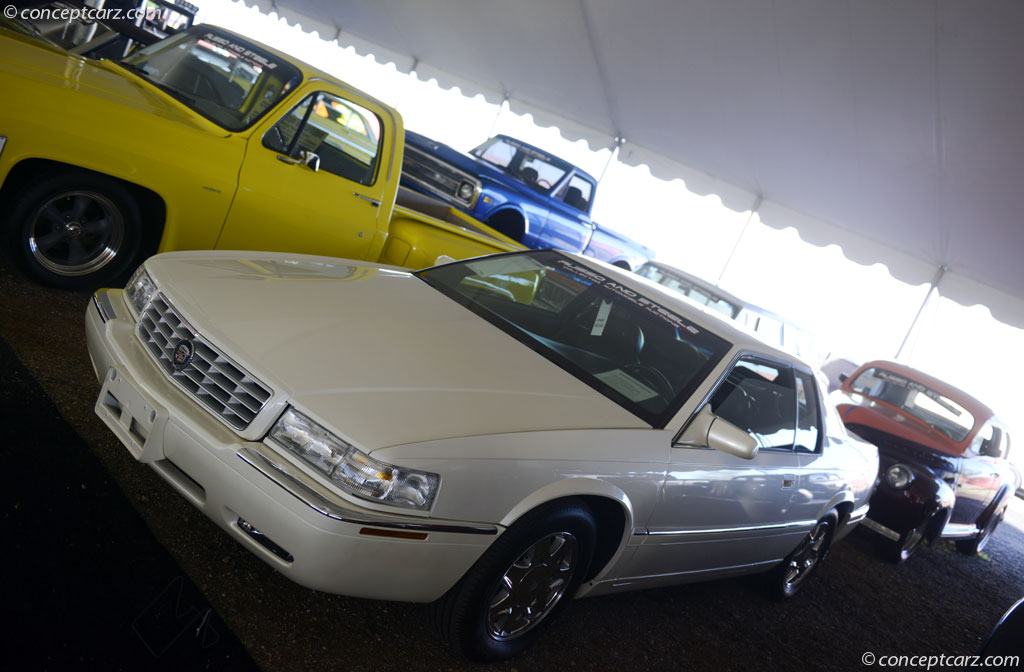
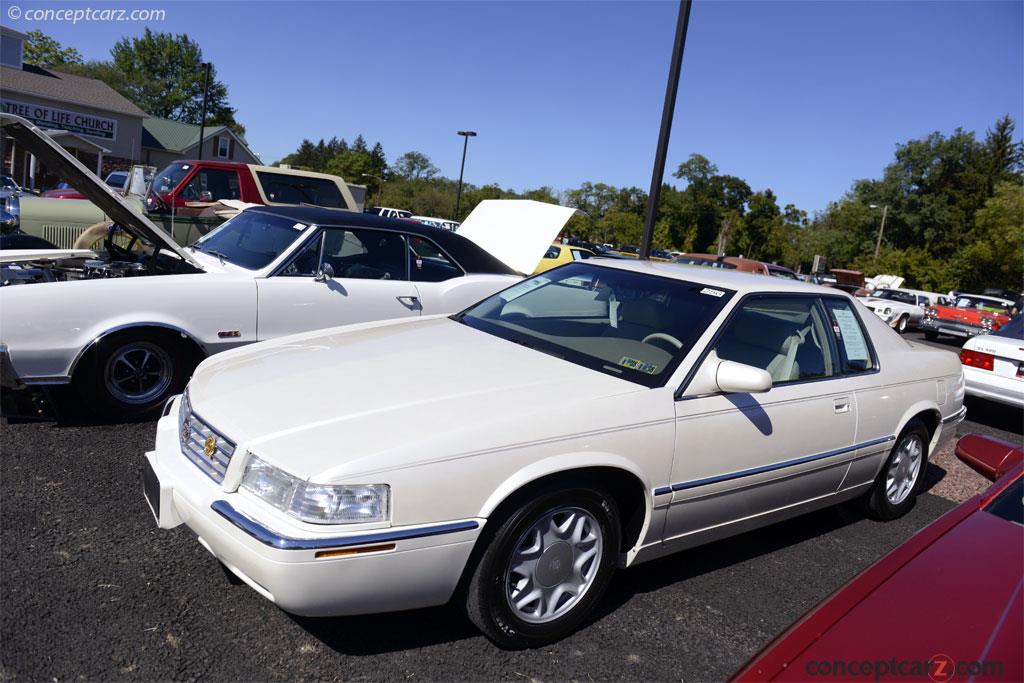
In addition to the ETC's fresh new look for 2000, the Eldorado's bold exterior styling will be enhanced by the following exterior colors: Crimson Pearl, White Diamond, Sable, Black, Sterling, Cashmere, and Polo Green.
Coupe
Chassis #: 1G6EL12YXYB703467
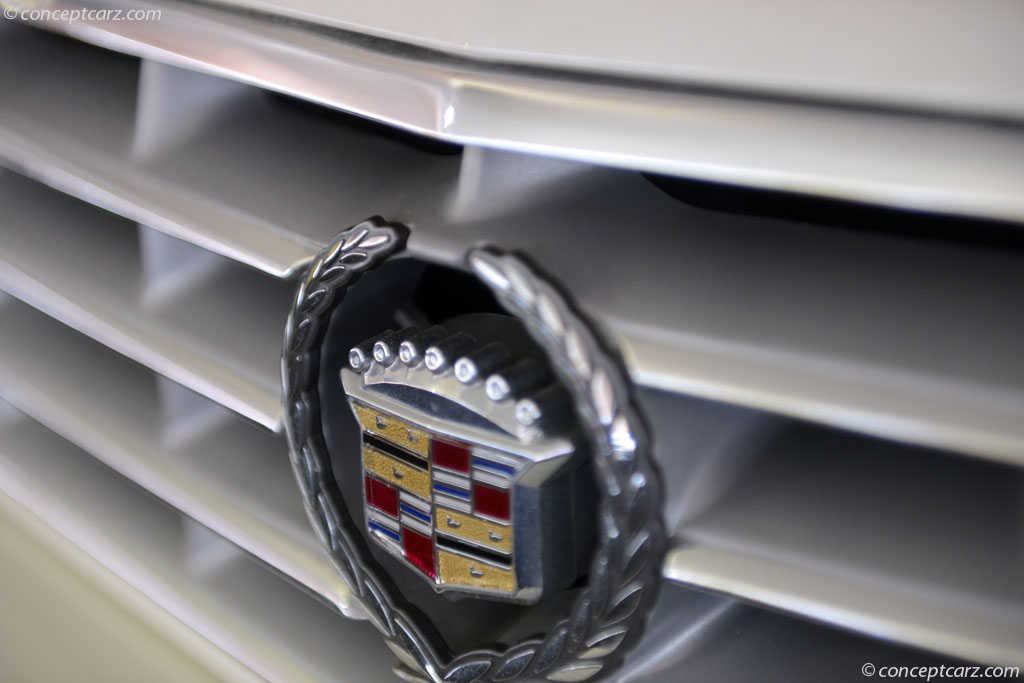
View info and historyA new logo, ESC (for Eldorado Sport Coupe), has been added to the Eldorado model.Interior
Eldorado and ETC's elegant interior is available in the following trim: Neutral Shale, Black, Oatmeal and Pewter. A wood trim steering wheel will be available as an option for the 2000 model Eldorado and ETC.Sound System
The up-level Bose® entertainment system is standard on the ETC and remains an option on the Eldorado. The system includes radio data system (RDS) technology, which allows the radio to receive digital data transmitted along with the standard radio signal. This information can include station call letters, program format, the name of the song and the artist playing and other useful information. RDS also makes it easier to find traffic and emergency information.
Coupe
Chassis #: 1G6EL12YXYB703467
View info and historyRDS also permits Eldorado and ETC buyers to personalize their radio to provide them whatever information they want, whether it's viewing stock quotes or searching for jazz stations.Commuters will appreciate the traffic announcement function of RDS. When the traffic announcement feature is turned on, the radio looks for a station that broadcasts traffic reports. This feature enables the radio to temporarily interrupt the audio program, including CD and cassette tape, with updated traffic conditions.A key safety feature of RDS is its alert system that will even interrupt a CD or tape to let listeners know of impending local or national emergencies.
Coupe
Chassis #: 1G6EL12YXYB703467
View info and historyAnother feature of the radio is the weather band, which allows customers to get National Weather Service reports 24 hours a day.The renowned Bose speaker system and a single-slot compact disc player are standard with the ETC sound system and available on the up-level Eldorado sound system. A 12-disc trunk-mounted CD changer is optional on both.All radios also feature a mute button, which silences the system when the button is pressed. The sound returns when the button is pressed again.
Coupe
Chassis #: 1G6EL12Y0YB704014
Auction entries : 1The ETC, as well as Eldorados equipped with the memory feature, offer home/away presets. Both driver 1 and driver 2 can select their preferred radio stations outside their home area, such as in frequently traveled business or vacation areas.All Eldorado and ETC radios are equipped with Theftlock™, which provides automatic theft deterrence for the radio. If the radio is removed from the car, it won't work in any other vehicle unless the vehicle identification number (VIN) is cleared. This can only be done by a dealership using a special tool. Once the VIN is scribed into the radio, the radio can be traced.Northstar System
The Eldorado features Cadillac's widely praised Northstar System, which can include a powerful dual overhead cam V8 engine with the StabiliTrak™ stability control system, continuously variable road-sensing suspension, all-speed traction control, ABS and Magnasteer™ steering.Northstar V8
The 2000 Eldorado benefits from the next step in modern engine design in the form of an improved Northstar V8. While the basic engine architecture remains a predominantly aluminum 4.6-liter DOHC 32-valve V8, major design improvements have been incorporated to deliver lower emissions, excellent mileage with regular unleaded fuel and smoother, quieter operation.
Coupe
Chassis #: 1G6EL12Y4YB701892
View info and history
Auction entries : 1The List Of New Northstar V8 Features Includes:Roller-follower valve train design Improved combustion chamber configuration
Coupe
Chassis #: 1G6EL12Y4YB701892
View info and history
Auction entries : 1Center-feed intake manifold New pistons Coil-on-plug cassette ignition system
Coupe
Chassis #: 1G6EL12Y4YB701892
View info and history
Auction entries : 1Siemens powertrain control module (engine and transmission control computer) Exhaust manifolds with integral air-injection passages Flex pipe between the exhaust Y-pipe and the catalytic converter Twin electrically driven, two-stage air pumps (LEV applications only) Direct mounting of all engine-driven accessories (power steering pump, AC compressor, electrical generator) Integrated coolant crossover and throttle-body support One result of these improvements is that the 2000 Eldorado will be certified for sale in California and certain Northeast states as a low emissions vehicle (LEV). This was achieved by means of a reaction-heated catalyst, pistons with reduced crevice volume and a new combustion chamber design.Revised combustion chambers are superior to previous designs in terms of both tumble motion of the incoming fuel-air mixture and burn rate. The intake and exhaust valves have been resized. The larger intake valves improve the engine's breathing ability, while the smaller exhaust valves increase flow velocity to aid catalyst light-off.While the new combustion chamber design helps maximize fuel efficiency, even larger gains are made by the addition of roller-follower devices between each cam lobe and valve stem. Compared to the previous Northstar's direct valve actuation, the result is a substantial reduction in friction. During moderate driving conditions, the torque necessary to turn Northstar's four camshafts is reduced by 50 percent or more.The Eldorado's fuel recommendation changes from premium (93 octane, lead-free) to regular unleaded, resulting in a major reduction in operating expense. To facilitate this gain, the Northstar's compression ratio was lowered from 10.3:1 to 10.0:1.The Northstar also benefits from a new ignition system that delivers power to the spark plugs directly instead of through wiring. A cassette containing four ignition coils linked by short secondary leads to adjoining spark plugs now attaches atop each cylinder head cover.In addition to improved reliability, the new ignition system permits scheduling the magnitude of the voltage sent to the spark plugs. High voltage is used during full-load, high rpm and heavy EGR (exhaust gas recirculation) conditions to guarantee complete combustion. The energy level is reduced to minimize electrical loads and radio frequency interference during light-load conditions, such as medium speed cruising. The result is extended spark-plug life and a peak energy capacity that is 130 percent higher than the system it replaced.Northstar's new powertrain control module is a single circuit board device housed within a sealed aluminum case engineered to withstand the harsh underhood environment. The module contains dual microprocessors to monitor and direct engine and transmission operations.Noise and vibration improvements are the result of adopting a center-feed design for the composite-plastic intake manifold, as opposed to the previous end-feed design. The new design facilitates a near equal-length induction path for all eight cylinders. In contrast, the previous design provided a long path to the front cylinders and shorter paths to rearward cylinders. With the reduction or elimination of many harmonic tones, the resulting induction sound is more of a hum.A molded-plastic cover backed with acoustical foam rests above the intake manifold to reduce induction, fuel-injector and other noises radiated by the engine. Direct mounting of accessories eliminates flex and vibration inherent with extra brackets. A flexible connection in the exhaust system en route to the catalyst helps quell another source of noise and harshness.Outstanding Power, Torque
The 4.6-liter dual-overhead-camshaft Northstar V8 installed in the Eldorado generates 275 horsepower (205 kW) at 5600 rpm and 300 lb.-ft. (407 N•m) of torque at 4000 rpm. The sportier ETC is equipped with a retuned version of the Northstar V8 producing 300 horsepower (224 kW) at 6000 rpm and 295 lb.-ft. (400 N•m) of torque at 4400 rpm. Redline for both models begins at 6500 rpm through 7000 rpm.The Northstar engines offer 100,000-mile (160,000-kilometer) durability and limp-home mode in case of total coolant loss. The Northstar's maintenance-free design can go up to 100,000 miles before the first scheduled tune-up — only changing the oil, oil filter and air filter is required in the interim — until the Eldorado logs 100,000 miles (160,000 kilometers). In limp-home mode, the engine can operate on four cylinders at speeds of 50 mph (80 kph) for about 50 miles (80 kilometers), giving the driver an opportunity to reach a safe location. The engine accomplishes this by alternately delivering fuel to four of the eight cylinders. The remaining four cylinders do not fire but continue to pump air, which cools the engine.On both ETC and Eldorado, the 4T80-E transaxle is linked to the engine via a viscous converter clutch, which assures smooth operation by reducing torque variation when the torque converter clutch is applied. The 4T80-E also features equal-length drive axles, which limit torque steer by minimizing angle differences from side to side as the car accelerates.StabiliTrak™
StabiliTrak will continue to be offered as standard equipment on the ETC and a stand-alone option on Eldorado.StabiliTrak is a stability control system that improves the stability of the vehicle on all surfaces at all speeds. At the heart of StabiliTrak are two sensors — a yaw rate sensor and lateral acceleration sensor — that work with the car's suspension, steering, ABS and traction control systems.StabiliTrak's computer compares the steering angle (where the driver wants the car to go) with feedback from yaw rate and lateral sensors (where the car is actually going).When the StabiliTrak system determines that the car is not going where the driver is steering it, the StabiliTrak computer (which also controls ABS and traction control functions) sends a complex but extremely rapid series of directions to the vehicle's traction control and ABS to help straighten the vehicle. For example, if the car is starting to fishtail, StabiliTrak gently applies the outside front brake to slow the vehicle and nudge its tail back into line.Road-Texture Detection
Road-texture detection, a standard feature on ETC, makes the anti-lock brakes more effective by measuring the roughness of the road and adjusting brake operation accordingly.Suspension Systems
The ETC is equipped with continuously variable road-sensing suspension (CVRSS), which produces optimum body and wheel damping under virtually all driving conditions by independently adjusting the damper setting at each corner of the vehicle and responding in real time. CVRSS can precisely match required damping to the severity of the input, enabling a refinement level not previously achieved. The benefits to the ETC customer include markedly improved rolling smoothness, road isolation and impact feel, with exceptional control during aggressive emergency maneuvers. The Eldorado features hydraulic dampers that provide good control while still delivering the well-isolated ride preferred by Eldorado customers.Magnasteer™
Another integral part of the Northstar System, Magnasteer is a continuously variable, speed-sensitive steering system that is standard on the ETC and Eldorado. Magnasteer varies the amount of steering effort in proportion to vehicle speed. Steering effort is reduced at lower speeds for parking ease and is increased as the vehicle speed rises for highway cruising.Sensitivity to lateral acceleration as well as speed is an enhanced feature of the Magnasteer system. When the cornering rate is up, as sensed by an on-board lateral accelerometer, steering effort is automatically increased to enhance the driver's feel of the road. In addition, if StabiliTrak is active, steering effort also is increased significantly to help the driver maintain command of the situation.Personal SecurityOnStar
New from OnStar for 2000 is a simplified, integrated three-button system. Attached to the rearview mirror of Eldorado and ETC, the OnStar three-button system has its own dedicated cellular network, which eliminates the need of an additional cellular contract.OnStar provides the most complete array of safety, security and convenience services available to drivers today. The system uses Cadillac's sophisticated on-board electronics, global positioning system (GPS) satellite technology and the cellular network to link the driver and the vehicle with the 24-hour OnStar Center.OnStar's services include route support, remote door unlock, theft detection notification, stolen vehicle tracking, emergency services, OnStar MED-NET, AccidentAssist and remote diagnostics. From a database of more than five million listings, an adviser at the OnStar Center also can provide a wide range of convenience services, such as providing the location of the nearest automatic teller machine (ATM), making hotel reservations or ordering flowers.Ownership And Warranty
All 2000 Cadillacs are backed by a four-year/50,000-mile (whichever comes first) bumper-to-bumper limited warranty with courtesy transportation for all warranty repairs and no deductible. The warranty also includes defects in the material and workmanship of tires. Additional coverage includes a six-year/100,000-mile (whichever comes first) rust-through protection.Cadillac 24-hour roadside assistance is available to Cadillac owners toll-free by dialing 1-800-882-1112. Cadillac-trained service technicians are dispatched to handle minor repairs and assist with flat tires, lockouts, jump starts, fuel deliveries and other roadside emergencies. If the repair cannot be completed on the spot, the technician can arrange to have the vehicle transported to a dealership and customers driven to their home or other local destination. Roadside assistance is provided at no charge for any warranty repair and at a nominal charge if the vehicle is not under warranty.Source - Cadillac
In addition to the ETC's fresh new look for 2000, the Eldorado's bold exterior styling will be enhanced by the following exterior colors: Crimson Pearl, White Diamond, Sable, Black, Sterling, Cashmere, and Polo Green.
Coupe
Chassis #: 1G6EL12YXYB703467
View info and history
Eldorado and ETC's elegant interior is available in the following trim: Neutral Shale, Black, Oatmeal and Pewter. A wood trim steering wheel will be available as an option for the 2000 model Eldorado and ETC.Sound System
The up-level Bose® entertainment system is standard on the ETC and remains an option on the Eldorado. The system includes radio data system (RDS) technology, which allows the radio to receive digital data transmitted along with the standard radio signal. This information can include station call letters, program format, the name of the song and the artist playing and other useful information. RDS also makes it easier to find traffic and emergency information.
Coupe
Chassis #: 1G6EL12YXYB703467
View info and history
Coupe
Chassis #: 1G6EL12YXYB703467
View info and history
Coupe
Chassis #: 1G6EL12Y0YB704014
Auction entries : 1
The Eldorado features Cadillac's widely praised Northstar System, which can include a powerful dual overhead cam V8 engine with the StabiliTrak™ stability control system, continuously variable road-sensing suspension, all-speed traction control, ABS and Magnasteer™ steering.Northstar V8
The 2000 Eldorado benefits from the next step in modern engine design in the form of an improved Northstar V8. While the basic engine architecture remains a predominantly aluminum 4.6-liter DOHC 32-valve V8, major design improvements have been incorporated to deliver lower emissions, excellent mileage with regular unleaded fuel and smoother, quieter operation.

Coupe
Chassis #: 1G6EL12Y4YB701892
View info and history
Auction entries : 1

Coupe
Chassis #: 1G6EL12Y4YB701892
View info and history
Auction entries : 1

Coupe
Chassis #: 1G6EL12Y4YB701892
View info and history
Auction entries : 1
The 4.6-liter dual-overhead-camshaft Northstar V8 installed in the Eldorado generates 275 horsepower (205 kW) at 5600 rpm and 300 lb.-ft. (407 N•m) of torque at 4000 rpm. The sportier ETC is equipped with a retuned version of the Northstar V8 producing 300 horsepower (224 kW) at 6000 rpm and 295 lb.-ft. (400 N•m) of torque at 4400 rpm. Redline for both models begins at 6500 rpm through 7000 rpm.The Northstar engines offer 100,000-mile (160,000-kilometer) durability and limp-home mode in case of total coolant loss. The Northstar's maintenance-free design can go up to 100,000 miles before the first scheduled tune-up — only changing the oil, oil filter and air filter is required in the interim — until the Eldorado logs 100,000 miles (160,000 kilometers). In limp-home mode, the engine can operate on four cylinders at speeds of 50 mph (80 kph) for about 50 miles (80 kilometers), giving the driver an opportunity to reach a safe location. The engine accomplishes this by alternately delivering fuel to four of the eight cylinders. The remaining four cylinders do not fire but continue to pump air, which cools the engine.On both ETC and Eldorado, the 4T80-E transaxle is linked to the engine via a viscous converter clutch, which assures smooth operation by reducing torque variation when the torque converter clutch is applied. The 4T80-E also features equal-length drive axles, which limit torque steer by minimizing angle differences from side to side as the car accelerates.StabiliTrak™
StabiliTrak will continue to be offered as standard equipment on the ETC and a stand-alone option on Eldorado.StabiliTrak is a stability control system that improves the stability of the vehicle on all surfaces at all speeds. At the heart of StabiliTrak are two sensors — a yaw rate sensor and lateral acceleration sensor — that work with the car's suspension, steering, ABS and traction control systems.StabiliTrak's computer compares the steering angle (where the driver wants the car to go) with feedback from yaw rate and lateral sensors (where the car is actually going).When the StabiliTrak system determines that the car is not going where the driver is steering it, the StabiliTrak computer (which also controls ABS and traction control functions) sends a complex but extremely rapid series of directions to the vehicle's traction control and ABS to help straighten the vehicle. For example, if the car is starting to fishtail, StabiliTrak gently applies the outside front brake to slow the vehicle and nudge its tail back into line.Road-Texture Detection
Road-texture detection, a standard feature on ETC, makes the anti-lock brakes more effective by measuring the roughness of the road and adjusting brake operation accordingly.Suspension Systems
The ETC is equipped with continuously variable road-sensing suspension (CVRSS), which produces optimum body and wheel damping under virtually all driving conditions by independently adjusting the damper setting at each corner of the vehicle and responding in real time. CVRSS can precisely match required damping to the severity of the input, enabling a refinement level not previously achieved. The benefits to the ETC customer include markedly improved rolling smoothness, road isolation and impact feel, with exceptional control during aggressive emergency maneuvers. The Eldorado features hydraulic dampers that provide good control while still delivering the well-isolated ride preferred by Eldorado customers.Magnasteer™
Another integral part of the Northstar System, Magnasteer is a continuously variable, speed-sensitive steering system that is standard on the ETC and Eldorado. Magnasteer varies the amount of steering effort in proportion to vehicle speed. Steering effort is reduced at lower speeds for parking ease and is increased as the vehicle speed rises for highway cruising.Sensitivity to lateral acceleration as well as speed is an enhanced feature of the Magnasteer system. When the cornering rate is up, as sensed by an on-board lateral accelerometer, steering effort is automatically increased to enhance the driver's feel of the road. In addition, if StabiliTrak is active, steering effort also is increased significantly to help the driver maintain command of the situation.Personal SecurityOnStar
New from OnStar for 2000 is a simplified, integrated three-button system. Attached to the rearview mirror of Eldorado and ETC, the OnStar three-button system has its own dedicated cellular network, which eliminates the need of an additional cellular contract.OnStar provides the most complete array of safety, security and convenience services available to drivers today. The system uses Cadillac's sophisticated on-board electronics, global positioning system (GPS) satellite technology and the cellular network to link the driver and the vehicle with the 24-hour OnStar Center.OnStar's services include route support, remote door unlock, theft detection notification, stolen vehicle tracking, emergency services, OnStar MED-NET, AccidentAssist and remote diagnostics. From a database of more than five million listings, an adviser at the OnStar Center also can provide a wide range of convenience services, such as providing the location of the nearest automatic teller machine (ATM), making hotel reservations or ordering flowers.Ownership And Warranty
All 2000 Cadillacs are backed by a four-year/50,000-mile (whichever comes first) bumper-to-bumper limited warranty with courtesy transportation for all warranty repairs and no deductible. The warranty also includes defects in the material and workmanship of tires. Additional coverage includes a six-year/100,000-mile (whichever comes first) rust-through protection.Cadillac 24-hour roadside assistance is available to Cadillac owners toll-free by dialing 1-800-882-1112. Cadillac-trained service technicians are dispatched to handle minor repairs and assist with flat tires, lockouts, jump starts, fuel deliveries and other roadside emergencies. If the repair cannot be completed on the spot, the technician can arrange to have the vehicle transported to a dealership and customers driven to their home or other local destination. Roadside assistance is provided at no charge for any warranty repair and at a nominal charge if the vehicle is not under warranty.Source - Cadillac
1999 5,599 (Through May '99)
1998 15,598
1997 20,609
1996 20,964
1995 23,200Vehicle HistoryThe Eldorado name first appeared on a convertible Cadillac in 1953. Introduced as a limited edition, this car signified a new direction in styling for Cadillac and GM. Over the next few years, the Eldorado helped distinguish Cadillac as the ultimate in the prestige class. In 1956, Cadillac offered two versions of the Eldorado: the convertible returned with the name Biarritz and a two-door hardtop called the Seville was unveiled. Designed to be a modern technical showcase, Cadillac's ultra-luxurious 1957 Eldorado Brougham introduced the quad headlight system, a power seat with memory, automatic door locks, air suspension and a foot-operated parking brake that automatically released when the transmission was shifted into gear. Eldorado's tail fins, also called rocket fins, reached their styling peak in 1959. The fins would begin a gradual decline in 1960 and reached a subdued form by 1964. Completely redesigned in 1967, the Eldorado was the first Cadillac with front-wheel drive. Cadillac stopped making convertible Eldorados in 1976, but teased enthusiasts in 1984 by producing 2,000 Eldorado Biarritz convertibles. In 1992, the Eldorado was dramatically restyled with sharp, razor edges and angular body. The Eldorado Touring Coupe (ETC) was also introduced, designed with a more aggressive and refined touring suspension. The two models offer the world-famous Northstar System. Today, the Eldorado is the only luxury coupe built in North America.Source - Cadillac
1998 15,598
1997 20,609
1996 20,964
1995 23,200Vehicle HistoryThe Eldorado name first appeared on a convertible Cadillac in 1953. Introduced as a limited edition, this car signified a new direction in styling for Cadillac and GM. Over the next few years, the Eldorado helped distinguish Cadillac as the ultimate in the prestige class. In 1956, Cadillac offered two versions of the Eldorado: the convertible returned with the name Biarritz and a two-door hardtop called the Seville was unveiled. Designed to be a modern technical showcase, Cadillac's ultra-luxurious 1957 Eldorado Brougham introduced the quad headlight system, a power seat with memory, automatic door locks, air suspension and a foot-operated parking brake that automatically released when the transmission was shifted into gear. Eldorado's tail fins, also called rocket fins, reached their styling peak in 1959. The fins would begin a gradual decline in 1960 and reached a subdued form by 1964. Completely redesigned in 1967, the Eldorado was the first Cadillac with front-wheel drive. Cadillac stopped making convertible Eldorados in 1976, but teased enthusiasts in 1984 by producing 2,000 Eldorado Biarritz convertibles. In 1992, the Eldorado was dramatically restyled with sharp, razor edges and angular body. The Eldorado Touring Coupe (ETC) was also introduced, designed with a more aggressive and refined touring suspension. The two models offer the world-famous Northstar System. Today, the Eldorado is the only luxury coupe built in North America.Source - Cadillac
• Improved Northstar V8 • Freshened exterior on Eldorado Touring Coupe (ETC) • Body color inserts on side and fascia moldings replace chrome (ETC) • Seven-spoke wheel with Cadillac wreath and crest center cap (ETC)
• Simplified ETC decklid logo design • ESC decklid logo for Eldorado Sport Coupe
Source - Cadillac
• Simplified ETC decklid logo design • ESC decklid logo for Eldorado Sport Coupe
Source - Cadillac
Similarly Sized Vehicles
from 2000
Cadillac Monthly Sales Volume
March 2023
36,321


2000 Cadillac Eldorado Vehicle Profiles

Recent Vehicle Additions


Performance and Specification Comparison
Price Comparison
$31,005
$38,650 - $45,600
$44,480
Eldorado Twelfth Generation Specification Comparison by Year
Year
Production
Wheelbase
Engine
Prices
25,230
108.00 in.
8 cyl., 279.00 CID., 275.00hp
8 cyl., 279.00 CID., 300.00hp
8 cyl., 279.00 CID., 300.00hp
$38,220 - $41,535
16,172
108.00 in.
8 cyl., 279.00 CID., 275.00hp
8 cyl., 279.00 CID., 300.00hp
8 cyl., 279.00 CID., 300.00hp
$39,225 - $43,500
13,993
108.00 in.
8 cyl., 278.57 CID., 275.00hp
8 cyl., 278.57 CID., 300.00hp
8 cyl., 278.57 CID., 300.00hp
$39,700 - $43,245
7,052
108.00 in.
8 cyl., 278.57 CID., 275.00hp
8 cyl., 278.57 CID., 300.00hp
8 cyl., 278.57 CID., 300.00hp
$42,130 - $45,265
Related Automotive News

2022 Volkswagen Tiguan: Brand best-seller improved with bolder design and advanced standard features
Tiguan is the best-selling Volkswagen in the U.S. and worldwide
Revised exterior features a bold front end with standard LED headlights
New standard tech includes Digital Cockpit, KESSY® keyless entry available features include Climatronic® Tou...

NEW VOLKSWAGEN GOLF R MAKES ITS U.S. DEBUT AT THE 2014 NORTH AMERICAN INTERNATIONAL AUTO SHOW
Most powerful production Golf ever for the North American market
New car has an estimated 290 horsepower, but is more fuel efficient than previous Golf R
EA888 TSI® 2.0-liter engine propels DSG® equipped Golf R from 0 to 62 mph in 4.9 seconds
...

NEW VOLKSWAGEN GOLF R MAKES ITS U.S. DEBUT AT THE 2014 NORTH AMERICAN INTERNATIONAL AUTO SHOW
Most powerful production Golf ever for the North American market
New car has an estimated 290 horsepower, but is more fuel efficient than previous Golf R
EA888 TSI® 2.0-liter engine propels DSG® equipped Golf R from 0 to 62 mph in 4.9 seconds
Car...

2014 KIA SOUL EARNS NHTSA 5-STAR SAFETY RATING
Kias Iconic Urban Passenger Vehicle Achieves NHTSAs Highest Rating
All-new 2014 Soul scores five stars for frontal and side impact tests and earns 5-star overall rating
Souls long list of standard safety features and use of high-tensile steel he...

VOLKSWAGEN E-GOLF TO MAKE NORTH AMERICAN DEBUT AT THE LOS ANGELES AUTO SHOW
The first fully electric Volkswagen for the U.S. market promises everyday usability and versatility with zero tailpipe emissions and low ownership costs
Drivetrain consists of 24.2 kWh lithium-ion battery and 115 horsepower electric motor 7.2 kW o...