

Coupe
Chassis #: 079803
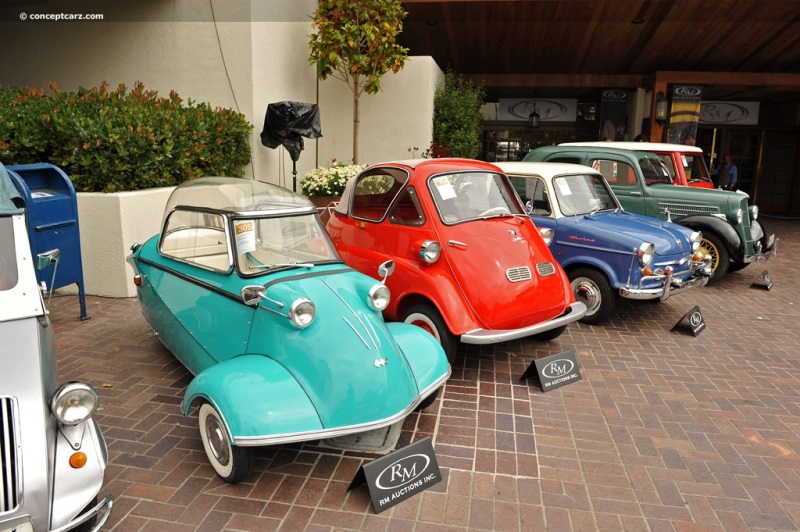
For 1955, Messerschmitt introduced an improved version of the KR-175, the KR-200. This had a 10.2 horsepower Fichtel and Sachs 191cc two-stroke engine, an improved suspension, and an improved canopy. To move the car in reverse, the engine was merely re-started in the other direction, which provided four speeds backward as well as forward. Messerschmitt would produce over 60,000 examples through 1964, by which time the European country's fortunes had improved, which meant micro-cars of this type were losing its popularity. By this point in history, Messerschmitt had returned to the aircraft business and lost interest in producing the kabinenrollers. This well-restored KR-200 is painted in turquoise. The engine and chassis have been completely restored. There is a white interior with snakeskin upholstery and a two-stroke single-cylinder engine offering 10.2 horsepower.In 2010, the car was offered for sale at the Sports & Classics of Monterey, presented by RM Auctions. It was estimated to sell for $35,000 - $45,000 and offered without reserve. As bidding came to a close, the car had been sold for $55,000 inclusive of the buyer's premium.
By Daniel Vaughan | Dec 2010
During World War II, the Messerschmitt Company produced German fighter planes such as the popular ME109 fighter. The company came into existence in 1923 and was founded by Professor Willy Messerschmitt. When WWII came to a close, the company switched to manufacturing automobile parts, as well as other industries, such as sewing machine production. Designs for the Messerschmitt automobiles began as early as 1953 by Fritz Fend. The Messerschmitt three-wheeled KR175 Kabinenroller (cabin scooter) was the original Messerschmitt. Power was from a one-cylinder, two-stroke engine that displaced 175cc and produced 9.5 horsepower. The rear-mounted engine powered the single rear wheel and mated to a four-speed manual gearbox. The cars were suspended by a rubber torsilastic suspension, and braking was handled by four-wheel mechanical drum brakes. Steering was by a handlebar-type system. The interior cockpit had room for two, though seating was in tandem with the passenger sitting behind the driver. In total, around 10,000 examples were sold.
By Daniel Vaughan | Apr 2009
The KR200 was introduced a short time later and powered by a large, two-stroke engine that displaced 191cc. Horsepower rose to 10. There was a tilt-over, cockpit-style bubble canopy top formed from plexiglas. The KR200 had a reverse gear (the engine could be spun the opposite way to go backward) and a self-starter. The KR175 did not have a reverse and had to be pick-up or pushed to go backward.
By Daniel Vaughan | Apr 2009
One of a kind, the quirky three-wheeled Messerschmitt KR200 was a bubble car designed by Fritz Fend, an aircraft engineer. The KR200, also dubbed Kabinenroller or cabin scooter, was produced from 1955 through 1964 in the German aircraft manufacturer Messerschmitt's factory. The year was 1952, and Messerschmitt was temporarily banned from manufacturing aircraft, so they turned their attention and resources to other production. Fend took his idea of a small motor vehicle based on an invalid carriage, Fend Flitzer, to the German company. The result of their collaboration was the KR175, which would be the first of Fend's vehicles to enter production at Messerschmitt's Regensburg factory. The car wore the Messerschmitt name and insignia, but a separate company Regensburger Stahl- und Metallbau GmbH was created to both manufacture and market the car. In 1955 the KR200 was born. Taking the same basic frame as the KR175, the KR200 sported an improved canopy design and updated bodywork that included wheel cutouts in the front fenders. Hydraulic shock absorbers were now found at all three wheels, the tire sizes were enlarged to 4.00x8 and the rear suspension and engine mountings were revamped. Retailing around $1724.71, or DM 2,500, the KR200 was met with immediate fanfare. Nearly 12,000 models were constructed in its first year alone. Amazingly light, the KR200 had a maximum speed of around 56 mph and a claimed power output of only 10 PS.
The KR200 Kabrio model was debuted in 1957. Sporting a cloth convertible top, the Kabrio had fixed side window frames. Soon after the KR201 Roadster was introduced, with a folding cloth top, a windscreen, removable side curtains and no window frames. Closely following the arrival of these models was a Sport Roadster with no top and a fixed-in-place canopy. The driver had to climb in and out of the vehicle via the top of the car. The early KR200 models carried some of the KR175 characteristics that included yellow ochre-colored interior primer, beige-colored interior trim, and double-strip front bumper trim. The spunky little KR200 and its four-wheeled derivative, the FMR Tg500 shared the narrow little body that was a microcar trademark and the transparent acrylic bubble canopy. One had to enter the car via a canopy door hinged on the right side of the vehicle. For most vehicles except the Roadster, the door included all the windows and the frame in which it was set and extended from the right side of the monocoque tub to the left. The canopy was fixed in place on the Sport Roadster model and only a tonneau cover was in place of a top or any windows at all. A larger curved glass windshield that formed A-pillars with the side window frames on the KR200 was a much more simplified version from the previous KR175. This made the bubble much more compact, easier, and less expensive to produce. The KR200 featured an electric windshield wiper, which was an upgrade from the manual KR175 one. Tandem seating was used in the narrow body of the KR200, which allowed the body to 'taper like an aircraft fuselage', within a practical length. The microcar had an mpg of around 87. The KR200 featured capable handling thanks to the tandem seating and centralized mass of the car with the longitudinal axis, low weight, and low center of gravity and wheel placement. The tandem seating also made an export version to left-hand drive countries unnecessary.Powering the KR200 was a 11.7 cu in Fichtel & Sachs air-cooled single-cylinder two-stroke engine nestled in front of the rear wheel, right behind the passenger's seat. With two sets of contact breaker points, to reverse the KR200, the engine was stopped and then restarted, going backward. Whether intentionally or not, this was achieved by pushing the key further into the ignition switch than normal. The same four gear ratios were available in reverse as in the forward movement thanks to the positive-stop transmission. Similar to flying an aircraft, the controls inside the KR200 were all operated by pushing instead of turning. The steering bar provided a very direct response best suited to small, measured inputs thanks to its connected directly to the track rods of the front wheels. Putting the car in neutral no matter what gear it had been in before when actuated, the gearshift lever had a secondary lever on it. The transmission would have to be shifted back to first before the car would be able to move from a direct stop. The KR200 featured a full set of pedals that included a brake, clutch, and accelerator, unlike its predecessor, the KR175. Using cables, the brake pedal still operated mechanical brakes. Messerschmitt prepared a KR200 to break the 24-hour speed record in 1955 for three-wheeled vehicles under 15.3 cu in. to prove the durability under the hood of the microcar. Tested mercilessly for 25,000 kilometers, the prototype broke 22 international speed records in its class, including the 24-hour speed record (which is set at 64 mph). The record car had a highly modified engine and a special single-seat low-drag body, while the steering, suspension, and braking components were stock. The throttle, brake, and clutch cables were replicated.
Sales drooped significantly in 1962, and by 1964, sales of the KR200 ceased completely. The German economy was booming, and demand for basic economic transport in Germany had dwindled. This was also happening in other parts of Europe, including the U.K., where the biggest export location was the U.S., whose fascination was focused on the arrival of the popular Mini. Today there is a small niche for the microcar lover, and fan could pay upwards of €20,000 for a well-maintained 'Schmitt'. Aftermarket reproduction marks are made for the KR200 and include reproduction bubble tops constructed from car-safe polymethyl methacrylate. Sources:
http://en.wikipedia.org/wiki/Messerschmitt_KR200
http://www.rmauctions.com/lots/lot.cfm?lot_id=1057226
By Jessica Donaldson
When 1956 rolled around and Messerschmitt was once again allowed to manufacture aircrafts, they lost their interest in Fend's microcars. The German company sold the Regensburg works to Fend who partnered with Valentin Knott, brake and hub supplier, with the end result being Fahrzeug- und Maschinenbau GmbH Regensburg (FMR). The new company continued to produce the KR200 along with Fend's other vehicles.
Factory-converted Service Cars were manufactured by Messerschmitt and, eventually, FMR, to order by the automobile service industry. An estimated twelve Service Cars were built, and only one is thought to have survived. The idea behind the concept was similar to the service offered by the Harley-Davidson Servi-Car and the Indian Dispatch Tow. The Service Car featured a detachable tow bar and clamp, and a revamped front suspension that housed the tow bar when it wasn't used, and a storage system inside the car to accommodate the tow bar when not used. The idea was that the service tech would tow the disabled car by attached the tow bar to the front of the Service Car and clamp the other end to the bumper of the customer's car and drive it back to the garage.
http://en.wikipedia.org/wiki/Messerschmitt_KR200
http://www.rmauctions.com/lots/lot.cfm?lot_id=1057226
By Jessica Donaldson
1963 Messerschmitt KR200 Vehicle Profiles
Recent Vehicle Additions


Performance and Specification Comparison
Price Comparison
KR200 Specification Comparison by Year
Year
Production
Wheelbase
Engine
Prices
Related Automotive News

SILVERSTONE CLASSIC ROARS FROM STRENGTH TO STRENGTH
Full preview to the worlds biggest classic motor racing festival
Special 40th anniversary James Hunt celebrations
World Champions and Grand Prix winners in legendary line-up
HSCC, Viper and Porsche top milestone track parades
Sir Geoff Hurst...

MORE STANDS FOR BARGAINS AT BEAULIEU'S SPRING AUTOJUMBLE
Hundreds of autojumblers jostled for the best finds as they packed Beaulieus 23rd Spring Autojumble in spite of the weather. As many as 14,735 event-goers visited the show, an unmissable highlight of the classic events calendar in the Beaulieu parkland...

JOHN SURTEES CBE ANNOUNCES AUCTION LOTS FOR THE 2016 HENRY SURTEES FOUNDATION TEAM KARTING CHALLENGE
Tuesday 5 July 2016 – Mercedes-Benz World Circuit, Brooklands
Team entries are shaping up well for the hotly contested Henry Surtees Foundation Team Karting Challenge, which will take place on Tuesday 5 July 2016. The event organised by John S...

ECURIE ECOSSE GLORIES AGAIN AS BONHAMS SELLS SCOTTISH TEAM COLLECTION FOR £8.8M
All eight cars in British connoisseur **** Skipworths collection from the legendary Scottish team that won two consecutive Le Mans 24-Hour races in 1956 and 1957, sold at Bonhams today (1 December) for record prices.
Just as they did in the 1950s,...

Dennis Hopper and Steve McQueen Motorcycles Added to Mecum Celebrity Items Auction
Rare and Vintage Motorcycles Join a Growing List of Collectible Vehicles Set to Hit the Auction Block This Summer
Walworth, WI - June 20, 2013 -- Mecum has announced the addition of two vintage, celebrity motorcycles to the upcoming Celebrity...