Concept Cars Home
 

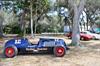
1961 Ferguson Climax P99 news, pictures, and information

Chassis Num: P99-01
 
Sold for $648,948 (£410,000) at 2010 RM Auctions.
To win a race, an advantage is needed. If that advantage proves to be very successful, chances are it will be immediately banned to keep the playing field level. If this theory holds true, then the Ferguson Climax P99 four-wheel-drive F1 racing car was a victim of its own success and ingenuity.

Harry Ferguson was the first man to build and fly his own airplane in the British Isles. He later invented and patented the three-point linkage and draft-control systems used worldwide on tractors. After World War II, he won an estimated $9 million for patent infringement by Ford on the 8N tractor. Ferguson would use this new-found wealth to bankroll a company to build four-wheel-drive cars in England. A number of prototypes were built, and were met with little sales success as the industry was still in a post-war funk and few were willing to take a chance on the new technology.

So Ferguson, along with racers Freddie Dixon and Tony Rolt, decided to build a Grand Prix car to showcase the four-wheel-drive's potential. Claude Hill from Aston Martin was hired to design the space-frame chassis. A 2.5-liter engine was intended to fit under the bonnet and power the car. Unfortunately the rules changed and Formula 1 was restricted to 1.5-liters, which meant the extra weight of the four-wheel-drive system would be a handicap. But since it rains a lot in London, the team still felt they would have an advantage. A new series was soon established, the Inter/Continental series (which allowed the 2.5-liter engines), and the Ferguson was built to accommodate both Climax motors.

The work to build this new F1 racing car took less than a year to complete. Dixon had calculated that the differentials, bearings, gears and other drivetrain parts could be lighter if the energy was dispersed to four wheels rather than two. Ferguson's central differential system - which would later become the setup used by Peugeot and later Audi to earn them rally success in the 1980s - could balance out the delivery of that power to the wheels. Another ingenious technology was the Dunlop Maxaret anti-lock brake system, which would later be used by the mainstream automotive community three decades later.

Sadly, Ferguson passed away before his dream car could take to the track. Rolt took over the dream and passion for the project, seeing it through to completion.

When Cooper and Lotus began using mid-engine cars in the early 1960s, the hopes for a strong finish with the P99 seemed highly unlikely. The mid-engine setup had transformed the Formula One world, making the front-engined cars nearly obsolete.

The inaugural racing debut for the P99 was at the 1961 British Empire Trophy at Silverstone, and Jack Fairman drove the car in Rob Walker's team colours of dark blue and white. After mechanical problems, the P99 was retired prematurely from the race. The cars next outing was at Aintree in the British Grand Prix. Rob Walker entered the P99 for Jack Fairman and a Lotus 18 for Stirling Moss. When the Lotus broke, Moss took over the P99. He was black-flagged after a push-start, so his rapid progress through the field came to nought.

In September of 1961, Moss and the P99 competed in the Oulton Park Gold Cup. The weather was cooperating with the strengths of the vehicle - it was 57 degrees and there was a steady drizzle resulting in a wet track. As the checkered flag fell, it was Moss who crossed the finish line first, followed by Jack Brabham 46 seconds later. This would be the only Grand Prix ever won by a four-wheel-drive car. After the race, Formula 1 promptly banned four-wheel-drive. Moss had the option of using the Dunlop Maxaret anti-lock brakes but preferred to turn them off and use his own judgment. This technology would re-appear in 1967 on the Jensen FF.

The next race for the Ferguson P99 was in 1963 in Australia. By now, it was powered by 2.5-liter engine and raced in the hands of World Champion Graham Hill. The car finished 6th in the Australian Grand Prix and 2nd at the Lakeside International. The car returned to England and was lent to hillclimb racer Peter Westbury, who won the 1964 British championship with it. It also ran competitively in 1965 and 1966 and was retired in 1968.

Matra, Lotus and McLaren all tried the Ferguson system, while Cosworth devised their own. The new technology for 1969 was wings, which proved that it was possible to achieve the same traction without the weight penalty. In total, only eight four-wheel-drive F1 cars were built.

The Fergusson P99 spent over 35 years in the Donington Collection. In 2004, it was recovered to the Ferguson Family Museum on the Isle of Wight and overhauled. The work to the car was extensive; it was completely stripped and was found to be in remarkably good order. It was meticulously re-assembled using all of the original parts, including the twin-choke Weber 58 carburetors. The bodywork was re-fitted and it still wears the original Rob Walker team paint and livery.

In 2005, Sir Stirling Moss drove it at the Goodwood revival and at the Monaco Historic Grand Prix in 2008. In 2006, Barry 'Whizzo' Williams drove it at Goodwood.

The P99 is currently powered by a 2495cc DOHC Coventry Climax four-cylinder engine offering 243 horsepower. There is a five-speed transmission and four-wheel Dunlop hydraulic disc brakes.

In 2010, the vehicle was offered for sale at the Automobiles of London sale presented by RM Auctions. It was estimated to sell for $735,000 - $890,000. As bidding came to a close, the car had been sold for the sum of $410,000, inclusive of buyer's premium.

By Daniel Vaughan | May 2011
Grand Prix Circuits: Pau Circuit
Some grand prix circuits just have a mythical status about them. Besides the drivers and great races, a lot of the equation comes down to how memorable the circuit truly is. In the case of the Pau Circuit, its sheer place in motorsport history and lore makes this tight, twisting circuit a true legend. From its very beginnings, Pau would be at the heart of travel and transportation. Situated in a rather deep valley with the Pyrenees mountains lending an imposing back-drop, the area that would ...[Read more...]
1970 Monaco Grand Prix: A Reversal of Fortunes
In gambling and sports there is one word that seems to be absolutely foundational to both—luck. Heading into the 1970 season Jack Brabham had had his share of luck. Jochen Rindt, on the other hand, seemed to have none of it. This would all change on the 10th of May, 1970. Jochen Rindt had come into Formula One during the mid-1960s and was certainly fast straight-away. Often one of the quickest drivers on the circuit, Rindt would find his choice of teams to be his biggest letdown as the reliab...[Read more...]
1969 United States Grand Prix: The Rise of Rindt
If there was one racer in the Formula One paddock that drivers and spectators alike believed should have scored his first victory before the start of the 1969 season it would almost unanimously be Jochen Rindt. Fast and flamboyant, the Austrian exhibited car control that enthralled just about everyone it seemed, except perhaps the cars themselves. Constantly undercut by poor reliability, it seemed Rindt was to forever suffer under such an oppressive weight. However, at the 1969 United States Gra...[Read more...]
1962 Monaco Grand Prix: McLaren Carries the Cooper Flag back to the Top
By the beginning of the 1962 Formula One season Jack Brabham had left Cooper to form his own racing team. It seemed the glories days of the double World Championship were well and truly behind them. However, left in Brabham's stead would be a man very akin to the Australian in so many ways. And in Bruce McLaren, Cooper had a driver and competitor more than apt to help carry the team forward into the future. The first race of the 1962 season, the Grand Prix of the Netherlands, certainly didn't...[Read more...]
A Monaco story: When Nico met Mika
It's a scene that happens hundreds of thousands of times a day around the world: two people meet in a lift, greet each other and begin to chat about work and life. The twist in this particular story, though, is that the elevator is in Monte-Carlo; the two men are resident in the same apartment building, separated by little more than a few floors; and both have written their own chapters in the very exclusive grand prix racing history of Mercedes-Benz. Mika Hakkinen was the first Mercedes-Ben...[Read more...]

1961 Formula One Season
PosTeamConstructorChassisDriversPoints
Scuderia FerrariFerrari156 Belgium Olivier Gendebien
United States Paul Richard 'Richie' Ginther
United States Philip Toll Hill, Jr
Belgium Willy Mairesse
Mexico Ricardo Rodríguez
Germany Wolfgang von Trips 
40
Team LotusLotus
18
21 
United Kingdom James 'Jim' Clark, Jr.
United Kingdom Robert McGregor Innes Ireland
Belgium Willy Mairesse
United Kingdom Trevor Taylor 
32
Porsche KGPorsche
718/2 
Sweden Joakim 'Jo' Bonnier
United States Daniel Sexton Gurney
Germany Hans Herrmann 
22
Cooper Car CompanyCooper
T55 
Australia Sir John Arthur 'Jack' Brabham
New Zealand Bruce Leslie McLaren 
14
Owen Racing OrganisationBRM United Kingdom Charles Anthony Standish 'Tony' Brooks
United Kingdom Norman Graham Hill 
7
 Gilby EngineeringGilby United Kingdom Keith Greene 
 Ecurie MaarsbergenPorsche
718/2 
Netherlands Carel Godin de Beaufort
Germany Hans Herrmann 
 Scuderia SerenissimaDeTomaso
T51
F1 Alfa 
Italy Giorgio Scarlatti
France Maurice Bienvenu Jean Paul Trintignant
Italy Nino Vaccarella 
 Scuderia SettecolliDeTomaso
F1 Alfa 
Italy Roberto Lippi 
 Isobele de TomasoDeTomaso
F1 Alfa 
Italy Roberto Bussinello 
 Scuderia ColoniaLotus
18 
Switzerland Michael May
Germany Wolfgang Seidel 
 Ecurie BelgeLotus
18 
Belgium Lucien Bianchi
Belgium Olivier Gendebien
Belgium Willy Mairesse
Belgium André Pilette 
 Camoradi InternationalLotus
18 
United Kingdom Ian Burgess
United States Masten Gregory 
 Rob Walker Racing TeamLotus
18
21 
United Kingdom Jack Fairman
United Kingdom Sir Stirling Moss 
 UDT Laystall Racing TeamLotus
18 
United Kingdom Henry Clifford Allison
Belgium Lucien Bianchi
Argentina Juan Manuel Bordeu
United States Masten Gregory
United Kingdom Henry Taylor 
 Anthony Ernest MarshLotus
18 
United Kingdom Anthony Ernest 'Tony' Marsh 
 Reginald ParnellLotus
18 
United Kingdom Reginald 'Tim' Parnell 
 Gerald AshmoreLotus
18 
United Kingdom Gerald Ashmore 
 Louise Bryden-BrownLotus
18 
South Africa Anthony Francis O'Connell 'Tony' Maggs 
 Prince Gaetano Starrabba di GiardinelliLotus
18 
Italy Prince Gaetano Starrabba di Giardinelli 
 J Wheeler AutosportLotus Canada Peter B. Ryan 
 Jim HallLotus
18 
United States Jim Hall 
 J Frank HarrisonLotus
18 
United States Lloyd Ruby 
 Camoradi InternationalCooper
T53 
United States Masten Gregory 
 Yeoman Credit RacingCooper
T53 
United Kingdom Roy Francesco Salvadori
United Kingdom John Surtees 
 Scuderia SerenissimaCooper
T51 
France Maurice Bienvenu Jean Paul Trintignant 
 H&L MotorsCooper
T53 
United Kingdom Jackie Lewis 
 Scuderia Centro SudCooper
T53
T51 
Italy Lorenzo Bandini
Italy Massimo Natili 
 Bernard Marie François Alexandre Collomb-ClercCooper
T53 
France Bernard Marie François Alexandre Collomb-Clerc 
 Fred Tuck CarsCooper
T45/51 
United Kingdom Jack Fairman 
 Pescara Racing TeamCooper Italy Renato Pirocchi 
 James SharpCooper
T53 
United States James 'Hap' Sharp 
 John M Wyatt IIICooper
T53 
United States Roger S. Penske 
 Momo CorporationCooper
T53 
United States Walt Hansgen 

1961 Season Review
RaceCircuitDateWinning DriverConstructor
 Monaco Grand Prix  MonacoMay 1961  Sir Stirling MossLotus 
 Dutch Grand Prix  ZandvoortMay 1961  Wolfgang von TripsFerrari 
 Belgian Grand Prix  Spa-FrancorchampsJun 1961  Philip Toll Hill, JrFerrari 
 French Grand Prix  Reims-GueuxJul 1961  Giancarlo BaghettiFerrari 
 British Grand Prix  AintreeJul 1961  Wolfgang von TripsFerrari 
 German Grand Prix  NürburgringAug 1961  Sir Stirling MossLotus 
 Italian Grand Prix  MonzaSep 1961  Philip Toll Hill, JrFerrari 
 United States Grand Prix  Watkins GlenOct 1961  Robert McGregor Innes IrelandLotus 

Formula One World Drivers' Champions
1950 G. Farina
1951 J. Fangio
1952 A. Ascari
1953 A. Ascari
1954 J. Fangio
1955 J. Fangio
1956 J. Fangio
1957 J. Fangio
1958 M. Hawthorn
1959 S. Brabham
1960 S. Brabham
1961 P. Hill, Jr
1962 N. Hill
1963 J. Clark, Jr.
1964 J. Surtees
1965 J. Clark, Jr.
1966 S. Brabham
1967 D. Hulme
1968 N. Hill
1969 S. Stewart
1970 K. Rindt
1971 S. Stewart
1972 E. Fittipaldi
1973 S. Stewart
1974 E. Fittipaldi
1975 A. Lauda
1976 J. Hunt
1977 A. Lauda
1978 M. Andretti
1979 J. Scheckter
1980 A. Jones
1981 N. Piquet
1982 K. Rosberg
1983 N. Piquet
1984 A. Lauda
1985 A. Prost
1986 A. Prost
1987 N. Piquet
1988 A. Senna
1989 A. Prost
1990 A. Senna
1991 A. Senna
1992 N. Mansell
1993 A. Prost
1994 M. Schumacher
1995 M. Schumacher
1996 D. Hill
1997 J. Villeneuve
1998 M. Hakkinen
1999 M. Hakkinen
2000 M. Schumacher
2001 M. Schumacher
2002 M. Schumacher
2003 M. Schumacher
2004 M. Schumacher
2005 F. Alonso
2006 F. Alonso
2007 K. Raikkonen
2008 L. Hamilton
2009 J. Button
2010 S. Vettel
2011 S. Vettel
2012 S. Vettel

© 1998-2012. All rights reserved. The material may not be published, broadcast, rewritten, or redistributed.