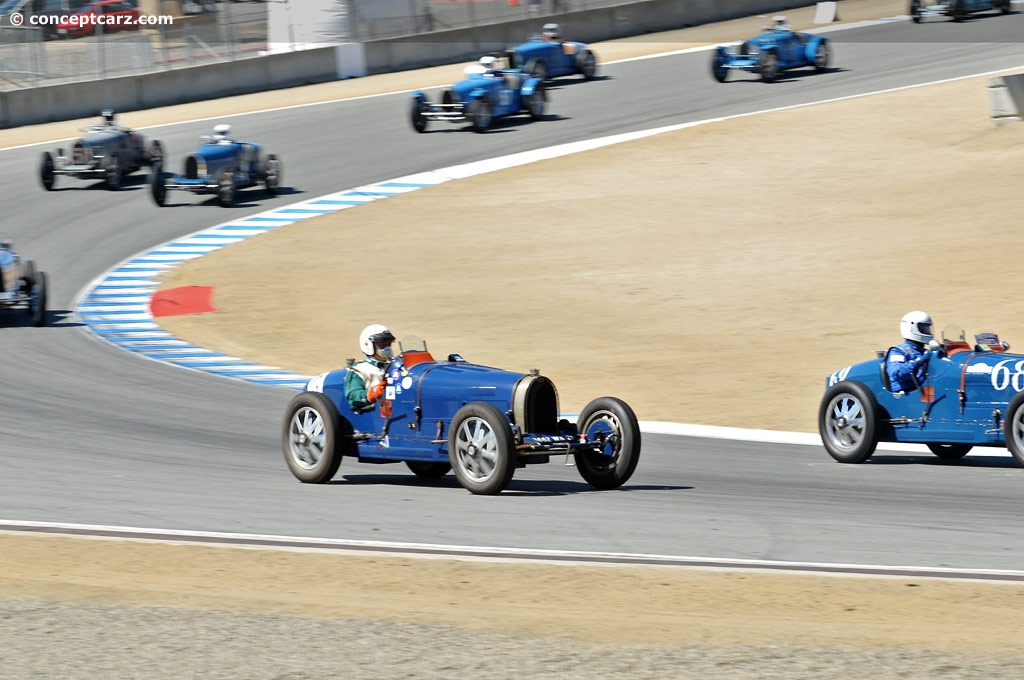
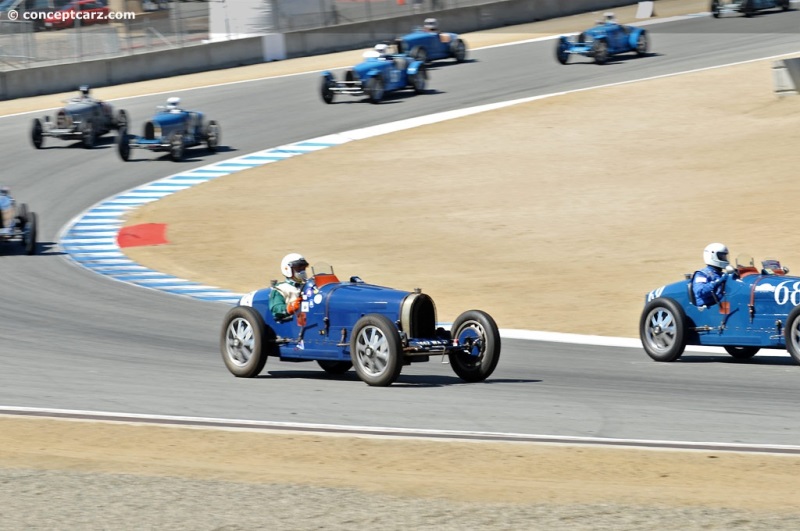
Ettore Bugatti's Type 35 was introduced in 1924 and quickly established its credentials as the definitive Grand Prix racing car, remaining competitive for the next decade. Its attractive and effective design would continue with few visual changes through the final Type 51 variant of 1931/1932. During its competition career, it won over 1,000 races and took the Grand Prix World Championship in 1926. 
Roadster
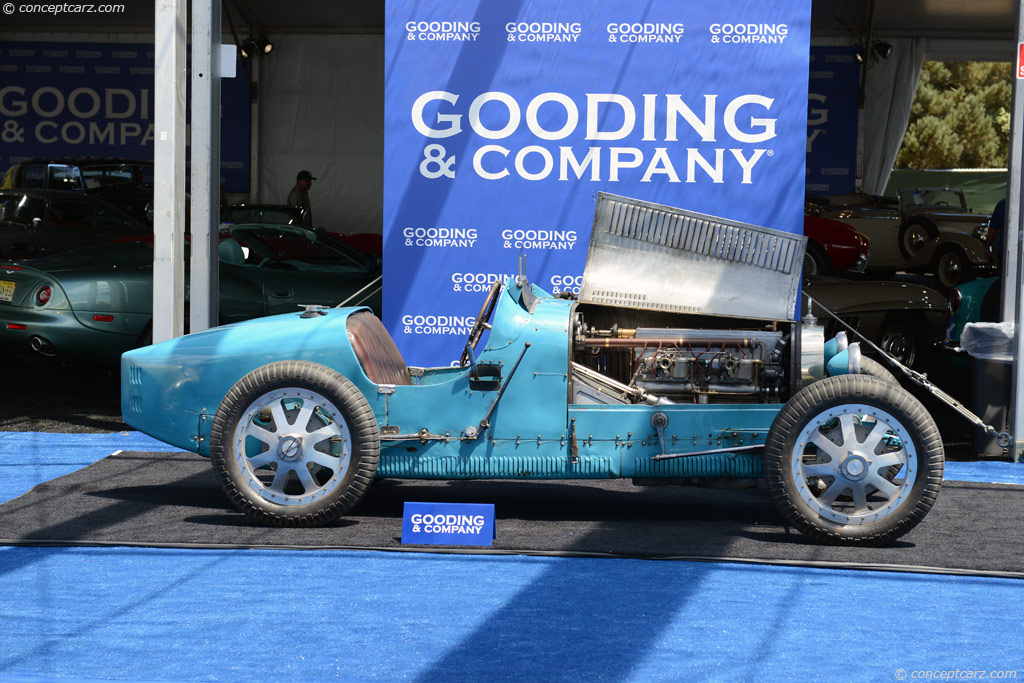
View info and historyBeneath the graceful bonnet was an engine first used with the Type 29. It was a three-valve 2.0-liter overhead camshaft straight-eight with a 60mm bore and a stroke of 88mm. It had five main bearings with a non-traditional ball bearing system which allowed high revolutions, up to 6,000 RPM, and 90 horsepower. It had two intake and one large exhaust, twin carburetors, and tubular exhaust headers. Its tapered chassis was rigid and used a hollow front axle, quick-change flat-spoke alloy wheels with integral brake drums, and leaf springs. The springs passed through the front axle rather than the system used on previous cars of U-bolting them together. The minimalistic body had a sharply pointed rear end (boattail) and a horseshoe-style radiator grille. The wheelbase measured 94.5-inches (2400mm) and had an overall length of 144.9-inches (3680mm).Ten examples had been constructed at Bugatti's Molsheim factory by the time of the 1924 French Grand Prix held at Lyons, with five Works entries and five held in reserve. The team was plagued by tire issues throughout the race but did manage to finish in 7th place for the lead Bugatti, putting the world on notice in the process. The Type 35s would soon dominate Grand Prix racing, capturing 351 victories and 47 records in its first two production years. Factory driver Meo Constatini's outright victory at the 1925 Targa Florio was the first of five successive Bugatti victories there, dominating through 1929. The Type 35A was introduced in May of 1925 and was essentially a less expensive version of the Type 35 intended for fast touring with body and chassis identical to the racing Type 35. Its engine used a simpler ball-bearing crankshaft, smaller valves, and battery-and-distributor ignition instead of a magneto. It developed less horsepower than the Type 35, but was easier to maintain. Instead of the alloy wheels of the Type 35, the 35A received wire-spoked wheels. It was given the nickname the 'Tecla' after a famous maker of imitation jewelry, even though it was capable of approaching 100 mph at 4,500 RPM in top gear.
Roadster
Chassis #: 4613
Engine #: 44
View info and history
Auction entries : 1Ninety-six examples of the Type 35 were built along with 139 of the Type 35A.When Ettore Bugatti reluctantly added the Roots supercharger to his Grand Prix car, the Type 35C was birthed. It used a single Zenith carburetor and offered nearly 128 horsepower. Fifty examples were built and continued to build upon the Type 35's Grand Prix legacy by winning the French Grand Prix at Saint-Gaudens in 1928 and at Pau in 1930. To contest the 1926 Targa Florio race, Bugatti built a special version of the Type 35 known as the Type 35T, also known as the Targa Florio. Its engine was given a longer 100mm stroke which boosted displacement to 2.3-liters (2,262cc). Thirteen examples were built but their appeal was limited as Grand Prix rules capped engine displacement at 2.0 liters.
Roadster
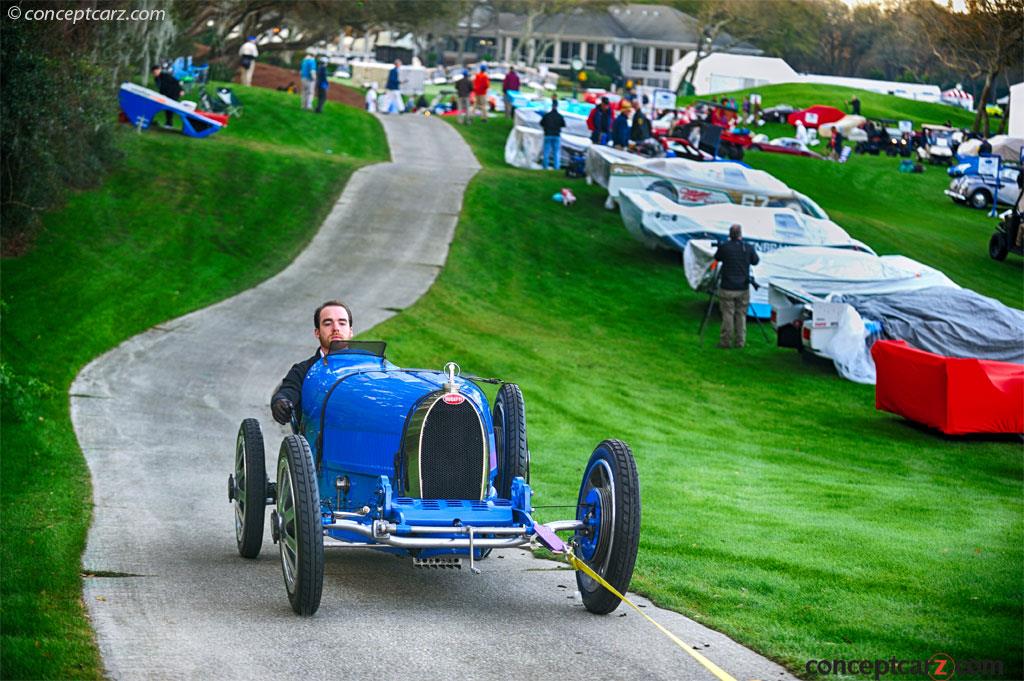
Chassis #: 4487
Engine #: 43
View info and history
Auction entries : 1The final iteration of the Type 35 was the Type 35B of 1927, although its original name was the Type 35TC. It used the 2.3-liter engine of the Type 35T along with a supercharger which brought output to 138 horsepower. The Type 35B boasted incredible performance figures and was capable of accelerating from zero-to-sixty mph in six seconds with top speed achieved at 125 mph. Forty-five examples were built and accolades achieved in competition include a victory in 1929 at the French Grand Prix at Le Mans.
by Daniel Vaughan | Jan 2022
Roadster
View info and history
Roadster
Chassis #: 4613
Engine #: 44
View info and history
Auction entries : 1
Roadster
Chassis #: 4487
Engine #: 43
View info and history
Auction entries : 1
by Daniel Vaughan | Jan 2022
Related Reading : Bugatti Type 35 History
The Bugatti Type 35 is regarded by many as one of the most beautiful pre-war racers from the legendary Bugatti Company. Its beauty is matched by its accomplishments, is one of the most successful pre-war racer winning over 1000 races and capturing the 1926 Grand Prix World Championship with 351 races. During that two-year period, it also claimed 47 records. From 1925 through 1929, the Bugatti Type....
Continue Reading >>
Continue Reading >>
THE LEGENDARY BUGATTI TYPE 35 – THE WORLD'S MOST SUCCESSFUL RACING CAR
Light, strong, fast and elegant. The Bugatti Type 35 is one of the most successful racing cars of all time. And deservedly so the French manufacturers open-top sports car secured over 2,000 victories between 1924 and 1930. Today, the Type 35 is a legend in international motor sport. And a whole lot more besides. The Bugatti Type 35 is one of the icons of Bugattis rich history and tradition.....
Continue Reading >>
Continue Reading >>
Similar Automakers
Similarly Sized Vehicles
from 1925


1925 Bugatti Type 35 Vehicle Profiles

Recent Vehicle Additions


Related Automotive News

Bugatti Type 35: celebrating a century of design, engineering and racing genius
Without equal at its launch in 1924, the epoch-defining Bugatti Type 35 secured more than 2,500 race victories during its active time, and its beauty, technical ingenuity and driving brilliance remain just as appealing a century later.
To understand...

Important sports and racing cars join the astounding offering at Bonhams Quail Auction
The Prototype Bugatti Type 35 Grand Prix is added to the line-up as the final call for entries is announced
The finest motorcars in the world continue to be added to what has fast become Bonhams most anticipated US automotive event in recent years...

The Pearl Collection's Fritz Burkard announced as 'The Collector' at Concours of Elegance 2023
Swiss classic car aficionado Fritz Burkard will showcase diverse selection from Pearl Collection
Line-up to include Ettore Bugattis first-ever racing machine from dawn of motoring age
1933 Alfa Romeo 8C 2300 Monza first registered to Scuderia Fe...

Bugatti'S Dominance In 1928
90 years since the racing season packed with victories for the Type 35
From the very first day of the car manufacturer from Molsheim, the Bugatti myth was created mainly by motorsports. In this respect, 1928 was a special year for Bugatti. The...

120 years of motor sport at Mercedes-Benz take centre stage at the Goodwood Festival of Speed 2014
Addicted to Winning at this years Goodwood Festival of Speed, Mercedes-Benz looks back on some fascinating racing victories of the last 120 years
The unique motor sport heritage of the Mercedes-Benz brand is being celebrated with an exclusive i...

Techno Classica 2014: more than 30 racing cars to celebrate 120 years of Mercedes-Benz motor racing history
Cars that were the heroes of magical moments put their stamp on this high-powered, most comprehensive show presentation
With more than 30 vehicles, Mercedes-Benz Classic presents motor racing history in all its unique breadth and depth
120 years o...

Goodwood Festival of Speed 2013: auction of Mercedes-Benz W 196 R one of highlights at world's 'largest motorised garden party'
Mercedes-Benz Classic presents great moments in motor-racing history at Goodwood
Motorsport festival celebrating its 20th anniversary
Auction of only privately owned post-war Silver Arrow by Bonhams sure to cause a stir
Stuttgart – This...