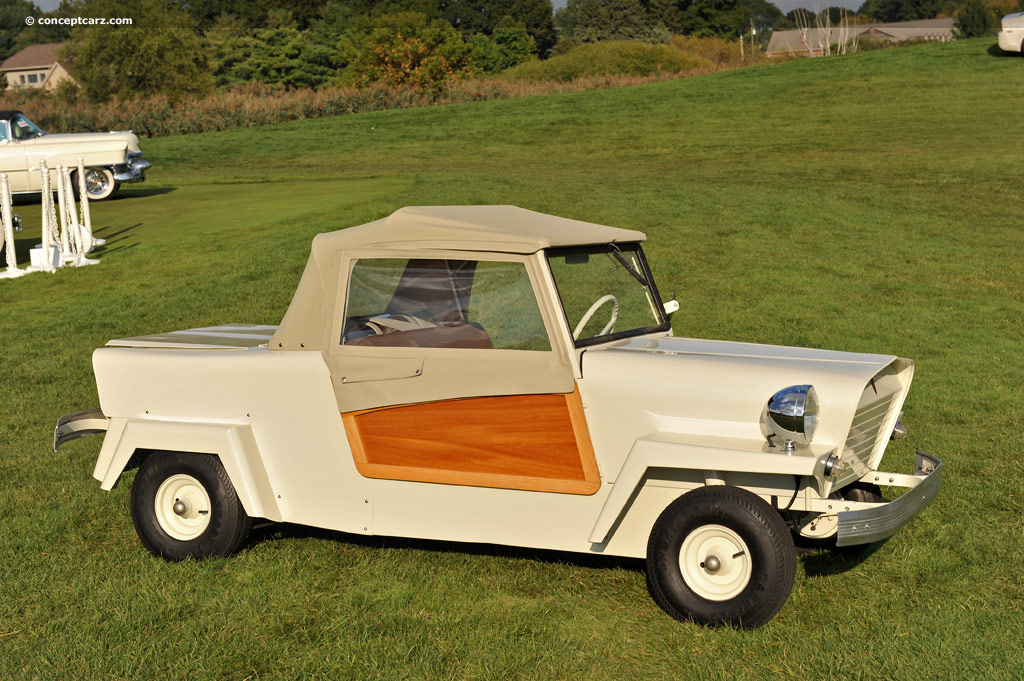
Advertised as the 'World's Most Exciting Small Car' and the 'World's Number One Fun Car' the King Midget was one of the only small cars that were continuously manufactured for almost 25 years from 1946 until operations ended in 1970. For many years Midget Motors Corporation was the 6th largest automobile manufacturer in the U.S. At the time when large manufacturers were introducing automatic transmissions to the public, the King Midget featured its very own uniquely designed automatic transmission, making it very special. Featuring incomparable fuel economy, light years ahead of its competitors, Midget Motors' use of aircraft lightening techniques and unit-body construction resulted in a super strong, yet light vehicle. 
Convertible
View info and historyIn 1946 Claud Dry and Dale Orcutt, civil air patrol pilots during WWII, became friends who dreamt up King Midget as an affordable, inexpensive vehicle for just about anyone. The King Midget was developed and sold as a single-passenger kit car in which any single-cylinder engine could be installed. The kit came with a $270 assembly book, the frame, springs, axles, steering mechanism and dimensioned patterns for the sheet metal which could be fabricated by a local metal smith. The Model 1 was offered from the factory as either a kit or a completely assembled car with a 6 HP Wisconsin engine in the late 1940s until 1951. It drove only one rear wheel, which eliminated the need for a differential. The Model 1 King Midget kits sales were added to two other existing businesses, the MIDGET MOTORS Directory and Midget Motors motor scooter manufacturing and sales. A period publication booklet, the Directory was offered twice a month and advertised government surplus materials like wheels, tires and bearings and a variety of used engines of various sizes and makes. The Super-Cycle motor scooter was manufactured by Midget Motors and came in two models; the Deluxe and the Highway-Master. Both of these models could carry up to two passengers and featured a built-in package compartment. Continuing into the early 1960s both Directory and motor scooter sales continued on strongly until the King Midget became the main Midget Motors product.The second model King Midget was developed in 1951 by Orcutt and Dry. A two-passenger convertible, this model was available either completely assembled or as a kit, powered by a 23 cu inch 7.5 horsepower Wisconsin AENL engine. This model did much to establish the reputation of the King Midget as a competent and worthy vehicle. Not only could it carry more than its own weight, but it could pull extremely heavy loads while keeping incredibly agile, even over difficult terrain.
Convertible
View info and historyThe 500 lb car was initially offered for $500. A basic vehicle, the Model 2 King Midget came with a hand start cable on the left, outside behind the seat. It featured brown plastic seat upholstery, a black three-spoke steering. It didn't have a speedometer or reverse. This was the model that first offered optional automatic transmission, electric starter, reverse, shatterproof safety-glass tinted windshield, top, steel winter doors with sliding Plexiglass windows. It also featured a hot air heater, turn signals, a speedometer, hand-operated controls for handicapped persons and the gold models. The golf models came with two golf bag bags, unique low gearing, extra-wide traction tires on the rear, footrests on the front fenders, and an especially quiet muffler system. In 1955 the Custom model was introduced alongside the standard model King Midget. Standard for both models were new Philippine mahogany doors and winter enclosures. The customer received new two-spoke white steering wheels, bright red and bone white upholstery, cowl parking lights and chrome bumpers. This model lasted through 1957 with a price still under $550. A four-passenger 1952 Crosley CD sedan could be purchased, completely assembled for $943, while a wagon could be purchased as low as $1,002.Unless you were willing to shell out an additional $10, the King Midget came in just one color; California Cream. Fast forward to 1955 and the standard vehicle color was Peace Rose Cream before eventually becoming bone white. These and other eventual paint colors became the same ones used by Ford Motor Co.
Convertible
View info and historyThe King Midget Junior and the King Midget Trainer were also developed by Midget Motors during the 1950s. The owner had full creativity with the design as neither had a body. The Junior had an overall width of 32 inches and length of 67 ½ inches with an adjustable wheelbase of 42 or 47. It featured fenders over the wheels and had a raised tubular steel frame around the front and rear. A square tubular steel frame construction made up both models. The larger Trainer didn't have the raised steel frame around the front. With an overall width of 35 inches, the length measured 72 inches, and a 50-inch wheelbase. The Trainer was powered by a 3 HP Briggs and Stratton engine while the Junior's power came from a 2 ½ HP Briggs & Stratton. Both cars came with an automatic clutch with a geared, reverse transmission in the drive train. In the early sixties, both models were discontinued.In 1957 the Model 3 King Midget was introduced by Dry and Orcutt with a body design that would be used through the end of production. Major changes include unit-body construction with the frame and all foxed body components joined together for strength, 4-wheel hydraulic brakes, and powered by a 9.2 hp engine. Still smaller than a Crosley, it was now 76.5 in wheelbase and measured 117 inches overall. In 1958 the Model 3 was priced at $900. Vehicle improvements continued throughout the years. Aluminum doors replaced the Philippine mahogany doors, and then eventually steel doors. In 1961 the electrical system was upgraded from 6 volts to 12 volts. Several years later in 1966, a 12 horsepower Kohler K301 engine replaced the old standby Wisconsin AENL engine. The following year a silent Borg-Warner one-way clutch replaced the clicker low-speed pulley. A vinyl-covered black or white top replaced the brown canvas top. Optional items included an electric windshield wiper, windshield washer, carpeted panels, floor mats, safety belts, radio and brand new paint colors: Rangoon red, yellow, blue, Corinthian white and aqua.Three groups of people were responsible for the manufacturing of the King Midget throughout its lifespan. At first, the King Midget was sold as part of the Midget Supply operations in Athens Ohio by Claud Dry and Dale Orcutt. The name Midget Motors Manufacturing Co., was the new name used in 1948. The name was once again changed to Midget Motors Corporation in 1956. Ten years later, a group of investors purchased Midget Motors Corporation and Joseph C. Stehlin, Jr. became the president. Unfortunately, the financial fortunes of the company declined heavily, and in 1969 the assets were sold to Barthman Corporation, led by Vernon D. Eads. As a young college student, Eads had worked as a consultant for Midget Motors during the development of the second model. He'd always hoped to one day again build King Midget.Eads tried to resuscitate the King Midget. He constructed the King Midget commuter, a dune buggy type automobile with a molded fiberglass body, for an American export show and then eventual production. He went as far as attempting to start a licensing operation in both Canada and Florida. Unfortunately, a fire at the fiberglass plant destroyed thirteen bodies and the mold. This, along with the monetary costs of the required new Federal crash test program and the dwindling demand for the car, caused Eads to stop making the King Midget. Following the end of production, King Midget Pars Co. was formed in Dayton, Ohio, to continue to provide parts support for the vehicle. Eads' sister Vivian and her husband, Bob Craven were the operators of the business. Eads's brother-in-law Bob had strived to help Eads during the last few months of production to improve assembly processes and factory output. Unfortunately, even with this assistance, the efforts were fruitless.The parts from the Florida licensing operation were purchased in 1980 by John Weitlauf of Daytona, Ohio. All of these parts had been in storage for ten years. Weitlauf's sales also extended to owners of King Midget for parts support. Weitlauf's remaining parts were purchased in 1985 by Dave Stults of Westport, Indiana. Three years later, he purchased the Craven's parts, and from Eads, all of the rights to Midget Motors, King Midget and King Midget Commuter. He purchased the remaining Canadian licensing operation parts in 1990 from Brian Coleman and Bob Cook of Hamilton and Binbrook, Ontario. Stults had now accumulated all the King Midget parts that he could find and he could now provide owners with advice, parts, and support through his King Midget Auto Works store and mail order business. Dave Stults owns several King Midget models, including the final one that was produced. Alan Conley of Waverly, Ohio, purchased the bulk of Stults' parts and all rights to Midget Motors, King Midget and King Midget Commuter in 1995. The name was changed to Midget Motors Supply. The number of available parts were expanded by Conley, either by making them himself, or finding someone else to manufacture parts that were no longer available. Conley also did much of the King Midget restoration work.Once again changing hands, in 2001, Mike Beebe of Norwalk, Ohio, purchased all of Conley's parts and all rights to Midget Motors, King Midget and King Midget Commuter. The name changed once again, this time simply to Midget Motors. Beebe announced that someday he hopes to build a Model 4 King Midget one day.By Jessica Donaldson
Convertible
View info and history

Convertible
View info and history

Convertible
View info and history
King Midget
Similarly Sized Vehicles
from 1958


1958 King Midget Series III Vehicle Profiles

Recent Vehicle Additions


Performance and Specification Comparison
Price Comparison
Related Automotive News

BEACH CARS STORM THE 2014 AMELIA CONCOURS d'ELEGANCE
For an event like The Amelia a class of beach cars is appropriate and ideal, said Warner. After all, when you take a break from the concours field and sit on the veranda at the Ritz-Carlton with a cool drink in front of you, you stare at the ocean...

KIA MOTORS AMERICA ELECTRIFIES LAS VEGAS WITH MUSIC-DRIVEN SOULS AT SEMA
Inspired by the Eclectic World of Contemporary Music, Kia Partners with RIDES Magazine and Popular Mechanics to Open the Show in Amplified Fashion
Five 2014 Souls debut with live mobile performances, featuring a cutting-edge DJ station and a...

1964 Nurburgring 1000 Kilometers: Survive for One Last Victory
During the late 1950s, Richie Ginther would begin a relationship with John von Neumann and this partnership would result in one of the most dominant periods of American sportscar racing in which Ginther and Porsche would be virtually unbeatable. Nearly...

1967 Can-Am Road America: The Beginning of the 'Bruce and Denny Show'
While Formula One will be forever considered the pinnacle of motorsport, from a period between 1966 and 1986 there existed a series that would likely be the closest to anything goes as any motor racing series could truly get. Based upon the FIA Group...

Carroll Shelby, Ford Family for More Than Half a Century
Carroll Shelby was a member of the Ford family for the better part of 60 years, producing stunning performance vehicles from concepts to production models.
He once said his energy and passion for performance products were always strongest when he was...