Many believed Ken Tyrrell's chances were minimal at best when Matra refused to provide his team with a new car. The rumors and questions appeared to be true when Tyrrell decided to go with a new March chassis that was only a top ten car at best. But what everyone didn't know is that Tyrrell had a surprise, an ace up his sleeve that would cause him to be remembered as one of the best in Formula One's history. 
Monoposto
Chassis #: 002
View info and history Tyrrell was well aware of the fact Matra was not going to supply his team with a new chassis. Matra was focused on building its own project, its own team, centered around its V12 engine. Therefore, for Tyrrell to have use of the Matra chassis he would have to agree to use the Matra V12 as well. This created some problems. He had been running the Cosworth engine, which was produced by Ford. A large amount of his budget came from Ford. Matra had merged with Simca. Simca was a subsidiary of Chrysler, a rival to Ford. This would have negated the large amount of funding received from Ford.However, Tyrrell wasn't all that impressed with the Matra V12 engine. Stewart had tested the big V12 and found it to be inferior to the Cosworth V8. That was it. The test would only confirm Tyrrell's own thoughts about the 3.0-liter Cosworth DFV V8 engine. Wary of the deal, Tyrrell would refuse and would be left with practically nothing heading into the 1970 season.Tyrrell knew the engine he wanted. And he would get it. He just needed a chassis in which to place the powerful Ford engine. Unfortunately, time was short. He needed a substitute to provide himself some time to find a suitable chassis capable of producing championships.
March was a relatively new company. And while their cars had shown some promise, the inexperience of the company meant their chassis was not quite up to the level of the main competitors. But options were short and time was even shorter. Therefore, Tyrrell would go with March to buy himself some time.
While making due with the March chassis, many believed Tyrrell was trying to shop around for a better chassis. But he wasn't. He had a surprise already in the making. And at a non-championship race at Oulton Park, about halfway through the season, Tyrrell would drop a bomb upon his fellow competitors, and just about everyone else for that matter, that would have competitors reeling for months.
Monoposto
Chassis #: 002
View info and history About the time Tyrrell learned of the particulars of the potential deal with Matra Tyrrell commissioned his designer Derek Gardner to start work on their first in-house chassis. The project started and would carry on in secret at the team's facilities in Ockham, Surrey.
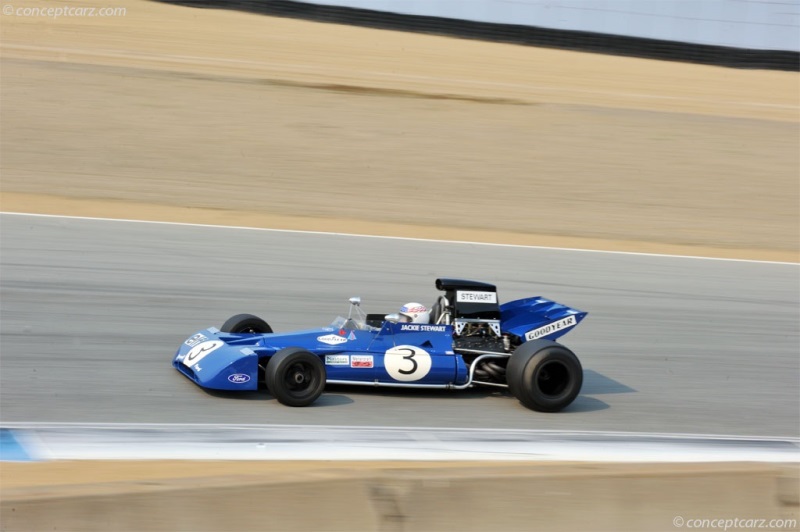
Gardner would keep to what the team was familiar. He would set about designing what would become known as the Tyrrell 001. It would bear similarity to the Matra MS80. However, it would have some important differences. Most notably, the Tyrrell 001 would feature a hammerhead-style front wing that covered the radiator inlet tucked underneath. While its debut would be marred by constant reliability issues it would still show some good pace and would serve as a strong basis for future designs. As the Tyrrell 001 made its debut, Derek Gardner was hard at work making a follow-up design. This design was to be new in a number of different ways. It would also kick-off a trend in Formula One that would remain in use for a number of years within the World Championship. As Gardner set about building the follow-up chassis he would have some very important details to take into account. Not the least of these were the differences in height between Tyrrell's two drivers. Francois Cevert measured a little more than 6 feet in height. In contrast, Jackie Stewart was just 5 feet, 3 inches. The vast difference between the two drivers would be an important consideration in the layout of the two cars for their respective drivers.
Monoposto
Chassis #: 002
View info and historyAnother important aspect that would come into play in the car's wheelbase was the simple fact that Jackie wanted a car with a shorter wheelbase. A car with a shorter wheelbase meant a much more nimble car. But it also meant the car would be much more susceptible to spinning.Besides the obvious considerations, Gardner had some new design elements in mind that would change Formula One in the short, and long term. And one of those new design elements would be clearly obvious just by looking at the nose of the car.Gardner had based the 001 on the Matra MS80 in many respects. The nose especially followed the Matra except for the hammerhead-designed wings that rested over the top of the radiator inlet concealing the inlet a fair degree. This design would remain for 002 and 003. It would be seen at some races like Monaco where cooling the engine would be certainly more important than aerodynamics. However, when aerodynamics and cutting drag was very important, Gardner would conceive of a radical idea taken from another motor racing discipline.
Monoposto
Chassis #: 002
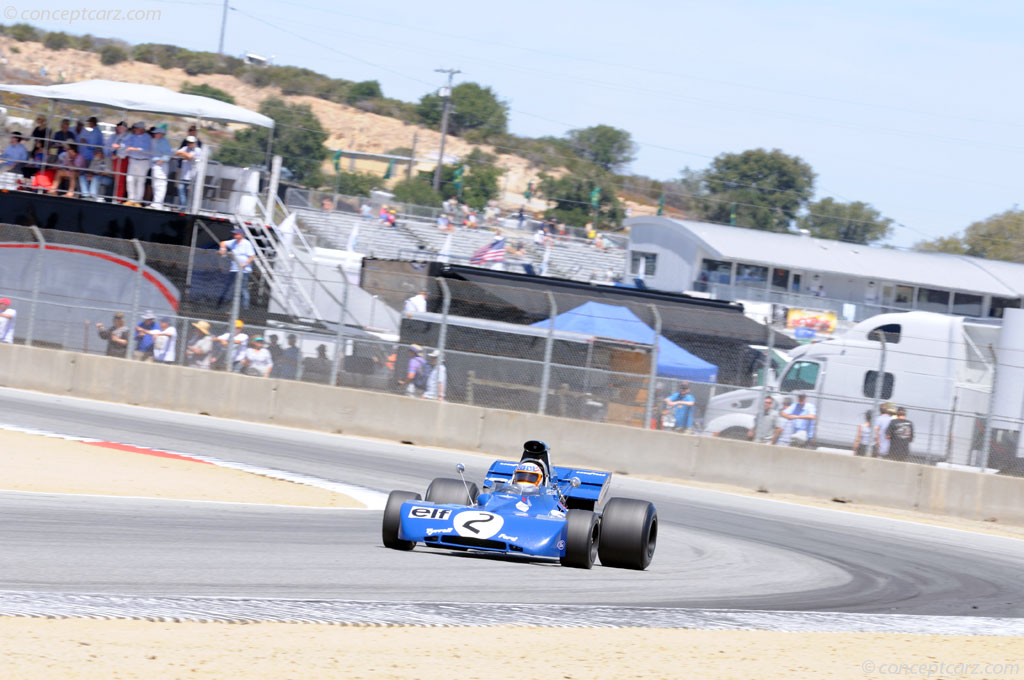
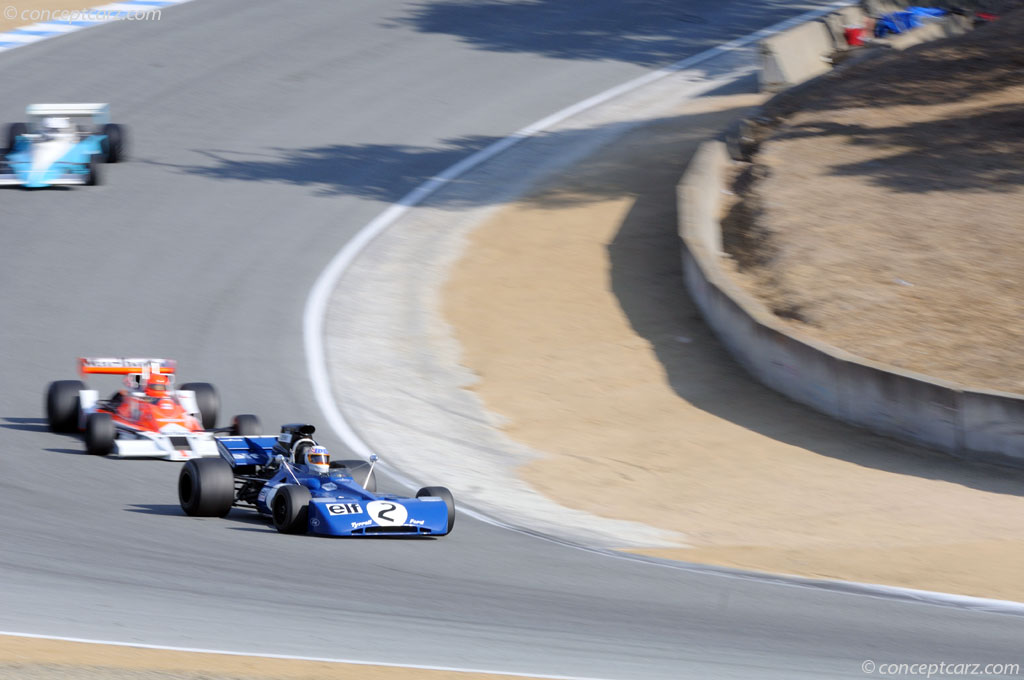
View info and historyAlthough Formula One was defined as open-wheel racing many designers would work very hard at negating the ill-effects of the drag imposed around the nose section of a car's design. Gardner's idea, however, would be a joining of forces to some degree. Following in the same path as the old Mercedes-Benz W196 with its sportscar body styling, Gardner would create a nose that would befit sportscar racing as much as Formula One. The wedge-shape design would help to cover the boxy radiator inlet thereby reducing the drag. Instead of a square inlet that produced larger amounts of drag, the sleek nose featured just a wide, low-profile opening in the nose that fed air to the radiator. The wedge shape would have further benefits in that it would act as a blocker for the front suspension. Therefore, the air not directed to the radiator would pass over the top of the nose and over the suspension members which also created large amounts of drag.Reducing the drag on the nose of the car would lead to some understeer issues but these would be rectified by the additions of some small flaps placed in the middle of the nose, and or, along the outer edges of the top of the nose. These small flaps would aid in increasing downforce created by the nose of the car.One important side-effect of the wedge-shaped nose was the simple reality that cooler air would not make its way to the disc brakes to help cool them. This would be countered by the addition of two more small holes made in the front of the nose just on either side of the radiator inlet. These small holes would direct adequate airflow through some ducting to the disc brakes.
Monoposto
Chassis #: 002
View info and historyThe wedge-shaped nose also helped with another couple of important aspects as well. The pulling in on the sides would help to direct airflow out and around the car. In addition, the shape of the nose bodywork would also help to reduce the drag imposed by the smaller front wheels. While it would not reduce the drag anywhere near the amounts a fully-enclosed fender would provide, it would still reduce the drag to some degree. The newly designed nose would attach to the car's aluminum monocoque structure along the same attach point as the hammerhead wing. Where it would attach there were a couple of venting ducts helping to extract the much warmer air from the radiator. This would reduce the drag created by the air building up around the radiator. Plus, it would help to pull more cooler air in.Hidden by the wedge-shaped nose was the car's double-wishbone front suspension. A coil spring attached at a 45-degree angle would provide the suspension and handling for the front wheels. The coil exposed in between the wheel and the bodywork would be negated in the drag equation as a result of the nose. The nose would enable the bodywork and monocoque structure to remain low to the ground thereby maintaining its low center of gravity. Otherwise, to hide the suspension components and reduce the drag issue, the car's bodywork would have to be made taller in order to hide the suspension.
Monoposto
Chassis #: 002
View info and historyAft of the nose, the car would bear many similarities still to the MS80. It would feature the wide, rounded bodywork with its coke bottle shape. Gardner's design would feature a portion of raised bodywork forming a point toward the nose of the car. This raised bodywork would widen and rise as it travelled aft. It would serve as something of a leading edge for the wrap-around cockpit bodywork.Totally removable, the bodywork that served as the enclosure for the bodywork, swept steeply upward around the driver given the tall positioning of the driver in the low-profile chassis. The front portion of the bodywork would serve as something of a wrap-around windscreen to help protect the driver but it lacked the structural strength to provide much protection. This was a sad fact of the day and it would come into play in Cevert's death in 1973.When the top bodywork was totally removed from the car the aluminum monocoque structure would be readily apparent. The driver's legs would be totally exposed. The steering column, the pedals and the tubular structure used for strengthening and mounting of the steering wheel and instrument panel would also become readily seen. On the other side of the mount for the pedals, when the nose was removed, the rack and pinion steering would be also very clearly seen.
Monoposto
Chassis #: 002
View info and historyThe bodywork surrounding the pilot was quite tight and provided very little room. This would cause a problem when it came to shifting the Hewland 5-speed FG 500 gearbox. In order to provide the room necessary to complete the shifting operations a rounded bulge would be incorporated into the bodywork. This would provide just enough room for the driver's hand to grab the lever and make the shift. Resting to either side of the driver, in the sculpted, bulbous bodywork, would be the car's fuel tanks capable of holding 58 gallons of fuel.. This would be the extent of the car's bodywork. From this point on the fully stressed engine provided the structure for the rear of the car and all components would be exposed to the passing air.Speaking of passing air, Gardner would introduce one other important innovation on the 002 and 003. For the first time, an airbox would be fitted to the engine to provide forced-induction of airflow into the engine. When combined with the Lucas Fuel Injection, the 3.0-liter Cosworth V8 engine was capable of producing 450 bhp. When combined with the car's weight of a little more than 1230 pounds, the power from the engine would produce a car capable of going from zero to 60 mph in just 3.2 seconds and could cover a quarter of a mile in under twelve seconds.
Monoposto
Chassis #: 002
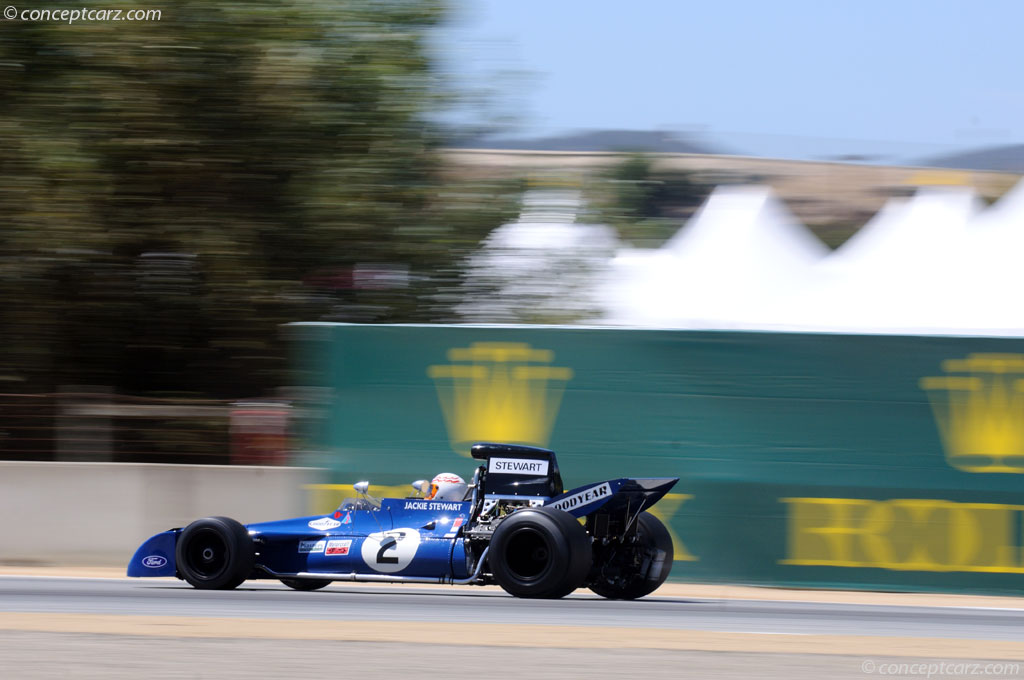
View info and historyOne of the most difficult sections of a car to design would have to be the rear. Keeping the area around the engine clean and aerodynamically efficient with the suspension, rear-wheel drive, brakes, exhaust pipes and other components all in the area would be practically impossible. One of the methods used at the time, of which would be incorporated into the 002 and 003 as well, would be the moving of the disc brakes for the rear wheels inboard. Just aft of the engine the discs and calipers for the rear wheels would be found. A flexible shaft would attach the drive shaft and disc brakes to the wheels. The rear suspension would be the same as the front with double wishbones and coil springs. However, with the presence of the engine longer trailing arms would be used for the wishbones. An anti-roll bar would be attached across the top of the suspension and between both wheels.The exhaust would wrap around from the sides of the engine. Each side would blend into one single pipe which exited out the back of the car just over the drive shaft. Attached to the top of the gearbox would be the large adjustable rear wing. While really nothing more than a single large aerofoil with a smaller secondary plane, the angle of both the main plane and the smaller plane could be adjusted to provide increasing, or decreasing, amounts of rear downforce. Just to either side of the rear wing mount would be two very important components. The oil used in the car needed to be cooled just like the water. Given car design at the time, it was difficult to find an appropriate location for the oil coolers. The best location at the time would be just about as far aft as one could get. The Tyrrell 002 and 003 would be no different. The coolers would be tucked underneath the rear wing and about the furthest point aft. While causing drag at the rear of the car, the coolers would receive enough cooling air to help cool the hot oil.
Monoposto
Chassis #: 002
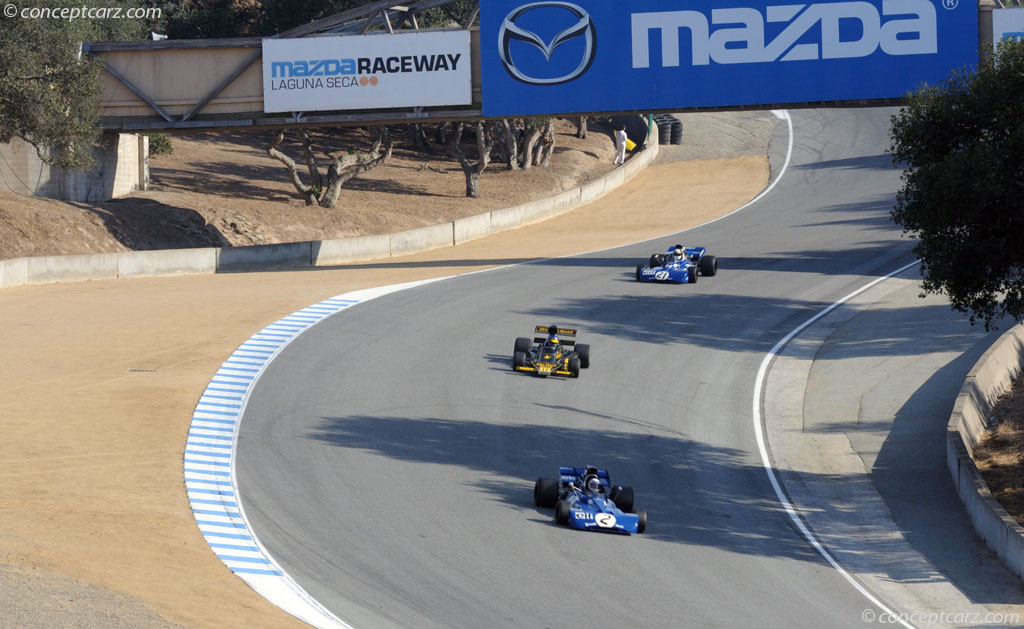
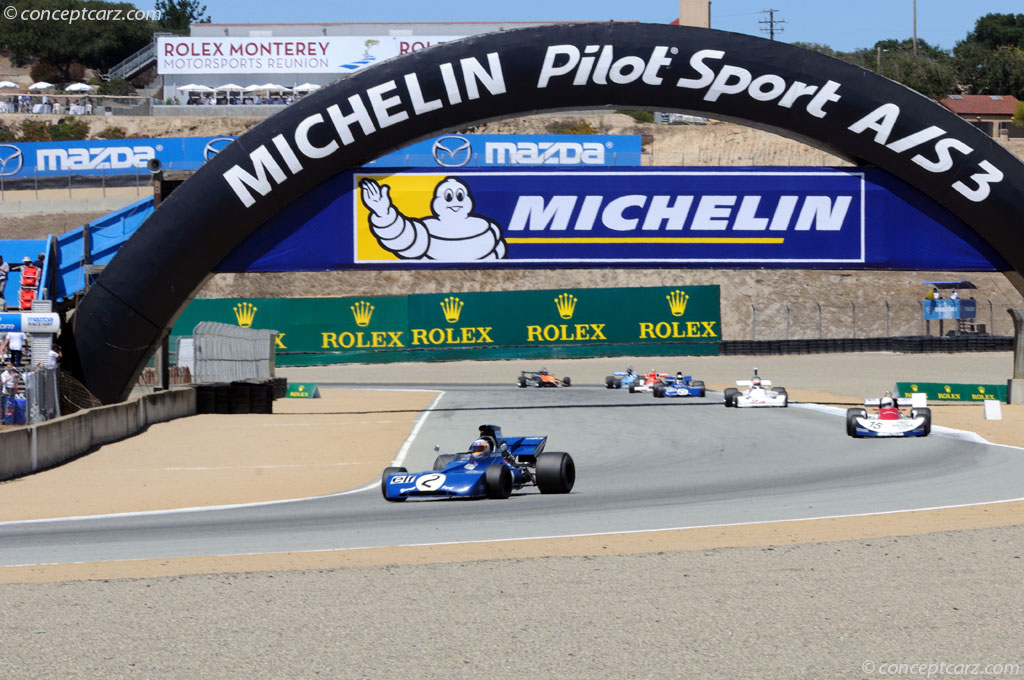
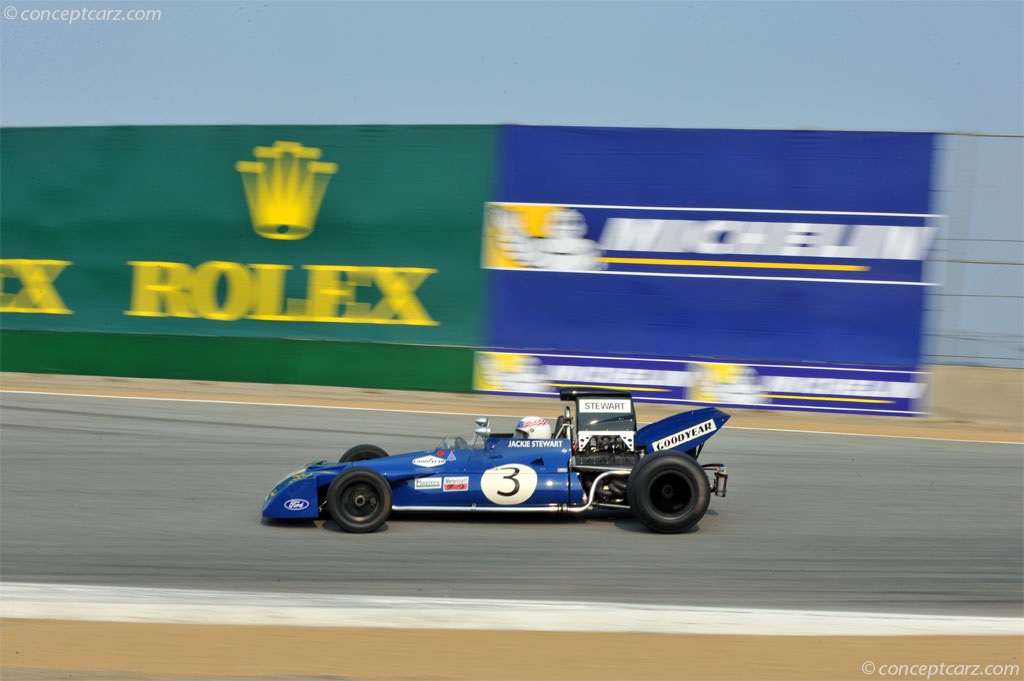
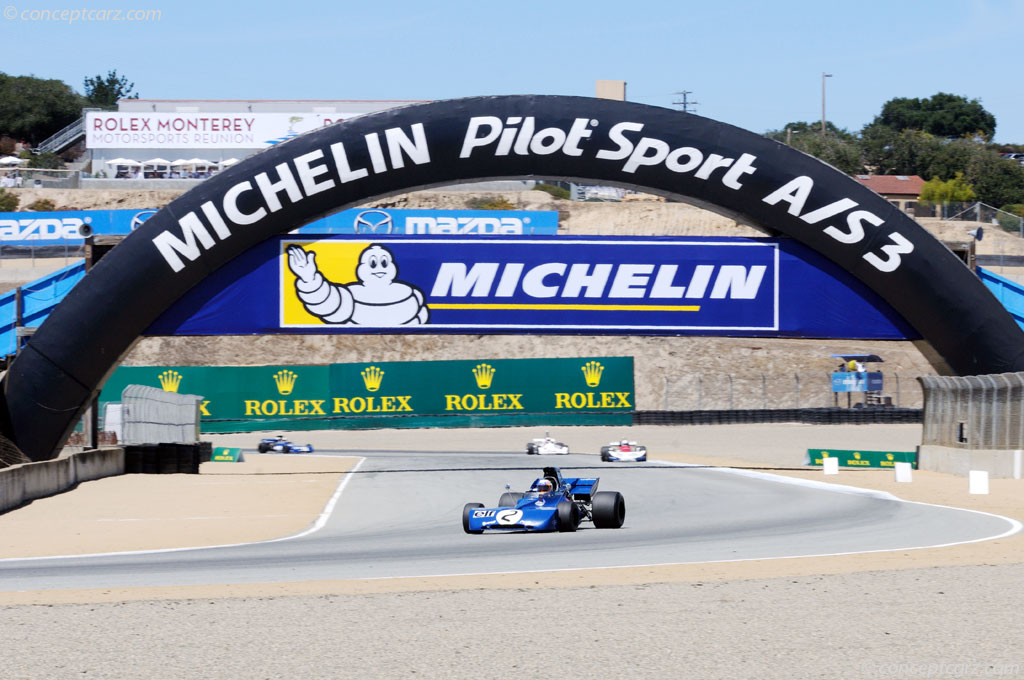
View info and historyFor 1971 Gardner would complete two chassis. They would be numbered 002 and 003. Chassis 002 would be designed and built for Cevert. It would have a wheelbase more than three inches longer than 003. This meant the car would be less twitchy, which would be good for the relatively inexperienced Cevert. The longer wheelbase also meant it fit the 6-footer much more easily and comfortably than what 003 would have.Both Stewart and Cevert would use the 002 and 003 chassis to good effect throughout the 1971 season. Jackie Stewart would score six victories and would run away with the Driver's Championship. Francois Cevert, in just his second full season of Formula One, would score his one and only career victory when he took the win in the United States Grand Prix. Scoring 1st and 3rd in the Driver's Championship meant Tyrrell-Ford ran away with the Constructors' Championship as well. The team would score 73 points. BRM would be next-closest in the standings and they would end the season with just 36 points.Tyrrell 002 and 003 would be one of the most dominant chassis in Formula One history. The car's once unique features live on as common components of modern Formula One cars in one way or another thereby giving the car the honor it is more than due.
Monoposto
Chassis #: 002
View info and historySources:
'John Delane Tyrrell 002', (http://www.historicgrandprix.com/Drivers/John%20Delane%20Tyrrell%20002.htm). Historic Grand Prix. http://www.historicgrandprix.com/Drivers/John%20Delane%20Tyrrell%20002.htm. Retrieved 22 February 2012.'Tyrrell 002 (1971-1972)', (http://www.histomobile.com/dvd_histomobile/usa/220/1971_Tyrrell_002.htm). Histomobile. http://www.histomobile.com/dvd_histomobile/usa/220/1971_Tyrrell_002.htm. Retrieved 22 February 2012.'Tyrrell 001 Cosworth', (http://www.ultimatecarpage.com/car/1034/Tyrrell-001-Cosworth.html). Ultimatecarpage.com: Powered by Knowledge, Driven by Passion. http://www.ultimatecarpage.com/car/1034/Tyrrell-001-Cosworth.html. Retrieved 22 February 2012.'Tyrrell 002 Cosworth', (http://www.ultimatecarpage.com/car/1394/Tyrrell-002-Cosworth.html). Ultimatecarpage.com: Powered by Knowledge, Driven by Passion. http://www.ultimatecarpage.com/car/1394/Tyrrell-002-Cosworth.html. Retrieved 22 February 2012.Wikipedia contributors, 'Tyrrell Racing', Wikipedia, The Free Encyclopedia, 11 February 2012, 16:25 UTC, http://en.wikipedia.org/w/index.php?title=Tyrrell_Racing&oldid=476296600 accessed 22 February 2012
By Jeremy McMullen
Monoposto
Chassis #: 002
View info and history
March was a relatively new company. And while their cars had shown some promise, the inexperience of the company meant their chassis was not quite up to the level of the main competitors. But options were short and time was even shorter. Therefore, Tyrrell would go with March to buy himself some time.
While making due with the March chassis, many believed Tyrrell was trying to shop around for a better chassis. But he wasn't. He had a surprise already in the making. And at a non-championship race at Oulton Park, about halfway through the season, Tyrrell would drop a bomb upon his fellow competitors, and just about everyone else for that matter, that would have competitors reeling for months.

Monoposto
Chassis #: 002
View info and history
Gardner would keep to what the team was familiar. He would set about designing what would become known as the Tyrrell 001. It would bear similarity to the Matra MS80. However, it would have some important differences. Most notably, the Tyrrell 001 would feature a hammerhead-style front wing that covered the radiator inlet tucked underneath. While its debut would be marred by constant reliability issues it would still show some good pace and would serve as a strong basis for future designs. As the Tyrrell 001 made its debut, Derek Gardner was hard at work making a follow-up design. This design was to be new in a number of different ways. It would also kick-off a trend in Formula One that would remain in use for a number of years within the World Championship. As Gardner set about building the follow-up chassis he would have some very important details to take into account. Not the least of these were the differences in height between Tyrrell's two drivers. Francois Cevert measured a little more than 6 feet in height. In contrast, Jackie Stewart was just 5 feet, 3 inches. The vast difference between the two drivers would be an important consideration in the layout of the two cars for their respective drivers.
Monoposto
Chassis #: 002
View info and history
Monoposto
Chassis #: 002
View info and history

Monoposto
Chassis #: 002
View info and history
Monoposto
Chassis #: 002
View info and history
Monoposto
Chassis #: 002
View info and history
Monoposto
Chassis #: 002
View info and history
Monoposto
Chassis #: 002
View info and history
Monoposto
Chassis #: 002
View info and history
'John Delane Tyrrell 002', (http://www.historicgrandprix.com/Drivers/John%20Delane%20Tyrrell%20002.htm). Historic Grand Prix. http://www.historicgrandprix.com/Drivers/John%20Delane%20Tyrrell%20002.htm. Retrieved 22 February 2012.'Tyrrell 002 (1971-1972)', (http://www.histomobile.com/dvd_histomobile/usa/220/1971_Tyrrell_002.htm). Histomobile. http://www.histomobile.com/dvd_histomobile/usa/220/1971_Tyrrell_002.htm. Retrieved 22 February 2012.'Tyrrell 001 Cosworth', (http://www.ultimatecarpage.com/car/1034/Tyrrell-001-Cosworth.html). Ultimatecarpage.com: Powered by Knowledge, Driven by Passion. http://www.ultimatecarpage.com/car/1034/Tyrrell-001-Cosworth.html. Retrieved 22 February 2012.'Tyrrell 002 Cosworth', (http://www.ultimatecarpage.com/car/1394/Tyrrell-002-Cosworth.html). Ultimatecarpage.com: Powered by Knowledge, Driven by Passion. http://www.ultimatecarpage.com/car/1394/Tyrrell-002-Cosworth.html. Retrieved 22 February 2012.Wikipedia contributors, 'Tyrrell Racing', Wikipedia, The Free Encyclopedia, 11 February 2012, 16:25 UTC, http://en.wikipedia.org/w/index.php?title=Tyrrell_Racing&oldid=476296600 accessed 22 February 2012
By Jeremy McMullen
Tyrrell
Similar Automakers
Related Drivers
 Albert François Cevert Goldenberg Patrick André Eugène Joseph Depailler
 Peter Jeffrey Revson
 Sir John Young Stewart
Related Teams
Elf Team Tyrrell 


1971 Tyrrell 002 Vehicle Profiles
Recent Vehicle Additions


Related Automotive News

1972 Italian Grand Prix: Youth Beats Experience
From the moment Fittpaldi responded by earning victory following the tragic loss of Jochen Rindt back in 1970, it was clear the Brazilian was a World Champion in the making. The question would be How long would it take In just two short years, and...

The Jody Scheckter Collection—1979 Formula One World Champion's Remarkable Personal Collection Heads To Monaco Sale
The collection is led by the iconic 1979 Ferrari 312 T4, in which Scheckter secured the world championship and the chassis he drove to all his victories that season, including the Monaco and Italian Grands Prix
The Ferrari presents what...

Iconic Ex-Briggs Cunningham Corvette Le Mans Headed to Amelia Island Auction
ICONIC EX-BRIGGS CUNNINGHAM 1960 CHEVROLET CORVETTE LE MANS RACE CAR LEADS A LINEUP OF BANNER SPORTS AND RACING CARS FOR THE AMELIA ISLAND AUCTION
MORE THAN 80 OUTSTANDING MOTORS CARS SET FOR THE 22 MAY AUCTION
RM Sothebys announces exci...
1972 Italian Grand Prix: Youth Beats Experience
From the moment Fittpaldi responded by earning victory following the tragic loss of Jochen Rindt back in 1970, it was clear the Brazilian was a World Champion in the making. The question would be How long would it take In just two short years, and...

An Era of Perspective
Everyone loves a champion. At least that is the saying. But it isnt necessarily true. Instead, everyone loves their champion. When another proves to be equal or stronger, then all reason slips through the window when judging skill.
The lamentations...

1968 Belgian Grand Prix: A First for McLaren
McLaren and Formula One are truly synonymous. Over the course of its history, McLaren has completed 714 races and have garnered no less than 178 victories. But while McLaren and victory in Formula One are an almost certainty, the very first would be...


